OLYMPIA, Wash.— Thurston County Superior Court will hear arguments tomorrow in a case challenging the killing of endangered wolves by the Washington Department of Fish and Wildlife. The case is being brought by the Center for Biological Diversity and Cascadia Wildlands.
“We’re hopeful the court will protect Washington’s endangered wolves from the state’s reckless killing program,” said Amaroq Weiss, the Center’s senior West Coast wolf advocate. “The majority of Washingtonians want these magnificent animals to recover and thrive, not be gunned down for the private, for-profit livestock industry.”
What: Hearing in Center for Biological Diversity et al. v Washington Department of Fish and Wildlife et al. (No. 18-2-05620-34), a case challenging the department’s killing of state-endangered wolves in violation of state law
When: 9 a.m., Friday Nov. 1.
Where: Thurston County Superior Court, 2000 Lakeridge Drive SW, Building 3, Olympia, WA 98502, courtroom for the Honorable John C. Skinder.
The plaintiffs are represented in the case by the law firm of Animal & Earth Advocates PLLC. The Center’s lawyer and a Center representative will be available after the hearing for questions.
Background
Since 2012 the state has killed 31 state-endangered wolves, nearly 25 percent of the state’s confirmed population of 126. Of those 26 were killed on behalf of the same livestock owner. Those kills have now led to the eradication of four entire wolf packs, including the OPT pack this year, the Sherman pack in 2017, Profanity Peak pack in 2016 and Wedge pack in 2012.
In 2017 and 2018, the plaintiffs — the Center for Biological Diversity and Cascadia Wildlands — filed several lawsuits challenging the state’s wolf-killing program. The 2017 case was declared moot after the state destroyed the pack at issue, but the court has since required the department to provide eight hours’ public notice of any new kill operation, to allow plaintiffs or other members of the public time to seek a temporary restraining order.
In late summer and fall of 2018, the state agency issued new kill orders for members of the Togo, OPT and Smackout packs. A lawsuit was filed by the Center and Cascadia in November 2018 to challenge the kill orders on all three packs, and it is this lawsuit the court will hear arguments on tomorrow.
The court will decide whether to dismiss claims brought under Washington’s State Environmental Policy Act. That law requires analysis of, and public involvement in, any state actions that may harm the environment. The wildlife advocates argue that the department has failed to do this required analysis.
Washington’s wolves were driven to extinction in the early 1900s by a government-sponsored eradication program on behalf of the livestock industry. The animals began to return from neighboring Idaho and British Columbia in the early 2000s, and their population had grown to 27 confirmed packs by the end of 2018.
But wolf recovery in Washington is still a work in progress. Wolves remain absent from large areas of the state, and although the population has been growing, it remains small and vulnerable.
The Center for Biological Diversity is a national, nonprofit conservation organization with more than 1.6 million members and online activists dedicated to the protection of endangered species and wild places.
The Oregon Department of Fish and Wildlife has confirmed new kills by a group of Southern Oregon wolves called the Rogue Pack.
A 300-pound calf was found dead by a ranch hand last Friday, and a second 300-pound calf was found dead Saturday in the Rancheria area of Jackson County near the border with Klamath County, according to a press release issued by ODFW.
The Rogue Pack, which includes the famous wandering wolf OR-7, is suspected of killing more than a dozen livestock animals in western Jackson and eastern Klamath counties, according to ODFW.
The calf found dead at about 9 a.m. Friday was in a grass pasture on private land. Most of the muscle tissue from the hind legs as well as most organs had been consumed. The 5-month-old calf was estimated to have died within 12 hours of being discovered dead, ODFW said.
The calf had bite wounds on its legs, abdomen, shoulders and back. Bite marks, bleeding and muscle tissue trauma were similar to injuries observed on other calves attacked by wolves, the agency said.
“This depredation is attributed to wolves of the Rogue Pack,” ODFW said in a summary of its investigation.
The second calf was about 7 months old and was also in a pasture on private land. A ranch hand found its body at about 7 a.m. Saturday, and ODFW believes it also died within 12 hours of being found.
Unlike the first calf, the second calf’s carcass was largely intact, with about 95 percent of the muscle tissue and hide still remaining, ODFW said.
ODFW’s report attributed the second killing to the Rogue Pack, as well.
Ranchers in the Rogue Pack’s range have used a variety of tactics to try and fend off the wolves, including guard dogs, electric fences, lights, bright flags, noisemakers and a flailing, inflatable dancer like those sometimes used to attract people’s attention at car dealerships.
The devices have scared off wolves at first, until they become used to them.
Wolf sightings hit a record low along the road into Denali National Park this summer, and that’s driving wildlife advocates to push for a halt of wolf hunting and trapping on state lands along Denali’s northeastern boundary, where park road area wolves often roam, and are sometimes killed.
A report recently issued by the National Park Service, shows only 1 percent of agency wildlife survey trips along the road into Denali National Park this summer recorded wolf sightings.
Park biologist Bridget Borg says that’s the worst number since trained park observers began officially tracking wildlife sightings along the road into Denali in the mid-1990s. Viewing percentages previously ranged from as low as 3 percent and as high as 45 percent. Borg says the currently poor wolf sighting percentage is likely primarily representative of natural factors.
“Just there being a lot of variability in where wolves den, and the size of packs over the years,” she said. “Not to say there aren’t the potential for other things to influence that outside of the park.”
Biologist and wildlife advocate Rick Steiner has been trying unsuccessfully for years to get the state to close wolf hunting and trapping on state lands along Denali’s northeastern boundary. Steiner points to the damaging impact loss of an alpha wolf can have on a pack, and makes an economic argument for why the state should care, correlating recent poor wolf viewing opportunity with dips in Denali visitor numbers and spending.
“This is kind of the goose that laid the golden egg for Alaska — if we protect it and help restore it,” he said.
Half a million people visit Denali annually, but there’s state resistance to curtailing boundary area wolf harvest by a few hunters and trappers. Closure requests from Steiner and other Alaskans have been regularly turned down. Commissioner of Fish and Game Doug Vincent Lang recently rejected the second of 2 such petitions submitted since July. Commissioner’s spokesperson Rick Green explains why.
“Data from the Parks Service isn’t a very specified area, and when we manage we manage more of a habitat area — much larger scale — and haven’t seen the evidence to constitute an emergency on the wolf population,” he said.
Green says that means it’s an allocation issue and up to the game board, which has consistently failed to grant requests to re-establish a no wolf kill area, scrapped by the board in 2010. In a July interview, game board chair Ted Spraker pointed to wolves’ resilience, and the potential for wolf viewing to rebound.
“It could all change next year if one of these eastern packs dens close to the road,” he said.
But halting wolf hunting and trapping in the nearby northeast boundary area could also help, according to the Park Service’s Borg. She points to better wolf viewing during a decade long span when boundary area wolf harvest was closed.
“When the area adjacent to the park was closed to hunting and trapping, it was correlated with higher sightings, so we think that bears replication to see if there’s a similar effect,” she said.
The park service and wildlife advocates have submitted separate northeast park boundary no wolf kill buffer proposals to the game board for consideration at a March 2020 meeting, but any change would take place after the wolf trapping season. Steiner is pushing for an emergency game board meeting prior to the November first start of trapping season.
A wolf from Michigan’s Upper Peninsula is released on Isle Royale in
September 2019. The island now has 17 wolves, up from two a year ago. Photo
courtesy National Park Service.
ISLE ROYALE – One year into its effort to reestablish the wolf population on
Isle Royale, the National Park Service and its partners have a problem: Some
of the new wolves died and nobody knows why.
Since the Park Service began its relocation efforts in September 2018, 19
wolves have been transplanted from Minnesota, Ontario, Canada and Michigan’s
Upper Peninsula. Three of the wolves have died, the most recent on Sept. 15.
Another wolf left the island for mainland Ontario on an ice bridge in
January.
The number of wolves on the archipelago in Lake Superior is now 17: nine
males and eight females. Before the repopulation efforts began in fall 2018,
there were only two island-born wolves left roaming the island.
As the Park Service follows the progress of the newly relocated wolves, it
is also trying to ensure more wolves don’t die so soon after being
transported to the island.
Mark Romanski, division chief for natural resources at Isle Royale, said at
this point the Park Service doesn’t have many answers.
When dealing with wild animals, Romanski said it’s not unexpected that some
will die after being transported because the process of capturing and
relocating the animals can be stressful for them.
“And although we do everything we can to quickly handle the animal and get
them out to the island, of course, each animal is different,” Romanski said,
“and so they handle stress differently or maybe their capture event was
different or different combinations of circumstances.”
The Park Service has now changed its procedures so that the time between the
capture of a wolf and its release on the island is less than 24 hours,
instead of 36-48 hours when the effort began, Romanski said.
Dean Beyer, Wildlife Research Biologist with the Michigan Department of
Natural Resources, helps capture wolves that would make good candidates for
the move.
Beyer said that wildlife capture and relocation is something that scientists
can’t totally control and that death is sometimes part of the process. He
said it is important to minimize risk for animals when they’re captured and
handled by members of the DNR.
“We do everything we can do on the front end,” Beyer said. “So we develop
capture plans and all the people involved in the work have gone through
extensive training in terms of how to capture and handle animals and how to
chemically immobilize them.”
He also said that all the DNR’s plans are reviewed by wildlife
veterinarians.
One possible factor in the deaths may be a phenomenon called capture myopathy, a complex physiological process that involves high levels of stress resulting in damage to muscle tissues. The breakdown in the muscles
can release toxins in the bloodstream which may result in shock, or damage
to organs such as the kidneys.
Michelle Verant, a veterinarian for the National Park Service stationed out
of Fort Collins, was tasked with monitoring the wolves while they were
transported to Isle Royale.
She said that there wasn’t evidence of capture myopathy in the first wolf
that was tested by the Park Service, but said that doesn’t necessarily rule
it out.
“And then this final wolf, thankfully we were able to collect that carcass
pretty quickly and it is currently at the National Wildlife Health Center
getting a full necropsy,” Verant said. “And we may get some evidence there
to suggest whether capture myopathy was involved.”
Here’s what the National Park Service knows about the death of three wolves
transported to Isle Royale:
The first wolf, a male from northeast Minnesota, died in October 2018, about
one month after being transported to the island. The Park Service wasn’t
able to retrieve the carcass until a week after the wolf died because it
didn’t have personnel on the island.
The carcass of the wolf was sent to the National Wildlife Health Center in
Madison, Wis., where they performed a necropsy. The lab determined the wolf
died of pneumonia, but the Park Service doesn’t know how the wolf contracted
the illness.
The second wolf, a male from mainland Ontario, likely died in early April
2019, after being transported to Isle Royale in late February. The Park
Service wasn’t able to retrieve the carcass from the swamp it was in until
May, at which point the carcass was too far decomposed to send in for
necropsy.
Romanski said there wasn’t external evidence of the wolf getting into some
kind of fight, though the Park Service doesn’t ultimately know what happened
to him.
The third wolf, a female from the Upper Peninsula, likely died on Sept. 15
when a mortality signal was sent from its collar. It had been moved to the
island on Sept. 13 and was recovered by Park Service staff on Sept. 17.
The carcass was submitted to the National Wildlife Health Center for
necropsy Sept. 24.
A group seeking voter approval to reintroduce gray wolves in Colorado says it has collected around 168,000 signatures to get the question put on the ballot.
That number is more than the 124,000 signatures needed to make the ballot, a spokesman for the Rocky Mountain Wolf Action Fund, the primary backer of the initiative, told The Center Square. The group is aiming for 30,000 more signatures before it needs to submit them to the Secretary of State’s Office for verification by mid-December.
The Colorado Restore Gray Wolf Population Initiative would require the Colorado Parks and Wildlife Commission (CPW) to create and execute a plan to restore gray wolf populations on designated lands west of the continental divide.
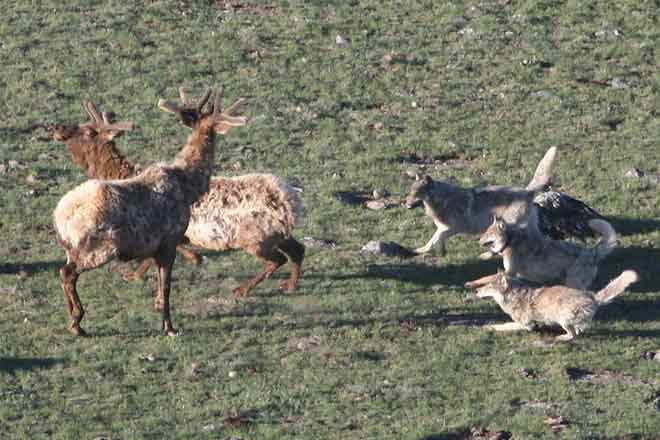
Wolves hunting elk in the Rocky Mountains. Courtesy National Park Service.
“When we succeed in safely restoring wolves to their home in Western Colorado, we will have closed the missing link and restored the gray wolf’s historical range from the High Arctic to Mexico,” RMWAF says on its website.
If passed, implementing the initiative would cost (CPW) over $344,000 in fiscal year 2021-22 and over $467,000 in fiscal year 2022-23, according to a legislative fiscal impact statement.
The Rocky Mountain Wolf Project, a parallel group to the action fund that educates on wolf restoration in the state, is backed by the Sierra Club Colorado, the Center for Biological Diversity, and the Endangered Species Coalition, among other environmental groups.
The Stop the Wolf Coalition, which is made up of several farming, livestock and hunting groups, opposes the initiative, citing potential damage to livestock and wildlife, diseases, and overcrowding in the state.
“Forced wolf introduction is not only a disastrous idea that will impact our wildlife, livestock and Colorado’s growing population,but it’s also not fair to the wolves,” the coalition’s website says.
“A forced introduction of wolves to Colorado would cost untold amounts of taxpayer dollars, redirect already limited wildlife management resources and would have a significant negative economic impact to the state,” said Blake Henning, chief conservation officer for the Rocky Mountain Elk Foundation. “In Colorado, you are dealing with about a third of the land mass of the Northern Rockies’ states but almost double the human population. A forced reintroduction would trigger the potential for real issues in the state.”
Friday, October 4, 2019 – Washington Department of Fish and Wildlife (WDFW) officials announced today that they killed a female member of the Grouse Flats wolf pack on September 25. She was believed to be the mom.
On September 24, in accordance with the agency’s controversial Wolf Plan and 2017 wolf-livestock interaction protocol, Director Kelly Susewind authorized the incremental “removal” of wolves following livestock depredations in Grouse Flats territory on both private lands and state wildlife areas in southeast Washington.
The announcement of the killing comes after Governor Jay Inslee expressed concern over the state’s Wolf Plan:
“We must find new methods to better support co-existence between Washington’s livestock industry and gray wolves in our state. The status quo of annual lethal removal is simply unacceptable.”
Since 2012, WDFW has killed an estimated thirty one endangered wolves and pups, has obliterated entire wolf families (including the Old Profanity Territory pack in August), and has caused countless packs to fragment as a result of targeting individual wolves.
Moreover, peer-reviewed research demonstrates that employing lethal action to deter depredation on cows can even result in increased attacks.
Enough is enough.
Please contact WDFW Director Kelly Susewind and respectfully ask him to stop the assault on Washington’s wolves.
Washington Gov. Jay Inslee heads out after speaking with reporters, Thursday, Aug. 22, 2019, in Seattle. Inslee is seeking changes in how the state deals with problem wolves in Ferry County, in an effort to reduce the number of gray wolves that are being killed. (Elaine Thompson / AP)
That was the message Gov. Jay Inslee sent to Washington’s wildlife management agency in a letter, Monday.
“We must find new methods to better support co-existence between Washington’s livestock industry and gray wolves in our state,” Inslee said in the letter. “The status quo of annual lethal removal is simply unacceptable.”
Inslee acknowledges that in most cases Washington’s wolves are existing peacefully with livestock and people. According to agency statistics 90% of Washington’s wolves aren’t causing problems. He also praised the state’s Wolf Advisory Group, which has members representing cattle, conservation and business interests.
However, in northeast Washington it’s been a summer of conflict with wolves killing and injuring cattle, prompting the state and, in some case, ranchers to kill wolves, in turn prompting environmental groups to sue the state.
In response to the state-ordered killings, Inslee urged a reexamination of policy and procedure in parts of northeast Washington where WDFW has repeatedly killed wolves charged with attacking cattle.
“For reasons that are not entirely clear, numerous conflicts with livestock producers have occurred in a handful of federal grazing allotments,” the letter states.
He also asked WDFW to work more closely with the U.S. Forest Service to work to reduce such conflicts with wolves, “including changes in allotment policies for public lands that are prime wolf habitat, the addition of more intensive range riding, and other proven or promising methods.”
Inslee requested WDFW respond to his requests by Dec. 1.
WDFW responded to the letter by issuing a statement that said reducing wolf kills “ is a top priority” for the agency and that the repeated depredations in the Kettle Range is “greatly impacting” all involved.
“The forest conditions and livestock operations in this particular landscape make it extremely challenging, and unfortunately, has resulted in repeated lethal removal actions,” WDFW’s statement said. “We all share the perspective that something has to change to reduce the loss of both wolves and livestock in this area. WDFW believes this is consistent with the Governor’s request.”
In an email, WDFW spokeswoman Staci Lehman said no immediate changes have been made and “there will be discussion in the coming weeks to see what/if anything changes.”
Wolf advocates and others have questioned whether that land, which is particularly thick and steep, is suitable for grazing. A lawsuit filed by three individuals and supported by a Washington, D.C.-based advocacy group alleges that the cattle ranchers and the state did not use nonlethal deterrents prior to ordering the killing of the OPT pack.
WDFW has also ordered the killing of wolves in the Togo pack and the Grouse Flats pack, although as of Tuesday the state hadn’t killed any of those wolves.
Inslee’s letter was greeted enthusiastically by Chris Bachman, wildlife program director at theSpokane-based Lands Council.
“It’s been pretty amazing and pretty emotional,” he said. “I think that’s a huge success for conservation and for the wolf.”
Bachman has written Inslee a number of letters questioning whether non-lethal deterrents were being used and if the thick, steep terrain is a suitable place to graze cattle.
Inslee’s letter, Bachman said, gives his group and others “leverage” to push change in WDFW policy and procedure.
Mitch Friedman, executive director of Conservation Northwest, also supported the letter and its message.
“Our core position is that the collaborative process and nonlethal deterrents are the answers,” he said. “As long as the governor and other political, elected officials are making statements in line with that, I’m happy.”
More money is already being funneled into nonlethal measures this year after passage of a new law that directs the state to spend nearly $1 million over the next two years on nonlethal deterrents in northeastern Washington.
The letter comes after several out-of-state groups have publicly campaigned Inslee and the state to change how it manages wolves.
The Center for a Humane Economy, an animal-welfare group based in Washington D.C., ran a full-page ad in the Seattle Times July 21 protesting the state’s handling of wolf-cattle conflicts.
Some in northeast Washington view suchoutside pressure as out-of-touch and provocative.
Kretz did not respond to a call seeking further comment Tuesday.
Stevens County commissioner Don Dashiell said he sees the governor’s letter as a political move.
“He’s just gotten enough pressure from wolf advocates to think he has to say something about it,” he said.
Dashiell doesn’t expect it to change much.
“It wasn’t like the department was running around killing wolves all over the place,” he said “So how can we tell the difference?”
Friedman with Conservation Northwest acknowledged that some stakeholders may see Inslee’s letter as overreach but said hehopes it doesn’t cause critics to “disengage” from the Wolf Advisory Group’s collaborative process.
“It might bruise feelings for a bit, but it’s truthful,” Friedman said. “I think we’re all adults and we’ll play our roles, and hopefully we find solutions together to face the challenge and come through it.”
“Just as ships’ bottoms pick up layers of barnacles over time, so, through their lives, human societies and individuals become encrusted with layers of cultural and ideological sediment. … The cemented coating clings as though chemically bonded to me and screams bloody bloody murder at my slightest advance…”~John Livingston
Awar on wildlife in British Columbia never ends; cruelty goes on, unabated. We cannot unshackle ourselves from the self-centered belief system — the thickened layer of barnacles — that destines us to view nature as a resource subordinate to our needs. When, in 1981, John Livingston wrote “Fallacy of Wildlife Conservation”, he cautioned against the fallacy of turning the Earth’s fabric into a “natural resource”. It was echoed by Neil Evernden who recognized that, once deemed a resource, nature inevitably becomes a casualty of reckless exploitation. And this is what has happened. Under the guise of fostering “conservation”, we have concocted a management approach that gives us a license to discard a delicate assembly of life as if it were a lump of coal.
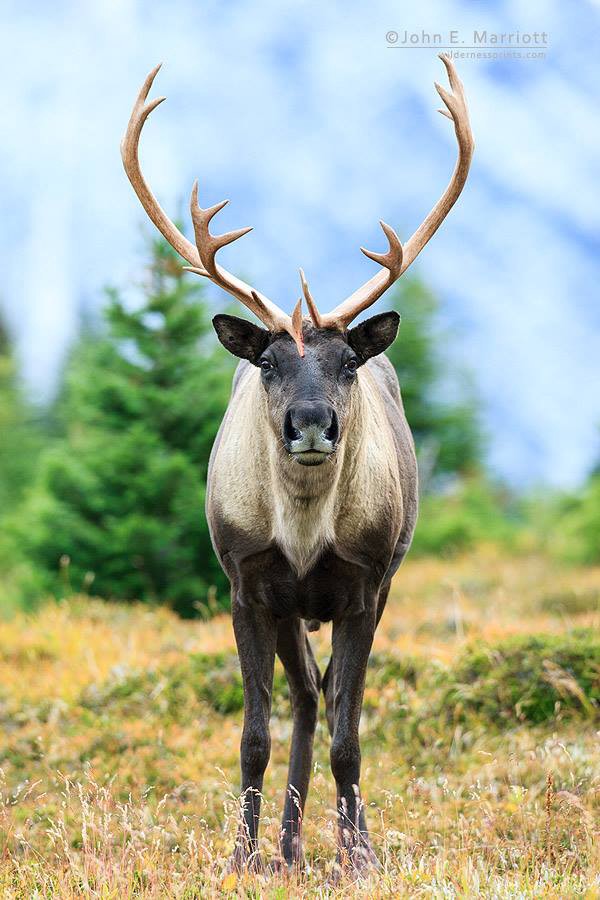
The decades-long tragedy of the caribou habitat is a proof, as good any, of cruelty and travesty inherent to current wildlife management strategies. What strikes the most is how long it has lasted. In the 1970s, a biologist, Michael Bloomfield, showed that the widespread destruction of the habitat by logging and other resource development activities threatened caribou survival. These warnings were never listened to. The B.C. government has allowed for the destruction of the habitat to continue, and the caribou population dwindled from 40,000 in the early 1900s to approximately 15,000 today, all scattered among 54 herds. Thirty of those herds are at risk of extinction and 14 have fewer than 25 individuals.
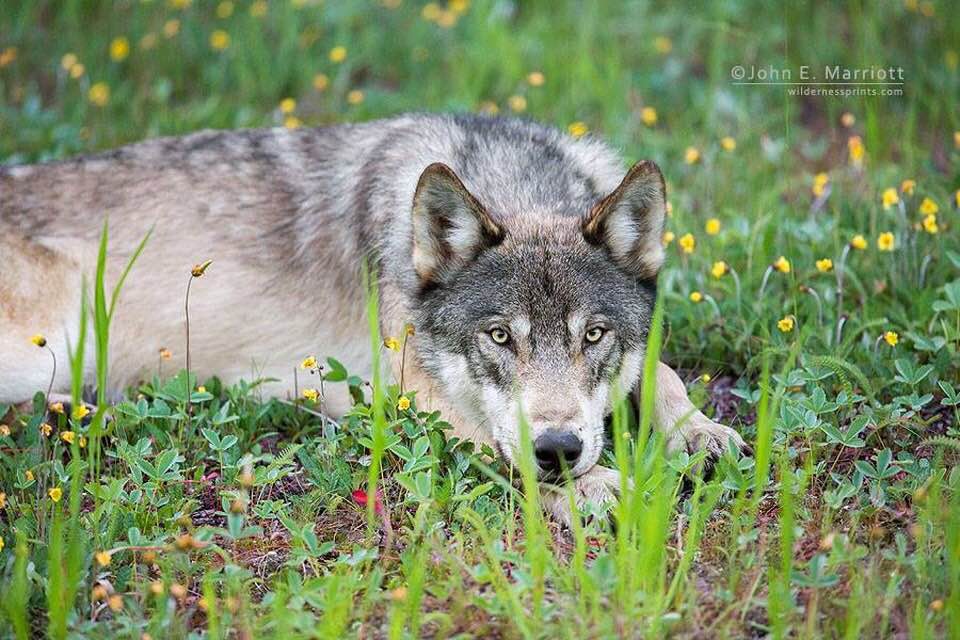
Photo credit: John E. Marriott
This is the current reality. With impunity grounded in political support — regardless of a party in power — the industrial encroachment fragments the caribou habitat and decimates their food source. Consequently, chances for the survival of the caribou diminish as their habitat shrinks in size. The resilience of nature is no match for greed and political expediency. A cycle of life gets broken. What is worse, the officially sanctioned ecological devastation not only ensures the eventual disappearance of the caribou but sentences to death wolves, cougars, and many other species that depend on the same habitat.
Death comes in many forms, and, for some animals, anguish and agony mark the path. The fate that wolves suffer shows most glaringly the tragedy that befalls nature when the government gives in to demands of the resource-extraction industry. In 2014, the B.C. government, with its Management Plan for the Grey Wolf, authorized the war on wolves. Since 2015, under the guise of caribou conservation, over 700 wolves have been killed. They were trapped, hunted, poisoned to death, gunned down from helicopters. Even more abhorrently, extermination tactics have used “Judas wolves” to find their packs and wipe out all of their members. But this not where the war against the wolf ends. The stated number does not include “wolf whacking” contests that take place in the interior of B.C. — an officially sanctioned bestiality that not only dooms wild animals but debases us, as human beings.
Photo credit: John E. Marriott
And, yet, even this is not enough. Now, the NDP government argues that “landscape scale habitat management is needed to support self-sustaining caribou populations”. It thus proposes a predator hunt legislation that would — in the name of reversing caribou population declines — erase more than 80 percent of the wolf population in parts of the central B.C. In other words, it would get rid of the “surplus” of wolves. To call this wildlife management approach fallacious and unethical is to be greatly euphemistic. The innocuously sounding phrase — “landscape scale habitat management” — camouflages an outright slaughter.
And it is the slaughter compounded by ecological ignorance. Any discussion about maintaining stable wolf populations — an underlying premise behind the predator hunt legislation — defeats its purpose if the exact number of wolves in a habitat remains unknown. As so is the case here. The Management Plan for the Grey Wolf states that the wolf population might be approximately 8,500. In reality, this number can be anywhere between 5,300 and 11,600, since, as the plan admits, estimating the population size is challenging due to the secretive nature of wolves, their extensive range, and the density of forested habitats they inhabit. Moreover, hunting data in B.C. lack reliability. The plan states that there is “considerable uncertainty in the current take of wolves by resident hunters and trappers as B.C. does not have a mandatory reporting system…[and] without more reliable estimates of the harvest, it is difficult to assess the sustainability of BC’s wolf harvest.” This ignorance does not, however, prevent the government, Max Foran states, from accepting “generous hunting quotas, no limit on killing females or pups, no bag-limit zones, long and sometimes open year-round hunting seasons, no license requirement for residents.” This is not management but a “wolf killing plan”, he writes.
Killing that will never stop. The ministry’s scientists claim that “a very extensive effort will be required every year to continue to keep the wolf population low” because of the wolf’s natural resilience and quick recovery. Like stubborn weeds, wolves must be eradicated repeatedly. This malignancy cannot be allowed to grow.
Unfortunately, the cruelty and the bureaucratic cold-heartedness underpinning this statement account for merely a part of its tragic perversity. However inhumane, the perpetual killing of wolves is based on the premise that, following a bout of slaughter, the species is able to recover. Only an unfounded human hubris would allow for such a premise to sustain itself. The so-called “surplus” of wolves is very fragile in the face of climate change, and wolves are vulnerable to the unpredictable ecosystem dynamics. Precariousness and unpredictability are the words that define a broad range of interdependences in the critical caribou habitat. The social-ecological system operates on various scales– some of them observable and some not — and there are tipping points, the crossing of which takes us into a place of no return. After all, we live in the times of a rapid environmental change where the only certain expectation is uncertainty. That is why the “managed” killing of predators is a callous misnomer that is bound to unleash not only savagery but also unknown ecological ramifications.
Photo credit: John E. Marriott
Still, numerical variations in the wolf population, as well as both known and unknown ecological consequences of their repeated slaughter, do not tell the whole story. What remains hidden from all of us, living far away from the land of the wolf, is individual suffering to which, through our political indifference, we implicitly consent. What we do not see is paralyzing anguish, pain, and psychological trauma that comes in the aftermath of the shattered family structure. Death destroys even those who survive. After a killing spree is temporarily over, surviving wolves return to mourn a loss. They also face a world unknown to them. As Marc Bekoff and Sadie Parr write, “those individuals that survive to make new wolf families must do so without access to the knowledge and culture held by their slain family members, something that takes generations to build. They become refugees on their own land.”
Finally, this is not only about the caribou or the wolf, but also about us, humans. Perceiving nature through the prism of its cruel and ignorant management comes at a price that we will have to pay. Destroying wolves destroys us as a society. It diminishes us. Our appreciation of and compassion for the natural world have evolved throughout centuries and molded into moral and ethical principles. We break these principles at our peril.
It is time to start peeling layers of “cultural and ideological” sediment we wrapped ourselves in. The cemented coating that clings to us offers the comfort of familiarity, but it is a false comfort that chips away at our humanity. The main argument for killing wolves in the caribou habitat is ensuring that the caribou will still be there, in the future. So our children and their children can watch them roam the forest. Given the ongoing destruction of the habitat, it will not happen no matter how many wolves we decide to shoot. But even if the demise of the caribou were to be somehow temporarily postponed by the merciless “recovery” plan, what then? Should we tell our children how many generations of wolves we have killed to accomplish this? Should we tell them that they what they see is the legacy of killing fields?
“The Ford government wants wolves and coyotes to pay the price for declining moose populations in Ontario. By re-opening a proposal abandoned by the previous government after it was outed as being unscientific and unethical, the PCs are trying to liberalize the hunting of both wolves and coyotes across northern Ontario.”
scrapping plans for a series of public meetings, state wildlife officials are now seeking input online on how to manage Washington’s growing wolf population.
The Washington Department of Fish and Wildlife is asking people to take an online survey or leave comments by going to bit.ly/2ki1TMV. The department will also have interactive webinars later this month and in October where people can ask questions and find out how to provide their views.
Comments may also be mailed to WDFW — Wolf Post-Recovery Plan Scoping, PO Box 43200, Olympia, WA 98504-3200. The deadline to submit comments is Nov. 1.
Washington’s wolf population was virtually eliminated in the 1930s but has rebounded since 2008. The numbers have now grown to the point where wildlife officials expect wolves to be removed from the endangered species list in Washington in the next few years.
The state agency maintains a map of gray wolf packs on its website and shows four in this region, including:
the Touchet pack, with at least four wolves including a successful breeding pair in southern Columbia County as well as the upper Whiskey Creek and Coppei Creek areas of Walla Walla County,
the Butte Creek pack, also in southern Columbia County, with at least two wolves but not considered a breeding pair,
the Tucannon pack with a minimum of two wolves not considered a successful breeding pair in southern Columbia and Garfield counties,
Donald Trump’s tenure in the White House, along with the Republican Party’s reign in Congress, will be an unmitigated disaster for the environment. A witch hunt is already underway for federal employees who support the science of climate change. Protections for the 640 million acres of public land you and I own in this country are already being stripped away. Oil and gas extraction on public land is expected to be deregulated, and even coal—a heavily polluting, inefficient energy source the market has rendered obsolete—may see reinvestment. A victim of all of those programs, and even the target of specific GOP plans for eradication? The gray wolf, only recently reintroduced to western states to help check overpopulated elk and deer and restore balance to the natural food chain there.
Update: On January 17, 2017, Republican Senators introduced a bill nicknamed, “The War on Wolves Act.” If passed S.164 will not only remove ESA protections from wolves in Minnesota, Michigan, Wisconsin and Wyoming, but it will also strip citizens of the right to challenge it in court.
Where the Wolf Stands Today
It’s important to understand that the gray wolf, as a species, is not under threat overall—it’s just specific populations of wolves in certain geographic areas. There are approximately 60,000 wolves living in the wilds of Alaska and Canada. Those will only suffer the general impact of anti-environment policies, accelerated climate change, and habitat loss.
It’s the wolf populations reintroduced to the American West that GOP policy is directly targeting.
There’s also a population of more than 3,500 gray wolves in and around the Great Lakes—in Wisconsin, Michigan, and Minnesota—that, to a lesser extent, is also threatened.
Wolves were first brought back to the West in 1995, when 66 were brought from Canada to Yellowstone National Park and Idaho. The Northern Rocky Mountain Wolf Recovery Plan also allowed for the natural southern dispersal of other wolf populations from Canada. Since then, the species has spread to Montana, Wyoming, Washington, and Oregon, and now there’s even a single pack living in Northern California. The population of wolves in those states is approaching 1,700—a huge success story for conservationists, albeit one that’s still ongoing. Wolves numbered 2 million on this continent just a couple hundred years ago but were killed off as modern civilization expanded westward.
As part of the reintroduction, the burgeoning population of gray wolves in the West was initially protected by the Endangered Species Act. Largely due to the controversial nature of the wolf reintroduction that we’ll get to a little later, however, those protections have variously been repealed, replaced, and repealed again at federal and local levels. Wolf populations have returned to just 10 percent of their original range in the West, making their existence there still tenuous and dependent on some sort of protection.
Watch: How Wolves Change Rivers
Why We Need Wolves
As an apex predator, wolves create a trophic cascade of benefits in their ecosystem, restoring balance the whole way down the food chain. (This process is explained very well in the video embedded above.)
In Yellowstone, for instance, the reintroduction of wolves corrected an imbalance caused by the unchecked expansion of ungulates. Historically, wolves kept the elk population in balance in that area; without them, the elk became too numerous and their movements too static. Grasslands were overgrazed. Willows, cottonwood, and aspen were damaged, destroying the riparian habitats of beavers, songbirds, otters, muskrats, ducks, fish, reptiles, and amphibians. Wolves fixed that. They also checked the population of coyotes, which preyed heavily on small animals. So those populations returned, too, along with the birds of prey that feed on them. The revitalized shrubbery produced more berries, expanding the bear population. The entire ecosystem benefited and was returned to balance by the mere reintroduction of a handful of wolves. It’s that whole circle of life thing that Elton John once sang about in that Disney movie.
Can wolves restore balance to ecosystems elsewhere in their historic range? This study, published in the scientific journal Trends in Ecology and Evolution, suggests they can, and that they may also enable the successful coexistence of invasive species with their native counterparts. The study argues that allowing the return of apex predators like the wolf may be much cheaper than trying to manage these environments through human methods.
Need a dollar amount to define their value? Wolves bring in more than $35 million a year of tourist spending to the Yellowstone area. Local businesses benefit from the mere presence of wolves.
Why Republicans Are Afraid of the Big Bad Wolf
Wolves kill and eat stuff. As described above, that’s their job. Things they like to kill and eat include things people like to kill and eat—primarily deer and elk, but also sometimes sheep and cattle. Which makes us rivals. Between 1995 and 2005, wolves killed 213 cattle and 173 sheep in Wyoming. The elk population has also fallen since the reintroduction of wolves, though drought, disease, and hunting also play a role. There were 17,000 elk in the park when the reintroduction began. Today there are 4,844.
Perhaps due to an exaggerated presence of wolves in nursery rhymes and fairy tales, we humans also find them scary. There have been only six documented fatalities due to wild wolves (two of which were rabid) in North America in the past 100 years. The number of people killed by wolves pales in comparison to the number of people who die each year due to, say, bee stings (in the United States, that’s 100 people every year). Others complain that the loss of livestock hurts ranchers’ livelihood, even though state governments compensate ranchers for any losses. Still others lament the decrease in lucrative guided elk hunts in wolf states, though that has largely been attributed to an increase in out-of-state tag prices.
Politicians from rural areas have been pressured to address those unsubstantiated fears of their constituents, but that doesn’t come close to explaining the scale of the GOP’s war on wolves. The 114th Congress (2015–17) introduced 20 bills targeted at eliminating protections for the gray wolf alone. The Center for Biological Diversity (CBD) called it “the most anti-wildlife Congress we’ve ever had.” Until the 115th, that is.
Why exhaust so much time and energy attacking a single species? The real answer is that the protections wolves require in the West can run counter to the interests of industrial agriculture businesses and the oil and gas industry, both of which want to operate on land that is currently subject to protection because it’s wolf habitat.
The CBD has tracked donations from those industries to Congress and compared them with the number of bills introduced that threaten the Endangered Species Act (ESA). As campaign donations from the oil and gas industry and industrial agriculture have increased, so too have legislative assaults on the ESA. Because wolves have large ranges, the ESA may prevent energy extraction or industrial farming across larger areas than some other species. That explains the focus on removing the wolf’s protections.
Campaign donations to Congress versus anti-ESA bills. Confused by the huge uptick in bills coming after the increase in donations? Remember that these are campaign donations, and the bills they buy only come after the congressmen and senators are elected. America! (Illustration: CBD)
How Republicans Will Kill the Wolf
In 1973, partly motivated by the plight of the bald eagle, President Richard Nixon called on Congress to take action to protect species on the verge of extinction. Congress created the Endangered Species Act by a nearly unanimous vote. Bald eagle populations have since increased from a low of 417 mating pairs to more than 11,000 today. That species was delisted (removed from the ESA’s protections) in 2007, although it remains subject to other protections as our national bird. Today, the ESA protects more than 1,600 endangered plants and animals.
Not every animal protected by the ESA is a success story. Due to the precarious nature of many of the species it protects, delistings are infrequent. Take, for instance, the case of the Death Valley pupfish. Only a handful exist in two ponds in Death Valley National Park. Totally isolated, it’s obviously unrealistic to expect that the species will ever expand its population enough that it will ever be considered anything but endangered. Does the pupfish deserve our protection? Environmentalists would say yes. And the law has prevented extinction for 99 percent of the species it protects. But Republicans argue no, because only 1 percent have been rehabilitated.
“It has never been used for the rehabilitation of species. It’s been used for control of the land,” argues House National Resources Committee Chairman Rob Bishop (R-Utah). He has stated that he “would love to invalidate” the ESA.
A representative survey of registered voters across the United States conducted in 2015 found that 90 percent supported the ESA.
The Associated Press reports that congressional Republicans are preparing to amend the ESA, transforming it “from a tool to protect huge areas of habitat for imperiled species into little more than limits on hunting for protected animals.”
The wolf’s protection under the ESA has always been precarious. Due to the politically charged nature of their reintroduction, initial population targets that would trigger a delisting were set incredibly low—just 150 in Idaho, for instance. That didn’t sound like a viable population to wolf advocates, so, since the species started triggering delistings shortly after its reintroduction, its status has bounced back and forth both nationally and locally in a process of litigation and lawsuits so confusing and asinine that I’ll spare you a recap of it here.
To the best of my understanding, wolves are currently protected by the ESAeverywhere in the lower 48 with the exception of Montana, Idaho, and the eastern third of both Washington and Oregon. In large part, those protections are thanks to lawsuits conducted by environmental organizations like the CBD. Acknowledging that, Republican lawmakers have begun introducing anti-wolf laws as riders on essential budget bills, disturbingly including language that prevents legal challenge.
Trump has yet to go on the record about either the ESA or wolves, but he does oppose environmental policies that get in the way of drilling. It’s not expected that he’d veto any legislation designed to weaken or repeal the ESA or any riders intended to remove wolf protection. Trump’s nominee for interior secretary, Ryan Zinke, who will manage the U.S. Fish and Wildlife Service, which administers ESA programs, once sent out a Christmas card featuring a dead wolf. Last year, Zinke co-sponsored a bill designed to remove federal protections for wolves. It looks like the anti-wolf, anti-ESA Republican Congress is finally getting both the president it needs to rubber stamp this legislation, combined with an administrator of the Department of the Interior prepared to carry it out.
In addition to both that rollback of the ESA and likely direct challenges to the wolf’s inclusion in it, wolves are under threat from the GOP’s plan to steal our public lands. Like all wild animals, wolves need habitat to survive. Development of resource extraction on those lands will further threaten them.
This was the Christmas card Trump’s pick for interior secretary sent out in 2011. Note the dead wolf.(Illustration: Office of Ryan Zinke)
What You Can Do About It
Well, you could start by not voting for politicians who drum up support based on manufactured and exaggerated populist issues, and then work to steal from you once they’re in office. Like the public land heist, the war on wolves is another great example of that. If killing wolves results in increased wolf conflict for farmers, if wolves pose virtually no risk to human life, and if they’re essential to ecosystem rehabilitation in the West while bringing in tens of millions in tourist dollars, then remind me why we’re going to spend a bunch of taxpayer money killing them? Especially when 90 percent of us support the ESA. And you can stop voting for these jerks and enabling this behavior just because you think they’ll lower your taxes. They won’t.
In the meantime, you can call and write your congressional representatives. Tell them you support the ESA, you don’t want them to steal our land, and that you oppose any legislation intended to remove wolf protection. While you’re at it, maybe ask them to start working in your interest, too.
You can also donate to organizations like the Center for Biological Diversityand Defenders of Wildlife. They’re the ones who will be fighting this legislation as much as possible through this historic assault on our environment, our wildlife, and our natural heritage.






 Exposing the Big Game