ODFW report says Oregon has met criteria to delist wolves

http://www.eastoregonian.com/eo/capital-bureau/20151008/odfw-report-says-oregon-has-met-criteria-to-delist-wolves

By Eric Mortenson

Capital Bureau

Published:October 8, 2015 2:27PM
Last changed:October 8, 2015 5:37PM

Courtesy of ODFW
A 100-pound adult male wolf was GPS radio-collared in the Mount Emily unit on May 25, 2014. Taking wolves off Oregon’s endangered species list won’t significantly affect their management because the state wolf plan would remain in place, according to a biological status review that will be presented to the state wildlife commission on Oct. 9.

SALEM — Taking wolves off Oregon’s endangered species list won’t significantly affect their management because the state wolf plan would remain in place, according to a biological status review that will be presented to the state wildlife commission on Friday.

Taking no action on the delisting question, however, might undermine support for the 10-year-old wolf plan and “thereby reducing public tolerance for wolves,” the report concludes.

The report compiled by Oregon Department of Fish and Wildlife biologists says the state’s wolf population continues to increase in “abundance and distribution” and has met the required criteria for delisting in every instance.

Discussion of the report at Friday’s commission meeting in Florence, Ore., is billed as an informational biological status review, with no action scheduled. But it could provide a preview of the commission’s ultimate decision when it meets again Nov. 9 in Salem.

It also coincides with controversy over ODFW’s refusal to authorize killing Mount Emily Pack wolves that repeatedly attacked a sheep herd this summer, and with the unsolved deaths of two wolves known as the Sled Springs Pair.

To take wolves off the state endangered species, the commission must make five findings. They are: Wolves aren’t in danger of extinction in any portion of their range; their natural reproductive potential is not in danger of failing; there’s no imminent or active deterioration of their range or primary habitat; the species or its habitat won’t be “over-utilized” for scientific, recreational, commercial or educational reasons; and existing state or federal regulations are adequate to protect them.

Each of the criteria is examined in depth in the report. “The probability of population failure is very low,” the biologists concluded.

Wolves in Northeast Oregon have been taken off the federal endangered species list but remain on the state list. The federal listing still applies in the rest of the state, including where the famous traveling wolf, OR-7, resides with his pack in the Southwest Oregon Cascades.

The U.S. Fish and Wildlife Service introduced 66 gray wolves into Idaho and Wyoming in 1995-96. As expected, a few Idaho wolves migrated to Northeast Oregon beginning in 1999. Oregon’s first pack, the Wenaha, was documented in 2008.

Other highlights of the report:

• Oregon’s wolf population as of July is a minimum of 85 individuals in 16 packs or groups, up from 81 wolves at the end of 2014. Biologists believe more wolves live in the state but only 85 are documented. The number does not include pups born this year.

• The population will surpass 100 to 150 wolves in the next one to three years, “regardless of listed status.”

• Wolves now use 12.4 percent of their potential range statewide, 31.6 percent in Eastern Oregon.

• From 2009 through June 2015, confirmed losses to wolves stood at 79 sheep, 37 cattle, two goats and two herd protection dogs. Ranchers believe wolves are responsible for much more damage, saying livestock often disappear in wolf country.

• No wolves have been killed while attacking or chasing livestock. Since 2009, ODFW has killed four for “chronic” livestock attacks, but none since 2011. At least five wolves have been illegally shot since 2000; one died in an ODFW capture attempt in 2011; one was hit and killed by a vehicle in 2000

New Mexico says no to wolves, creating quandary for federal officials

The Mexican wolf

Jim Clark/USFWS  The Mexican wolf

 By

A new political battle is brewing over Mexican wolves, a species that was hunted and poisoned to extinction in the U.S. Southwest, but reintroduced to the wild by the federal government in 1998. Earlier this week, the New Mexico Game  Commission upheld an earlier decision denying the U.S. Fish and Wildlife Service (FWS) permits to release Mexican wolves onto federal land in southwestern New Mexico. According to FWS and independent scientists, such releases are critical for diversifying the gene pool of the increasingly inbred wolf population.

State officials have said they are unwilling to approve new releases until FWS updates its recovery plan for the wolf, which was written in 1982. Concerned about impacts to ranchers and elk hunters, they’ve pressed FWS for the total number of wolves it aims to restore to the landscape in the long-term. But the agency doesn’t have that number yet, and though it is updating the recovery plan, the process is likely to take at least 2 years.

Now, the federal agency must decide whether to release the wolves against the state’s wishes. Federal policy requires FWS to consult state agencies and comply with their permitting processes when releasing endangered animals from captivity, even when releases are made on federal land. But there’s one exception: If a state agency prevents the service from fulfilling its statutory responsibilities, the feds can go over the state’s head.

In this case, “our responsibility is to recover the Mexican wolf,” says FWS spokesman Jeff Humphrey. “Our recovery could be stalled, at best, by failing to be able to insert a more diverse gene pool into the existing wild population.”

Still, the agency is remaining vague about its next move. The agency’s top brass would have to reach a formal decision that it can’t recover the wolf without new releases for them to proceed without the state’s blessing, Humphrey says.

Long controversy

The effort to restore wolves to the Southwest has always been mired in controversy. In the Northern Rockies, gray wolves were reintroduced into Yellowstone National Park, a large protected area where neither cattle grazing nor big game hunting are allowed. In the case of the Mexican wolf, however, the 18,100-square-kilometer recovery area straddling Arizona and New Mexico is national forest land that is both grazed and hunted, which has increased human conflict with the animals.

Over the years, the feds have made concessions to the states. In the beginning, for example, New Mexico rejected the release of captive animals within its borders (though wolves could wander in on their own), so the feds didn’t try. But because most of the recovery area is in New Mexico, that left only a small swath of Arizona for the animals. Wolves populated that area fairly quickly, making it difficult to make additional releases, which became few and far between.

On top of that, any wolves that roamed outside the official recovery area were captured and kept in captivity, or released back into their approved wild habitat. Wolves that killed cattle also were removed from the wild, sometimes by killing them. Wolves were poached, and some were baited by ranchers to predate on cattle and violate a “three strikes” rule, which allowed the feds to kill them.

Inbreeding concerns

When wolves were removed from the wild, however, their genetic value to the population was never considered. And a series of removals in the mid-2000s left only one pack on the landscape that had high reproductive success, says Rich Fredrickson, an independent population geneticist based in Missoula, Montana, who serves on the recovery team.

That pack’s dominance has created inbreeding problems. The individuals in the wild population today are, on average, as related as siblings, Fredrickson says. “This is the poster child, in my mind at least, in North America for the need to pay close attention to genetic management,” he says.

Last year, FWS biologists estimated the population of Mexican wolves at 109 animals, the highest it’s been since reintroduction and double its size in 2010. It’s important to try to diversify the gene pool while the population is still small, biologists say; the larger it gets, the less likely management actions are to be effective.

The agency had hoped to introduce some greater genetic diversity this summer by “cross-fostering” pups; that’s a process in which pups born in the wild are removed from dens and replaced with pups born in captivity. It also wanted to release a mating pair currently being held at the Sevilleta Wolf Management Facility in La Joya, New Mexico, if they had pups.

New Mexico says no

A federal rule change earlier this year opened the door for releases in New Mexico, and also expanded the territory where wild wolves would be allowed to roam. But in June, Alexa Sandoval, director of New Mexico’s Department of Game and Fish, declined to issue permits for the release of the mating pair, or cross-fostering pups, arguing that the feds have not provided specific criteria which must be met for recovery of the wolf to be considered successful, nor detailed the steps it must take to get there.

The Game Commission, a seven-member body appointed by the governor that oversees Sandoval’s agency and sets its policies, upheld her decision on 29 September after hearing an appeal from FWS last month. In August, the Arizona Game and Fish Commission also voted to not allow the release of adult wolves from captivity, but to allow as many as six pups per year to be cross-fostered.

On its own, however, cross fostering won’t solve the wolves’ genetic woes, researchers say. For it to help at all, the pups have to survive and breed. “In general, lots of pups die in captivity and the wild,” Fredrickson says.

Cross-fostering introduces additional complications: Genetically valuable pups must be born in captivity at almost exactly the same time as a wild litter, and managers have to closely monitor wild wolves to know that has happened. The pups then have to be swapped within 2 weeks of birth. “To the extent they can do cross-fostering, that’s great, but it’s not going to be enough,” Fredrickson says. “They need to increase releases.”

Oregon Wildlife Officials Won’t Allow Killing of Wolves

Oregon Wildlife Officials Won't Allow Killing of Wolves

Wildlife officials won’t allow people to kill wolves in eastern Oregon’s Mount Emily pack despite five confirmed attacks on a sheep herd this summer.

Jeremy Bingham of Utopia Land and Livestock formally requested permission to kill the animals that he says are “massacring” his sheep, reported the East Oregonian, but the department turned him down.

The pack killed at least seven sheep and a guard dog in June and August, but the Oregon Department of Fish & Wildlife said non-lethal control measures have worked since the last attack, according to department spokeswoman Michelle Dennehy.

Although the state wolf recovery plan allows “lethal control” of wolves after two confirmed livestock losses, non-lethal measures must prove unsuccessful before killings are authorized. In this case, wolves have not killed any livestock on the property since the end of August, Dennehy said. Bingham did not request lethal control until nearly a month after the last livestock attack, she added.

The wolves also have to be present routinely on the property and propose a significant risk to livestock for the state to authorize killing them. In this case, Dennehy said, the wolves have moved to the central and southern part of the range, and the sheep are in the northeastern edge.

In addition, Dennehy said, the seasonal use on the rancher’s grazing allotment ends Oct. 19, so the sheep will be gone from the range in a couple of weeks.

The department hasn’t authorized killing any wolves since there were two in 2011.

“We are sorry your experience with Oregon’s forest lands has been problematic this year,” wildlife biologist Mark Kirsch wrote in a letter the department sent to Bingham. “It is our hope you complete your grazing season with no further loss.”

Bingham does have the right to use lethal force if a wolf is caught in the act of biting, wounding, killing or chasing his sheep or dogs. This does not require a permit from the state.

Bingham called the officials dishonest and told the Capital Press that “the only interest to them is that the wolves eat the economy of Eastern Oregon.”

He said he’s followed the state guidelines even while losing an estimated 100 ewes to wolves over the past two years. In addition to the guard dog killed this year, two were injured last year and another disappeared and is presumed dead.

“We have not harmed any wolves but we are not in the business of sacrificing assets to feed (the wildlife department’s) pet dogs,” Bingham told the Capital Press by text.

There aren’t wildlife department reports to corroborate all of Bingham’s claimed losses, but he said he didn’t report many of the attacks. According to the East Oregonian, other farmers suspect wolves kill many more cattle and sheep than are confirmed by the state.

The Department of Fish & Wildlife follows a strict protocol to confirm wolf attacks, including an examination of wounds and measuring bite marks and tracks.

Tell Governor Martinez and her Game Commission: it’s time to end the war on New Mexico’s wolves and other carnivores

Please sign the petition today and stand for wolves and wildlife at the rally and  commission meeting in Santa Fe on Thursday, August 27th!
none

351px-CMM_MexicanWolfCMorrison

New Mexico Governor Susana Martinez and her hand picked Game Commission are clearly out of touch with the majority of New Mexico voters, who support wolf recovery.

Please stand with us for wolves, cougars and bears on August 27th.

In the past few months, the New Mexico Game Commission has repeatedly sought to undermine the recovery of endangered Mexican gray wolves, first by denying, without justification, the 17 year old permit for Ted Turner’s Ladder Ranch to continue assisting with the Mexican wolf reintroduction and more recently by denying the U.S. Fish and Wildlife a permit to release Mexican gray wolves into New Mexico, which is necessary to boost the wild population’s declining genetic health.

This is particularly troubling given that Representative Steve Pearce (R-NM) recently introduced legislation to remove Mexican gray wolves’ federal Endangered Species Act protections, which would leave them at the mercy of states clearly hostile to their recovery.

The U.S. Fish and Wildlife Service’s appeal of the Mexican wolf permit denial is on the agenda for the August 27, 2015 Commission meeting. Members of the public will not be allowed to speak during the Mexican wolf agenda item, but we intend to make our voices heard at a rally at 8:00 am before the meeting begins and to stand in silence for wolves in the meeting during these agenda items.

The commission will also vote on its proposals to allow cougars to be cruelly trapped and to expand bear hunting in NM. Those who wish to speak for cougars and bears should plan to be at the meeting by 8:30 am to fill out speaker cards.
 

Please join us on August 27th to give wolves, cougars and bears a voice.


NM Game Commission Meeting and Rally
Santa Fe Community College
Jemez Room
6401 Richards Ave.
Santa Fe New Mexico
Click here for map
Got to the west side of the main entrance and gather at the front of the building.
You can see a flagpole at the front entrance as you drive up the hill to the front entrance-go towards the flag.
The rally is at 8 am

Please RSVP for the rally here.

The Game Commission meeting begins at 8:30 a.m.
The bear and cougar rules and wolf agenda items are numbers 7-8
For more information about the rally and meeting, email info@mexicanwolves.org
You’re also invited to join us tonight for a pre-rally presentation: Key Predators in Wildlife

Wolf supporters are invited to learn more and get inspired at an event hosted the night before the rally by conservation groups, including the Sierra Club, Center for Biological Diversity, Mexicanwolves.org, Animal Protection of New Mexico, Sandia Mountain BearWatch, Southwest Environmental Center and Great Old Broads for Wilderness.

August 26, 2015
Santa Fe, NM
August 26, 2015
6 – 7:30 pm
Santa Fe Public Library Community Room – 2nd Floor
145 Washington Avenue
Santa Fe, NM 87501

Michael Robinson from the Center for Biological Diversity will give a Mexican wolf presentation. Mexicanwolves.org representatives will introduce the Santa Fe Packtivist program for area wolf activists. Sierra Club’s Mary Katherine Ray will talk about the Game Commission’s proposals to expand bear hunting and cougar trapping.

For more information about this event, email tc.seamster@gmail.com

Help protect the imperiled Archipelago wolf!‏

From http://www.Defenders.org

A rare and dramatically declining gray wolf subspecies in Alaska will face critical threats from hunting this year unless we act immediately.

The population of Archipelago wolves found on Prince of Wales Island, a remote island in southeast Alaska, has plummeted in recent years due to unsustainable old-growth logging and hunting. Despite this population crash, the federal government plans to allow subsistence hunting – a decision that may push the population to the edge of extinction.

The subsistence hunting season for Archipelago wolves on Prince of Wales Island will open on September 1st unless the Federal Subsistence Board cancels the hunt.

On Prince of Wales Island, roads built for old-growth logging are making it easier for hunters, trappers, and poachers to kill Archipelago wolves at an unsustainable rate. The Prince of Wales Island wolf population is now very low, perhaps only a few tens of wolves – down from an estimated 250 to 350 in the mid-1990s.

The start of hunting is just a few days away and could serve as a fatal blow to these embattled wolves.

Demand that the hunting of these rare wolves be stopped!

copyrighted wolf in water

New Mexico’s Native Wolves Need Your Voice

Tell Governor Martinez and her Game Commission: it’s time to end the war on New Mexico’s wolves and other carnivores

Please sign the petition today and stand for wolves and wildlife at the rally and  commission meeting in Santa Fe on Thursday, August 27th!
none

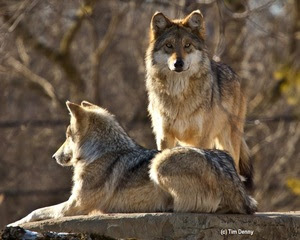
leader of the pack tim denny

New Mexico Governor Susana Martinez and her hand picked Game Commission are clearly out of touch with the majority of New Mexico voters, who support wolf recovery.

This is particularly troubling given that Representative Steve Pearce (R-NM) recently introduced legislation to remove Mexican gray wolves’ federal Endangered Species Act protections, which would leave them at the mercy of states clearly hostile to their recovery.

Please stand with us for wolves, cougars and bears on August 27th.

In the past few months, the New Mexico Game Commission has repeatedly sought to undermine the recovery of endangered Mexican gray wolves, first by denying, without justification, the 17 year old permit for Ted Turner’s Ladder Ranch to continue assisting with the Mexican wolf reintroduction and more recently by denying the U.S. Fish and Wildlife a permit to release Mexican gray wolves into New Mexico, which is necessary to boost the wild population’s declining genetic health.

The U.S. Fish and Wildlife Service’s appeal of the Mexican wolf permit denial is on the agenda for the August 27, 2015 Commission meeting. Members of the public will not be allowed to speak during the Mexican wolf agenda item, but we intend to make our voices heard at a rally at 8:00 am before the meeting begins and to stand in silence for wolves in the meeting during these agenda items.

The commission will also vote on its proposals to allow cougars to be cruelly trapped and to expand bear hunting in NM. Those who wish to speak for cougars and bears should plan to be at the meeting by 8:30 am to fill out speaker cards.


Please join us on August 27th to give wolves, cougars and bears a voice.
NM Game Commission Meeting and Rally
Santa Fe Community College
Jemez Room
6401 Richards Ave.
Santa Fe New Mexico
Click here for map
Got to the west side of the main entrance and gather at the front of the building.
You can see a flagpole at the front entrance as you drive up the hill to the front entrance-go towards the flag.
The rally is at 8 am

Please RSVP for the rally here.

The Game Commission meeting begins at 8:30 a.m.
The bear and cougar rules and wolf agenda items are numbers 7-8
For more information about the rally and meeting, email info@mexicanwolves.org
You’re also invited to join us for a pre-rally presentation: Key Predators in Wildife

Wolf supporters are invited to learn more and get inspired at an event hosted the night before the rally by conservation groups, including the Sierra Club, Center for Biological Diversity, Mexicanwolves.org, Animal Protection of New Mexico, Sandia Mountain BearWatch, Southwest Environmental Center and Great Old Broads for Wilderness.

August 26, 2015
Santa Fe, NM
August 26, 2015
6 – 7:30 pm
Santa Fe Public Library Community Room – 2nd Floor
145 Washington Avenue
Santa Fe, NM 87501

Michael Robinson from the Center for Biological Diversity will give a Mexican wolf presentation. Mexicanwolves.org representatives will introduce the Santa Fe Packtivist program for area wolf activists. Sierra Club’s Mary Katherine Ray will talk about the Game Commission’s proposals to expand bear hunting and cougar trapping.

For more information about this event, email tc.seamster@gmail.com

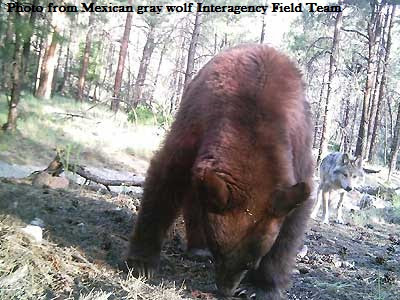
Middle-Fork-AM871-and-Bear IFT

Download rally/event posters here.

You can also help by signing a petition to the Governor, asking that she and her commission work for, not against, wolf recovery.

Please join us to stand for wolves and other carnivores.

Let’s Clean Up Our Language…Cigarettes come in packs, wolves come in families!

by Oliver Starr

Like all of you, I was overjoyed to hear the extraordinary news that a new wolf family has made California their home. For the first time in nearly 100 years the howls of WILD WOLF PUPPIES are gracing the slopes of Mt Shasta! How fitting that such a picturesque location would host such an important guest.

But my joy quickly turned to dismay when I saw that once again, as a community, we are making a mistake in our collective use of language and this mistake is harming wolves.

People that know wolves are well aware that groups of wolves are families — not “gangs of associated animals”. The term “pack” as defined by Webster’s provides many meanings for the word; most of them negative, none of them having anything in common with the reality of wolves: http://www.dict.org/bin/Dict…*

When we use the term “pack” to refer to wolf families, we “de-humanize” the species and we diminish what they are. The use of the term “pack” when applied to wolves is not only biologically inaccurate, it plays into the hands of those that hate them. It’s one thing for “Wildlife Services” to say, they’re eliminating the Wedge Pack, then if they told the truth and said they were going in to kill the Wedge Family of Wolves.

Even as I write this, I am watching tweets appear announcing the “Shasta Pack” in Northern California, I’ve received at least half a dozen emails from NGO’s and seen more news items than I can count announcing the same thing.

But imagine the even more positive nature of this news if the headlines read like this instead:

“California Welcomes Shasta Wolf Family as Species Gains Ground in West”

“CDFW Reports New Wolf Family Confirmed Via Camera Trap: Meet The “Shasta’s”

“Shasta Family: newest wolves to grace the Siskiyou…”

It’s a small change in language but one that gives a vastly different impression. It’s also a distinction that’s factually true. We can help the wolf by taking control of this language and consistently bringing this point home.

I know there are many others among you that share this conviction, one I owe to the late Gordon Haber. So for Gordon and for the wolves, let’s take back the dialog and welcome all wolf families, but most especially the Shasta Wolf Family, home.

1453351_1488724231352782_186999841_n

First Wolf Pack in Decades Spotted in Northern California

http://abcnews.go.com/US/wireStory/wolf-pack-decades-spotted-northern-california-33212137

California Wolf Pack

Now Playing: Teen Pulls Wolf’s Jaws Off His Head With Bare Hands
Share

<br/><a href=”http://abcnews.go.com/”>ABC Latest News</a> | <a href=”http://abcnews.go.com/Video”>Latest News Videos</a> Copy

California has its first wolf pack since the state’s gray wolf population went extinct in 1924.

State and federal authorities announced Thursday that a remote camera captured photos earlier this month of two adults and five pups in southeastern Siskiyou County.

They were named the Shasta pack for nearby Mount Shasta.

The pack was discovered four years after the famous Oregon wandering wolf OR-7 first reached Northern California.

Karen Kovacs of the California Department of Fish and Wildlife said it was an amazing accomplishment for gray wolves to establish themselves in Northern California just 21 years after wolves were reintroduced in the Northern Rockies.

Those wolves eventually migrated into Oregon and Washington before reaching California, where they are protected by federal and state endangered species acts.

Just where these wolves, all black in color, came from will have to wait for DNA testing on scat at an Idaho lab, but it is likely they are a continuation of the increasing numbers of wolves migrating from Oregon’s northeastern corner to the southern Cascade Range, Kovacs said.

Though the wolves have been spotted by local ranchers tending their herds, there have been no reports of wolf attacks on livestock, Kovacs said.

Kirk Wilbur, government affairs director for the California Stockmens Association, said ranchers remain worried about the potential for losing animals to wolves as their numbers increase.

Amaroq Weiss, of the conservation group with Center for Biological Diversity, said she was more worried the wolves could fall victim to hunters as hunting season gets underway.

Anticipating that wolves would migrate into the state, California declared them an endangered species last year, but the state Fish and Wildlife Department does not expect to have a management plan in force until the end of this year, Kovacs said.

The department has no goals for how many wolves might eventually live in California and no idea how many once lived in the state, she added. California’s last known native wolf was killed in 1924 in neighboring Lassen County.

There are at least 5,500 gray wolves in the contiguous 48 states, according to the U.S. Fish and Wildlife Service.

A win for Idaho wolves‏

From Defenders.org

The Idaho Fish and Game Department has announced that no wolves will be killed in the federally-protected Frank Church-River of No Return Wilderness during the winter of 2015-16.

The announcement comes after a lawsuit brought by Defenders and other conservation groups to stop the killing of wolves to boost elk populations in federally-protected wilderness lands like Frank Church Wilderness.

The Frank Church Wilderness is the largest national forest wilderness area in the Lower 48 States and a core habitat for gray wolves in the western United States. I know you share my view that wilderness should be managed as wilderness, not as a game farm for favored hunters and commercial outfitters.

The state has previously planned to kill up to 60 percent of the wolves living in Frank Church, in large part to artificially inflate elk numbers for hunters. Those wolves can breathe easier for another winter after this latest decision.

Still, it’s important to remember that this reprieve is only temporary and that we must remain vigilant in our efforts to defend wolves in Idaho.

But thanks to you and your support, Defenders will continue to work tirelessly to protect wolves throughout the Lower 48.

Thank you for your compassion and your continued partnership!

copyrighted wolf in river