“Social Acceptance” of Wolves has Disappeared in NE Washington

[Never mind that wolves are social animals too…]

From Capital Press: http://www.capitalpress.com/Washington/20150224/wolf-cougar-and-hemp-bills-meet-deadline-to-stay-alive-in-olympia

Here is a look at where some agriculture-related bills stand:

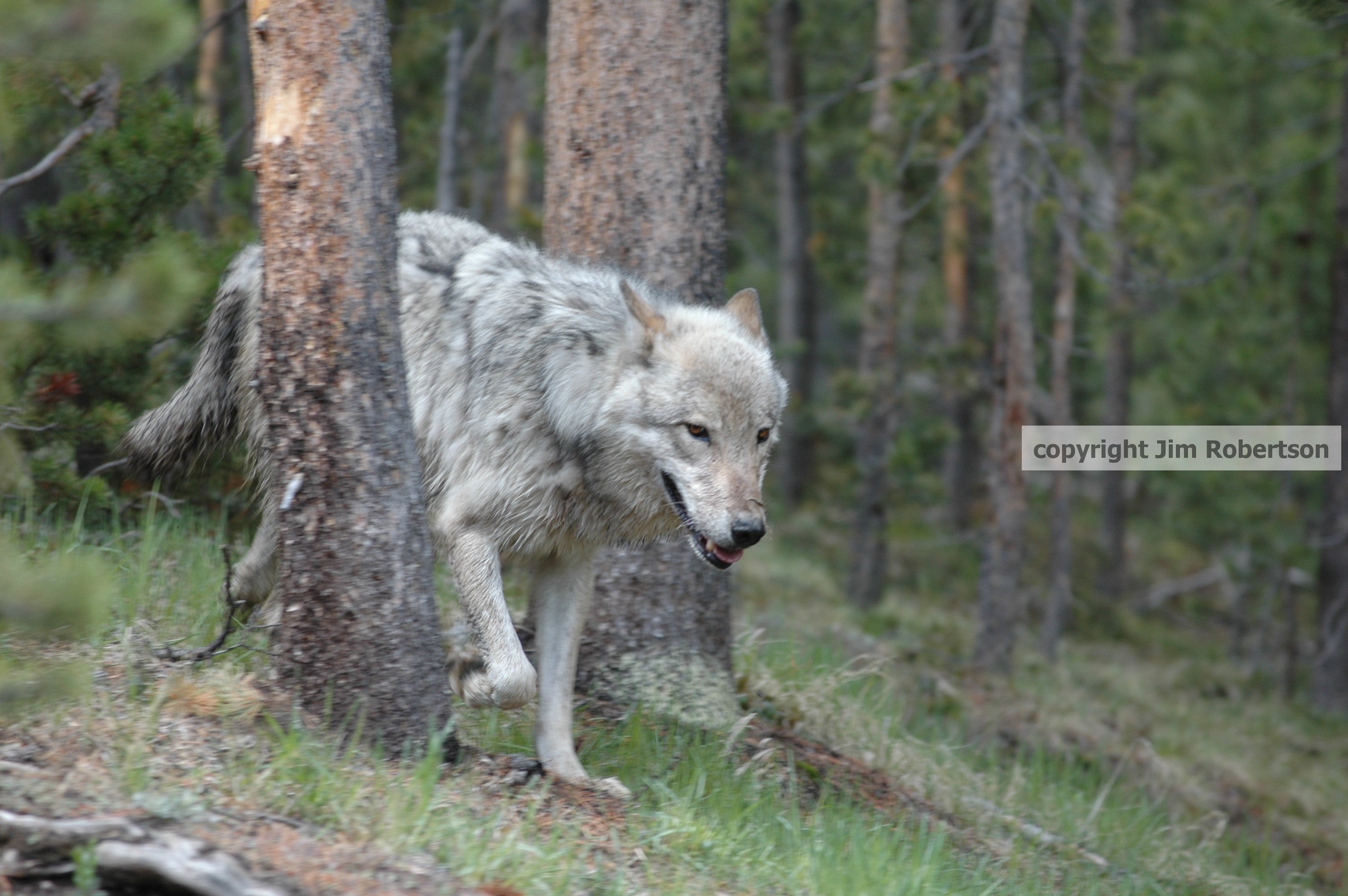
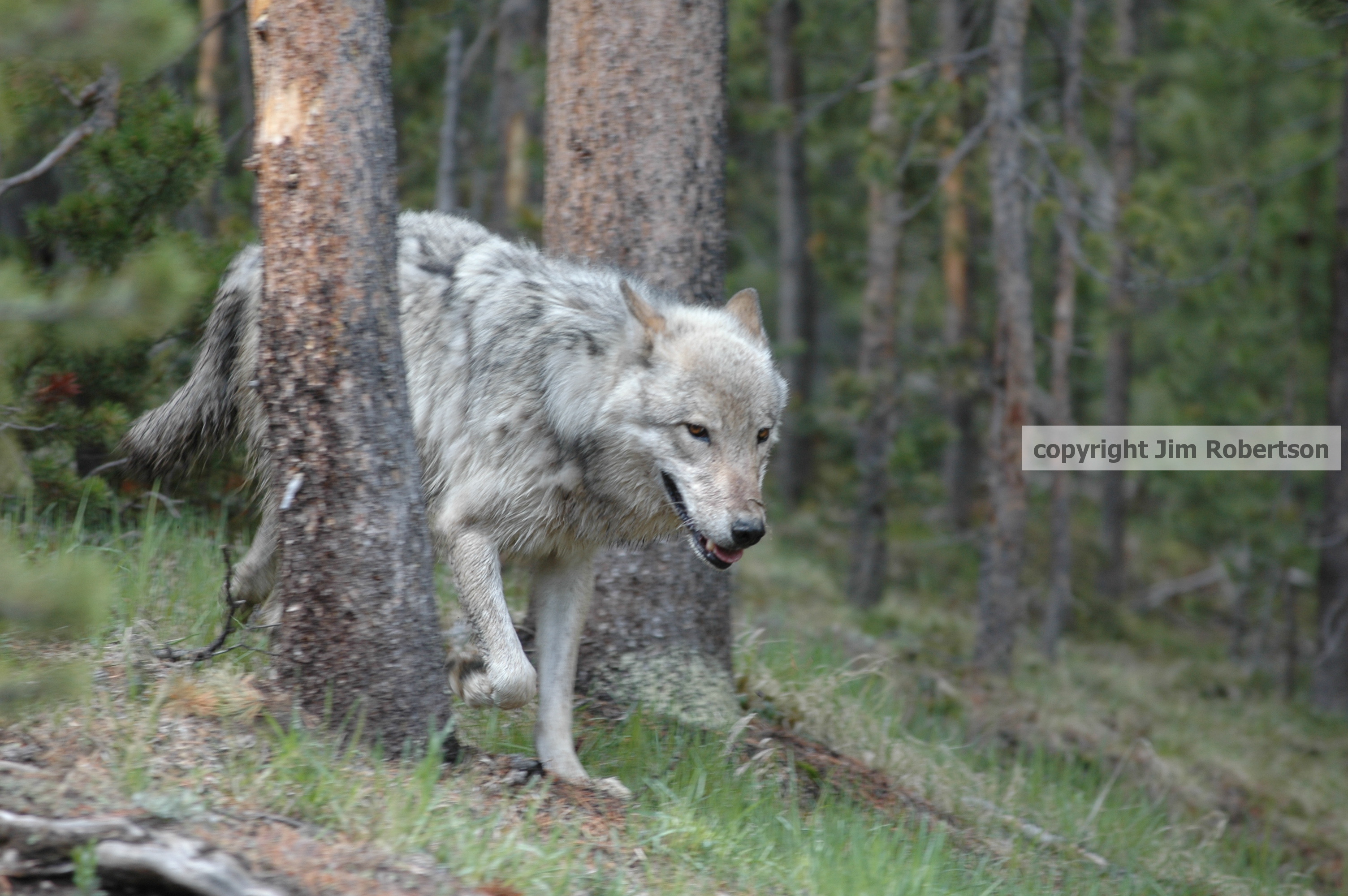
• Wolves: House Bill 2107 requires the Department of Fish and Wildlife to amend by June 30, 2017, the wolf recovery plan. The bill instructs game managers to review thecopyrighted Hayden wolf in lodgepoles plan in light of the fact that wolves are concentrated in northeast Washington but have not spread throughout the state.

The bill got bipartisan support in the House Agriculture and Natural Resources Committee. But it may be amended by the full House to require that changes to the wolf plan be reviewed under the State Environmental Policy Act, a lengthy process.

Northeast Washington officials say “social acceptance” of wolves has about disappeared in their corner of the state. If SEPA is attached to HB 2107, any change to the wolf recovery plan likely will be pushed back much later than mid-2017.

• Cougars: SB 5940 would allow hounds be used to pursue or hunt cougars in Ferry, Stevens, Pend Oreille, Chelan and Okanogan counties for the next five years. Other counties could opt in. The bill received bipartisan support in the Senate Natural Resources and Parks Committee.

Alberta Wolf Kill and “Collateral Damage”‏

Besides the 1000 wolves at least 163 cougars have been killed, along with 38 wolverine, etc. It also demonstrates what happpens when you allow habitat degradation to occur.

http://www.raincoast.org/2015/01/alberta-wolf-slaughter/

Alberta slaughters more than 1,000 wolves and hundreds of other animals

WARNING:  THIS A DISTURBING ACCOUNT OF ANIMAL SUFFERING AND SLAUGHTER

Killing wolves for

Published on 2015 · 01 · 10 by Raincoast
Raincoast scientists Dr. Paul Paquet and Dr. Chris Darimont, along with colleagues at the University of Saskatchewan, have published the paper “Maintaining Ethical Standards during Conservation Crises” in the journal Canadian Wildlife Biology and Management.  It  addresses the ethics and science of the  Alberta wolf cull as published in Canadian Journal of Zoology, November 2014.
Download this paper: Brook et al 2015 CWBM
Download the press release
The wolf kill
For the last few years, Raincoast has been sounding the alarm about the slaughter of wolves at the hands of the Alberta government.  This slaughter is a consequence of Alberta oil and gas development, and other industrial activities, that have endangered caribou.  The Alberta government and its resource industries have transformed the caribou’s boreal habitat into a landscape that can no longer provide the food, cover and security that these animals need to survive.  Rather than address this problem, Alberta has chosen to scapegoat wolves that are using a huge network of new roads and corridors to reach dwindling numbers of caribou.
For a decade now, the Alberta government has hired hitmen and biologists to kill wolves, more than 1,000 of them, through aerial gunning from helicopters, poisoning with strychnine, and allowing them to be strangled with neck snares.  They also trap and collar wolves that become “Judas wolves,” leading the gunners to the pack.  After shooting all but the collared wolf, the collared wolf then leads the gunners to more wolves and then watches as they too are slaughtered.
Not just wolves
In addition to aerial gunning, strychnine is set out to poison wolves.  Many other species that incidentally eat the poison also die. We do not have a death toll for the additional animals that died from poisoning. Neck snares, another form of torture and suffering, are also permitted.  Internal Alberta government documents show that up until 2012, neck snares were the primary cause of death for 676 animals, in addition to the wolves, around the Little Smokey region in Alberta. Note caribou, the reason for the wolf cull in the first place, are dying as incidental deaths in neck snares.
Number of animals/species that have died incidentally in Alberta’s wolf kill (up to 2012) near the Little Smokey region, primarily in neck snares.  Numbers obtained from internal Alberta government documents.
Black bear 12
Caribou 2
Cougar 163
Deer 62
Eagle (bald and golden) 40
Fisher 173
Fox 3
Grizzly bear 3
Goshawk 1
Lynx 70
Moose 12
Otter 73
Owls 12
Small mammals (marten, mink, skunk, squirrel, weasel) 12
Wolverine 38
TOTAL 676
Calling it science
In 2014, 5 authors (3 from Alberta government, 1 from University of Montana, 1 from University of Alberta) published a paper in the Canadian Journal of Zoology (CJZ) called Managing wolves to recover threatened caribou in Alberta.  This paper describes, condones, and implements the use of aerial gunning and strychnine poisoning as acceptable methods to undertake their study on caribou survival. Neck snares are not included in the journal study methods, despite their known use for killing wolves in the Little Smokey Region.
A response to this paper was published in the journal of Canadian Wildlife Biology and Management in February 2015  by Raincoast scientists and colleagues called “Maintaining Ethical Standards during Conservation Crises“.
The above response addresses the issue of ethics and animal welfare in science. Research on animals in Canadian universities and papers published in the CJZ must meet ethical standards from an animal care committee (nationally, the Canadian Council on Animal Care). Poisoning and aerial gunning (using Judas wolves)  do not meet these criteria.  Below is the call for proposal from the beginning of the study with the statement that the lethal methods being employed were approved according to protocols 008 and 009.  Also below are protocols 008 and 009 that show such activities are not permitted.  The objective of these protocols (specifically 9) is to enforce the humane treatment of animals and ensure minimal stress. In the event that a wolf is injured during a study it describes how euthanasia must occur.  A gun shot is explicit to extreme cases in close range where a single shot to the head causes instant death.  To imply such permits allow a wildlife slaughter is dishonest, at best.
Huffington Post Articles
Additional files for download

Feds restore protected status for Great Lakes wolves!

http://www.detroitnews.com/story/news/local/michigan/2015/02/20/gray-wolves-endangered/23726317/?fb_ref=Default

Associated Press 6:58 a.m. EST February 20, 2015

Traverse City — Gray wolves in the western Great Lakes region are protected by federal law once more.

The U.S. Fish and Wildlife Service is publishing a rule Friday designating wolves in Michigan and Wisconsin as “endangered” and those in Minnesota as “threatened.”

The rule complies with a federal judge’s order in December that overruled the agency’s earlier decision to revoke wolves’ protected status and hand management authority to the states.

It means sport hunting and trapping of Great Lakes wolves is no longer permissible.

A spokesman says the agency hasn’t decided whether to appeal the court ruling. Legislation to overturn it has been introduced in Congress.

More than 50 scientists this week signed a letter to Congress saying wolves occupy a small fraction of their former range and still need legal protection.

copyrighted wolf in water

Lessons From the Brief, Lonesome Life of Echo the Wolf

by Shelby Kinney-Lang

February 18, 2015 at 8:40
Photo from the Arrizona Game and Fish Department shows the wolf spotted on the Kaibab Plateau

Even true stories about wolves sound like fables.

Last October, an animal appearing to be a gray wolf showed up on the Kaibab Plateau in Arizona, just north of the Grand Canyon National Park. At first, no one was sure what, exactly, the “wolflike animal” was, but if, as suspected, it was a gray wolf that had migrated from the northern Rockies, it would have been the first time since the 1940s one had set foot in the Grand Canyon. Although there were once an estimated 2 million gray wolves across the continent, humans hunted and poisoned them to the point of oblivion. But thanks to federal protections under the Endangered Species Act (ESA), since the 1970s, gray wolf populations have slightly rebounded. After reintroducing 60 Canadian wolves in Yellowstone in 1995, the U.S. Fish and Wildlife Service (FWS) estimate their population is now up to about 1,500 animals across Montana, Idaho, and Wyoming.

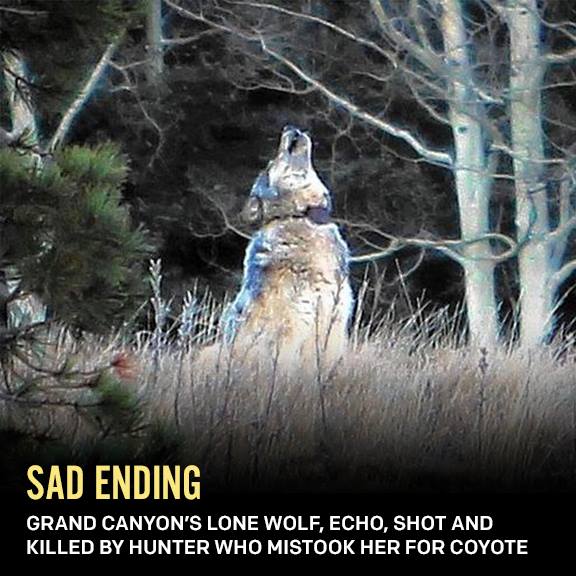
People reported sightings of the Grand Canyon creature through November and December and heard her howls across the forest. Scientists analyzed her poop and confirmed it: she was a gray wolf from the northern Rockies, 450 miles north, first collared near Cody, WY in January 2014. The itinerant, lonesome wolf seized the imagination of the nation and then the world. In a contest for school children, she was given the nickname “Echo.”

In late December, a hunter shot and killed a wolf near Beaver, Utah, thinking it was a coyote. (The state of Utah permits bounty hunting for coyotes, $50 a head.) Federal agencies refused to say whether the dead wolf was the same one from the Grand Canyon.

That is, until last week. Genetic testing by the FWS confirms Echo was shot dead.

More: http://magazine.good.is/articles/death-of-echo-the-grand-canyon-wolf

Experimental wolf cull in Alberta ignites scientific criticism over inhumane research

“The caribou are endangered because extensive and unabated industrial development of [obscenely omnipotent] oil, [goddamn] gas and [fucking] forestry operations has destroyed and degraded the habitat that provides life sustaining food, shelter, and security.” [NOT because of the wolf!!]

http://www.raincoast.org/2015/02/wolf-cull-ignites-critisim/

Experimental wolf cull in Alberta ignites scientific criticism over inhumane research

Scientists highlight the failure to abide by ethical standards of animal research and welfare.

3 running wolves-PCP

In a scathing commentary published today in the peer-reviewed journal, Canadian Wildlife Biology and Management, scientists from the Raincoast Conservation Foundation and the Universities of Saskatchewan and Victoria denounce the failure of researchers, government agencies, research institutions, and the scientific publishing process to abide by recognized ethical standards of animal research and welfare.

Download  the journal paper Maintaining ethical standards during conservation crises

In the November issue of the Canadian Journal of Zoology, a team of researchers described a gruesome wolf culling experiment and last-minute bid to halt the decline of the Little Smoky caribou herd in Alberta. The caribou are endangered because extensive and unabated industrial development of oil, gas and forestry operations has destroyed and degraded the habitat that provides life sustaining food, shelter, and security.

The researchers oversaw a study in which at least 733 wolves and hundreds of other animals suffered and died by methods considered inhumane by the Canadian Council of Animal Care (CCAC). The CCAC provides ethical guidelines that scientists in Canada normally comply with to ensure that animals used in research are treated humanely. Bypassing CCAC standards, managers from Alberta Environment and Sustainable Resource Development administered the killing. Cooperative university investigators assessed the outcome of the cull. Most wolves died violent deaths via aerial gunning from helicopters. Others succumbed to poisoning after ingesting baits laced with strychnine. These methods of killing do not conform to CCAC’s recognized and acceptable standards of euthanasia, owing to the extended pain and suffering they often cause.

“Expedient but inadequate emergency ‘fixes’ have been experimentally implemented to arrest the impending loss of caribou”, said co-author Dr. Ryan Brook of the University of Saskatchewan, “but no context can justify methods that impose such suffering”.

Co-author Dr. Gilbert Proulx, Director of Science at Alpha Wildlife Research & Management Ltd, agreed. “There is a need to improve checks and balances that would normally prevent the approval, execution, and publication of unethical animal research”, he said. Despite questionably modest improvements to caribou declines, the researchers advocated for the continued killing of wolves. “Such short-sighted recommendations add fuel to the fire regarding the growing controversy and scrutiny of the unethical and unscientific Alberta wolf cull”, stated Chris Genovali, Executive Director of the Raincoast Conservation Foundation.

The study also troubled co-author Dr. Chris Darimont, Hakai-Raincoast Professor at the University of Victoria and science director for the Raincoast Conservation Foundation. “Proponents of resource extraction can now announce that a ‘solution’ to the caribou crisis is in hand, enabling additional habitat destruction that harms caribou and wolves. So despite intentions otherwise, wolf control creates greater long-term harm than good to animals and ecosystems, failing a simple test of ethics.”

“In this case, the intended but very uncertain ends cannot justify the means”, said co-author Dr. Paul Paquet, senior scientist at the Raincoast Conservation Foundation and Adjunct Professor at the University of Victoria and. “Experiments that involve the intentional inhumane killing of animals violate the fundamental principles of ethical science and rightfully endanger the reputation of science and scientists, as well as the journals willing to publish them”.

Citation: Brook, Ryan, Marc. Cattet, Chris T. Darimont, Paul C. Paquet, & Gilbert Proulx. 2015. Maintaining ethical standards during conservation crises. Canadian Wildlife Biology and Management Issue 4, pages 72-79.

Available in Open Access format here or download the pdf

Bills to end Endangered Species Act protections for wolves introduced in Congress


Two bills have been introduced in the U.S. House this week to strip federal Endangered Species Act protections from wolves in several states. Rep. John Kline, R-Minn., introduced HF 843 that would prohibit the U.S. Fish and Wildlife Service from listing wolves under the Endangered Species Act in Minnesota,… Duluth, 55802Duluth Minnesota 424 W. First St. 55802

2015-02-12 15:56:22

Two bills have been introduced in the U.S. House this week to strip federal Endangered Species Act protections from wolves in several states.

Rep. John Kline, R-Minn., introduced HF 843 that would prohibit the U.S. Fish and Wildlife Service from listing wolves under the Endangered Species Act in Minnesota, Wisconsin and Michigan.

Meanwhile, Rep. Reid Ribble, R-Wis., introduced HF 884, broader legislation that would restore wolves to their earlier unprotected status under a U.S. Fish and Wildlife Service rule from 2012 in not just the Great Lakes states but also Wyoming.

Reps. Collin Peterson, D-Minn., and Sean Duffy, R-Wis., are among several co-sponsors on both bills.

Kline, who manages a fifth-generation family farm in southeastern Minnesota, where few if any wolves exist, said individual states should be able to manage the big predators without federal interference.

A summary of Kline’s bill says that “the overpopulation of gray wolves in the Western Great Lakes region contributes to the decline of livestock, pets and other animals in the wild.”

“Wolf attacks are a concern for farmers and livestock producers in Minnesota, Wisconsin, and Michigan, where the overpopulation of gray wolves is directly linked to the decline of livestock and other animals,’’ Kline said in a statement Thursday. “This bipartisan legislation will remove the gray wolf from the federal endangered species list and return management to the states, providing greater flexibility and giving states exclusive jurisdiction over the wolves within their own borders.”

The proposed legislation is in response to a federal judge’s ruling in December that wolves in the Great Lakes states be immediately placed back under full protection of the Endangered Species Act, under the government’s original 1978 ruling to protect the animals which had been hunted, trapped and harassed to near-extinction at the time.

The judge ruled the U.S. Fish and Wildlife Service’s 2012 rule delisting wolves in the Great Lakes region, handing wolf management back to states and tribes, was improper. The federal agency has not yet decided whether to appeal the judge’s order. But thecopyrighted Hayden wolf in lodgepoles legislation introduced this week, if passed and signed into law by the president, would take precedent over the judge’s ruling.

The legislation is supported by groups such as the Minnesota Farm Bureau and Minnesota Farmers Union.

Wolf supporters, however, say wolves are in integral part of thriving ecosystems and that the legislation is an overreaction by politicians and wolf opponents who continue to wrongly cast the animals as storybook demons.

“This legislation is an end-around a series of federal court rulings that have determined that state and federal agencies have acted improperly” in managing wolves in recent years, said Wayne Pacelle, president and CEO of the Humane Society of the United States, in a statement Thursday. “This bill is just the latest act of political bomb-throwing and gamesmanship, and lawmakers who want balance on the wolf issue should reject it.”

In January the Humane Society and 21 animal protection and conservation organizations petitioned the Fish and Wildlife Service to list grey wolves as officially “threatened’’ across most of the U.S. That would continue federal oversight but enable some wolves to be trapped and killed by federally-approved trappers if the animals cause problems near pets or livestock.

Killing Canadian Wolves Violated Accepted Welfare Guidelines

Wed 2/11/15 6:15 PM

Killing Canadian Wolves Violated Accepted Welfare Guidelines

Killing Canadian Wolves Violated Accepted Welfare Guidelines

By Marc Bekoff Ph.D. on February 11, 2015 in Animal Emotions
A team of scientists has published an essay, just released today, that clearly shows that the killing spree by the Canadian government that resulted in the slaughter of 890 wolves should never have been conducted nor published because it violated clearly stated welfare guidelines. This new essay is a much-needed response to the horrific slaughter of the wolves.

It’s Official: Wolf Killed in Utah Was Animal From Rare Arizona Sighting

http://abcnews.go.com/Technology/wireStory/mistakenly-killed-wolf-animal-rare-arizona-sighting-28890684

A gray wolf that was shot by a hunter in Utah was the same one spotted in the Grand Canyon area last year, federal wildlife officials said Wednesday.

The 3-year-old female wolf — named “Echo” in a nationwide student contest — captured the attention of wildlife advocates across the county because it was the first wolf seen in the Grand Canyon in 70 years.

The U.S. Fish and Wildlife Service did DNA tests to confirm the wolf killed in late December by a Utah hunter who said he thought he was shooting a coyote was the same one that was seen roaming the Grand Canyon’s North Rim and nearby forest in October and November, said agency spokesman Steve Segin.

Geneticists at the University of Idaho compared DNA taken from the northern gray wolf killed in southwestern Utah with scat samples taken from the wolf seen near the Grand Canyon last fall.

The hunter who killed the wolf called Utah state officials in December and said he mistook the wolf for a coyote, said Utah Division of Wildlife Resources spokesman Mark Hadley. The man, whose name was not released, said he didn’t realize his mistake until he came up on the dead animal. In Utah, anybody can hunt coyotes.

The state handed over its initial findings of what happened to U.S. Fish and Wildlife, Hadley said. That investigation is ongoing and could take weeks or months to complete, Segin said. It’s not clear yet what penalties the hunter could face for killing the animal.

Wolves are protected in Utah under the Endangered Species Act.

Wildlife advocacy groups have called the wolf’s death heartbreaking and say they want the hunter prosecuted. They said the animal could have helped wolves naturally recover in remote regions of Utah and neighboring states.

“Wolves and coyotes are distinguishable if one pauses for a second before pulling a trigger,” said Michael Robinson with the Center for Biological Diversity. “There are consequences for pulling the trigger when you don’t know what you’re aiming at. It’s important to have justice for this animal.”

Wolves and coyotes often have similar coloring, but wolves are usually twice as large as coyotes, said Kim Hersey, mammal conservation coordinator with Utah Division of Wildlife Resources. Wolves also have longer legs, bigger feet and rounder ears and snouts, she said.

But, Hersey says how well a person could distinguish between the two would depend on the lighting, the distance and how much experience a hunter has comparing the two animals.

The wolf had worn a radio collar since January 2014.

Wolves can travel thousands of miles for food and mates. Gray wolves had been spotted as far south as Colorado until the Arizona wolf was confirmed. Gray wolves last were seen in the Grand Canyon area in the 1940s.

In recent years, the Fish and Wildlife Service lifted protections for the wolves in the Northern Rockies and western Great Lakes. But a federal judge recently reinstated the protections after wildlife advocates in Wyoming sued.

The Center for Biological Diversity has documented 11 cases since 1981 where hunters told wildlife officials they had shot a wolf thinking it was a coyote.

10906075_10155034869550301_2511370178161460178_n

Why killing wolves will make no difference to caribou recovery

1453351_1488724231352782_186999841_n

Just like British Columbia, wolves in ‪#‎Alberta‬ are also in the firing line as the scapegoat for dwindling caribou populations.

Please sign/share this petition http://bit.ly/1Hndkqh
via Raincoast Conservation Foundation for Alberta wolves

Please sign/share this petition http://chn.ge/1y7up1m
via Pacific Wild for BCwolves

The full story of the caribou situation and why killing wolves will make no difference to caribou recovery: http://bit.ly/1Ln71CL

‪#‎saveBCwolves

Taxpayers Fund Mass Killing of Wolves in British Columbia

http://panampost.com/rebeca-morla/2015/02/04/taxpayers-fund-mass-killing-of-wolves-in-british-columbia/

As many as 184 wolves must be shot in British Columbia, Canada, in order to save the caribou, according to a statement from the provincial government. The Ministry of Forests, Lands and Natural Resource Operations announced plans on January 15 to address what they consider the threat of wolf predation in the areas of the South Selkirk Mountains and the South Peace, along the border of US states Washington and Idaho.

The caribou, one of Canada’s most recognized national symbols, “is at high risk of local extinction,” according to the ministry’s statement.

The government claims the South Selkirk caribou population declined from 46 in 2009 to just 18 as of March 2014, adding that “evidence points to wolves being the leading cause of mortality.”

The ministry further cites a joint-research project between officials from British Colombia, Washington and Idaho states, First Nations, the US Forest Service, and the US Fish and Wildlife Service, which found wolves killed two of the remaining caribou in the past 10 months.

Authorities also claim that in the area of South Pearce, inhabited by four caribou herds, at least 37 percent of all “adult [caribou] mortalities have been documented as wolf predation.”

In order to “remove” the wolves from these areas, the government will deploy “trained sharpshooters” to shoot the animals from a helicopter. The operation will cost overcopyrighted wolf in water US$500,000.

This latest wolf cull follows the killing of more than 1,000 wolves in the forests of Alberta, between 2005 and 2012, in an attempt to protect 100 caribou living there.

However, while the wolf hunt in Alberta stabilized caribou numbers in the region, it did not result in a population increase, according to a study published in November 2014 in the Canadian Journal of Zoology

The War on Wolves

Ian McAllister, conservation director for Pacific Wild, believes the government’s focus on wolves ignores the real issue concerning the caribou’s habitat.

“While the government is not moving forward to protect adequate amounts of habitat to save the caribou, they’re instead using wolves as a scapegoat and planning just a horrific level of aerial killing in the coming months,” McAllister said. “This is truly a war on wolves in British Columbia.”

McAllister, who started an online petition against the cull, told local newspaper the Province that the fundamental threat to caribou is human encroachment and the destruction of their natural environment.

“Killing every single wolf in this province will not save those caribou. But they’re killing wolves anyway. The wolves are being used as scapegoats.”

Moreover, McAllister argues that the government’s wolf cull violates the guidelines set forth by the Canadian Council on Animal Care regarding wild animal euthanasia.

According to the guidelines, the only “acceptable methods” for animal euthanasia produce “death with minimal pain and distress when used on conscious or sedated animals.”

“There’s no way they can kill that many wolves without missing shots and injuring animals,” McAllister told the Province. “You will have wounded wolves returning to ripped-apart family units … their suffering will be extreme.”

“Foolish and Inhumane”

David Shellenberger, a self-described advocate of international liberty and animal welfare, told the PanAm Post that the mass killing of wolves in British Columbia is typical of the government’s treatment of wolves and other predators.

“States almost always serve themselves and their cronies,” said Shellenberger. “When it comes to wolves, this means doing the bidding of the hunting and livestock industries. Governments also fear monger regarding wolves, exploiting ignorance and prejudice.”

Shellenberger further explained that wolves benefit prey species, including caribou, and argued that they are “essential to the general ecological health of habitats.”

“The decline of caribou,” he states, “is the result of government’s mismanagement of land; it is not the fault of wolves. Killing wolves is foolish and inhumane. Wolves are not only ecologically essential, but also intrinsically and economically valuable.”

There are more efficient ways to preserve caribou herds, says Shellenberger, without sacrificing other species. “The long-range answer for the health of the caribou population is better stewardship of land, ideally through the government giving ownership to conservation organizations or creating a trust structure.”

“An immediate possible answer,” he added, “is the farming of caribou.”

Edited by Guillermo Jimenez.