WA legislation proposes relocating wolves

http://www.spokesman.com/outdoors/stories/2015/feb/05/kretz-legislation-proposes-relocating-wolves/

THURSDAY, FEB. 5, 2015, MIDNIGHT

Kretz legislation proposes relocating wolves

Washington’s best wolf habitat is in the southern Cascade Mountains, where vast federal lands support more than 20,000 elk in the state’s two largest herds.

State biologists expect wolves to discover this prime territory and thrive there by 2022, after gradually dispersing south along the Cascade range.

But seven years is too long a wait for state Rep. Joel Kretz, R-Wauconda, whose Northeast Washington legislative district is currently home to 11 of the state’s 14 wolf packs, as well as cattle ranchers and sheep herders.

He’s again sponsoring what he calls a “share the love” bill that would require the Department of Fish and Wildlife to try relocating wolves to other parts of Washington.

“Most of the support in the state for wolves … comes from areas where there are no wolves,” said Kretz, who last year sponsored a bill to capture Eastern Washington wolves and transplant them to the districts of West Side legislators opposed to any controls on the predators.

But the current bill, HB 1224, isn’t a jab at Western Washington, Kretz said. Instead, it’s intended to speed up wolves’ colonization of the state, which would hasten the removal of federal and state protections for wolves and allow for more active management.

The legislation is among several wolf-related bills scheduled for hearings today in the House Committee on Agriculture and Natural Resources.

Relocating wolves would face steep political hurdles, but some livestock producers and environmental groups think the idea has merit.

The Washington Cattlemen’s Association wants ranchers to have more options for dealing with wolves that attack livestock, said Jack Field, the association’s executive vice president. That won’t happen until wolf populations recover to the point that federal protections are lifted throughout the state, and relocating wolves would make that happen faster, he said.

According to Washington’s wolf recovery plan, wolves will remain a protected species until at least 15 breeding pairs are documented across the state for three years. The pairs must be geographically dispersed so there are breeding pairs in Eastern Washington, north-central Washington and a zone that includes the south Cascades and Western Washington.

Environmental groups also support faster colonization.

“The South Cascades has the best wolf habitat in the state because of the prey base,” said Mitch Friedman, Conservation Northwest’s executive director. In addition to the Yakima elk herd, with about 10,000 animals, the area contains the St. Helens herd, which is infected with a bacterial hoof disease.

“The state is hiring gunners to mercy-kill some of those elk. Wolves would do a better job,” Friedman said.

But the southern Cascades and the Olympic Peninsula, which also has good wolf habitat, are rural and conservative, much like Northeast Washington. Politically, it would be difficult to get the support to relocate wolves, Friedman said.

“There’s a big difference between wolves coming there on their own paws versus in a state pickup truck,” he said.

That’s one of the state Department of Fish and Wildlife’s concerns, said Dave Ware, the agency’s policy lead on wolves. In the Northern Rockies, anti-wolf advocates have never forgotten the federal government transplanted Canadian wolves into Yellowstone and Central Idaho.

“There’s that stigma that you brought them here, versus them moving in naturally,” Ware said.

The endeavor also would be costly and time consuming, he added. State biologists figure they would need to trap and transplant about 30 wolves – preferably in packs – to end up with several breeding pairs that would stick around in their new location.

Such an action would require thorough state and federal environmental analysis, which would take two to three years to complete. A wolf relocation pilot project, as outlined in Kretz’s bill, would cost about $1 million, according to state estimates.

In a few years, wolves will be establishing packs in the South Cascades on their own, Ware predicted. Wolf tracks have been documented northwest of Yakima, in the foothills of the Cascades, where credible sightings of multiple wolves also have occurred. Last spring, a photo of a wolf was taken in Klickitat County.

“They are bounding around. They’re looking,” Ware said. “It’s just a matter of time before a male and female find each other and decide to start a pack.”

But Kretz said livestock producers in Northeast Washington need faster action to protect their animals from wolf attacks. He and Rep. Shelly Short, R-Addy, also are sponsoring or co-sponsoring several other wolf bills.

Also on the agenda for today’s hearing are bills that would order the Fish and Wildlife Department to manage wolf problems with “lethal means” under certain circumstances and give the Fish and Wildlife Commission more leeway in changing a state endangered species classification.

Sen. Brian Dansel, R-Republic, is sponsoring a companion bill in the Senate, allowing state endangered species to be declassified by region. If adopted, it would allow the state to manage wolves differently in the eastern one-third of Washington than in other parts of the state.

“We’re putting out a number of ideas,” Short said. “We’re saying we just need some relief.”
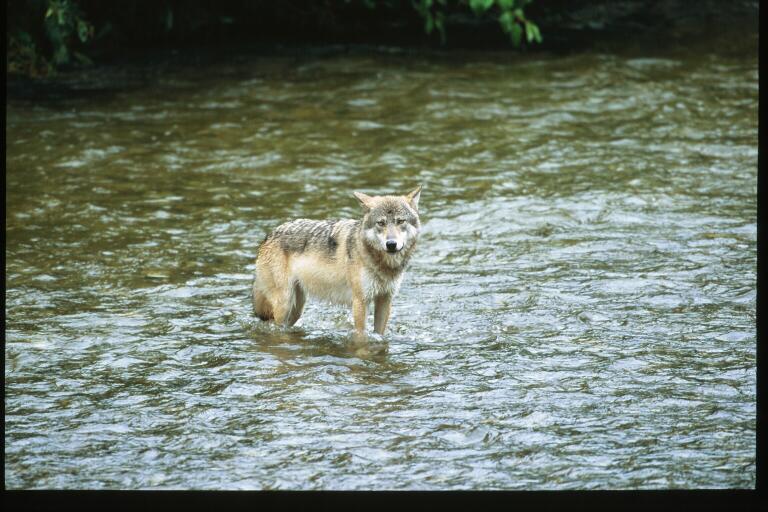
copyrighted wolf in river

This Bud’s Not For Me

Poll at bottom of page….

http://www.utsandiego.com/news/2015/feb/02/budweiser-puppy-ad-wolf-conservation/

A Super Bowl ad has some people howling mad.

No, not Nationwide’s commercial about a boy who died , though way to bring down the mood, Nationwide.

It’s Budweiser’s “Lost Dog” spot, which featured an adorable puppy, majestic Clydesdale horses and a big, bad wolf.

Budweiser 2015 Super Bowl Commercial ‘Lost Dog’

To summarize, dogs and horses good, wolves bad. (Sharks? Thanks to Katy Perry, that’s another story.)

No, the wolf lobby didn’t like it.

Viewers see horses come to the pup’s rescue as he’s being threatened by a menacing wolf who bares its teeth and snarls at the poor, frightened little guy. But then the pup returns home, joy ensues and all is right with the world, allowing us all to sit back and enjoy a cold one. (As if we weren’t doing that already.)

For puppy lovers and horse lovers and beer lovers, the ad was a touchdown.

But to wolf aficionados everywhere the ad unfairly demonized the endangered gray wolf population and was an affront to the species.

Witness this headline form onEarth, the magazine of the Natural Resources Defense Council.

“The King of Fears? Budweiser’s ‘lost puppy’ Super Bowl commercial has us howling on behalf of wolves.”

The people at the Center for Biological Diversity said the ad “drums up anti-wolf sentiment to try and capitalize on our culture’s outsized fear of wolf attacks.”

The organization launched a petition it called a “reality check” asking the beer maker to pull the spot. It has nearly 20,000 signatures.

photo

Here’s what the petition says: “1.2 million dogs are euthanized in shelters in the United States each year while another 1.2 million dogs are hit and killed by cars on America’s roads. By comparison, wolves are a virtually non-existent threat to our furry canine friends, only in very rare instances attacking dogs if they feel threatened or perceive them as competitors. The real threat to both dogs and wolves, as these numbers show and as Budweiser’s cynical attempt to boost sales indicates, is people.”

Here’s how it ends: “Purposefully demonizing an animal that is part of America’s natural heritage is no way to sell beer.”

There’s some growling going on about the issue on the The Wolf Conservation Facebook page.

Many of the commenters agree that the ad should no longer run but then there was this: ” For god sake this is stupid… It shows a wolf growling once and you do this? You people are unbelievable…”

What do you think? Weigh in below.

Should Budweiser pull its ad because of the wolf?

  • Yes. Wolves should be protected and not demonized.
  • No. What’s next? Do we ban Little Red Riding Hood?

See results

ID Wolf shooter turns down deal

http://www.cdapress.com/news/local_news/article_820326b1-aa8f-53ca-b1d6-692f105debc1.html

January 28, 2015 12:00 am | Updated: 12:31 am, Wed Jan 28, 2015.

COEUR d’ALENE – The man who shot a wolf on Rathdrum Mountain turned down a plea deal offered by Kootenai County prosecutors that would have had him pay a $200copyrighted wolf in river fine in exchange for a guilty plea.

He has opted instead for a jury trial.

“I said, ‘Nope,'” Forrest Mize said shortly after his arraignment Tuesday morning. Prosecutor Barry McHugh confirmed the offer was made.

Mize is representing himself on the misdemeanor charge of possessing a wolf without a tag. He doesn’t plan to hire an attorney at this stage.

“It’s going to be really hard to find a jury in North Idaho that finds me guilty for shooting a wolf to save my stinking dogs,” he said.

Mize, 53, shot the wolf Dec. 30 while he was out hiking in some fresh snow with his three dogs, all Labs, named Maggie, Jenny and Katie.

He was carrying a gun – a Kimber .22-caliber Hornet – with him for protection when he spotted the wolf, which he said looked like it was about to pounce on his pets. The dogs were 100 yards in front of him.

When he shot the wolf in the side through its heart, his three dogs were all close enough to be visible within the picture of his gun’s scope, he said.

He bought a wolf hunting tag later that day for $11.50 at a Rathdrum pharmacy. He is not a trophy hunter, he said, but wanted to keep the pelt.

According to Mize, two Idaho Department of Fish and Game officers showed up at his house a week after the shooting.

The officers, he said, were suspicious that he had purchased a wolf tag for 2014 on the next to the last day of the year, leaving him only one day to get a wolf.

At that point, he said, he admitted to having shot the wolf before buying the tag.

“I did the right thing, I just did it in the wrong order,” he said. “I’m not going to buy a tag (in advance), because I don’t hunt for wolves.”

He didn’t know there was a wolf near his home on the mountain.

Additionally, he said, he figured the officers would have some “understanding” for his perceived need to shoot the wolf in defense of his dogs.

Fish and Game declined a records request from The Press for any incident report that might have been created detailing the agency’s investigation findings.

Fish and Game confiscated the wolf’s pelt, which was already at a taxidermist, after finding Mize had killed the animal prior to purchasing a tag.

Oregon wildlife officials to consider removing gray wolves from endangered species list

http://www.oregonlive.com/environment/index.ssf/2015/01/wolf_delisting_oregon.html

By Kelly House | The Oregonian/OregonLive The Oregonian
Email the author | Follow on Twitter
on January 27, 2015

Protections for Oregon’s gray wolves could be rolled back after wildlife biologists counted more than four breeding pairs in eastern Oregon for the third straight year.

Under the state’s wolf plan, the Oregon Fish and Wildlife Commission can consider removing the eastern packs from the state’s endangered species list once that population bar is met.

Numbers from the annual wolf count released Tuesday afternoon indicate seven breeding pairs of wolves made it through 2014 – six of them in the eastern management area bounded by highways 97, 20, and 39.

Protections for wolves west of that boundary, including Oregon’s famed OR-7, are unaffected by the latest population figures.

The news came as no surprise to wildlife officials, who have said for months they expect to decide this year whether eastern Oregon wolves should continue to receive endangered species protections.

Of Oregon’s nine known wolf packs, only the Imnaha pack lacks a breeding pair. The Umatilla River pack still needs to be surveyed.

Conservationists and cattle ranchers hailed Tuesday’s news as proof that the state’s wolves are recovering, but their opinions diverged from there.

Rob Klavins, wolf advocate for Oregon Wild, argued that wolf numbers are still too low to consider delisting.

“We’re still a ways away from meaningful, long-term, sustainable recovery,” Klavins said.

Todd Nash of the Oregon Cattlemen’s Association said from his perspective, wolves in Oregon never should have been protected in the first place.

“There’s nothing delicate about their population,” he said. “I’m all for delisting them.”

Fish and wildlife commissioners who will decide Oregon wolves’ fate have offered no hints at their opinions on the matter, but state wolf coordinator Russ Morgan said both scientific data and public opinion will influence the commission’s eventual vote.

Before a vote can happen, Morgan said, wildlife biologists must complete a “status review” detailing how wolves are faring in Oregon. They will present their findings to the commission in April, along with a recommendation on whether wolves should remain listed.

“We have to do first things first, and the first thing here is to evaluate our data,” Morgan said.

In addition to triggering a review of Oregon wolves’ protected status, the increased number of breeding pairs triggers a new step in the wolf plan, giving ranchers more leeway to shoot wolves found mingling with their cattle.

Before the new population threshold was met, ranchers could only take wolves caught in the act of injuring or killing livestock. Now they can take wolves caught chasing livestock under some circumstances. Ranchers on private land also no longer need a permit to use beanbags, rubber bullets or other “non-lethal injurious harassment,” on wolves.

Nash, of the cattlemen’s association, said he’s happy the new rules give ranchers more options, but he doesn’t expect it to prevent many predations.

“Wolves kill at night,” he said. “There’s not much chance of catching them in the act at 2 a.m. in a remote area.”

The next step in assessing wolves’ recovering in Oregon will come in March, when fish and wildlife officials release their best estimate of the number of wolves in the state. They expect a significant increase from last year’s count of 64 known wolves.

 Wildlife Photography ©Jim Robertson

Wildlife Photography ©Jim Robertson

Wolf Murder Canadian Style Continues as if it’s Conservation

https://www.psychologytoday.com/blog/animal-emotions/201501/wolf-murder-canadian-style-continues-if-its-conservation

By Marc Bekoff Ph.D. on January 28, 2015 in Animal Emotions
The Canadian government plans to kill wolves once again to save caribou. An earlier murder escapade in Alberta didn’t work and there’s no reason to assume this one will. They even use collared “Judas” wolves to lead shooters to more wolves. The real problem is loss of habitat due to oil and gas development and logging. Some people just like to kill other animals for fun.

Animal Welfare Groups Push for Lesser ‘Threatened’ Status for Gray Wolf

http://wxpr.org/post/animal-welfare-groups-push-lesser-threatened-status-gray-wolf

A coalition of animal rights groups is pushing to downgrade federal protections for the gray wolf, hoping to compromise with opponents who want to remove protections altogether.

Gray wolves are back on the endangered species list in most U.S. states.
Credit ifaw.org

The groups are asking the U.S. Fish and Wildlife Service to list the gray wolf as threatened rather than endangered.

Wolves are currently endangered in Wisconsin and Michigan, thanks to a court ruling in late December that put the wolf back under federal protection.

But some members of Congress are pushing to change that status through legislation.

Now the Humane Society of the United States and twenty other wildlife protection groups are advocating for what they call a compromise plan to give the wolf the less-restrictive designation of ‘threatened.’

Humane Society President Wayne Pacelle says it could give managers and property owners more flexibility, even allowing lethal control in some cases.

“We feel that this petition provides a way forward that gives something meaningful to both sides.  More active management of problem wolves, but maintaining federal protections.”

Wolves are on the endangered species list in most of the lower 48, except for parts of the Northern Rockies.

A federal court ruling in December re-listed wolves as endangered in Wisconsin and Michigan, and threatened in Minnesota.

The ruling put a stop to wolf hunts in all three states.

Delist or downlist? Michigan wolf debate rages on following federal ruling that blocked hunting

http://www.mlive.com/lansing-news/index.ssf/2015/01/delist_or_downlist_michigan_wo.html

Wolf Hunt
 

LANSING, MI — The debate over Michigan wolves — and whether the state should be able to proceed with future hunts or lethal removal — rages on in the wake of a recent federal decision that returned the Great Lakes population to endangered status.

U.S. Rep. Dan Benishek, a Republican whose district includes the entire Upper Peninsula, is working with colleagues from Wisconsin, Minnesota and Wyoming on bipartisan legislation that would reportedly remove federal protections that now block local wolf management in Michigan and other states.

“The language we are looking at would be narrow and would address the recent court decision,” Benishek said in a statement provided to MLive. “It would not seek to change the Endangered Species Act, but would be designed to meet the need in our region for responsible stewardship of the wolf population. We are finalizing the details now and are hoping sometime in the next few weeks.”

State Sen. Tom Casperson, R-Escanaba, on Tuesday introduced a resolution that, if adopted, would offer support for the pending federal legislation and encourage the U.S. Fish and Wildlife Service and Michigan Department of Natural Resources to appeal the federal court ruling.

Jill Fritz, state director of the Humane Society of the United States and the Keep Michigan Wolves Protected coalition, said it would be difficult to comment on the pending federal legislation because she has not seen the language, but she noted her group “would oppose any action to strip federal protections from Great Lakes Wolves.”

HSUS and other animal protection groups this week submitted a petition asking the USFWS to “downlist” all gray wolves in the contiguous United States by reclassifying them as a threatened species — rather than an endangered one.

The proposal, if adopted, would allow USFWS to work with state and local wildlife authorities to kill or remove nuisance wolves attacking livestock, which has been an issue for farmers in Michigan and other states.

“If wolves are downlisted to threatened status across the board, then if there are concerns about depredation on livestock and they want to use lethal controls, they can do so,” said Fritz.

“What it would not allow is that wolves return to management under the states, which did not work. The states, particularly Minnesota and Wisconsin, started off with these aggressive killing and population reduction programs that really threatened to stop recovery of wolves in its tracks.”

Wolves in Michigan and other Great Lakes states were removed from the federal endangered species list in 2012, but U.S. District Judge Beryl Howell ruled last month that the removal was “arbitrary and capricious” and violated federal law.

Federal endangered status trumps Michigan laws that had allowed the for lethal removal of problem wolves and a pending law reauthorizing the Natural Resource Commission to name new game species and establish hunting seasons.

Michigan’s Upper Peninsula is home to slightly more than 600 wolves, up from just six in the 1970s. Hunting advocates argue the population warrants stronger management to reduce conflicts with livestock and comfort levels around humans.

As MLive reported earlier this month, there were 35 wolf attacks on livestock or dogs in Michigan last year, up from 20 in 2013 but lower than the 41 in 2012.

Twenty-two wolves were killed in late 2013 during Michigan’s first-ever wolf hunt. There was no hunt last year, when voters rejected two separate wolf hunting laws, but a newer version is set to take effect in April.

Groups Petition to Reclassify Gray Wolves to Threatened Status under Endangered Species Act

I haven’t had a chance to look into this yet, but this line, from an article entitled, “Finding Balance in the Wolf Wars” in the Huffington Post caught my eye: “Our plan respects the purpose and intent of the Endangered Species Act but gives a nod to the folks who want more active control options for wolves, especially ranchers,”

The wolf is in no way “recovered” in the lower 48; they should never have been downgraded from endangered. In 1885 5,500 wolves were killed in Montana alone. Now there’s less than 5,000 in the entire country…

copyrighted Hayden wolf in lodgepoles

Does anyone have any insights on this they want to share?


http://www.humanesociety.org/news/press_releases/2015/01/esa-threatened-gray-wolves-012715.html


January 27, 2015


Proposal presents a reasonable alternative to congressional delisting and a path to national recovery

Animal protection and conservation organizations petitioned  the U.S. Fish and Wildlife Service to reclassify gray wolves under the Endangered Species Act as threatened throughout the contiguous United States, with the exception of the Mexican gray wolf which remains listed as endangered. If adopted, the proposal would continue federal oversight and funding of wolf recovery efforts and encourage development of a national recovery plan for the species, but would also give the Fish and Wildlife Service regulatory flexibility to permit state and local wildlife managers to address specific wolf conflicts.

Gray wolves are currently protected as endangered throughout their range in the lower 48 states, except in Minnesota where they are listed as threatened and in Montana, Idaho and eastern Oregon and Washington where they have no Endangered Species Act protections. Some members of Congress are advocating for legislation to remove all protections for wolves under federal law by delisting the animal under the Endangered Species Act. The petition proposes an alternative path to finalizing wolf recovery based on the best available science, rather than politics and fear, and would help to find a balanced middle ground on a controversial issue that has been battled out in the courts and in states with diverse views among stakeholders on wolf conservation.

Wayne Pacelle, president and CEO of The Humane Society of the United States, said: “Several states have badly failed in their management of wolves, and their brand of reckless trapping, trophy hunting, and even hound hunting just has not been supported by the courts or by the American people. We do, however, understand the fears that some ranchers have about wolves, and we believe that maintaining federal protections while allowing more active management of human-wolf conflicts achieves the right balance for all key stakeholders and is consistent with the law.”

Wolf populations are still recovering from decades of persecution—government sponsored bounty programs resulted in mass extermination of wolves at the beginning of the last century, and the species was nearly eliminated from the landscape of the lower 48 states. Wolf number have increased substantially where the Endangered Species Act has been implemented, but recovery is still not complete, as the species only occupies as little as 5 percent of its historic range, and human-caused mortality continues to constitute the majority of documented wolf deaths.

Kierán Suckling, executive director of the Center for Biological Diversity, said: “A Congressional end run around science and the Endangered Species Act will create more controversy and put wolves and the law itself in jeopardy. The better path is to downlist wolves to threatened, replace the failed piecemeal efforts of the past with a new science-based national recovery strategy,and bring communities together to determine how wolves will be returned to and managed in places where they once lived, like the Adirondacks, southern Rocky Mountains, Cascades and Sierra Nevada.”

The U.S. Fish and Wildlife Service’s piecemeal efforts to delist gray wolves in the northern Rockies and western Great Lakes have been roundly criticized by scientists and repeatedly rejected by multiple federal courts. In addition to denouncing the Service’s fragmented approach to wolf recovery, courts have recognized that several states have recklessly attempted to quickly and dramatically reduce wolf numbers through unnecessary and cruel hunting and trapping programs. The public does not support recreational and commercial killing of wolves, as evidenced by the recent decision by Michigan voters in the November 2014 election to reject sport hunting of wolves. Wolves are inedible, and only killed for their heads or fur.

Adam M. Roberts, CEO of Born Free USA, said: “Complex conservation problems require sophisticated solutions. The history of wolf protection in America is riddled with vitriolic conflict and shortsightedness and it is time for a coordinated, forward-thinking approach that removes the most barbaric treatment of this iconic species and focuses on the long-term viability of wolf populations throughout the country.”

The threatened listing proposed by the petition would promote continued recovery of the species at a national level so that it is not left perpetually at the doorstep of extinction. A threatened listing would also permit the Fish and Wildlife Service some regulatory flexibility to work with state and local wildlife managers to appropriately address wolf conflicts, including depredation of livestock.

Groups filing the petition include national organizations and those based in wolf range states:

Born Free USA

Center for Biological Diversity

Detroit Audubon

Detroit Zoological Society

The Fund for Animals

Friends of Animals and Their Environment

Friends of the Wisconsin Wolf

Help Our Wolves Live

Howling for Wolves

The Humane Society of the United States

Justice for Wolves

Midwest Environmental Advocates

Minnesota Humane Society

Minnesota Voters for Animal Protection

National Wolfwatcher Coalition

Northwoods Alliance

Predator Defense

Sault Sainte Marie Tribe of Chippewa Indians

Wildlife Public Trust and Coexistence

Wildwoods (Minnesota)

Wisconsin Federated Humane Societies

Wolves of Douglas County Wisconsin


Also on: http://www.huffingtonpost.com/wayne-pacelle/finding-balance-in-the-wo_b_6558340.html

Murderers Must Obtain the Proper Permit

Clan-Couger-Killers_053249498396

I’m sure you remember Washington State wolf-poacher, Bill White of Twisp. I knew him all too well, having spent a third of my life outside the same small town. Like most serial killers, he’d seem like a nice guy if you saw him chatting it up with passers-by from his booth at the farmer’s market, selling his popular “all natural” “grass-fed” beef to unsuspecting buyers of all political stripes.

Little did they know they were supporting a soon-to-be infamous serial-poacher who defied “game” laws galore while hound-hunting bears and cougars and ultimately baiting the state’s first known wolf pack, the “Lookouts,” luring them to their deaths at his 100 acre ranch on the side of Lookout Mountain.

Not only did he and his son kill most of the Lookouts before the pack was even officially recognized, the poaching ring also flouted international trade laws by trying to send a bloody wolf hide over the border into Canada. Ironically, that crime was to be their undoing.

As it turns out, if they had waited for the government to declare them legal, those exact same crimes would have been perfectly acceptable—with the applicable authorizations. Hunters in Montana can now get permits to do just what the Whites tried to do illegally, murder wolves and ship their hides to Canada.

The message being sent here is: murder isn’t a crime as long as you get permission. Kill a wolf in cold blood, skin it and send its hide to a dealer across the border? No problem, just get a permit. (Washingtonians or Oregonians, be sure to say it was chasing your cows, or looking crossways at dog or baby first.) There’s a permit for everything…you just have to learn to jump through the right hoops.

Another case of permits making killing all better: the shooting of sea lions—an all too common practice that has driven the Steller (or Northern) sea lion to the brink of extinction. That endangered species’ population has been reduced by 80% from what they were before the thrill-killing heyday. The Marine Mammal Protection Act, passed in the early 1970s, may have slowed the killing, but exploiters could always get permits to do away with the competition. For the longest time all a commercial fisherman would have to do was claim sea lions ate “their fish” and they were granted a permit to fire at will.

Text and Wildlife Photography ©Jim Robertson. All Rights Reserved

Text and Wildlife Photography ©Jim Robertson. All Rights Reserved

Apparently, snuffing out a beautiful, sentient, social being is not considered a crime, but failure to get the right permits is another thing altogether. Want to dredge the bottom of the ocean for every last little bit of sea life, entangling and starving out sea lions, seals, whales and dolphins in the process? Kill off the entire planet in the name of resource extraction? No problem—just be sure you have a permit first.

Remember, even budding serial killers must obtain the proper permit.

Captain Paul Watson on B.C. Wolf Kill

copyrighted wolf argument settled

http://www.theglobeandmail.com/news/british-columbia/bc-sparks-controversy-by-bringing-back-wolf-hunt/article22547547/

Critics of the helicopter hunt say endangered caribou herds are in decline because of habitat loss, not wolf predation, and that shooting wolves in a pack can traumatize the rest of the family group.

B.C. sparks controversy by bringing back wolf hunt

The British Columbia government is back in the air shooting wolves nearly 30 years after it abandoned a controversial aerial hunt that triggered rallies in several U.S. cities and saw activists parachuting into the wilderness in an attempt to stop the kill.

The government is refusing to divulge how many animals it has shot during the first week of the helicopter hunt, but its plan to protect endangered caribou by eliminating nearly 200 wolves in the South Selkirks and South Peace regions is once again threatening to stir protests from activists, including Paul Watson.

Mr. Watson, perhaps the world’s most famous wildlife campaigner, said B.C.’s justification for the hunt is no more acceptable now than it was in the 1980s, when he first drew international attention to it.

“There are a lot of activists in British Columbia. I’m going to talk to them about reviving Friends of the Wolf,” Mr. Watson, head of the Sea Shepherd Conservation Society, said on Tuesday in an interview from Paris.

Mr. Watson founded Friends of the Wolf in 1984 to campaign against the hunt, which stopped in 1985, only to be revived briefly in 1987. Over four years, about 1,000 wolves were killed to reduce predation of moose, caribou and mountain sheep.

“Maybe we’ll have to make a big deal of it, like we did in 1984, ’85,” Mr. Watson said.

“I think it’s a complete disgrace,” he said of the hunt. “There’s no scientific evidence behind this. Wolves and their prey are very important and essential part of the ecosystem and we are constantly disrupting it.”

Ian McAllister, a wildlife photographer and head of Pacific Wild, said opposition to the wolf hunt is growing rapidly.

“I can say that in 20 years of wildlife work, I’ve never seen a reaction like what we are seeing right now. We’ve had one-and-a-half million people go through our website, we got something like 40,000 signatures [on a petition] urging government to reconsider this,” he said. “All our phone lines were jammed with people calling. They are just outraged about this.”

Mr. McAllister has spent years photographing wolf packs at close quarters. He said wolves are highly social, and shooting even one in a pack can traumatize the rest of the family group.

“To start killing and wounding numerous ones, day after day, it’s horrendous. It’s one of the most inhumane things humans could commit in the natural world. It’s unthinkable,” he said.

Sadie Parr of Wolf Awareness Inc., a B.C.-based non-profit foundation dedicated to public education, said the endangered caribou herds are in decline because of habitat loss, not wolf predation.

“This certainly is a conservation dilemma,” she said of the declining caribou herds. “It’s a very complicated problem. But we have to recognize we are in this situation because of us [humans], not because of anything wolves have done.”

Ms. Parr said she has been bombarded with requests for information since the hunt was announced last week.

“People are really, really upset, and rightfully so. This is barbaric and the world is paying attention,” she said.

The B.C. Ministry of Lands did not have a spokesperson available on Tuesday, but e-mailed a statement from Stan Boutin of the University of Alberta, who conducted an independent review of the wolf management plan.

“I support the B.C. government decision to use wolf control in an attempt to recover the herds,” he wrote. “Wolf control appears to be part of a broader recovery plan that also includes important measures to protect and recover habitat.”

But Green MLA Andrew Weaver said the government cannot verify its claim that wolves are the leading cause of caribou mortality.

“I am supportive of science-based initiatives that promote conservation but in this particular case, I cannot find the ‘evidence’ the government is apparently relying on,” he wrote in a letter to Lands Minister Steve Thomson.