|
Earthjustice went to court to stop Idaho from exterminating the Golden and Monumental wolf packs in central Idaho’s Frank Church—River of No Return Wilderness.
And we won! The Idaho Department of Fish and Game announced that it is halting its wolf extermination program as of today.
This will stop the wolf killings and restore the natural balance between predator and prey in the Idaho wilderness area.
|
||||
|
Category Archives: Wolves
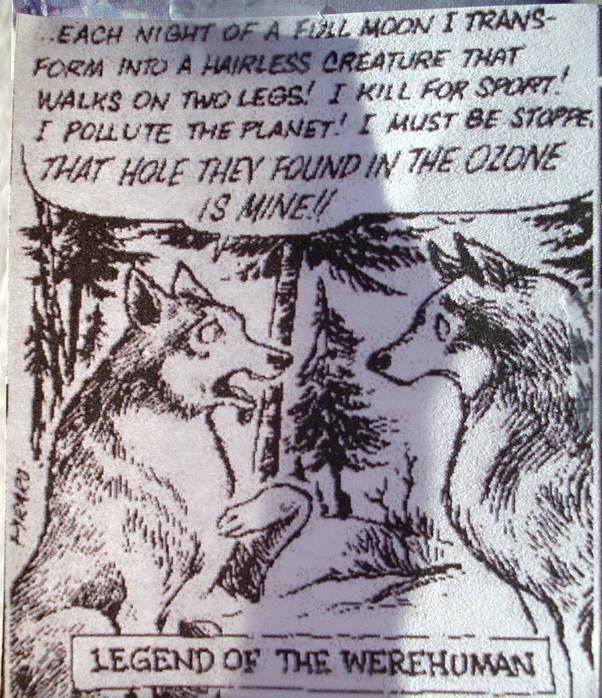
Beware the Wereman
Image
If wolves could manage humans it might look like this:
DRAFT Management Plan for Humans (Homo sapiens) in British Columbia
By Ken S. Lupus et al., B.C. Ministry of Wild Wolves
We model the structure of our plan after the B.C. government’s “Draft Management Plan For The Grey Wolf In British Columbia.” Although our plans are fundamentally different in how we decide to treat one another, we similarly assert that this document is premised on the best available scientific information. (Note: we consulted with Raincoast biologists and
large carnivore experts Drs. Chris Darimont and Paul Paquet).
Notably, however, our management plan for humans draws upon an additional and important dimension that shapes policy in advanced civilizations: commonly held ethical values.
As the province did, we begin with some straightforward conservation context. Based on their rapidly increasing numbers and range, humans have been categorized as not at risk by the Lupine Committee of Categorizing Other Animals We Have Never Harmed. We note, however, on the other hand-
and despite thousands of management plans by humans -global biodiversity is severely threatened as a result of human activities.
According to information shared by human sources, Homo sapiens play a very important role in maintaining so-called “game” populations, raising livestock among us wolves in formerly wild landscapes, and saving animals like caribou from rapid extinction due to resource extraction activities. On the other hand, some hunters, livestock groups and government-industrial complexes behind these ostensibly noble acts also comprise a significant threat to wolf safety and welfare. Accordingly, our plan must strike a balance to manage humans for conservation while minimizing conflicts with wolves.
We likewise adopt the same four management objectives stated by our simian colleagues, though with modified details. Topping this list is to ensure a self-sustaining population of humans throughout the species’ range. We suppose that we will have to accept this inevitability. We suspect, however, that this spells trouble for us. If human behaviour remains unaltered – and caribou continue to dwindle and ranchers continue to believe that some god created landscapes with only their cows in mind – we expect a future of increasing conflicts.
Our plan’s second objective is to provide for non-consumptive use of humans. Why not? No harm in setting up some eco-tourism by us wolves to partake in some human-watching. We need not look further than Yellowstone National Park, and Algonquin Park to know that humans can make a mint with sustainable wolf-based eco-tourism.
Unlike the province’s anachronistic seat-of-the pants wolf management plan, however, which was designed by more wanton predators, we have no plans for so-called “consumptive” use of humans. Although humans would be easy pickings, we are just not known to do this. And really, why would anyone kill something for any other reason than to eat?
For sport or for trophy? No thanks. Surely no advanced society would ever condone or endorse that sort of behaviour. Nor
would any real hunter. That just leaves a bad taste in our mouths (and to put how awful that is in perspective, we often eat poop).
Perhaps the most important part of our “Draft Management Plan For Humans In British Columbia” is to minimize the threat to wolf safety caused by humans. Whereas wolves pose a very limited threat to humans, the opposite is certainly not true. For instance, the B.C. government says that approximately 1,200 of us wolves were killed deliberately in 2010 by hunters and trappers for sport, trophy or profit.
While human “wildlife managers” are quick to point out that we wolves can replenish our numbers, even amidst such persecution, our concern is the suffering imposed on us. Imagine the pain when the hot metal of bullets shreds our viscera (or worse, our limbs) or the agony inflicted when one of
us is tormented by a leg-hold trap. Clearly, any management plan should address suffering among highly sentient animals.
Unfortunately, our plan to minimize threats to wolf safety has no details. Given all the technological advantages humans have acquired to use against wolves like high-powered rifles, helicopters, deadly poisons, traps, snares and explosive devices, predator calls to lure us and more, they simply have
the upper hand.
Finally, and again mirroring the B.C. government’s wolf management plan, our fourth objective is to control specific populations of humans where their activities are likely preventing the recovery of a species at risk (e.g.,
endangered populations of caribou). Whereas humans have hatched some vicious scapegoating campaigns and lethal plans for us as last ditch efforts to save caribou from logging or oil and gas extraction, we have yet to find successful methods to control these industries. We therefore appeal to our human friends within B.C. for help.
To conclude, we turn to history to muse about the future. It has taken decades to expunge, in part, the nonsense about wolves portrayed in human generated fairy tales (and not just children’s stories, but also adult constructs such as the perversely and ironically named “North American Model of Wildlife Conservation”). How many more decades will it take to do the same in provincial management plans for wolves?
This article was co-authored with Raincoast Conservation Foundation science director Dr. Chris Darimont and Raincoast senior scientist Dr. Paul Paquet.
Idaho “Tough on Wolves”
Here is part of an article entitled “Tough on Wolves” in Spokane’s Inlander: http://www.inlander.com/spokane/tough-on-wolves/Content?oid=2256023
If the education budget is in JFAC’s custody and Medicaid expansion is off the table, what hot topics will the legislators address? My prediction: Guns and wolves will attract a fair amount of attention.
According to the Fish and Game Department, Idaho now has around 680 wolves throughout the state. In 2009, wolf hunting became legal, and the governor announced he wanted to shoot the first one.
Idaho and its predators caught the attention of the New York Times this past December, when a planned coyote and wolf shoot-to-kill derby was scheduled in Salmon. Organizers offered $2,000 to the participants who killed the most animals. The event fell flat when no wolves and only 21 coyotes were bagged by the 230 registered contestants.
Not everyone is happy with Governor Otter’s $2 million budget request to establish a special wolf control board, separate from the Department of Fish and Game. “Control” is another word for “kill.” I, for one, would rather put the $2 million in the public school pot.
The Fish and Game Commission is already actively “controlling” wolves by hiring a lone gunman to eliminate wolves in the 2,367-acre Frank Church River of No Return Wilderness. The Idaho Conservation League has been remarkably tolerant on the wolf issue. But recently its Executive Director Rick Johnson asked, ” If they can’t live in the backcountry, where can they live?”
When 35 gray wolves were released in central Idaho in 1995, schoolchildren gave them names and followed their radio-relayed paths through the wilderness. As they thrived, their names disappeared and the wolves became numbers. As they multiplied, they became pests. Wolves, like coyotes, have always been pests to Idaho ranchers — and to the Idaho legislature.
It’s refreshing to learn about Oregon’s approach to a burgeoning wolf population. Oregon has developed a policy that calls for sheep and cattle outfits to use nonlethal methods to prevent wolves from snatching baby animals, especially lambs. These include simple measures such as keeping herds away from known wolf dens, employing loud noise alarms and scare devices, enlisting protective dogs and human herders, constructing barriers and building fences. Such items add costs but also avoid conflicts.
Consumers could be wooed to pay a little bit more for lambs raised in a certified, nonlethal-to-wolves environment.
The questions the reintroduction of wolves into Idaho has presented are worth pondering. Do we believe game hunting should include animals that we don’t plan to eat? Is there room in our hearts, minds and geographical space for predators other than our own species?

Gray Wolf Shot and Killed within Grand Teton National Park
[If not safe there, where?]
MOOSE, WY — A gray wolf was shot and killed at a private inholding within Grand Teton National Park on Monday, January 20, 2014. The person who fired the lethal shot notified Wyoming Game and Fish Department wardens and they reported the situation to park rangers at approximately 10:30 a.m.
Grand Teton National Park rangers and a park biologist responded to the area to investigate the incident. The Wyoming Game and Fish Department is conducting a concurrent investigation.
The wolf was a two-year-old male and was not radio-collared; its pack affiliation is unknown. At the time of the shooting, this wolf was in the company of three to four pack mates.
The incident is under investigation by the National Park Service in consultation with United States Attorney’s Office, District of Wyoming, and no further information will be released until the investigation is concluded.
With 9 wolves now dead, Fish and Game meeting provides outlet for supporters, detractors
http://www.idahostatesman.com/2014/01/16/2976203/with-9-wolves-now-dead-fish-and.html#storylink=cpy
by Rocky Barker
Stabe Hedges of Boise spoke quietly before a crowd of 150 people and the Idaho Fish and Game Commission on Wednesday.
But he spoke for hunters across Idaho who no longer find it relatively easy to find elk in the place where they have hunted since their youth.
“I know what we used to have here and I know what was lost,” Hedges said.
As Hedges looked around the room, most of the people were there to protest Fish and Game’s elk management plan authorizing the agency to hire a hunter-trapper to eliminate two packs of six wolves in the Frank Church-River of No Return Wilderness. John Robison, public land director of the Idaho Conservation League, asked the people filling the Washington Group Center auditorium for a show of hands for people angry about the killing.
The majority raised their hands.
“Its upsetting to me that so many people support an animal that has decimated the state,” Hedges said.
Despite the great differences in opinions, hunters and animal lovers passionately expressed their feelings about wolves and elk but also listened to each other. The hearing was a far cry from the angry confrontations that have marked past hearings on wolves in Idaho and perhaps reflected the shift since the animal was removed from federal protection and opened to hunting.
“Restoration must include predator harvest on a consistent basis as research indicates that wolf populations can withstand human-caused mortality of 30 to 50 percent without experiencing declines in abundance,” said Grant Simonds, executive director of the Idaho Outfitters and Guides Association.
Boise resident Pam Marcum told the commission to “please have some grit to cancel the wolf eradication.”
And Jen Pierce, a geology professor at Boise State University, read a statement from 15 scientists, including professors at the University of Idaho and Idaho State University, protesting the killing.
“We feel your decision to hire a professional hunter to exterminate two wolf packs in the Frank Church Wilderness does not demonstrate informed management, both economically and ecologically, and contradicts the mission statement of the Idaho Fish and Game,” Pierce said. “Sending in the hunter-trapper prior to the IDFG state elk management meeting on January 16th is also perplexing.”
So far the agency’s hunter-trapper has killed nine wolves in the wilderness area, said Jon Rachael, Fish and Game’s big game manager.
Read more here: http://www.idahostatesman.com/2014/01/16/2976203/with-9-wolves-now-dead-fish-and.html#storylink=cpy
Activists Protest Killing Wolves to Boost Elk Numbers
By BRIAN SMITH
BOISE • Have some “grit” and stop “exterminating” Idaho’s wolves.
That was Pam Marcum’s message to Idaho Fish and Game commissioners Wednesday night.
Marcum’s charge was echoed by numerous other biologists, wildlife advocates and enthusiasts, many of whom questioned the science and ethics behind Fish and Game’s predator management plan.
Many locals complained that the commission was solely focused on boosting elk populations and keeping hunters happy instead of balancing the state’s wildlife. Some said wolves can have a positive impact on the ecosystem, despite hunters’ claims to the contrary.
“Use peer-reviewed science, not political science,” Marcum said.
Several hunters spoke in support of state wolf control. Stabe Hedges said it was upsetting to see so many people supporting an animal that harms Idaho’s economy. He advocated for increased wolf hunting opportunities.
“I personally would like to see the numbers of wolves reduced by 40 or 50 percent,” Hedges said. “I would like to see some of the elk numbers rebound. I hiked 32 miles this year before I saw a single elk, and that’s a vast difference from years gone by.”
The public comment hearing preceded today’s annual commission meeting, which was open to the public.
The commission is set to hear a legislative update and presentations from Fish and Game staff on wildlife such as elk, turkeys, chinook salmon and deer today. Later in the day, it will hear a budget preview and a report on a wildlife collision reduction project.
At 9:35 a.m., the commission is to consider approving its new elk management plan. The plan, last updated in 1999, is a guide for season-to-season management of the state’s many herds.
The plan also addresses changes in elk habitat, how growing elk populations damage crops, and how to more aggressively target predators such as bears, mountain lions and wolves.
Idaho Conservation Leauge’s John Robison said his organization is “deeply concerned” about the elk management plan and its impacts on wolves.
Robison asked for a show of hands from the audience to see who was angered by a recent pack killing at state expense in the Frank Church-River of No Return Wilderness. Most people in the packed room raised their hands.
“We believe that this unprecedented public outcry about this decision should force the commission to stop and reassess its approach on wolves, wilderness and predators,” he said.
The commission also should reduce its wolf-trapping program, said Ken Cole, a National Environmental Policty Act coordinator with the Western Watersheds Project. It should require trappers to check their snares more often, he said.
“These animals should not be out there suffering for more than 72 hours,” he said.
Not so — the areas where wolf trapping is allowed should be expanded in southern Idaho, said Pat Carney, president of the Idaho Trappers Association.
“Instead of the state having to pay trappers to go in and trap these other wolves, it would be better if locals could go in and do it instead of having tax dollars pay for it,” Carney said.
The decision to kill wolves in wilderness areas doesn’t make sense “economically and ecologically,” said Jennifer Pierce, an associate professor of geosciences at Boise State University.
“As scientists who have worked in the Frank Church area for decades, the eradication of large predators from this ecosystem is potentially detrimental to all parts of the ecosystem,” she said. “Was there a science-based rationale for killing wolves in wilderness? If so, what was it?”
‘Carnivore cleansing’ is damaging ecosystems, scientists warn
http://www.theguardian.com/environment/2014/jan/09/carnivore-cleansing-damaging-ecosystems
Extermination of large predators such as wolves and bears has a cascading effect on delicate ecological balance
· theguardian.com, Thursday 9 January 2014 19.00 GMT

Hunters skin a wolf killed in a forest in the Ukraine. Humans have waged a long-standing war with large carnivores that kill livestock and threaten rural communities. Photograph: Vasily Fedosenko/Reuters
A plea to restore populations of some of the world’s most dangerous animals has been made by scientists who claim the loss of large carnivores is damaging ecosystems.
More than three-quarters of the 31 species of large land predators, such as lions and wolves, are in decline, according to a new study. Of these, 17 species are now restricted to less than half the territory they once occupied.
Large carnivores have already been exterminated in many developed regions, including western Europe and eastern United States – and the same pattern of “carnivore cleansing” is being repeated throughout the world, said scientists.
Yet evidence suggests carnivores play a vital role in maintaining the delicate balance of ecosystems which cannot be replaced by humans hunting the animals they normally prey on.
“Globally, we are losing our large carnivores,” said lead researcher Prof William Ripple, from the department of forest ecosystems and society at Oregon State University in the US.
“Many of them are endangered. Their ranges are collapsing. Many of these animals are at risk of extinction, either locally or globally. And, ironically, they are vanishing just as we are learning about their important ecological effects.”
Humans have waged a long-standing war with large carnivores that kill livestock and threaten rural communities.
But the international team from the US, Australia, Italy and Sweden called for a global initiative to conserve large predators.
The scientists suggested it could be modelled on the Large Carnivore Initiative for Europe, an expert group affiliated with the International Union for the Conservation of Nature (IUCN). It is committed to helping European predators including the wolf, lynx and brown bear reoccupy many of their former habitats.
Prof Ripple and his colleagues focused on seven key species whose ecological impact has been extensively studied – the African lion, leopard, Eurasian lynx, cougar, grey wolf, sea otter and dingo.
A review of the evidence showed how the decline of cougars and wolves from Yellowstone and other North American national parks led to an increase in browsing animals such as deer and elk.
This in turn had a cascading effect, disrupting vegetation growth and upsetting populations of birds and small mammals.
Studies of the European lynx, Australian dingo, lions and sea otters have shown similar effects, said the researchers whose findings were reported in the journal Science.
Lynx were strongly linked to the abundance of roe deer, red fox and hare, while in Africa the loss of lions and leopards had coincided with a dramatic increase in olive baboons, which threaten farm crops and livestock.
In the waters of south-east Alaska, a decline in sea otters hunted by killer whales had led to a rise in sea urchins and the loss of kelp beds.
Ecosystems had responded quickly where large carnivores had been returned to their former habitats, said Prof Ripple. Two examples were the reintroduction of wolves in Yellowstone and the Eurasian lynx in Finland.
“I am impressed with how resilient the Yellowstone ecosystem is,” said the professor. “It isn’t happening quickly everywhere, but in some places, ecosystem restoration has started there.”
The classic concept of predators being harmful is outdated, the scientists claimed.
Prof Ripple added: “Human tolerance of these species is a major issue for conservation. We say these animals have an intrinsic right to exist, but they are also providing economic and ecological services that people value.
“Nature is highly interconnected. The work at Yellowstone and other places shows how one species affects another and another through different pathways. It’s humbling as a scientist to see the interconnectedness of nature.”
Disruption of large carnivore populations had led to crop damage, altered stream structures, and changes to the abundance and diversity of birds, mammals, reptiles and invertebrates, said the scientists.
By keeping herbivores in check and allowing woody plants to flourish and store more carbon, carnivores also acted as a buffer against climate change.
The researchers accepted that getting human communities to accept the reintroduction of large carnivores was a “major sociopolitical challenge”.
They wrote: “It will probably take a change in both human attitudes and actions to avoid imminent large carnivore extinctions. A future for these carnivore species and their continued effects on planet Earth’s ecosystems may depend on it.”
No Surprise: Utah Farm Bureau urges delisting of wolves
by Caleb Warnock
“The Endangered Species Act, if you look at the numbers, is a colossal failure,” said Leland Hogan, president of the Utah Farm Bureau Federation, in the latest issue of Utah Farm Bureau News magazine.
There are no wolves in Utah, but that doesn’t put a damper on the debate over their potential future in the state, should they ever appear here.
The federal government has oversight of all gray wolves in the U.S. because they are listed as endangered species. Now the feds are proposing to delist gray wolves and turn their management over to states, which in Utah would likely make it legal to shoot wolves, should they cross the border.
Because wolves prey on livestock, there is no love lost between the creatures and the Farm Bureau.
There has only been a single confirmed wolf sighting in Utah’s modern history. On November 30, 2002, a wolf from Yellowstone’s Lamar Valley was captured in Morgan County and returned to Yellowstone.
Since that day, there “have been a few border incursions, as extreme northern Utah is not far from Wyoming wolf range,” said John Shivik of the Division of Wildlife Resources, who oversees the management of large predators in Utah. “There is no evidence, however, that wolves have taken up residence in Utah.”
Hogan and the Farm Bureau are calling the Endangered Species Act a waste of taxpayer cash. In the UFB article, he calls wolves both “sinister” and “marauding.”
“Since its enactment in 1973, only about 20 out of nearly 2,000 endangered or threatened species — about 1 percent of the total — have been declared recovered, despite spending hundreds of millions of taxpayer dollars,” said Hogan in UFB magazine. “The draft rule being proposed by the agency would remove the gray wolf from the Endangered Species List in the continental 48 states and turn over wolf management to the states. We support the Service’s proposal to delist the gray wolf; however, we do not support listing the Mexican wolf as an endangered subspecies. In addition, Utah Farm Bureau calls on the federal government to turn management of wolves to the states.”
The Farm Bureau is not alone in its ideas for wolf management. The leadership of the Utah Division of Wildlife Resources, Gov. Gary Herbert and Utah’s congressional delegation “have repeatedly requested delisting throughout Utah,” said Shivik.
As for the Mexican wolf, their “core population did not range farther north than central Arizona and New Mexico, and Utah maintains that Mexican wolf recovery areas should not include any parts of Utah,” Shivik said.
The Mexican wolf is a unique subspecies that occurred in Mexico and parts of the southwestern United States.
Even when wolves are sighted in Utah, the state maintains some skepticism, based on experience.
“Coyotes and domestic dogs are often confused with wolves on the landscape, especially after news reports cause interest in the subject,” said Shivik. “Some people have hybrid or domestic dogs that very strongly resemble wolves, which adds to the confusion too. Division biologists receive hundreds of reports every year, but less than 3 percent are even potentially wolves.”
So if you think you saw a wolf, should you, well, cry wolf?
“If it is near a town, or not particularly afraid of humans, it may be best to call the local animal control officers,” said Shivik.
Meat-eaters versus carnivores: Is your diet killing wolves?
http://www.csmonitor.com/Science/2014/0110/Meat-eaters-versus-carnivores-Is-your-diet-killing-wolves
Most most large land carnivore populations are in decline. A report from Oregon State University suggests that livestock production is partly to blame.
By Fabien Tepper, Staff writer / January 10, 2014
A gray wolf poses for a photo at the Wildlife Science Center in Forest Lake, Minn., in 2004. Twenty-three wolves were killed in the Upper Peninsula during Michigan’s first wolf hunt in four decades, the state reported on Jan. 1, 2013. Dawn Villella/AP/File
Of the 31 largest species of land carnivore (including the Giant panda, a rare herbivore in the Carnivora order), 23 are in population decline, the authors report. One, the red wolf, is critically endangered, and eight more are considered likely to go extinct throughout all or most of their natural range.
“Globally, we are losing our large carnivores,” says William Ripple, an Oregon State University ecologist who was the paper’s lead author.
Human infringements on these animals are numerous – including the fur industry and many forms of traditional medicine – but the report gives a special nod to “human carnivory.” To support a global rise in per-capita meat-eating, livestock farming continues to expand, shrinking and fragmenting natural habitats in the process. And when cramped predators adapt by preying upon livestock, some ranchers go to extreme measures to keep them away, such as strapping pouches of neurotoxins to the necks of grazing lambs, or calling upon the United States Department of Agriculture to shoot down predators from government helicopters.
“Global livestock production continues to encroach on land needed by large carnivores, particularly in the developing world, where livestock production tripled between 1980 and 2002,” reports the study.
But if our very food production brings us to blows with other meat-eaters, surely we need the land at least as much as they do. Why should we privilege wolf and puma habitat over farmland?
“Human tolerance of these species is a major issue for conservation,” says Mr. Ripple. “We say these animals have an intrinsic right to exist, but they are also providing economic and ecological services that people value.”
According to these scientists, there is every reason to protect carnivores – and not only the species, but the individuals themselves. For one thing, animals’ intrinsic value may dwell in individuals’ capacities for pain, pleasure, learning, and social relationships, all qualities which these megafauna have in spades.
“Because we’re aware and self-aware, we have a well-being that can be helped and harmed by our actions,” explains Bill Lynn, a research scientist at Clark University‘s George T. Marsh Institute, who is an expert on ethics and predator management. “With respect to carnivores, they too are aware and self-aware. They, too, have a well-being that can be helped or harmed by our actions.”
“Thus,” adds Mr. Lynn, “how human beings relate to wildlife and the environment, are of direct moral concern.”
Many large carnivores are also considered to be keystone predators, who play crucial roles within their ecosystems – roles that are shaped by the size, metabolic demands, sociality, and hunting tactics, of each individuals.
“Each one of them becomes more important because there’s fewer of them,” explains Ripple.
The gray wolf, for example, whose fate has become the subject of ongoing policy debates after its extirpation from much of Western Europe, the US, and Mexico, is the top US predator of deer, after humans. In North America‘s now-wolfless areas, deer populations are nearly six times higher than elsewhere, which has led to drastic changes in plant communities, as well as increases in automobile collisions. And sea otters have been shown to keep North American kelp populations healthy and well distributed, by limiting the growth of sea urchin colonies.
Both of these ecological functions – protecting woodland foliage and aquatic kelp – are vital for keeping the earth’s carbon sequestered safely in plant tissues (and out of the atmosphere), notes the study, suggesting that charismatic carnivores actually play a vital role in keeping global warming at bay.
In view of this and other important “ecosystem services,” the authors have called for the creation of a Global Large Carnivore Initiative modeled after an existing European initiative which aims “to maintain and restore, in coexistence with people, viable populations of large carnivores as an integral part of ecosystems and landscapes.”
Such a body could establish carnivore reserves, suggests Ripple, and improve the enforcement of international wildlife laws.
“Ideally, discussions regarding potential decreases in both human fertility rates and per-capita meat consumption would be part of a long-term strategy for overcoming these concurrent challenges,” suggests the report. “It will probably take a change in both human attitudes and actions to avoid imminent large-carnivore extinctions.”
“These are some of the world’s most revered and iconic species. Ironically, they are also some of the most threatened,” says Ripple. “I think in the end, to preserve these large carnivore species, it comes down to humans having tolerance to live with them.”