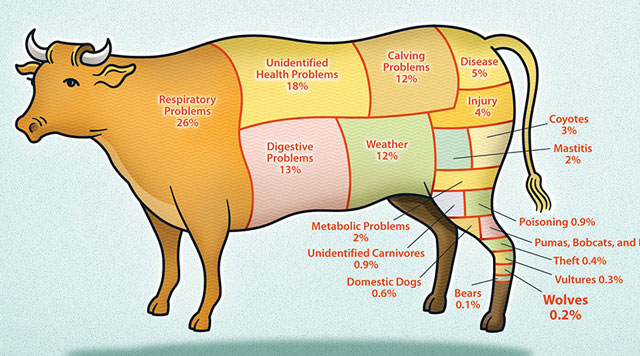
Needless to say, 100% of the cows who survive all of the above are slaughtered and eaten by humans.

Needless to say, 100% of the cows who survive all of the above are slaughtered and eaten by humans.
December 06, 2013
By Chuck Quirmbach
The Department of Natural Resources reports that two grey wolves killed in Wisconsin this week were shot by hunters who used dogs to pursue the wolves.
The wolf deaths happened in Rusk and Washburn counties. The DNR’s Dave MacFarland says hunters registered the wolf kills by phone. MacFarland says it may take a while to learn more details about how the dogs were used during the wolf harvest.
“The hunters are required by the fifth day of the month after harvest – so for these animals, that would be Jan. 5 – to organize a registration meeting with one of the wardens,” says MacFarland. “So the warden registration component of the registration process has not yet occurred for these animals.”
MacFarland says most of the discussions between wolf hunters and DNR wardens happen fairly quickly.
Rachel Tilseth of the animal protection group Wolves of Douglas County says she’d like to hear more details of this week’s wolf deaths, and hear soon.
“I would like to see more wardens out there,” says Tilseth. “I would like to know how many wardens were out there, and I haven’t heard anything on that. Once I find that out, I would like to know if the dogs chewed up the wolf. I want to know the condition of the animal.”
The DNR says it remains committed to enforcing state law, which only allows hunters to use dogs to track the wolves, not fight with them. The DNR says wolf hunters are now 32 short of this season’s quota. The only remaining wolf hunt zone is one in northwest Wisconsin.

by THE ASSOCIATED PRESS and DAILY SUN STAFF
“We can’t, over time, maintain genetic viability in the little area that they have,” said Southwest
Regional Director Benjamin Tuggle.
The agency has proposed expanding the range of the wolves and as a result has reignited passions about whether and where humans should coexist with the predators.
Ranchers and rural families were outraged as the plan was discussed at a public meeting on Tuesday in Pinetop. A similar meeting took place last month in Albuquerque, N.M., where environmentalists spoke in favor of the proposal.
The federal agency hadn’t planned to have any meetings in Arizona but was pressured by politicians to allow Arizonans the chance to speak as well.
Under the current proposed plan, wolves would be allowed to live in forested habitat as far north as Interstate 40. The USFWS is considering removing the gray wolf from the endangered species list nationwide and designating the Mexican gray wolf as a protected subspecies. But it would likely
keep its experimental population designation. That means that if wolves left their designated borders, they would be captured and removed.
However, biologists have identified the Grand Canyon region as some of the last, best territory for wolves. Although few people live in the area, the reintroduction has been blocked in part by hunters who want to protect big game on the North Kaibab.
“It’s up to the U.S. Fish and Wildlife Service to go forward and do their jobs based on the best available science and not the politics of state and federal agencies,” said Emily Nelson of the Grand Canyon Wolf Recovery Project. “We might see the opportunity slip by us if we’re not outspoken about wanting to see wolves in the Grand Canyon.”
The State of Utah has paid hundreds of thousands of dollars to a group called Big Game Forever to
lobby against the lobo and its potential reintroduction to the North Rim. The group was audited at the request of Democratic state legislators after receiving payments of $300,000 the past two years for unspecified lobbying purposes, according to the Salt Lake Tribune. The lobbying group said it was fighting the Mexican gray wolf’s reintroduction, which many in southern Utah fear will quickly migrate into the remote region.
a test of time
The Mexican wolf was reintroduced in 1998. Biologists say there are at least 75 wolves in the wild in the two states. Federal officials believe it’s necessary to make more room for packs — 14 at last count — to squeeze the most from a limited gene pool.
Nelson said that whatever happens with the official reintroduction plan, she’s optimistic about the chances of wolves in northern Arizona.
“I’m always very optimistic that the wolves will come here on their own because the wolves will follow the best habitat and seek out the best places to find mates,” Nelson said. “I think the people of northern Arizona are much more supportive of wolf recovery. Every public poll in Arizona has shown the majority of people support wolf recovery in the Grand Canyon region.”
But many local elected officials from rural areas of the state spoke out against expanded wolf reintroduction at the meeting in Pinetop on Tuesday.
“The sad truth is that the wolves are already here,” Globe Mayor Terry Wheeler said during Tuesday’s meeting.
But if they’re released in Gila County as proposed, he said, wolves will soon be in Scottsdale “munching down on pink Pomeranians.”
Others in the crowd of about 300 people responded with pronouncements of hysteria or “lobophobia” after several people angrily accused the government of endangering children. Biologists said wolves are wild animals requiring caution but they have not attacked anyone since reintroduction began.
Members of the White Mountain Apache and Havasupai tribes spoke for protection. A group of Havasupai elders said they wanted to see wolves inside the Grand Canyon.
The U.S. Fish and Wildlife Service proposes to more than double the area in which captive wolves could be released to 12,500 square miles. The release zone currently is restricted to the southern Apache National Forest, but it would grow north and west to the Payson area, including the full Apache-Sitgreaves National Forest and three ranger districts in the Tonto National Forest. It would also expand east in New Mexico, across Gila National Forest and into Cibola National Forest.
Eric Betz can be reached at 556-2250 or ebetz@azdailysun.com.
The Associated Press contributed to this report.
By Michael Walsh / NEW YORK DAILY NEWS
A missing hiker turned up dead in a national park on Tuesday after the government shutdown forced many rescuers to postpone their search for her.
The body of Jo Elliott-Blakeslee, 63, was found in Craters of the Moon National Monument and Preserve in central Idaho just a mile from where the body of her hiking partner, Amy Linkert, 69, was discovered late last month, park rangers said.
RELATED: GOVERNMENT SHUTDOWN HINDERS HUNT FOR MISSING HIKER
The pair was reported missing Sept. 24, but the federal government shutdown, which went into effect Oct. 1, hindered the search. Unpaid yet undeterred, ten park service rangers continued to look for Elliott-Blakeslee on foot without access to government resources, such as search helicopters, dogs or planes, reported ABC News.
RELATED: SHUTDOWN ENDS: FEDERAL EMPLOYEES RETURN TO WORK, NATIONAL PARKS AND MONUMENTS REOPEN AFTER 16 DAYS
Elliott-Blakeslee’s body was finally located in the lava fields northwest of the Tree Molds Trail during a helicopter search. Authorities are awaiting autopsy results to determine the cause of her death. It is believed that Linkert died of exposure, and she showed signs of dehydration.
Take cover–here comes a wolf-poodle hybrid!
I’m not going to vouch for this source (as you can see by the title and the attitude throughout the article, “badassberry” is pretty much a wacko), but here’s the word from the white-sheet-over-the-face ant-wolf fanatics. Interestingly, he uses the word “murdered” in the title, even though hunters reject when we use it for what they do to non-humans. Italics are added to denote examples of extremist anti-wolf hyperbole …
http://polymontana.com/liberals-wolves-murder-2-women-hikers/
Liberal’s Wolves murder 2 women hikers
December 2, 2013
by Dr. Ed Berry, aka badassberry
Let’s cut the politically correct crap. But for the mentally defective, wolf-loving liberals, these 2 women would still be alive. Against the objections of common sense conservatives, the environmentalist-controlled US Department of Fish and Wildlife forced non-indigenous Canadian Wolves on several states in America.
These wolves have decimated Montana’s elk herds, killed cattle on ranch lands, killed hunting dogs, and now they have killed 2 women who were hiking in Idaho’s Craters of the Moon National Monument.
Now, to protect the liberal agenda for America, government agents are hiding evidence that might clarify the horrific event.
Wolf populations, now far larger than the so-called federally required minimums, have inundated the states of Montana, Idaho, Oregon, and Washington. The feds are still adding wolf populations in Arizona, New Mexico, California, Colorado, Utah, and Texas. Wolves mate with other dog species. Dangerous wolf-hybrids have been sighted in Illinois, Missouri, North Dakota, South Dakota, Ohio, and Pennsylvania.
I recommend the feds put wolves in Golden Gate Park in San Francisco. This is the dominant area of the Sierra Club and other eco groups who are behind the federal placement of the large Canadian wolves in America. Some day, a pack of wolves will devour a Sierra Club hiking group, armed with bear spray useless against wolves.
Rewriting the rules on wolf hunting, trapping
13 hours ago • By Mike Ferguson
Through Dec. 20, Montanans can weigh in on proposed rule changes that will give landowners more latitude in killing a wolf that threatens their livestock or their pet — and doing so without a hunting license.
By video conference Tuesday evening, the Montana Department of Fish, Wildlife and Parks took comments and answered questions on the proposed changes from three sites — Billings, Helena and Great Falls.
The department is charged with writing the rules to implement Senate Bill 200, which was passed during the most recent legislative session. The new law allows landowners to kill a wolf if it’s a “potential threat” to human safety, livestock or dogs. Current law requires the wolf be in the act of attacking, threatening or killing livestock before the wolf can be killed.
The landowner or his/her agent must notify the department when a taking occurs and must preserve the carcass of the wolf.
In addition, the law lowers the cost of a nonresident wolf license from $350 to $50. Montana residents pay $19.
Quentin Kujala, the department’s wildlife bureau coordinator, said the rulemaking process to implement SB 200 has trimmed language and eliminated redundancies in existing rules. Under the new law, the same process will continue to apply when a landowner kills a wolf that’s threatening livestock, people or pets, he said. That rule requires the U.S. Department of Agriculture’s Wildlife Services to investigate the taking, and that the taking be reported to Fish, Wildlife and Parks.
The state’s wolf population has been on the rise in recent years. Montana’s most recent wolf count released last spring showed 147 verified packs consisting of 625 wolves. Thirty-seven of the packs had confirmed breeding pairs.
Two Helena residents who attended the video conference said they have concerns with the proposed rules.
Jonathan Matthews said bite marks on livestock don’t necessarily equate to predation and said “scientific precision” is being removed under the new rules.
“I like the fact … that we are not regarding wolves as vermin that should be shot almost without consideration,” he said. Wolves are wildlife, he noted, “and should be treated with respect like other wildlife.”
Sarah Sadowski said she doesn’t support “folks taking measures into their own hands.” She said she’d rather landowners be required to obtain a permit and to contact the department “before making a kill.”
To read the proposed revisions, visit fwp.mt.gov/news/publicNotices/armRules/pn_0143.html.
Send comments to: Fish, Wildlife and Parks Wildlife Division, P.O. Box 200701, Helena MT 59620-0701. Or email comments to fwpwld@mt.gov.
http://www.leadertelegram.com/news/daily_updates/article_fc4bbdbc-5c3d-11e3-963d-001a4bcf887a.html
MADISON (AP) — Traps have apparently become wolf hunters’ weapon of choice in Wisconsin.
New state Department of Natural Resources data shows hunters used traps to capture 174 of the 216 wolves taken between the wolf season’s Oct. 15 opener and Nov. 30. Hunters shot 41 wolves with a gun and killed one wolf with a bow.
Monday marked the first day of the season hunters could use dogs to chase down wolves. DNR large carnivore specialist Dave MacFarland said no hunters using dogs had registered any wolves as of Monday afternoon.
All but one of the state’s six wolf hunting zones have closed after hunters reached their kill limits in the areas. Hunters were 37 animals shy of their kill limit in the last open zone as of Tuesday morning.
http://wuwm.com/post/dogs-enter-wisconsin-wolf-hunt-monday
by Susan Bence
Wisconsin’s second wolf hunt reaches a turning point December 2. Licensed hunters can now use up to six dogs to help track wolves. Wisconsin is the only state to allow the practice. Some celebrate the rules and others take to court.
Lucas Withrow started hunting with his dad years ago. Hunting with dogs runs deep in their family tradition. Today, Withrow raises and trains more than a dozen dogs on his property in Brodhead.
“I have a kennel of 15 hounds. Three or four dogs that I use on coyotes, and that’s all I run them on and the rest are pretty much a mix of bear and coon hounds. “
Hunting bear is Withrow’s passion.
Eight years ago, he joined the Wisconsin Bear Hunters Association and now represents the group on the DNR’s wolf advisory committee. Withrow says dogs will serve a valuable function in helping manage the state’s wolf population.
“The function would be to make sure that we use and utilize all opportunities to harvest the quotas that we are responsible for harvesting to help keep the population stable and healthy,” and Withrow adds, “it’s something else that we can enjoy with our dogs.”
Withrow rebuts criticism that the practice subjects dogs to potential violent injury or death.
“From my perspective, I would tell you a dog introduced into the woods with the intention of chasing of wolf, that’s part of the responsibility of assuming the hunt. When you assume the responsibility for pursuing the wolf, you assume the responsibility for what can happen.”
“Allowing dogs to get torn up by wolves for the enjoyment of their owners, seeking to pursue wolves in this fashion, violates animal cruelty law,” Jodi Habush Sinykin says.
She is a Milwaukee attorney and represents a collection of humane societies, conservation groups and what she calls, “mainstream hunters.” She successfully took the issue to court. Sinykin argued that the DNR failed to write rules to protect hounds used in hunting wolves.
At least during Wisconsin’s inaugural wolf hunt in 2012 – a judge issued an injunction against the use of dogs. The lawsuit now rests in the hands of the state court of appeals. Sinykin has been awaiting a decision for weeks.
“Without intervention from the Court of Appeals starting December 2, dogs will be used by their owners with the known risks of what transpires when dogs who are unleashed and unprotected and at significant distances from their handlers encroach on wolf territory,” explains Sinykin. “And as we know from 25 years of depredation payments is that dogs are maimed and killed by wolves.”
For those years, hunting wolves was illegal in Wisconsin because their numbers were scarce. During that time, if a wolf killed a dog, the state reimbursed the owner.
Now that wolves have shifted to ‘hunt and trap status’, the state will not compensate hunters, if their hounds are killed during the chase.
We may not find out how many dogs are killed during the hunt. The DNR wants hunters to report dog casualties, but they are not required to do so.
The season will end on February 28 or when hunters take the state quota of 251.


By Tim Skubick | Politics Columnist for MLive.com
on December 03, 2013
If those who want to stop the next wolf hunt in Michigan fail, Walt Disney may be to blame.
One of the leaders of the Protect the Wolves coalition concedes the public’s view of wolves is based on “a lot of misinformation.”
Maybe it started at a tender young age with the reading of the classic, “The Three Little Pigs,” featuring none other than the “Big Bad Wolf.” Talk about a sinister label.
Jill Fritz in her pitch to protect the BBW does use that reference because she claims it’s wrong.
She argues the attitude that “wolves are snarling and stalking people and being very aggressive,” is not accurate. “That’s not consistent” she counters, because they are “shy animals and elusive.”
Hence the need for an image re-do. “There does need to be a lot of public education leading up to the election about wolf behavior,” she asserts.
So can we expect to see the three little pigs in an ad welcoming Mr. Wolf into their brick house via the front door and not the chimney?
The movement probably won’t go there but as they gather petition signatures to place the issue before you, they will have to find a message to soften the image.
It’s not that Michigan voters are unsympathetic to animals. They voted overwhelmingly to stop the killing of doves, but you don’t need to be Mort Neff (anybody remember him?) to realize the difference between a tiny dove and a mean-looking wolf.
The petition drive, of course, resulted when state lawmakers voted to render a previous petition drive null and void, even thought the pro-wolf lobby was this close to blocking a wolf hunting season.
Ms. Fritz contends many citizens were offended by the end-run by legislators, which is providing fuel for the petition drive fires.
“They are upset,” she explains while refusing to disclose how many signatures they have in hand.
Yet here comes another effort to mute this petition drive. The Citizens for Professional Wild Life Management are set to launch their own counter-petition drive to allow the state to control hunting seasons. So it’s possible voters will face dueling ballot questions next year, one to protect the wolves and another to render that amendment useless.
Then perhaps we can identify who is really afraid of the big bad wolf.
Watch “Off the Record with Tim Skubick” online anytime at video.wkar.org
Compass: Denali wolves need a buffer of state land
By MARYBETH HOLLEMAN December 2, 2013
The recent news that wolf sightings by visitors to Denali National Park this past summer were the lowest on record is disheartening but not surprising. This is precisely what many scientists warned would happen in 2010, when the Alaska Board of Game eliminated the small no-take wolf buffer on state lands east of the national park.
And it is precisely what Gordon Haber, whose research on Denali’s wolves spanned 43 years, concluded: hunting and trapping of park wolves on these state lands often kills the alphas of the family group, thus causing the entire group to fragment and disintegrate–resulting in fewer park wolves, and fewer park visitors seeing wolves.
Along with Yellowstone National Park, Denali had been known as one of the best places in the world to view wild wolves, but no longer. Over 400,000 visitors come to Denali each summer–many of them Alaskans–contributing over $140 million to our state’s economy. Many cite their desire to see wolves as a primary reason for visiting the park. As Denali superintendent Don Striker says, seeing wolves in the wild is an “amazing, oftentimes transformative experience” for park visitors.
But when park wolves range across the park’s eastern boundary following the winter migration of prey, they’re killed by hunters and trappers. The three most-often-seen wolf family groups in Denali have been decimated by losses here, and visitor viewing success has consequently suffered.
Recognizing the economic value of wolf viewing in Denali, from 2000-2010 the state closed some of these lands to wolf take. But, as Haber warned, this small buffer wasn’t sufficient; in some winters, as many as nineteen park wolves were killed east of the buffer – 15 percent of the total park wolf population.
This prompted many organizations, including the Park Service, to propose at the 2010 meeting of the Alaska Board of Game–just a few months after Haber’s untimely death in a research flight crash–that the inadequate buffer be expanded. Instead, the Board eliminated the buffer and passed a moratorium on considering the issue again until 2016. Many predicted this would accelerate the already precipitous decline in park wolf numbers and viewing success–and it has.
Today, the numbers of wolves within the six-million-acre national park and preserve has declined from 143 in fall 2007 to just 55 in spring 2013 – a drop of more than half in six years. And, since the state removed the buffer in 2010, wolf-viewing success for the park’s 400,000 annual visitors has plummeted: from 44 percent in 2010 to just 4 percent in 2013. This downward spiral in wildlife viewing success may be unprecedented in the history of the entire national park system.
As Gordon Haber concluded, it’s not how many wolves killed, it’s which wolves are killed. In 2012, the last breeding Grant Creek female, from the park’s most-viewed family group, was trapped in the former buffer. The death of this one wolf left the survivors with no pups that spring, whereupon they abandoned their den site and fragmented, shrinking from fifteen to three wolves. Rather than visitors witnessing the fifteen-member family group attending new pups at the den site, they saw nearly none. Viewing success dropped by 50 percent that summer alone–all from the loss of one wolf.
Last week, in a letter to U.S. Secretary of Interior Jewell and Gov. Parnell, a coalition of Alaska citizens and organizations proposed a “win-win” solution: that the state transfer a permanent no-take wildlife buffer conservation easement east of the national park, in exchange for the federal government transferring a like-valued easement, or purchase value, to the State of Alaska.
This would fix the problem. It would allow Alaskans and visitors a better chance of seeing wild wolves, and would sustain and grow Denali’s valuable wildlife viewing economy for generations of Alaskans to come. Let’s hope the Governor and Interior Secretary can get together and solve this issue once and for all.
_______________
Alaska writer Marybeth Holleman is co-author with the late Gordon Haber of “Among Wolves: Gordon Haber’s insights into Alaska’s most misunderstood animal.”
Read more here: http://www.adn.com/2013/12/02/3207873/compass-denali-wolves-need-a-buffer.html#storylink=cpy
 Exposing the Big Game