People using pest control glue traps face up to a year in prison

Craig MeighanWednesday 24 June 2026 05:55 EDT

Bookmark popover

Removed from bookmarksClose popover

A rat glue trap
A rat glue trap (Humane World for Animals UK)

Your support helps us to tell the story

Support Now

From reproductive rights to climate change to Big Tech, The Independent is on the ground when the story is developing. Whether it’s investigating the financials of Elon Musk’s pro-Trump PAC or producing our latest documentary, ‘The A Word’, which shines a light on the American women fighting for reproductive rights, we know how important it is to parse out the facts from the messaging.

At such a critical moment in US history, we need reporters on the ground. Your donation allows us to keep sending journalists to speak to both sides of the story.

The Independent is trusted by Americans across the entire political spectrum. And unlike many other quality news outlets, we choose not to lock Americans out of our reporting and analysis with paywalls. We believe quality journalism should be available to everyone, paid for by those who can afford it.Your support makes all the difference.Read more

People found using glue traps in Scotland could face severe penalties, including up to a year in prison, as a nationwide ban on the pest control method comes into effect next month.

Described by the Scottish Government as “indiscriminate and cruel”, these devices are criticised for their inability to differentiate between target pests and other creatures.

Any animal coming into contact with the traps risks becoming ensnared, leading to prolonged distress or even death for non-target species such as songbirds.

From July 1, the use, supply, or possession of glue traps will constitute a criminal offence, carrying potential fines of up to £40,000 or a maximum of 12 months imprisonment. This follows the recent passing of the Wildlife Management and Muirburn (Scotland) Act 2024.

The implementation of this ban was delayed by two years due to the UK Government’s Internal Market Act 2020, which generally mandates that goods lawfully sold in one part of the UK must be available across the entire nation. Scottish ministers successfully sought an exemption for glue traps from these internal market rules, paving the way for the prohibition to proceed.

RECOMMENDED

Newly-elected MP Lara Bird accused of faking accent after oath allegiance row

Daughter of famous director found dead in car alongside husband

How To Drain Lymph Fluid In Ankles & Legs? It’s SimpleMovingoo|

Sponsored

Washington Launches New Rule for Cars Used Less Than 50 Miles/dayBindright|

Sponsored

Powered by Taboola

A grass snake in Cornwall had to be freed by the RSPCA from a glue trap
A grass snake in Cornwall had to be freed by the RSPCA from a glue trap (RSPCA)

Jim Fairlie, minister for agriculture and connectivity, said: “Glue traps are indiscriminate and cruel.

“They have no place in a Scotland that takes its responsibilities to wildlife and animal welfare seriously.

“This ban sends a clear message that we will not tolerate methods that cause unnecessary suffering.

“Now that the legal barriers put in place by the UK Government’s Internal Market Act which delayed this ban have been resolved, we can move forward with confidence, knowing we have the tools to enforce it fully.”

The ban applies to vertebrate animals, with invertebrates not being covered by the legislation.

The offences will also apply to anyone who knowingly causes or permits another person to use or supply a glue trap.

What’s the risk of humans getting sick from bird flu? | The Extinction Chronicles

Australia reports second H5N1 bird flu case in migratory seabird

By Reuters

Australia reports second H5N1 bird flu case in migratory seabird | Reuters

June 21, 20268:45 PM PDTUpdated 11 hours ago

SYDNEY, June 22 (Reuters) – Australia reported a second case of highly pathogenic H5N1 bird flu in ​Western Australia on Monday, after confirming its first over the ‌weekend, as the government vowed to rein in the spread of the virus.

A migratory seabird known as a northern giant petrel found sick on a remote ​beach tested positive, Agriculture Minister Julie Collins said, after a brown ​skua case on Saturday. Both birds were found near ⁠the coastal town of Esperance, about 570 km (350 miles) southeast of ​the state capital of Perth.

Keep up with the latest medical breakthroughs and healthcare trends with the Reuters Health Rounds newsletter. Sign up here.

Advertisement · Scroll to continue

“We’re working very closely with both the chicken, ​meat and the egg poultry system and industries to do everything that we can do and improve biosecurity, and those systems and those areas to stop it ​from getting into those production systems,” Collins said.

“Can we do that ​forever? We don’t know the answer to that, that is a hypothetical,” she added.

Illustration shows test tubes labelled "Bird Flu" words

Human ‌infections ⁠remain rare, but the global spread of avian influenza has devastated flocks, disrupted supplies and pushed up food prices in recent years.

Until now, Australia had been the only continent without a confirmed mainland case, though ​the virus was ​detected in late ⁠2025 on the sub-Antarctic territory of Heard Island.

Advertisement · Scroll to continue

In its efforts to tackle bird flu, Australia has tightened ​farm biosecurity, increased testing of shorebirds, vaccinated vulnerable species ​and conducted ⁠response simulations.

Poultry producer Inghams (ING.AX), opens new tab said it would move to a complete lockdown as a precaution across all farms and processing sites in Western Australia.

“There ⁠has ​been no detection in commercial poultry, which ​includes Ingham’s operations and its supply chain,” Inghams said in a statement.

Advertisement · Scroll to continue

Reporting by Christine Chen ​and Renju Jose in Sydney; Editing by Alasdair Pal and Himani Sarkar

Bycatch has ‘shocking’ toll on British marine life, first-ever analysis reveals

Conservationists say cherished creatures such as whales, dolphins and seabirds are being killed in large numbers by fishing tackle

Bycatch has ‘shocking’ toll on British marine life, first-ever analysis reveals | Marine life | The Guardian

Seascape: the state of our oceans is supported by

theguardian.org

About this content

Karen McVeighWed 10 Jun 2026 00.00 EDTShare

Prefer the Guardian on Google

Thousands of Britain’s most charismatic and protected marine wildlife, including whales, porpoises, dolphins, seals and seabirds are being killed as “collateral damage” by fishing vessels every year, according to the first-ever analysis of bycatch data.

The analysis, by the Wildlife and Countryside Link, a coalition of voluntary conservation groups, reveals the devastating toll bycatch, the accidental capture and killing of non-target species by fishing vessels, is having on marine species.

The “shocking” scale of annual deaths in the report, Hidden in the haul: The true scale of bycatch is likely to be “the tip of the iceberg”, it said, as only a fraction of the UK fishing fleet monitor bycatch. Only 0.05% of dredging vessels monitor this. They, like the bottom trawlers exposed in the recent David Attenborough film Oceans, drag heavy gear across the sea floor and are known for doing damage to marine life on the sea bed. Non-UK vessels operating in UK waters were not included in the data.

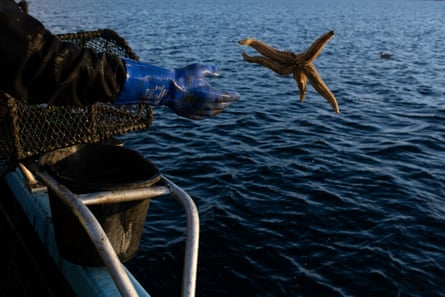
A starfish is returned to the sea
A starfish is returned to the sea off the coast of Kyleakin, Scotland. Any small amounts of bycatch are tossed back into the loch when caught by creel fisheries and the vast majority of it survives the process. Photograph: Emily Whitney/AP

The deaths estimated in the report, which were extrapolated from datasets on bycatch and discard numbers, were more than 1,000 harbour porpoises and common dolphins killed annually, 10,000 seabirds and 500 seals. Six humpback whales and 30 minke whales were also found dead in Scottish creel ropes. Over 1,000 endangered Atlantic salmon and 120 tonnes of protected sharks, skates and rays are also caught and killed as bycatch by commercial fishing vessel every year.

Richard Benwell, the chief executive of Wildlife and Countryside Link, said most of the deaths were avoidable by using a range of mitigation measures. He called on the government in England to deliver promised action on bycatch of protected species.

“From razorbills and dolphins to endangered salmon and sharks, the scale of destruction exposed in this report is shocking, with animals dying in awful and unnecessary ways.”

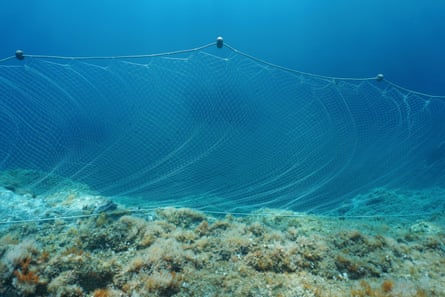
In English waters, the use of gillnets, a type of static net that hangs like a curtain in the water, is the highest risk for seabird bycatch. Birds including puffins, gannets and razorbills get caught and drown when they dive for food. Gillnets cause 400,000 seabird deaths globally, according to research by BirdLife International.

Gillnets are the highest risk for seabird catch.
Gillnets are the highest risk for seabird catch. Photograph: Seaphotoart/Alamy

Benwell said: “The government mustn’t let these terrible losses continue. To protect marine wildlife, Ministers must finally deliver strong bycatch action plans, backed by strict mandatory monitoring and enforcement, before more wildlife is pushed closer to extinction.”

“We need to support fishers to move to more modern methods and not cause collateral damage.”

Cetaceans dying as bycatch is a key reason the UK is failing to meet its legal obligations to achieve good environmental status in some British seas, the report found.

Ruth Williams, head of marine conservation at the Wildlife Trusts, said: “For many in the fishing industry, bycatch is a distressing and unwanted outcome – these species are critical to the health of our seas, and their deaths will have serious consequences on marine ecosystems.”

Successive governments have failed to address this “silent and largely unseen” crisis, Williams said.

The coalition is also calling on the government to require remote electronic monitoring on all fishing vessels operating in English waters, including small vessels under 10 metres that it said are responsible for a large proportion of bycatch.

While the study covered deaths in UK waters, the recommendations are largely targeted at the UK government in England, drawing on the expertise of WCL’s English members, the report said.

It highlighted solutions already employed by UK fishers. Small-scale fishers in Filey Bay, Yorkshire, near the UK’s largest mainland colony of seabirds, worked with conservationists to reduce annual bycatch from 700 seabirds to four or five by trying new methods, including heavier nets. In Scotland, where research found most whale entanglements were caused by floating ropes between creels, trials of weighted creel ropes have shown success in reducing the risk of whales becoming entangled.

A Defra spokesperson said:“This government is committed to restoring our oceans to good health and we are taking action to reduce the bycatch of marine species.”

“Our flagship programme, Clean Catch, uses electronic monitoring to collect bycatch data and evaluate the effectiveness of mitigation measures, and our new Seabird Bycatch Action Plan will look to reduce seabird deaths in and around English waters.”