Bird flu arrives in Southwest after millions of birds die

Bird Flu Arizona FILE – A bird lands on the top of the net behind home plate during a spring training baseball game between the Colorado Rockies and the Milwaukee Brewers Wednesday, March 24, 2021, in Phoenix. Arizona officials have confirmed the first cases in the Southwest of a bird flu that has led to the deaths of 37 million birds from commercial farms in the central and eastern U.S. (AP Photo/Ashley Landis, File) (Ashley Landis)

https://www.wokv.com/news/bird-flu-arrives/T7VHO3EKQA5FINDU65UZWTDDAY/

By BOB CHRISTIEJune 09, 2022 at 8:41 pm EDT

PHOENIX — (AP) — Arizona officials have confirmed the first cases in the Southwest of a bird flu that has led to the deaths of 37 million birds from commercial farms in the central and eastern U.S.

The disease was spotted after tests by federal wildlife officials in three wild cormorants that had been found dead in a park in the Phoenix suburb of Scottsdale, Arizona Game and Fish officials announced this week.

The disease has not yet been found in any domestic birds or in commercial operations, the agency said.

But it is a concern, according to Glenn Hickman, president and CEO of Hickman Family Farms, one of the largest egg producers in the Southwest. Hickman operates four chicken ranches in Arizona, one in California and two in Colorado.

The company has stopped any visits to its farms and doublechecked its biosecurity program, which is designed to prevent its approximately 2 million chickens from being infected. Its chickens are kept in barns that are secured so that wild birds can’t enter, and any people or tools that enter are disinfected.

The company dodged a scare recently when the avian flu was found in a flock 3 miles (4.8 kilometers) from one of its Colorado farms, Hickman said Thursday. And while he’s concerned about the Scottsdale find, its not anywhere near as concerning as if a nearby commercial operation had an outbreak.

“Those are a lot scarier because the massive amount of virus that is potentially produced when you have a large population is much more than the relatively small amount of virus per bird in the wild bird population,” he said. None of his farms were affected.

Arizona Game and Fish officials have been closely monitoring for the disease, which had been no closer than Colorado before this week’s announcement, by responding to all calls of dead birds.

Anne Justice-Allen, the department’s wildlife veterinarian, said calls from the public alerted her agency to the dead cormorants, water-loving birds that often nest in groups. The three juveniles had fallen out of their nests and were spotted dead by morning walkers in the park, who called wildlife officials.

“It’s a good thing they did,” Justice-Allen said, because they were able to collect the birds and test them before park workers removed them.

“We had a high suspicion that it was something that we do not normally see,” Justice-Allen said. “We have resident cormorants in the area, and we do not normally see mortality events in them.”

Justice-Allen said a major concern is backyard flocks of chickens, which are allowed in parts of metro Phoenix. The disease has been found in many homeowner flocks across the country.

Bird owners should watch for symptoms like birds not eating or lethargy, runny noses, seizures or diarrhea, she said. Anyone seeing those symptoms should call the state Department of Agriculture.

The first U.S. detection of the new strain of highly contagious avian flu in domestic poultry was in February in Indiana. More than 37 million birds have been killed to prevent the infection from spreading since then.

As of June 3, it had been detected in wild birds in 40 states, but not in California, Arizona, Nevada or New Mexico. Commercial flocks in 19 states have been infected.

Once an infection is found, the birds won’t recover and are killed to prevent spreading the illness, Justice-Allen said.

The outbreak has not only killed domestic fowl. It has also had a heavy toll on bald eagles and other wild bird species, much more so than the nation’s last bird flu outbreak detected in 2014. That outbreak cost more than 50 million domestic poultry.

Hickman said egg producers are so far making up for lost production from outbreaks affecting flocks this year.

“I think I can speak pretty firmly that regardless of how many birds that have been affected and depopulated, there are still eggs on every shelf in every grocery store in America,” Hickman said.

6 reasons for doctors to prescribe plant-based diets, from weight loss to lowering blood pressure

Gabby Landsverk 

Jun 9, 2022, 9:17 AM

https://www.insider.com/health-reasons-to-try-plant-based-diet-doctors-say-2022-6

what is a vegan diet
A vegan diet consists entirely of plant-based foods 
  • Plant-based diets can help address a variety of health issues, according to a new expert commentary. 
  • Eating more plants and less animal products may help manage weight and blood sugar. 
  • Nutrients in plants can also help prevent chronic illnesses like cancer and heart disease. 

Over 3 million people read Morning Brew  ; you should too!Email address

By clicking ‘Sign up’, you agree to receive marketing emails from Insider as well as other partner offers and accept our Terms of Service and Privacy Policy.

https://af8a8a26f7a65e8907af02c08337e857.safeframe.googlesyndication.com/safeframe/1-0-38/html/container.html

A plant-based diet might help improve health by managing weight and preventing illness, and doctors should take note, according to a commentary published May 26 in the American Journal of Lifestyle Medicine. 

Doctors with the Physicians Committee for Responsible Medicine, a nonprofit organization of health experts advocating for vegan diets, wrote in the commentary that medical experts should be more aware of the evidence-based benefits of diets rich in plant foods like greens, beans, fruits, and nuts. 

Plant-based diets may be especially helpful for six common health concerns, research suggests, ranging from cancer and cognitive decline to weight management and stable blood sugar. 

Low-calorie plant foods may aid weight loss

Eating a mostly vegan diet could help you maintain a healthy weight, according to the commentary. The authors cite a 2013 study of more than 70,000 people which found vegans tended to weigh nearly 10 pounds less, on average, than their omnivorous peers. 

https://af8a8a26f7a65e8907af02c08337e857.safeframe.googlesyndication.com/safeframe/1-0-38/html/container.html

Diets rich in plants may make it easier to maintain a lower weight because plant foods tend to be lower in calories than processed foods or animal products. Switching to a plant-based diet can help people lose weight, too — a 2022 study found vegan diet led to weight loss in 12 weeks, compared to either a Mediterranean diet or participants’ typical eating habits. 

Vegan diets may also help with weight loss by feeding the gut microbiome, beneficial bacteria in your digestive system, with plenty of fiber, according to a 2019 study. Fiber may also help you feel full for longer after eating, according to dietitians. 

Fiber in plant foods could help prevent cancer, too

Fiber is an important nutrient for long-term health and disease prevention, according to the commentary, and plant-based diets have been linked to lower risk of breast cancer, colorectal cancer, and prostate cancer. 

Adding more vegetables, fruits, and grains may also prevent cancer by increasing your intake of antioxidants, micronutrients that help reduce inflammation and stress on the cells. 

Plant-based diets may reduce diabetes risk

Plant based diets are also linked to significantly lower risk of diabetes, according to the commentary, and fiber likely plays a role. 

Fiber slows the digestion and absorption of glucose as your body breaks down carbohydrates for energy, which helps prevent dips and spikes in blood sugar, dietitians previously told Insider. 

As a result, plant foods may also help people who have diabetes manage their blood sugar too, research suggests. 

Nutrient-dense plants could protect brain health as you age

The vitamins, minerals, and micronutrients in plant foods could also stave off cognitive decline, evidence suggests. A 2020 study found that combined with other healthy lifestyle factors, eating more vegetables, grains, and legumes was linked to significantly lower risk of Alzheimer’s disease. 

https://af8a8a26f7a65e8907af02c08337e857.safeframe.googlesyndication.com/safeframe/1-0-38/html/container.html

As a result, plant-based diets should be recommended to fight Alzheimer’s and other forms of dementia, according to the commentary.

Cutting out cholesterol on a plant-based diet is heart-healthy

A wealth of evidence suggests eating plants is great for your heart by adding beneficial foods and reducing foods like meat linked to heart disease. 

Studies show vegetarians and vegans have significantly lower risk of heart attacks and similar issues than omnivores. 

Plant foods tend to be low in cholesterol and saturated fat, both of which have been linked to risks for heart health. 

Some evidence suggests plant-based diets are linked to lower risk of COVID complications

More research is needed, but the health benefits of eating plants may be protective against the pandemic, according to the commentary. Healthy plant-based diets were linked to significantly lower risk of severe coronavirus infection, one 2021 study found.

KEEP READING

HEALTH

Forget keto: The carnivore diet is the next big thing for people looking to cut out carbs and processed foods. No one knows the long-term health outcomes.More: HealthScienceNutritionDiet

Cumberland Abandons Plan to Trap ‘Nuisance’ Beavers Because State Law Requires They Be Killed, Not Relocated

Exposing the Big Game's avatarCommittee to Abolish Sport Hunting Blog

By Colleen Cronin/ ecoRI News staff

June 8, 2022

Share

Cumberland officials recently scrapped a plan to trap beavers. (istock)

CUMBERLAND, R.I. — A town plan to trap “nuisance” beavers to reduce the flooding they cause has been halted after a town official learned the captured animals would be killed.

Mayor Jeff Mutter said the town stopped trapping beavers after a newsarticleon the plan was published May 19, and he became aware the beavers would be killed and not relocated.

“We suspended the activity the very next day,” Mutter said. He explained that at the time of approving the action, he didn’t realize state law required trapped beavers be killed unless they were released back into the same area.

“I should have been aware,” he said. When the article was published, two individuals reached out to him about the lethal action, and the trapping was immediately…

View original post 516 more words

Here are all the changes to Louisiana hunting, fishing licenses that took effect this month

Exposing the Big Game's avatarCommittee to Abolish Sport Hunting Blog

1of 3

BR.wildartchasingrainbows.012220 TS 241.jpg (zac)

Zachary’s Mo Vo tends several rods set out with baits Tuesday, Jan. 21, 2020 on the pond at BREC’s Burbank Park, after the pond was stocked earlier that morning with approximately 400 pounds of rainbow trout. Stocking at seven community ponds across the state was done as part of the Louisiana Dept. of Wildlife and Fisheries’ ‘Get Out and Fish!’ program. The six other parks included Lafayette’s Girard Park (200 pounds), Walker’s Sidney Hutchinson Park (200 pounds), Hammond’s Zemurray Park (300 pounds), New Orleans’ Joe W. Brown Park (500 pounds), Jennings’ Oil & Gas Park (500 pounds) and Youngsville’s Southside Regional Park (200 pounds). An additional 2,100 pounds of trout were stocked in other ponds throughout the state Tuesday. The fish, which are frequently disoriented after the trip to a new…

View original post 732 more words

Thai man gets 2.5 years in prison for hunting gun made from shovels

Exposing the Big Game's avatarCommittee to Abolish Sport Hunting Blog

06/08/2022 09:49 PM

https://www.facebook.com/v3.1/plugins/like.php?action=like&app_id=524202197752727&channel=https%3A%2F%2Fstaticxx.facebook.com%2Fx%2Fconnect%2Fxd_arbiter%2F%3Fversion%3D46%23cb%3Df20dcbbc1b29114%26domain%3Dfocustaiwan.tw%26is_canvas%3Dfalse%26origin%3Dhttps%253A%252F%252Ffocustaiwan.tw%252Ff1ada4ffeabb5e%26relation%3Dparent.parent&container_width=0&href=https%3A%2F%2Ffocustaiwan.tw%2Fsociety%2F202206080021&layout=button_count&locale=en_US&sdk=joey&share=false&size=large&width=

Listen

Photo courtesy of Taichung City Police Department
Photo courtesy of Taichung City Police Department’s Dajia Precinct

Taichung, June 8 (CNA) A Thai man handed a two-and-a-half-year prison sentence for constructing a homemade firearm from old shovels, scrap metal, and pipes said he made the weapon in order to hunt for food, according to the Taichung District Court Wednesday.

According to the verdict issued by the court, the man, a migrant worker from Thailand, was arrested on Sept. 7, 2021, after authorities found him shooting birds by an embankment in Taichung’s Da’an District.

Police then confiscated the man’s homemade firearm, as well as gunpowder, and metal pellets he was using as ammunition.

The verdict said that the worker had assembled the firearm from shovels, discarded metal pieces, and pipes in his dormitory.

In his defense, the man said he had been using the weapon to hunt for food, with his lawyer citing the…

View original post 90 more words

Department of the Interior Proposes Proposes Expanding Conservation Technique as Climate Change Threatens Greater Species Extinction

Exposing the Big Game's avatarCommittee to Abolish Sport Hunting Blog

A graphic of light blue waves on a blue background

Image Details

PRESS RELEASE

Department of the Interior Proposes Expanding Conservation Technique as Climate Change Threatens Greater Species Extinction

Jun 6, 2022

Media Contactshttps://www.fws.gov/press-release/2022-06/department-interior-proposes-proposes-expanding-conservation-technique

Public Affairs HQ

In the first Endangered Species Act (ESA) interpretive rule produced under the Biden-Harris administration, the U.S. Fish and Wildlife Service is proposing to revisesection 10(j) regulationsunder the ESA to better facilitate recovery by allowing for the introduction of listed species to suitable habitats outside of their historical ranges. The proposed change will help improve the conservation and recovery of imperiled ESA-listed species in the coming decades, as growing impacts fromclimate changeandinvasive speciescause habitats within their historical ranges to shift and become unsuitable.

Reintroducing species of plants and animals back into areas where they have disappeared has been a regularly used technique in wildlife conservation for decades, and federal agencies were authorized by Congress to create experimental populations to aid in that…

View original post 638 more words

SARS-CoV-2 is a generalist virus, infecting and evolving in numerous mammals and humans

https://www.news-medical.net/news/20220608/SARS-CoV-2-is-a-generalist-virus-infecting-and-evolving-in-numerous-mammals-and-humans.aspx

By Shanet Susan AlexJun 8 2022Reviewed by Danielle Ellis, B.Sc.

In a recent article published in the bioRxiv* preprint server, researchers illustrated zooanthroponotic severe acute respiratory syndrome coronavirus 2 (SARS-CoV-2) transmission and viral mutations specific to hosts.

Study: Zooanthroponotic transmission of SARS-CoV-2 and host-specific viral mutations revealed by genome-wide phylogenetic analysis. Image Credit: Gallinago_media / Shutterstock

Background

Coronaviruses, including SARS-CoV-2, can potentially infect an array of animal hosts. Although the ancestral SARS-CoV-2 animal reservoir is unknown, it has near relatives in bats. Further, an ancestor SARS-CoV-2 variant probably spread to humans through an intermediary animal host in Wuhan, China, in a seafood market.

SARS-CoV-2 is a generalist virus that infects and evolves in multiple mammals, such as companion and captive animals, humans, and wild animals. Transmission across non-human species increases the chance of SARS-CoV-2 reservoirs forming, making eradication more challenging, and offers the virus with possibilities of novel evolutionary pathways, like the emergence of new mutant lineages and the selection of adaptive mutations.

Numerous studies demonstrated that SARS-CoV-2 transmits from humans to specific animal species and, in certain instances, backward to humans. However, despite the fact that these case reports have been helpful in identifying patterns of coronavirus disease 2019 (COVID-19) transmission and adaptability among particular animal species, a worldwide, systematic analysis of the present data is lacking.

About the study

In the current work, the researchers thoroughly investigated SARS-CoV-2 transmission among mammalian species, both human and non-human, to uncover mutations linked with each species using phylogenetic analyses and publicly accessible viral genome sequences. 

Utilizing a large dataset, the team systematically examined SARS-CoV-2 sequences generated from animal hosts. They used the Global Initiative on Sharing All Influenza Data (GISAID) to retrieve all existing SARS-CoV-2 genomic sequences obtained from non-human animals.

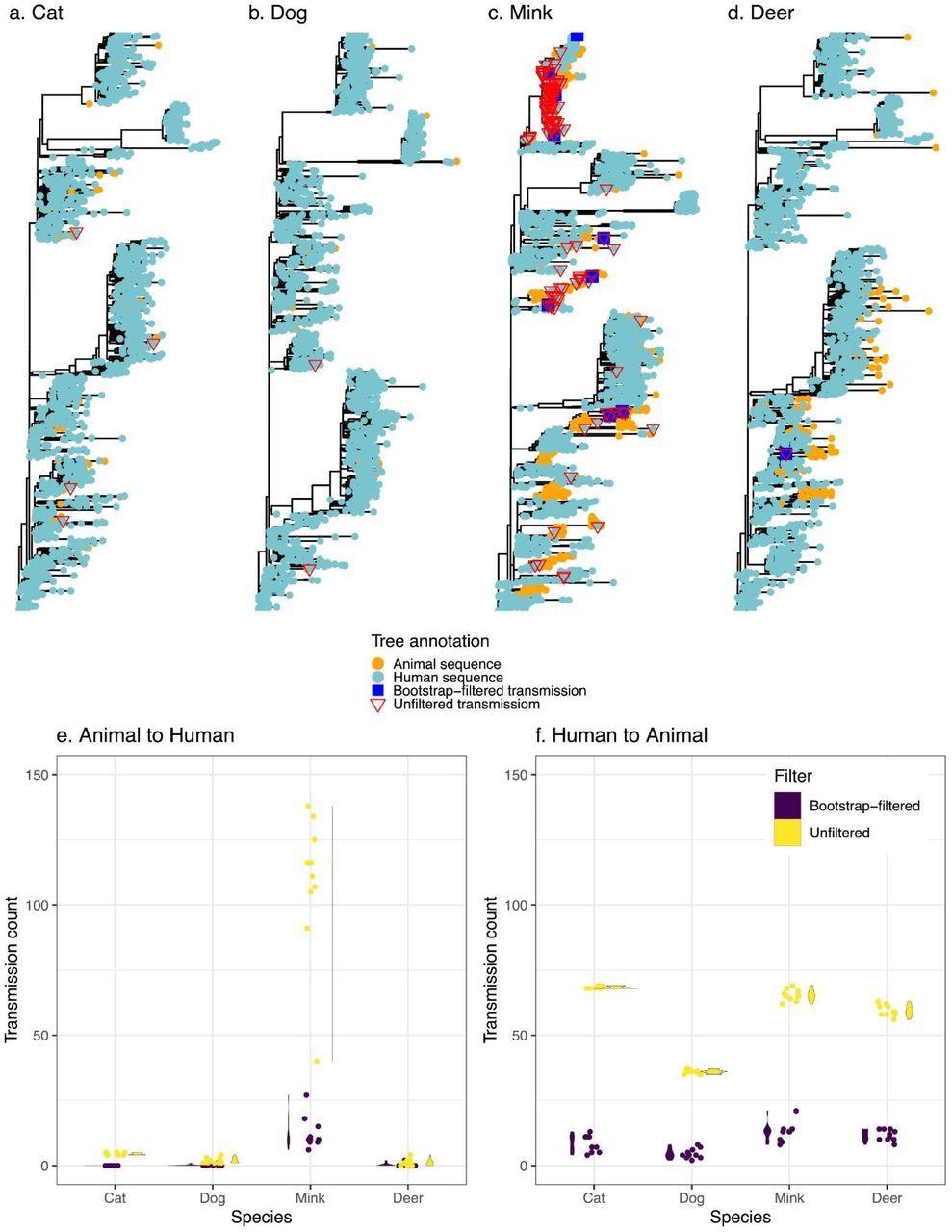
Transmission events inferred between humans and animals. Panels a-d display a representative tree for every species with animal to human transmissions marked on the tree. Trees are rooted with the Wuhan reference genome. Panels e and f display the distribution (violin plots alongside points plotted with jitter to avoid overlap) of inferred transmission counts (across 10 replicate trees) in each animal species, in both bootstrap-filtered and unfiltered trees.

Transmission events inferred between humans and animals. Panels a-d display a representative tree for every species with animal to human transmissions marked on the tree. Trees are rooted with the Wuhan reference genome. Panels e and f display the distribution (violin plots alongside points plotted with jitter to avoid overlap) of inferred transmission counts (across 10 replicate trees) in each animal species, in both bootstrap-filtered and unfiltered trees.

The scientists estimated the relative frequencies of transmission among humans and four other often afflicted animals (Felis catus domesticus (cats), Canis lupus familaris (dogs), Odocoileus virginianus (deer), and minks) using phylogenetic approaches. They employed ancestral state restoration on viral phylogenetic trees to thoroughly explore the probable animal-to-human transmission incidents, including the transmission direction. The team’s goal was to develop a uniform comparative methodology for interspecies transmission rather than extrapolate absolute frequencies of cross-species transmission of COVID-19.

Related Stories

The investigators used genome-wide association studies (GWAS) to investigate mutations linked to specific animal species relative to humans. They used POUTINE, a technique that implicitly regulates population structure and interconnection between mutations by addressing just homoplasic mutations that are similar by state and not by descent, which occurs independently numerous times within the phylogeny for conducting GWAS. Besides, the researchers performed a GWAS separately to discover variants correlated with each species.

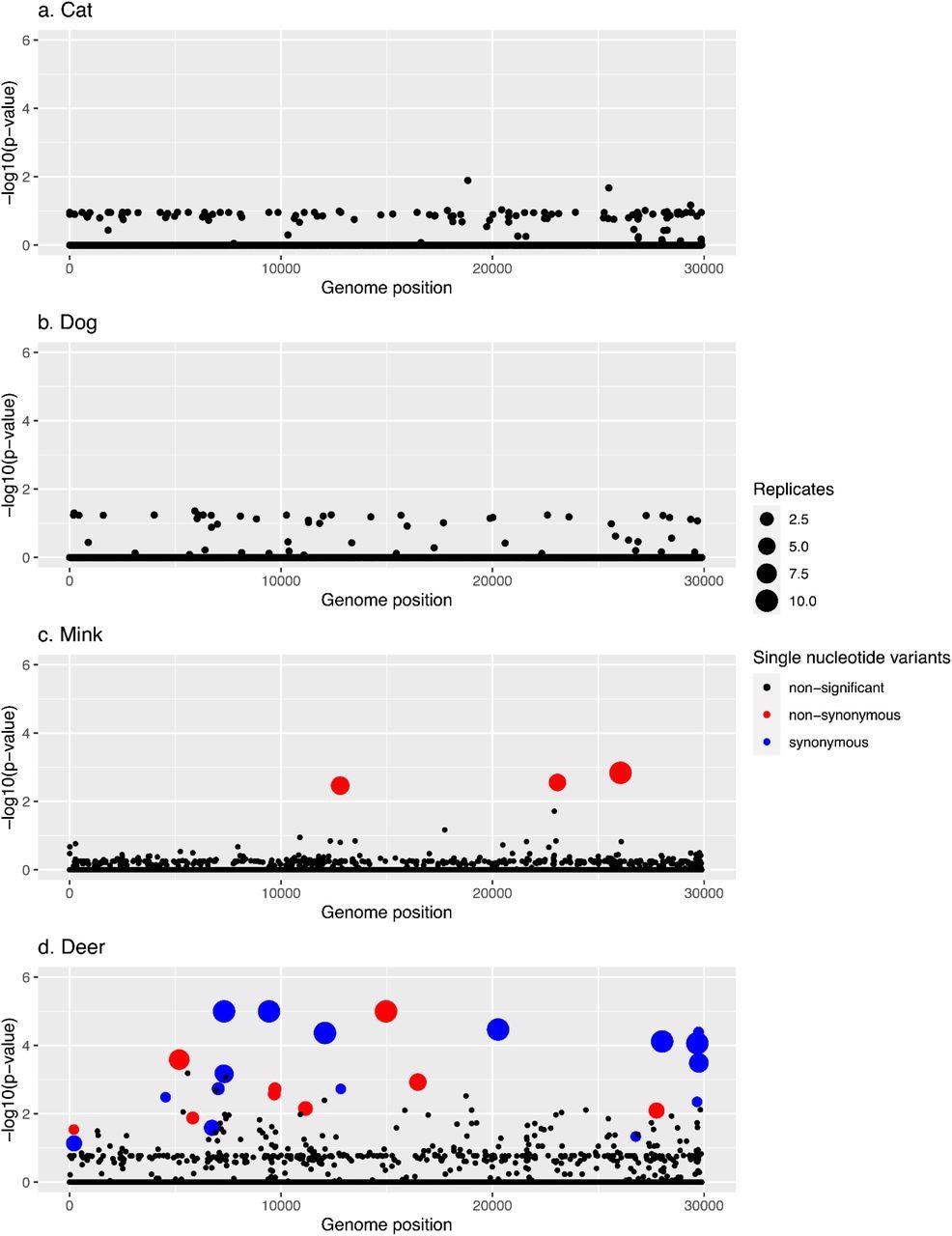
Manhattan plots summarizing GWAS hits in each animal species. In every panel, the x-axis represents the nucleotide position in the SARS-CoV-2 reference genome and the y-axis represents the -log10 of the pointwise p-values averaged over replicates. Statistically significant hits with family-wise corrected p-values of lower than 0.05 are shown in red (non-synonymous) or blue (synonymous), while non-statistically significant p-values are in black.

Manhattan plots summarizing GWAS hits in each animal species. In every panel, the x-axis represents the nucleotide position in the SARS-CoV-2 reference genome and the y-axis represents the -log10 of the pointwise p-values averaged over replicates. Statistically significant hits with family-wise corrected p-values of lower than 0.05 are shown in red (non-synonymous) or blue (synonymous), while non-statistically significant p-values are in black.

Results

The authors discovered that mink had the highest rate of animal-to-human SARS-CoV-2 transmission, agreeing with previous literature. On the contrary, the other examined species like dogs, cats, and deer had insignificant levels of SARS-CoV-2 transmission to humans. However, despite these findings, the possibility of SARS-CoV-2  transmission from cats or dogs to people cannot be ruled out, which could be more easily discovered with prospective household transmission research or deeper sampling. 

The transmission of SARS-CoV-2 from humans to animals was consistent across species, and the slight discrepancies might be due to different sampling approaches. Although potential sampling biases may restrict predicted transmission events, the present findings serve as a valuable baseline for future research.

The team recovered the N501T mutation priorly linked with mink and two additional amino acid variations in other SARS-CoV-2 genes. They also discovered several unique deer mutations, including non-synonymous and synonymous substitutions. None of the single nucleotide variants (SNVs) were substantially linked with dogs or cats in GWAS, while 26 SNVs closely correlated with deer and three with mink. 

Indeed, one of the three hits in minks appears in all 10 replicates, and at least 50% of the replicates harbored the remaining two. The three mutations, including N501T, were non-synonymous. Further, seven of the 26 hits in deer appeared in all 10 replicates, and five of them were present in at least 50% of the runs. Five of the 26 hits were intergenic mutations, whereas 12 were synonymous mutations. Additionally, 21 of the hits were cysteine (C)>uracil (U) transition mutations.

Conclusions

Together, the study findings uncovered a significant frequency of mink-to-human COVID-19 transfer incidents, while animal-to-human COVID-19 transmission from dogs, cats, and deer was uncommon. The team noted that future investigations should look into the SNVs strongly correlated with deer and minks to see if they harbor a function in variable pathogenesis, immune evasion, or modification of the host response.

The current findings support prolonged deer-to-deer COVID-19 transmission and emphasize the necessity of researching animal-related SARS-CoV-2 mutations to determine their potential influence on animal and human health. From accessible genomic sequences, the present work offers a quantitative methodology for monitoring COVID-19 transmission between animals and identifies numerous possible animal-adaptive mutations for further investigation.

*Important notice

bioRxiv publishes preliminary scientific reports that are not peer-reviewed and, therefore, should not be regarded as conclusive, guide clinical practice/health-related behavior, or treated as established information.

We Are Not Ready for Monkeypox

Exposing the Big Game's avatarThe Extinction Chronicles

We still don’t know if monkeypox will be the next pandemic, but we’re already fucking it up like we did with COVID.

By

Beth Skwarecki

Yesterday 4:30PM

https://lifehacker.com/we-are-not-ready-for-monkeypox-1849035126

Comments (30)

Alerts

Photo:Pablo Blazquez Dominguez(Getty Images)

Monkeypox is here, and it’sspreading. The couple of dozen cases in a few countries thatwe told you about last monthare now up to over a thousand cases worldwide, with 35 reported in the United States. But the U.S. almost certainly has more cases than the statistics suggest, and there is reason to suspect that we’re already fucking up the response to the epidemic in some ways that will feel uncomfortably familiar.

We aren’t testing enough

For the first few months of the COVID pandemic, when we had the chance to contain the virus if only we could locate all the cases and their contacts, testing was woefully inadequate. Plenty of people who had…

View original post 1,164 more words