San Francisco D.A. sues fisherman for nearly $1 million for ‘egregious’ illegal crabbing

Exposing the Big Game's avatarCommittee to Abolish Sport Hunting Blog

Fresh Dungeness crabs fill a tank

BYCHRISTIAN MARTINEZSTAFF WRITER

MAY 31, 2022 1:44 PM PT

https://www.latimes.com/california/story/2022-05-31/san-francisco-d-a-sues-fisherman-for-nearly-1-million-for-egregious-illegal-crabbing

The San Francisco district attorney’s office filed a lawsuit last week against a man accused of trapping nearly 300 Dungeness crabs in protected waters.

Tam Van Tran, a licensed commercial fisherman, allegedly set more than 90 traps in protected waters near the Farallon Islands off the coast of San Francisco, officials said. The D.A.’s office seeks nearly $1 million in fines against Tran.

Prosecutors called the illegal fishing “the most egregious case of unlawful crabbing activity in San Francisco’s history, as well as the largest incident of documented unlawful commercial crabbing in any Marine Protected Area in California.”

The Farallon Islands are part of a state marine reserve, the most protected category of waters under the state’s Marine Life Protection Act, through which “the taking of any marine resource is prohibited by law,” prosecutors wrote in the complaint filed…

View original post 297 more words

‘It’s neocolonialism’: campaign to ban UK imports of hunting trophies condemned

Exposing the Big Game's avatarCommittee to Abolish Sport Hunting Blog

African delegation says proposed new law ignores local voices and could harm rather than save wildlife

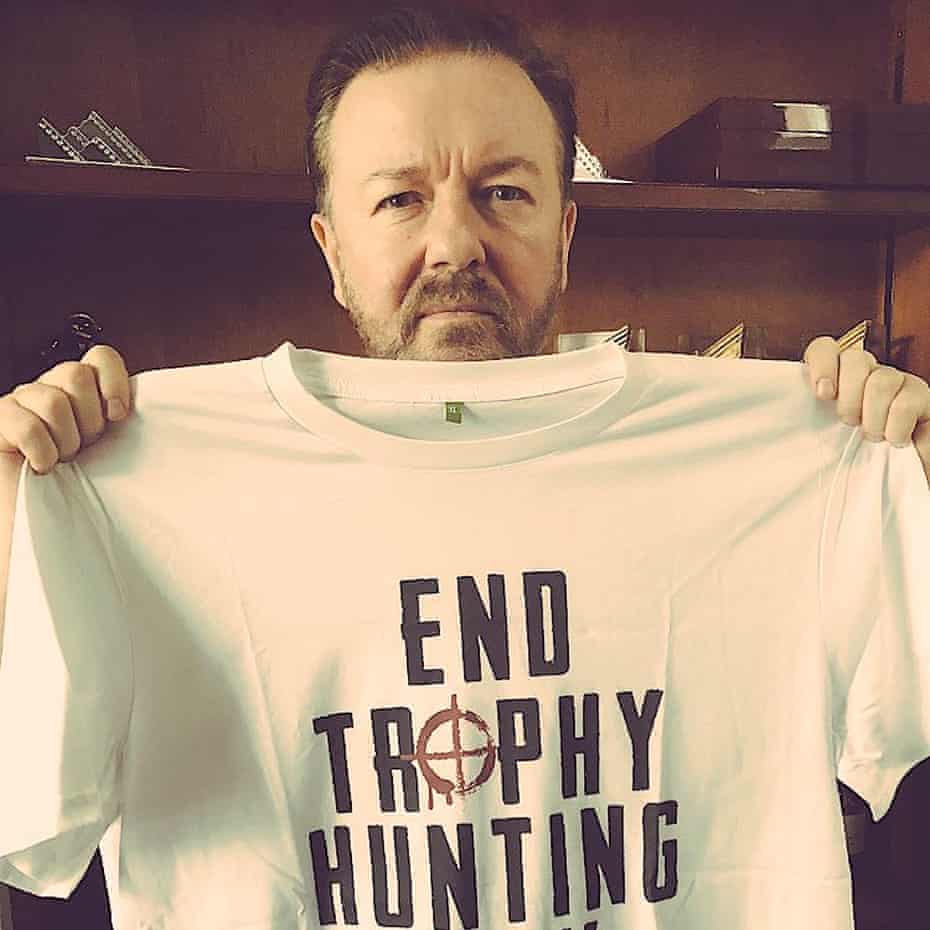
Celebrities including Ricky Gervais have spoken out in support of bans on trophy hunting.
Celebrities including Ricky Gervais have spoken out in support of a ban on trophy hunting.Photograph: Ricky Gervais/Twitter

The age of extinction is supported by

theguardian.org

About this content

Patrick Greenfield

@pgreenfielduk

Wed 1 Jun 2022 01.00 EDT

Britain’s international environment minister, Zac Goldsmith, and celebrity anti-trophy campaigners likeRicky Gervaishave been accused of neocolonialism by African community leaders, who warn they are ignoring the voices of people who live alongside elephants, lions and other wildlife.

The UK government is expected to bring forwarda ban on the import of hunting trophiesduring this parliament, arguing that the new law will strengthen the conservation of endangered species.

With widespread support from the British public, and an anti-trophy hunting campaign backed bycelebrities includingGervais, Brian May, Ed Sheeran and Joanna Lumley, a ban would be…

View original post 811 more words

4 hostile alien civilizations may lurk in the Milky Way, a new study suggests

Exposing the Big Game's avatarThe Extinction Chronicles

Brandon Specktor-Yesterday 8:17 AM

React734 Comments|783

The Milky Way is home to millions of potentially habitable planets — and approximately four of them may harbor evil alien civilizations that would invade Earth if they could, new research posted to the preprint database arXiv suggests.

©Provided by Live Scienceartist’s impression of an alien spaceship near Earth

The new paper, which has not yet been peer-reviewed, poses a peculiar question: What are the odds that humans could one day contact a hostile alien civilization that’s capable of invading our planet?

You’ll Never Believe The Features Of This $49 Smart Watch

AdTopgadgetWorld

To answer this, sole study author Alberto Caballero — a doctoral student in conflict resolution at the University of Vigo in Spain — began by looking back at human history before looking out to the stars.

“This paper attempts to provide an estimation of the prevalence of…

View original post 741 more words

World War 3 Has Started, Says Russian TV as Ukraine Called a ‘Rehearsal’

Exposing the Big Game's avatarThe Extinction Chronicles

Gerrard Kaonga – 6h ago

React|228

Russia’s state TV host and guests have said that World War 3 has started and noted Ukraine could be just the beginning of a potentially larger conflict with the West.

©Alexander Nemenov/Getty ImagesRussian President Vladimir Putin attends a meeting of the leaders of the Collective Security Treaty Organization (CSTO) member states at the Kremlin in Moscow on May 16, 2022. World War 3 has started, says Russian TV as Ukraine called a ‘rehearsal’.

The Daily Beast‘s Julia Davis shared a video Wednesday of a political scientist, commentators, politicians and the Russian state TV host speaking about the conflict between Ukraine and Russia.

“Russian propagandists and government officials look beyond Ukraine and threaten the collective West on Kremlin-controlled state television: ‘WWIII had started.’ ‘Expect us,'” she wroteon Twitter as she shared the video.

While the guests and the host make these claims…

View original post 466 more words

WHO can’t rule out monkeypox pandemic risk, says there’s a window of opportunity to stop outbreak

Exposing the Big Game's avatarThe Extinction Chronicles

PUBLISHED MON, MAY 30 202210:53 AM EDTUPDATED 4 HOURS AGO

https://www.cnbc.com/2022/05/30/monkeypox-who-says-there-is-a-window-of-opportunity-to-limit-outbreak.html

Karen Gilchrist@_KARENGILCHRIST

SHAREShare Article via FacebookShare Article via TwitterShare Article via LinkedInShare Article via Email

KEY POINTS

  • The WHO said Monday it is too soon to tell whether a recent monkeypox outbreak could lead to a global pandemic, but noted that there is a “window” of opportunity to curb rising cases.
  • The public health body said there are “still many unknowns” related to the spike in cases in non-endemic countries, but said the risks to the general public remain low.
  • “We don’t want people to panic or be afraid and think that it’s like Covid,” the WHO’s Sylvie Briand said during a briefing.

The World Health Organization has said that there is a "window" of opportunity to contain a recent monkeypox outbreak which has seen cases spread across Europe, the U.S. and Australia.

The World Health Organization has said that there is a “window” of opportunity to contain a recent monkeypox outbreak which has seen cases spread across Europe, the U.S. and Australia.

Nurphoto | Nurphoto | Getty…

View original post 603 more words

California fisherman sued in ‘egregious’ crabbing case

Investigators said they found over 90 crab traps within the ecologically fragile area off Northern California, where fishing of any kind is prohibited.

Share

https://www.kcra.com/article/california-fisherman-sued-in-egregious-crabbing-case/40145264#

AP

Updated: 2:09 PM PDT May 30, 2022Infinite Scroll Enabled

FILE - A tank is filled with fresh Dungeness crab on Fisherman's Wharf, Nov. 16, 2016, in San Francisco. A California fisherman allegedly caught hundreds of Dungeness crabs illegally in the protected North Farallon Islands State Marine Reserve. That's according to a lawsuit filed last Friday, May, 28,2022, by the San Francisco District Attorney's Office. (AP Photo/Eric Risberg, File)

FILE – A tank is filled with fresh Dungeness crab on Fisherman's Wharf, Nov. 16, 2016, in San Francisco. A California fisherman allegedly caught hundreds of Dungeness crabs illegally in the protected North Farallon Islands State Marine Reserve. That's according to a lawsuit filed last Friday, May, 28,2022, by the San Francisco District Attorney's Office. (AP Photo/Eric Risberg, File) 

SOURCE: Eric Risberg

GET LOCAL BREAKING NEWS ALERTS

The latest breaking updates, delivered straight to your email inbox.Your Email AddressSUBMITPrivacy Notice

SAN FRANCISCO —

A California fisherman illegally caught hundreds of Dungeness crabs in the protected North Farallon Islands State Marine Reserve, according to a lawsuit filed last week by the San Francisco District Attorney’s Office.

State Department of Fish and Wildlife investigators said they found over 90 crab traps within the ecologically fragile area off Northern California, where fishing of any kind is prohibited.

https://a5fbeb5af0b3fc559ae2975bccfa01da.safeframe.googlesyndication.com/safeframe/1-0-38/html/container.html

Advertisement

“Our officers received an anonymous tip from a commercial fisherman who said he saw another fisherman’s crab traps in the Marine Protected Area. He was concerned that this fisherman’s illegal activities would put other law-abiding fisherman in a bad light,” Fish and Wildlife Assistant Chief Eric Kord said in a statement.

More than 250 Dungeness crabs from those traps were released back into the ocean, the agency said.

| Video below | Dungeness crab season off most of California to end earlyPlay Video

Tags and buoys on the traps were traced back to the Pacific Mist, a boat owned by commercial fisherman and Vallejo resident Tam Van Tran, SF Gate reported Sunday. Efforts by The Associated Press to find contact information for Tran on Monday and seek comment about the lawsuit were unsuccessful.

The district attorney’s lawsuit alleges Tran gained an unfair business advantage by illegally fishing in a Marine Protected Area. It is a misdemeanor for commercial fishing operations to work in protected areas, punishable fines ranging from $5,000 to $40,000 for a first offense, SF Gate said.

“Upon information and belief, this is the most egregious case of unlawful crabbing activity in San Francisco’s history, as well as the largest incident of unlawful commercial crabbing in any Marine Protected Area in the entire State of California,” the lawsuit said.

The Farallons, a small collection of islands about 30 miles (48 kilometers) off San Francisco, holds one of largest bird nesting sites along the North American coast. Whales and sea turtles also pass through the area, and crab traps threaten to entangle them.

In order to protect the islands, they are completely closed to the public.

Bird Flu – a new threat to Scottish seabirds

Yvonne M

Yvonne M

27 May 2022

Paul Walton gives an update on the worrying bird flu threat to Scottish seabirds and outlines action needed to protect our precious wildlife.

The loss, to a deadly new strain of Avian Influenza, of 1/3 of the entire Solway barnacle goose population last winter was an unprecedented tragedy. It took us into uncharted territory regarding Highly Pathogenic Avian Influenza (HPAI) and wild birds. RSPB Scotland staff, with the help of our supporters, reacted quickly and effectively. Since then, we have been watching wetlands, coasts, and other areas where wild birds gather, for signs of any further impacts.

A dead barnacle goose at Mersehead. Image: RSPB Scotland

Seabirds have now become the focus of concern. Late last summer, sick and dead great skuas were found in Shetland, Orkney, the Flannan Isles and St Kilda. Corpses tested positive for HPAI. This happened just prior to migration – the species winters off North and West Africa – so the scale of impact on the population was unclear. Now the skuas, are back and RSPB Scotland is collating data from colonies to assess impacts – but an unexpected and worrying finding is that great skuas are again sick and dying from HPAI. Scotland supports around 60% of the entire world population of this species.

We have also seen HPAI being confirmed in other seabirds, including guillemots, gulls and, more recently, gannets.

Three factors make this development highly significant.

  1. Scotland’s seabird populations are of major global significance.
  2. They are already under massive pressure from human impacts including climate change, lack of prey fish, deaths through entanglement in fishing gear (known as by-catch) and development pressure – the index of 11 breeding seabirds in Scotland has declined by almost half since the 1986.
  3. Many seabirds breed in dense colonies, now risking rapid and devastating spread of HPAI viral infection.

Whilst Avian Influenza circulates in wild birds quite normally, and has for millennia, the new strain of HPAI is a more recent issue and hitting already struggling bird populations. It originated in intensive poultry operations in East Asia, and has now spread into wild birds by two mechanisms: the movement of poultry, poultry products and associated vehicles and equipment; and through the movements and migrations of wild bird populations. It is now recognised by the United Nations  that “Wild birds are victims of HPAI viruses.”

Given the major uncertainties about this new and emerging threat to wildlife, RSPB Scotland is urging the Scottish Government to do all it can to alleviate additional pressures on wild birds affected by HPAI in line with UN recommendations. We are in discussions regarding the development of a national HPAI in Wild Birds Response Plan. This should establish effective HPAI surveillance; biosecurity to safeguard wild bird populations; virus testing and carcass collection; minimising of human disturbance during local outbreaks; coordination with HPAI measures for poultry, gamebird rearing and captive flocks.

These are clear and immediate imperatives. But the most important message is that we must immediately elevate the political priority and funding directed towards the effective conservation of our wild bird species. There is a great deal that we can do for seabirds given the political will: a programme of ecosystem restoration for seabird islands and a lasting biosecurity legacy; an end to fishing for key seabird food species like sandeels; effective monitoring and constructive collaboration with fishing businesses to reduce seabird deaths from by-catch in fishing gear; the provision and maintenance of secure seabird breeding sites and ensuring that the imminent expansion of marine renewables, necessary to help tackle the climate emergency, minimises further harm to nature, and only happens in parallel with measures that restore nature.

If Scotland makes these a reality now, we will build resilience into our seabird populations, making them better able to cope with new human pressures like HPAI. The forthcoming Scottish Biodiversity Strategy and Seabird Conservation Strategy must move beyond rhetoric and deliver real actions at pace that result in positive impacts for our precious wildlife.

Although the risk of contracting the disease from a wild bird is very low, we recommend that people do not handle sick or dead wild birds, remain vigilant, and report dead seabirds, wild waterfowl (swans, geese or ducks), or birds of prey to the UK government Defra helpline (03459 33 55 77). Everyone, at all times but especially now, should take care to maintain good hygiene when feeding garden birds – regularly cleaning feeders outside with mild disinfectant, removing old bird-food, and spacing-out feeders as much as possible.

Main image: Great skua by Andy Hay (rspb-images.com)

Thousands of birds dying as avian flu runs riot among seabird colonies

Exposing the Big Game's avatarThe Extinction Chronicles

Ornithologist ‘extremely worried’ as there is nothing they can do to stop the flu from spreading

Hans J Marter

31 May 2022 16:43

372Shares https://www.shetnews.co.uk/2022/05/31/thousands-of-birds-dying-as-avian-flu-runs-riot-among-seabird-colonies/

A dead gannet washed up on a Shetland beach. Photo: Shetland Seabird Tours

AT LEAST 1,000 dead gannets have so far been recorded in the waters around the famous Hermaness sea bird colonies as avian flu runs riot in Shetland’s wild bird populations.

Meanwhile hundreds of great skuas (bonxies) have been found dead or dying mainly in Foula, Fair Isle, the south tip of Shetland and again at Hermaness in what has been described as unprecedented turn of events.

It comes after a case of highly pathogenic avian influenza (H5N1) in poultry was confirmed in Whalsay on Monday with environmental health officers visiting the island today (Tuesday) to help identify other cases.

A protection zone centred on the area in the southwest of the island…

View original post 682 more words

Rhino poacher jailed for 28 years

Exposing the Big Game's avatarCommittee to Abolish Sport Hunting Blog

30 May 2022 |Shadley Nash

Rhino poacher jailed for 28 years

File

A 45-year-old man has been jailed for 28 years after being found guilty of rhino poaching in a KwaZulu Natal.

https://www.algoafm.co.za/domestic/rhino-poacher-jailed-for-28-years

The National Prosecuting Authority said it welcomed the sentence imposed on Michael Masuku in the Empangeni Regional Court on Monday.

He was convicted of conspiracy to hunt rhino, two counts of hunting and killing a protected species, and one count of hunting without a permit.

NPA regional spokesperson, Natasha Kara Ramkisson, said the incident took place in the Hluhluwe Umfolozi Game reserve, in October 2018.

She said Masuku had conspired with another man to go into the game reserve where two rhinos were killed.

Ramkisson said they removed two horns from one animal and one from the other before fleeing the reserve. She said Masuku was arrested shortly afterward.

She said during the trial a state witness gave evidence tying him to…

View original post 29 more words

Stupid turkeys? Scientists say that the unfairly maligned bird may actually be stuffed with smarts

Despite their reputation, turkeys are highly intelligent birds with unique, under-appreciated evolutionary quirks

By MATTHEW ROZSA

PUBLISHED NOVEMBER 25, 2021 7:30PM (EST)

https://www.salon.com/2021/11/25/turkeys-actually-smart/

Turkey with a graduation cap (Photo illustration by Salon/Getty Images)Turkey with a graduation cap (Photo illustration by Salon/Getty Images)

Facebook

148TwitterReddit83Email

save

There is an old myth about turkeys that never seems to die. The basic premise is this: Every time there is a rainstorm, turkeys will turn their heads upward out of curiosity to observe the drops as they fall. Because they are reputed to be unintelligent, the folk tale says the turkeys will remain in this position even after it has become difficult to breath. Eventually, the turkeys will drown. The moral, it seems, is that turkeys are literally too dumb to survive.

While there is exactly zero scientific evidence supporting this belief, it underscores the larger cultural stereotype that turkeys are not very bright. It is hard to blame anyone for reaching this conclusion: Turkeys are, admittedly, a ridiculous-looking (and sounding) animal, with their necks pressed against their bodies, their ungraceful gaits and their “gobble gobble”-sounding cluck.

Yet if you want to feel less guilty about chowing down on a juicy gravy-covered drumstick on Thanksgiving, you can’t use the premise of turkey stupidity to do so. The science makes it clear that turkeys are actually pretty smart.

Advertisement:

“Turkeys probably can’t do multivariable calculus or explain string theory, but then neither can most people I know (me included),” Christopher Elphick, an ornithologist at the University of Connecticut, told Salon by email. “At one level, any organism that can survive and thrive in a constantly changing environment that they have little control over, as turkeys often do, must be doing something right.”

Elphick’s observation about surviving and thriving while one’s environment changes is crucial. When measuring intelligence, cognitive scientists emphasize an organism’s ability to effective adapt to its surroundings, not human-centric activities like reading a book or solving an algebraic equation. In other words, it is a mistake to dismiss turkeys as “stupid” because they can’t do tasks that humans must perform — but it would be rational to draw that conclusion if, for instance, they did indeed drown themselves whenever it rained. Yet turkeys have proved quite adept at surviving amid changing conditions, perhaps more so than a bipedal species that is currently overheating the planet.

Advertisement:

https://imasdk.googleapis.com/js/core/bridge3.517.2_en.html#goog_2019880820

How author Patricia Cornwell builds a mystery from a simple detailProgress Bar

00:54 / 04:08

Volume Bar

Alan Krakauer from the University of California–Davis expressed a similar point about turkeys’ versatility.

“Turkeys may not have the problem solving skills of crows and ravens, but I’m reluctant to call them stupid,” Krakauer wrote to Salon. “They can survive in all sorts of habitats, including cities, and make use of a huge range of different types of food. They have to do all this while navigating a complex social world. Turkey hunters will be quick to tell you how wary they can be during hunting season.”

That said, if you’ve ever seen a squashed turkey as roadkill, you’ll know that turkeys struggle with manmade environmental changes completely outside their sphere of understanding. This speaks not to “stupidity,” but the simple fact that wild turkeys had no reason to ever need to comprehend something as complex as traffic.

Of course, domesticated turkeys aren’t necessarily more intelligent for the experience. As Krakauer put it, there is a “night and day” difference between wild and domesticated turkey intelligence. Wild turkeys live in large ranges where older birds teach the younger ones how to flourish with a wild, unfettered lifestyle. Domesticated turkeys, by contrast, are stuffed into crowded quarters and bred to be docile.

Advertisement:

“Many of the early wild turkey management projects failed because they used genetically wild turkeys that were raised on farms and then released, and these weren’t able to gain enough survival skills to make it,” Krakauer recalled. “Wildlife biologists realized they had to catch already savvy wild adults and move them so the new stock would have those wild behaviors to pass along.”


Want more health and science stories in your inbox? Subscribe to Salon’s weekly newsletter The Vulgar Scientist.


One of those wild behaviors is the ability to form complex social structures. In this respect, wild turkeys are not dissimilar from humans. They both crave interactions and approval from other members of their species, and they rely on building teams in order to achieve immediate day-to-day needs.

These traits are not limited to merely forming rudimentary groups; turkeys have sophisticated social structures that they rigorously enforce.

“Males and females form separate flocks during the non-breeding season,” Elphick explained. “Within these flocks there are well defined social hierarchies – usually pretty stable in the female flocks, less so in the male flocks.” Elphick noted that this hierarchical behavior in poultry is where humans get the concept of a “pecking order.”

Advertisement:

Turkeys seem to embrace their various roles based not just on their relevant physical characteristic (size, speed, and so on), but also on their “personalities.” As Elphick pointed out, researchers are finding more and more evidence that individuals in various bird species have “personalities” of their own. As one example, some individuals in a species will be more or less likely to take risks, such as visiting a bird feeder when a human being is close by.

“Turkeys can certainly learn that it is safe to come in to feeders, and I have friends who have birds show up at a regular time every day as though they are ready to have the feeders filled – a sign of intelligence,” Elphick observed.

Krakauer also gave an example of turkey intelligence that involves a characteristic one does not usually associate with birds — putting one’s immediate self-interest aside in favor of the long view. Reflecting on male turkey behavior during mating season, Krakauer described how turkeys who are brothers or half-brothers “sometimes form teams to cooperatively court and defend females.” Their strategy is to make sure that a turkey hen breeds with a victorious member of their group; even though only one of them gets to breed, “the others benefit by passing on more of their genes through their successful brother than they would if they tried to go it alone.”

Advertisement:

Does this mean that one shouldn’t eat turkeys during Thanksgiving? Obviously this is a matter of personal preference — Krakauer said that he still enjoys eating turkey, while Elphick is a vegetarian — but, at the very least, it is illogical to do so on the grounds that turkeys are somehow too stupid to have lives that even matter. As Ingrid Newkirk, president of People for the Ethical Treatment of Animals, wrote to Salon, “wild turkeys are smart enough to find their way, to avoid many predators, to diligently protect their brood, to find food in the forest, and can fly up to 55 miles per hour and run up to 25 miles per hour. They haven’t a house with plumbing but they keep themselves impeccably clean by taking dust baths and preening their feathers meticulously.”

In other words, turkeys are definitely more complex than the Thanksgiving-friendly stereotype would want you to admit.