YAKIMA, Wash. — KAPP-KVEW’s Emily Goodell spoke with Staci Lehman, Communications Manager for the Washington Department of Fish and Wildlife (WDFW), regarding a goose that’s been spotted near Randall Park in Yakima with a dart stuck in its neck. While this may be jarring for Yakima parkgoers who spot the bird, Lehman and the WDFW crew thinks the animal is better off without interference.
The following is a transcript of Lehman’s conversation with Goodell, our Yakima Bureau Chief.
(Photo of the Yakima Dart Goose provided by Stacy Melton)
Can you tell me about the situation?
“We started receiving calls from the public about – it’s been almost two weeks ago now – regarding a goose at Randall Park that had a blow dart through its neck. People were very concerned, you know, which is understandable, absolutely. I have a biologist who has responded and he’s been monitoring the goose throughout this time. What we’re finding is that it is still moving around, it’s eating, it’s flying, it’s drinking water. So at this point, we do not plan to capture it or do anything like that and remove the dart because as long as wildlife are still functioning normally on their own, it’s usually easier on them to let them continue doing what they’re doing than try to trap them and sedate them which is very hard on animals, and then remove the dart. So as long as it’s functioning well, then we’ll continue to monitor and let it do its thing. We understand that’s hard for members of the public to see, especially in a park like Randall Park is very busy. So we have received many calls. But it is the most responsible course of action at this time. If we do notice that the goose is going downhill, we may try to capture it, which is also it’s hard to capture a wild goose, by the way. They do fly when you try to get near them, so that’s a challenge. So if we do notice that it’s going downhill, though, or it’s deteriorating, we will decide what the next course of action is. And that may involve a wildlife rehabbers.”
Is this a bigger problem or isolated incident?
“There’s a rumor that there may be a duck in the area with a similar situation, but nobody has really confirmed that so I don’t know for sure. But other than that, we get occasional calls, turkeys, wild turkeys with an arrow in them or this or that it’s not uncommon to tell you the truth, which is unfortunate, you know, in the case of a turkey with an arrow, it’s generally a hunting incident where the hunter didn’t finish the job. In the case of this blow dart, you know, who knows, but we do discourage that, you know, please don’t hurt our wildlife.”
Was it an accident?
“It’s hard to say you know, maybe it was kids messing around in a park. Either way, probably a park is not the safest workplace to be using a blow dart in general. And we do ask people if they know anything about this incident or any incidents where wildlife is being harassed, they report them to us. We have a you people can email report poaching@dfw.wa.gov or they can call 877-933-9847 if they see anything like this happening, or they have information on and it doesn’t have to be just poaching it can be any kind of harassment or injury to an animal.”
Is this a local goose?
“It’s hard to speculate on that but it is with a group of younger ones that apparently appear to not have bred this year. So they are seem to like they’ve been hanging around the area for a little while. So we suspect it was in the area probably when it happened.
What are the penalties for something like this if you can find the person who did it?
“There are definite, you know, it would depend on what the circumstances were generally, these kinds of cases, they’re very hard to solve unless somebody saw it or there’s a camera around. So it would depend on the circumstances. There’s fines, you know, in extreme cases, there’s jail time, things like that. So it would really depend and I don’t have off the top of my head like I couldn’t tell you what a fine would be or what jail time would be. But that we you know, we do have an enforcement arm of Washington Department of Fish and Wildlife and they do investigate situations like this regularly.”
How big of a problem is this?
“In the whole scheme of things, I would say it’s not. It doesn’t appear that there’s like a ring of people doing this or anything like that. It does. It does appear to be maybe, you know, probably a one time thing. So we’re aren’t super worried. We haven’t had others reported to us. Like I said, There’s a rumor that there is potentially a wounded duck as well, but nobody’s confirmed that we haven’t found it. So probably just a one off thing. But again, that park is heavily used so maybe somebody’s out there who saw it.”
Does that group of geese only congregate in that area of Yakima or could this have happened elsewhere?
“Yeah, they seem to be pretty much centered on that park right now. That doesn’t mean that they don’t like I said, when you approach that good still they fly, they fly a little distance or they fly a little further, whatever. So they they’re moving around the area a little bit that park seems to be their main place where they’re hanging out right now.”
Have you gotten any reports from anyone in the Yakima community saying they saw it happen?
“We just have had a lot of calls from concerned people wanting to report it. And another thing is, you know, we’ve also had people say, Hey, I’m going to go out and try to help it. And to that, we say please, please do not that ends up causing a lot more problems a lot of the time. There are laws saying that, you know, everyday people can’t transport wildlife. And also sometimes the animal ends up more injured when you try to capture it, or the human ends up injured. Geese can put up quite a fight as a lot of people know. So you don’t want to try to go grab one and then also, you know, we have an outbreak of avian influenza in Washington state and all over the country right now. So we don’t encourage people to handle any kind of wildlife now if they can help it. I mean, we always say that, you know, safest bet is not to – to prevent yourself from getting injured, the animal from getting injured or potentially taking up a disease. So best thing to do is if somebody sees an injured animal, just report it to us.”
Should people be feeding the goose?
“No, and they shouldn’t be. You know, in general, we understand like everybody loves to feed birds in particular because I like to watch him and it’s especially like during the pandemic, we were all sitting at home. You know, we all were just kind of watching our bird feeders all day, but in general, we discourage feeding wild animals. Bread isn’t something that is really actually good for geese. So let them do their thing and please don’t feed them and then it also habituates them to humans. You keep feeding them and then when you know maybe a mother with a child approaches and they don’t have bred and that animal might get aggressive. So in general, we ask you to please not feed wildlife. It does end up you know, a lot of the time it ends up with an animal being euthanized.”
Anything else?
“Just that we encourage people to please not hurt wildlife. I mean, in addition to, you know, the strain that it puts on an animal or kills it, you know, it’s a lot of resources that need to then end up being put into answering calls from the public and investigating and you know, checking on the animals. So just, you know, treat our wildlife like, you know, the resource that they are.”
SPOKANE — Despite a cool and wet spring, the state Department of Ecology on Thursday has extended a drought emergency declaration for watersheds in eight eastern Washington counties.
Under the declaration, five watersheds spanning parts of Spokane, Lincoln, Grant, Adams, Whitman, Stevens, Okanogan and Pend Oreille counties will remain in “drought emergency” status that was first declared last year.
All other counties east of the Cascade Range will be downgraded to “drought advisory” status. Counties west of the Cascades no longer fall under drought conditions.
The spring of 2021 was the second-driest on record, and then an unprecedented late June heatwave smashed temperature records across the state. In response, Ecology issued an emergency drought declaration in July 2021 covering 96 percent of the state. Only Seattle, Everett and Tacoma avoided the designation.
“Your 28 ways to avoid hitting animals that may save your life too! article saved the life of a squirrel yesterday!” testified California reader Jim Jensvold on September 20, 2018.
“What I learned from that article has saved multiple lives,” Jensvold added. “Mostly squirrels, but also coyotes, bobcats and deer, and the occasional unidentifiable rodent.
(Beth Clifton photo)
“I have seen too many killed animals by and on the road,” Jensvold wrote on an earlier occasion, urging his Facebook friends to read 28 ways to avoid hitting animals that may save your life too! “How many deaths could have been avoided? You may not be able to avoid every animal, but what if you learned something that would save just one animal’s life––or your own?”
Take Jim Jonsvold’s word for it: 28 ways to avoid hitting animals that may save your life too! are 28 ways that work, both for squirrels and for drivers.
(Anthony Marr photo; Beth Clifton collage)
28 ways to avoid hitting animals that may save your life too!
From real-life experience
by Merritt & Beth Clifton
Caught in the I-90 divider strip approaching Missoula, Montana, the panic-stricken four-point buck in velvet bolted repeatedly into the west-bound fast lane, then pivoted back to avoid oncoming cars.
Driving at the speed limit in the “slow lane,” with no cars behind us for a mile or more, Beth and I saw the buck from a quarter mile away. We immediately slowed, put on our four-way flashers to warn the cars behind of a hazard, and turned into the emergency lane about 100 yards from the buck.
The buck took the opportunity to dart as far as the middle of the “slow lane,” 10 feet from safety in front of us.
(Beth Clifton collage)
Animals rarely run in straight lines
Had the buck continued in a straight line, he would have been back into the woods and out of sight within seconds.
But instead of slowing down to see if we might be stopping because of a road hazard, two vehicles with Montana plates decided that was the time to accelerate to pass us. Startling backward, the buck barely dodged a pickup truck who swerved into the emergency lane to avoid him, cutting off his escape.
Driving in the “fast lane,” zooming up to about 90 miles per hour to pass the pickup, a small dark blue car, perhaps a BMW, hit the buck broadside without even visibly braking before the impact.
The buck catapulted end over end over the top of the car, landed in the grass divider strip, and thrashed as if with a broken back. Cars in the eastbound lanes slowed just a little to see what had happened.
(Beth Clifton photo)
Survived––for a while
Then, incredibly, the buck rose to his feet, staggered through the oncoming traffic with several more near-misses, and pushed his way through the second of two gaps that he tested in a barbed wire fence before disappearing into the forest.
The buck, though alive and using all four legs, was almost certainly badly injured. Very likely he will soon be prey for wolves, coyotes, or perhaps a grizzly bear.
The dark blue car, whose occupants were three middle-aged women, stopped in the emergency lane half a mile ahead of us. Beth ran to tell the occupants what we had been able to ascertain of the fate of the buck. The women were not interested. The driver was solely concerned about her broken left front headlight, which had apparently taken the brunt of the impact.
(Beth Clifton photo)
Dog in the road!
Half an hour later, having left I-90 to visit the National Bison Range, we saw a white dog in the road, just short of the town of Arlee, where the speed limit drops to 35 miles an hour.
Again we put on our four-way flashers and slowed to stop in the emergency lane.
This time, though, a speeding pickup truck behind us, doing at least 70 miles an hour, actually tried to pass us on the right by swerving into the emergency lane, even as we turned into it. We narrowly avoided colliding as the pickup jerked back to the left, also barely missing the dog, who ran away.
The two incidents underscored two of the most important points about how driving to avoid road-killing animals can save your life, as well.
First, and very obviously, speed kills. Driving above the speed limit, even in the Big Sky country of Montana, is unequivocally dangerous and stupid. Trying to pass anyone on the right, especially in an emergency lane, is even more dangerous and more stupid.
Wolf in Yellowstone National Park. When the car was right beside the wolf, the wolf’s head was at the same level as the car window. (Beth Clifton photo)
When you see flashers, slow down!
Second, and we would think equally obvious, is that when a car ahead puts on four-way flashers and slows down, drivers behind should also slow down and look for the reason why.
Very often the reason will be an obstacle in the road––an animal, a pedestrian, a piece of metal, a boulder, something lost off another vehicle––and slowing to avoid it is just plain common sense.
We have occasionally hit animals ourselves. Just before updating this article in early 2017, which was then called “27 ways to avoid hitting animals that may save your life too!,” I struck and killed my first deer in more than 40 years of driving in heavily populated deer habitat.
(Beth Clifton photo)
Curves are especially dangerous
A half-grown fawn, she bolted into the road from the inside of a curve on an uphill grade, while my headlights were pointed away from her. The fawn probably mistook that for a hint that she had not been seen by a potential predator––a car––and was therefore safe.
By the time the lights swung toward her, she had already crossed the center line.
Even though I was driving about five miles an hour below the posted speed limit, and got my foot off the gas pedal, I was unable to hit the brake before I hit her and most likely broke her neck on impact.
She flew 20 feet through the air, hit her head on landing, and was already dead when Beth ran to her side moments later.
Creeping vole––neither “threatened” nor “endangered,” but rare. (Merritt Clifton photo)
The good news
That’s the bad news.
The good news is that 10 minutes later, following some of the same advice below that I have offered for decades about driving with constant awareness of the animal habitat alongside roads, I was able to brake in time to give Beth her first-ever sighting of a rare creeping vole, who scurried across the road unharmed at about half the pace of the typical rodent.
Avoiding animals may not always be possible, but the average driver can save many animal lives by becoming above average in just one respect: recognizing what animals are likely to appear in each place that he or she drives, and correctly anticipating what those animals’ behavior will be when they are startled by an oncoming car.
(Beth Clifton photo)
1) The most important tip of all:
It is easier and safer to anticipate animals in the road than it is to miss them once they are in front of you. Watch for motion in roadside grass and shrubs. Remember that most lines in the woods are vertical. If you see something horizontal, it may be an animal.
(Beth Clifton photo)
2) Usually the safest thing to do, upon suddenly meeting any animal in the road, is to calmly slow down, and if necessary, stop.
Don’t honk or try to outguess the animal, and don’t slam on your brakes. Just slow down as quickly as you can without risking a skid, and stop, if necessary, as gently as you can. Allow the animal time to react and move aside, and proceed with caution.
3) Should you try to rescue an animal from the road, use your car as a shield against oncoming traffic, with your four-way flashers on.
4) Look for the second deer––and the third!
A record 210 Americans were killed in deer/car collisions in 2003, according to the Insurance Institute for Highway Safety. The annual toll has remained around 200 per year.
(Beth Clifton photo)
Studies indicate that up to 70% of all deer/car crashes occur when a driver slows for one deer, then steps on the gas and hits another. Fawns soon grow as big as their mamas, but continue to follow mama for a year or more. A doe will often have two fawns, so if you see one deer, slow down and look for two more.
5) Be extra careful in hunting season.
In spring and summer, deer hide from danger. In fall, when the leaves are down, they run. More than half of all deer/car collisions occur in October and November.
The rut (mating season) is one cause of this, but the peak for collisions coincides more closely with the peak days for hunting than with the peak of rut.
If you see hunters’ vehicles parked by the road, watch for frightened deer running from gunfire, or hunters driving deer. At night, look for disoriented deer who have been driven out of their home range by hunters, and are trying to find their way back.
(Beth Clifton collage)
6) If you collide with a deer, duck!
Driver deaths tend to result from a deer flying through the windshield after having her legs knocked out from under her. The lower you are, the safer you are when this happens.
7)Don’t waste your time & money––and put animals at risk––by using sonic alarms!
Sonic alarms, such as “deer whistles,” have been around almost as long as cars themselves, but have repeatedly flunked field testing by insurance companies, humane organizations, and others with an interest in preventing roadkills.
The Humane Society of the U.S. has advised since 1989 that the concept itself is unsound, since it flunks the basis premise of operant conditioning, whereby positive response must be rewarded and negative response discouraged.
In the case of sonic alarms, nothing happens if the animal responds positively, and the animal is usually killed if the animal responds negatively.
(Beth Clifton photo)
8) Don’t honk your horn, either!
Sonic alarms, like horn-honking, can actually have harmful effects, and not only by giving a driver a false sense of confidence that he/she can go like a bat out of hell without consideration for animals along the roadside.
For example, the first time a deer or any other animal hears an unfamiliar sound, the animal may freeze––and that might be right in the middle of the road. The second time the animal hears the sound, the animal remembers that nothing bad happened the last time, so pays no more attention to the sonic alarm or the frantic honking than to any of the many other strange sounds that humans make
Bear in mind that a deer (or a dog or a rabbit) can not only hear your car coming from more than a mile away, but can tell whether your radio is on or off.
This is not information that means anything to an animal, so animals do not respond differently whether you are listening to jazz, the news, a talk show, or death metal. Neither do animals respond differently if your car is making one sort of high-or-low-pitched squawk, scream, or thump instead of another.
Barn swallow babies. (Beth Clifton)
9) Brake gently for birds.
Many birds cannot rise fast enough to evade an oncoming car without using the air current the car pushes to provide extra lift. If you brake too abruptly for a bird flying straight ahead of you, you may take away the push he needs and send him crashing into your windshield. Lift your foot off the gas and slow down gently, gradually, until the bird rises above your car or peels away to one side.
10) Watch for intoxicated birds!
Birds may fly into the road when close to potentially intoxicating food sources, such as pyracantha berries, any sort of fermenting fruit, or freshly sprayed fields, where dying insects may become a lethal temptation.
(Beth Clifton photo)
11) When you see anything enter the road that a dog might chase, look for the dog!
Several hundred thousand dogs are killed on U.S. roads each year. Most are chasing something–a ball, a child, a cat, a squirrel, a bicyclist or jogger, even the cars that hit them.
(Beth Clifton photo)
12) Cats know cars are dangerous, but make the wrong moves.
Most roadkilled cats are hit at night. Typically cats know cars are dangerous, but appear to confuse the beams from a car’s headlights with the car itself. This may be because outdoor cats are mostly nocturnal, and perceive the danger as being from exposure by the headlights, rather than from being crushed by the tires.
(Beth Clifton photo)
Accordingly, cats usually hunker down in roadside ditches or among vegetation and try to avoid being caught in the headlights of an oncoming car. When the lights go by them, cats think it is safe to dash out––just as the car reaches them. Expect cats to make this mistake and you will be prepared to react if they do.
Cars killed about 5.4 million cats per year in the early 1990s––more than were killed in U.S. animal shelters! Since then both the roadkill toll on cats and the shelter toll have plummeted, to about 500,000 and two million, respectively, but only because the advent of neuter/return programs has markedly reduced the feral cat population.
(Trish Conner photo)
13) Opossums play possum.
Opossums feast on roadkill, a habit that gets about 8.3 million opossums a year roadkilled. A large object in the road at night may be roadkill plus an opossum, who may either freeze in your headlights or try to run away.
Opossums don’t run very fast, and sometimes play possum in front of cars, pretending to be dead in hopes of not being disturbed. Slow down until you have positively identified any situation involving an opossum.
Armadillo. (Trish Conner photo)
14) Armadillos jump.
Armadillos “seem similar in habits to opossums,” says Pat Hayes, an ANIMALS 24-7 roadkill prevention tip sheet user who has a lot more experience with them than we do. “They are slow, short-sighted, and cannot run out of the way fast. They seem to be attracted to the grass verges of roads, often several together, and wander onto the highway at night.
“Judging from the roadkills one sees, which are usually intact corpses at the edge of the highway,” Hayes says, “I would guess that most of them are side-swiped because they cannot get out of the way quickly enough. Watch for ‘bumps’ near the road, especially at night. If you see an armadillo, slow down and expect others nearby. You will have to drive around them, particularly on the highway, as they are not fast enough to avoid a moving vehicle.”
Relatively few rabbits and hares stop, look, and listen before entering a busy roadway, but this one did. (Beth Clifton photo)
Partially contradicts Rea Cord, executive director for the Humane Society of Elmore County in Wetumpka, Alabama, “Armadillos are surprisingly fast––not slow at all when they don’t want to be. Unfortunately, armadillos have an odd, but devastating reaction to fear when it comes to cars. When armadillos are startled they very often spring straight up into the air. Many are killed that way, as a driver tries to straddle them and they spring straight up into the undercarriage.”
15) Rabbits run in circles.
A rabbit scared out of the road by the car ahead of you may circle right back into the road. This is especially likely with varying hares, the rabbit species most often seen throughout the U.S.
A quick tap of your horn as you approach where the rabbit went may freeze him out of harm’s way––but not always.
A rabbit racing out in front of you might also be under pursuit by a fox or coyote, who will usually stop, or a dog, who may not, or a hawk, owl, or eagle, who may already be in mid-strike, at approximately your eye level.
(Larry Caine photo)
16) Squirrels, chipmunks, and rabbits zig-zag.
Squirrels, chipmunks, and rabbits are among the hardest species to avoid. All three evade predators, when on the ground, chiefly through their ability to rapidly change directions.
The surest way to avoid a rabbit, chipmunk, or squirrel is to stop and wait until the critter is safely out of the road. As long as you are still moving forward, the rabbit, chipmunk, or squirrel will continue to assess your car as a threat akin to a dog or fox, only bigger, or as a hawk, owl, or eagle, and keep switching and reversing course.
This explains why some fairly extensive studies have discovered that speed is not a factor in killing squirrels, rabbits, and chipmunks: they are as likely to get hit by a slow-moving car as one going like a bat out of hell, simply because they zig-zag in the wrong direction, mis-guessing which way the driver will swerve.
Rabbits, and probably squirrels and chipmunks too, will also often wait at a roadside until a car has come too close to stop, then run directly at the car to try to escape underneath it to the presumed safety on the other side. This apparently suicidal behavior actually saves many a rabbit’s life when a hawk, owl, or eagle swoops: once the raptor is committed to a strike path, and is descending too rapidly to change it, the rabbit runs straight toward the swoop so that the bird cannot strike without slowing down, pulling up, and reversing direction, all of which gives the rabbit getaway time.
Unfortunately, cars are supported not by the rush of air beneath wings, but by tires, which unlike a raptor’s talons extend all the way to the ground, and which rabbits often fail to see straight ahead of them because their eyes are set on the sides of their heads.
(Beth Clifton photo)
Fortunately, it is easy to anticipate when you are likely to see rabbit, chipmunk, or squirrel. Rabbits are most plentiful in lightly wooded areas or alongside brushy ditches, from the end of spring through the end of summer. They may be seen either by day or by night. At night they freeze in the glare of headlights.
Chipmunks and squirrels take to the roads in greatest number at the end of summer, when windy weather at the onset of fall tends to litter roadsides with edible nuts. Chipmunks and squirrels will remain plentiful on the roads all year in tree-lined areas where there is no snow cover, and in snow country will continue to appear until after the first snowfall that stays down. They are usually out only in broad daylight.
Rescued young beaver. (Dave Pauli photo)
17) Watch for beavers near culverts.
In spring and early summer young beavers leave their parents to seek their own pond. They move slowly, usually at night, and can be hard to see but if you are driving near wetlands, expect them. They typically try to cross roads at culverts.
18) Raccoons travel in families.
Raccoons often travel in families of up to seven members. If one is hit, the rest may stay beside her and get hit too. Raccoons also scavenge roadkills, so watch for raccoons around any roadkill site.
(Beth Clifton photo)
19) Raccoons often turn to face danger.
Raccoons may respond to an approaching car as they would to a predator they cannot outrun, turning to try to face the threat down, and thereby often stepping into the path of a speeding car.
20) Raccoons, skunks, and porcupines prefer to mind their own business.
If a raccoon, skunk, or porcupine is directly ahead, you will have to stop to let the animal escape.
Otherwise, the safest tactic around raccoons, skunks, and porcupines is to avoid attracting their notice. Don’t jam on the brakes, don’t accelerate; just ease off the gas and cruise on by. Raccoons, skunks, and porcupines who do not feel threatened will just mind their own business.
(Anthony Marr photo)
21) Beware of large dark animals: feral pigs, cattle, bison, horses, elk, moose, and bears.
Feral pigs, cattle, bison, horses, elk, moose, and bears are all most often hit in hilly and partially wooded areas where broken fences are not easily visible and even large animals can be unseen as they cross roads at dips. Dips tend to coincide with streams, which are natural animal corridors.
Feral pigs, cattle, bison, horses, elk, moose and bears are all hard to see at night, because they tend to be dark, and except for pigs, tend to stand above the driver’s visual focus, which will be where the headlights meet the pavement.
This bovine wears white at night. (Beth Clifton photo)
If a cow or bison is standing where the headlights meet the pavement, the car will move forward eight to 10 feet before most drivers see the cow, and if a horse, elk, or moose is there, the car may move forward another 12 feet. This markedly reduces stopping time, especially when driving fast.
Car collisions with pigs, cattle, bison, horses, elk, moose, and bears are frequently fatal to the driver. Hitting any of these species results in significant impact; knocking the legs out from under the taller species typically results in the body of the animal going through the windshield of the vehicle, crushing the occupants.
22) Beware of herd behavior.
Cattle and bison will usually break through a fence as a herd. They will stand their ground at the approach of a threat. This increases their likelihood of being hit, if not seen but cattle and bison are predictable, and once one member of a herd starts to move in a given direction, chances are good that they all will.
Grizzly bear. (Beth Clifton photo)
The responses of horses, elk, and moose are harder to anticipate. Some act like cattle; some bolt like deer.
23) Pigs and bears forage along roadsides at night.
Pigs and bears are often not seen at all, until too late. If you see a dark mass where you should see road, think pig or bear. Fortunately, pigs and bears rarely linger in roads. Pigs, however, often eat acorns alongside roads, and bears forage for berries in roadside ditches. Both pigs and bears may be hit on narrow roads because they are focused on the acorns or berries, not the traffic.
(Brooke Freimuth photo)
24) Pigs and bears cross roads on the run.
Where traffic is fast and frequent, pigs and bears usually cross roads on the dead run. Females tend to be followed by their offspring, so as with deer, if you see a pig or a bear, look for several more.
25) Frogs like wet weather.
In wet weather, if you are near a pond or ditch and it’s not yet cold, you’ll likely see frogs. Some frog species will freeze in your headlights. Others will just keep hopping. Slow down and try to drive around them.
(Beth Clifton photo)
26) Turtles look like rocks.
If you see a “rock” in the road that looks larger than rocks in roads usually are, or seems to move even just slightly, think “turtle.”
Turtles tend to try to look more like rocks when they perceive danger, by pulling in their heads and legs to hide inside their shells. As most drivers try to avoid hitting rocks, this would seem to be a good survival strategy. However, research by Western Carolina University psychology professor Hal Herzog and Clemson University student Nathan Weaver indicates that about one driver in 50 hits turtles deliberately.
(Faye McBride photo)
Small wonder, therefore, that roadkills appear to be among the major reasons for drastic declines in turtle populations throughout the U.S.
27) If you stop to rescue the turtle, use your car as a shield against traffic, with four-way flashers on.
Always move the turtle to the side of the road that the turtle is heading toward, as they tend to migrate along rigidly set routes.
(Beth Clifton photo)
28) Coldblooded snakes often warm themselves on roads.
If you see a straight object that looks like a stick in the road, assume it is a snake until you know it isn’t.
Late in the day, as the temperature drops, snakes may go into torpor and be unable to move quickly without help.
If trees arch over a road, fledgling birds may fall from nests into the road in late spring. If power lines cross a road, squirrels may fall off while trying to use the wires as a corridor from tree to tree. Animals who fall into roads usually survive the fall itself, only to be hit by cars moments later.
U.S. Vice President Richard Nixon and HSUS founding board member Delos Culver in 1954. (HSUS photo)
Win for HSUS is a gain, yet not the most cost-effective way to save animal & human lives on highways
WASHINGTON D.C.––The first official U.S. national commitment to preventing roadkills of wildlife appears to have been buried deep within the $1.3 trillion Infrastructure Investment & Jobs Act signed into law U.S. President Joe Biden on November 15, 2021.
Humane Society Legislative Fund president Sara Amundson, for one, was quick to acclaim what she termed “an historic allocation of$350 million for grants to mitigate human-wildlife conflict and vehicle collisionsthrough enhanced animal-friendly infrastructure at overpasses and underpasses across the U.S.”
Humane Society of the U.S. president Kitty Block & Humane Society Legislative Fund president Sara Amundson. (Beth Clifton collage)
FILE – In this Dec. 4, 2014, file photo, released by the Oregon Department of Fish and Wildlife, a wolf from the Snake River Pack passes by a remote camera in eastern Wallowa County, Ore. Government attorneys are due before a federal judge to defend a decision from the waning days of the Trump administration to lift protections for gray wolves across most of the U.S. Friday’s hearing before U.S. (Oregon Department of Fish and Wildlife via AP, File)
SPOKANE, Wash. (AP) — A poaching investigation has been launched after two Stevens County deputies stumbled upon four dead wolves in northeast Washington while on snowmobile patrol near the Canadian border on Feb. 8, the Washington Department of Fish and Wildlife said.
Some environmental groups contend the animals were poisoned, although they haven’t offered any evidence to support that allegation.
The Spokesman-Review reported Thursday the wolves were in the territory of the Wedge Pack.
“The Washington Department of Fish and Wildlife is aware of and actively investigating dead wolves found in Stevens County,” said agency wolf coordinator Julia Smith in a statement. “Because this incident is under active investigation by law enforcement, no further information is being provided at this time.”
Rumors of the deaths have been swirling in eastern Washington for months. On Wednesday, the Kettle Range Conservation Group issued a statement claiming the wolves were poisoned.
The Wedge Pack has been exterminated twice for preying on cattle, but new packs keep forming in the remote area. In 2012, WDFW killed all members of the pack following repeated attacks on livestock from the Diamond M Ranch. Wolves repopulated the area in subsequent years. In 2020, WDFW again killed all members of the pack following livestock attacks. As of last December, WDFW estimated there were 9 wolves in the pack.
Wolves were exterminated in Washington early in the last century. Since wolves naturally returned to the state in 2008, there have been numerous conflicts with ranchers.
There were a minimum of 206 wolves and 33 packs in Washington state in 2021, according to an annual survey conducted by state and tribal biologists.
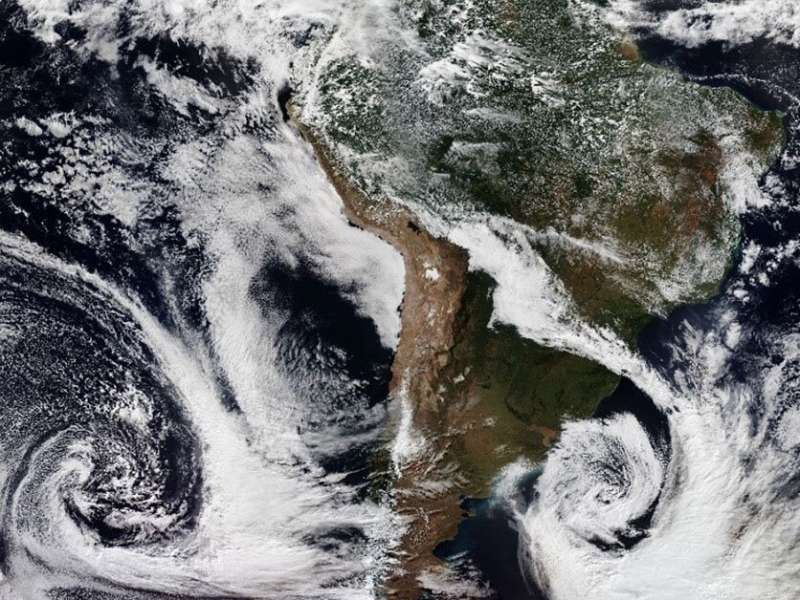
Winter storms in the Southern Hemisphere. Credit: NASA Worldview
About 30 massive, intricate computer networks serve the scientists who stand at the forefront of climate change research. Each network runs a software program comprised of millions of lines of code. These programs are computational models that combine the myriads of physical, chemical and biological phenomena that together form the climate of our planet. The models calculate the state of Earth’s atmosphere, oceans, land and ice, capturing past and present climate variability and using the data to predict future climate change. These results are analyzed by leading research institutes across the globe, including the Weizmann Institute of Science, and then incorporated into the UN’s Intergovernmental Panel on Climate Change (IPCC) assessment report. Policymakers rely on the IPCC report when they form adaptation and mitigation strategies for climate change, one of our generation’s greatest crises.
People gather outside the George R. Brown Convention Center to protest the National Rifle Association’s annual meeting in Houston, Friday, May 27, 2022. (AP Photo/Jae C. Hong)
HOUSTON (AP) — With protesters shouting outside, the National Rifle Association began its annual convention in Houston on Friday, three days after a gunman killed 19 students and two teachers at an elementary school on the other side of the state, renewing the national debate over gun violence.
Former President Donald Trump and other Republican leaders lined up to speak at the event. Leaders of the gun rights lobbying group planned to “reflect on” — and deflect any blame for — the school shooting in Uvalde. Hundreds of protesters angry about gun violence demonstrated outside, including some holding crosses with photos of the shooting victims.
With the protesters, Democrat Beto O’Rourke, who is challenging Texas Gov. Greg Abbott in the governor’s race, ticked off a list of previous school shootings and called on those attending the convention to “join us to make sure that this no longer happens in this country.”
ADVERTISEMENT
“The time to have stopped Uvalde was right after Sandy Hook,” O’Rourke said. “The time for us to have stopped Uvalde was right after Parkland. The time for us to have stopped Uvalde was right after Santa Fe High School. The time for us to stop the next mass shooting in this country is right now, right here, today with every single one of us.”
Some scheduled speakers and performers backed out of the event, including several Texas lawmakers and “American Pie” singer Don McLean, who said “it would be disrespectful” to go ahead with his act after the country’s latest mass shooting. Texas Lt. Gov. Dan Patrick said Friday morning that he had decided not to speak at an event breakfast after “prayerful consideration and discussion with NRA officials.”
The NRA said that people attending the gun show would “reflect on” the Uvalde school shooting, “pray for the victims, recognize our patriotic members and pledge to redouble our commitment to making our schools secure.”
The meeting is the first for the troubled organization since 2019, following a two-year hiatus because of the pandemic. The organization has been trying to regroup following a period of serious legal and financial turmoil that included a failed bankruptcy effort, a class action lawsuit and a fraud investigation by New York’s attorney general. Once among the most powerful political organizations in the country, the NRA has seen its influence wane following a significant drop in political spending.
Larry Miller, 56, from Huntington Beach, California, said he had no problem with the NRA meeting taking place so soon after the Uvalde shooting. He called the shooting “very sad and unfortunate” and said the gunman didn’t “have any respect for the people’s freedoms that we have here in this country.”
“We all share these rights, so to be respectful of other people’s rights is to respect other people’s lives, and I think with that kind of mentality, we should be here,” he said.
ADVERTISEMENT
Samuel Thornburg, 43, a maintenance worker for Southwest Airlines in Houston who was attending the NRA meeting, said, “Guns are not evil. It’s the people that are committing the crime that are evil. Our schools need to be more locked. There need to be more guards.”
Inside the convention hall, thousands of people walked around, stopping at booths that featured displays of handguns, rifles, AR-style firearms, knives, clothing and gun racks. Outside, police set up metal barriers at a large park where hundreds of protesters and counterprotesters gathered in front of the downtown convention center.
“Murderers!” some yelled in Spanish. “Shame on you!” others shouted at attendees.
Among the protesters was singer Little Joe, of the popular Tejano band Little Joe y La Familia, who said in the more than 60 years he’s spent touring the world, no other country he’s been to has faced as many mass shootings as the U.S.
“Of course, this is the best country in the world. But what good does it do us if we can’t protect lives, especially of our children?” he said.
Horacio Izaguirre, 18, a high school senior who lives in the Houston suburb of Deer Park, held up a sign that had an expletive next to Abbott’s name.
“Those poor innocent souls did not deserve that,” he said. “I have a brother, I have cousins. I want them to be safe.”
There is precedent for the NRA to gather amid local mourning and controversy. The organization went ahead with a shortened version of its 1999 meeting in Denver roughly a week after the deadly shooting at Columbine High School in Colorado. Actor Charlton Heston, the NRA president at that time, told attendees that “horrible acts” shouldn’t become opportunities to limit constitutional rights and he denounced critics for casting NRA members as “villains.”
Country music singer Larry Gatlin, who pulled out of a planned appearance at this year’s convention, said he hoped “the NRA will rethink some of its outdated and ill-thought-out positions.”
“While I agree with most of the positions held by the NRA, I have come to believe that, while background checks would not stop every madman with a gun, it is at the very least a step in the right direction,” Gatlin said.
Country singers Lee Greenwood and Larry Stewart also withdrew, Variety reported.
ADVERTISEMENT
White House press secretary Karine Jean-Pierre said Thursday that the NRA’s leaders “are contributing to the problem of gun violence and not trying to solve it.” She accused them of representing the interests of gun manufacturers, “who are marketing weapons of war to young adults.”
Most U.S. adults think that mass shootings would occur less often if guns were harder to get and believe schools and other public places have become less safe than they were two decades ago, polling finds.
Many specific measures that would curb access to guns or ammunition also get majority support. A May AP-NORC poll found, for instance, that 51% of U.S. adults favor a nationwide ban on the sale of AR-15 rifles and similar semiautomatic weapons. But the numbers are highly partisan, with 75% percent of Democrats agreeing versus just 27% of Republicans.
In addition to Patrick, two Texas congressmen who had been scheduled speak Friday — U.S. Sen. John Cornyn and U.S. Rep. Dan Crenshaw — were no longer attending because of what their staffs said were changes in their schedules. Abbott, who was to attend, was to address the convention by prerecorded video instead.
But others were going forward with their appearances, including Texas Sen. Ted Cruz, South Dakota Gov. Kristi Noem and Trump, who said Wednesday that he would deliver “an important address to America.”
ADVERTISEMENT
Though personal firearms are allowed at the convention, the NRA said guns would not be permitted during the session featuring Trump because of Secret Service security protocols.
___
Colvin reported from New York. Associated Press writer David A. Lieb contributed from Jefferson City, Missouri.
On April 21, the Ministry of Education of the People’s Republic of China held a press conference to announce updates to the Curriculum Standard for Labor Education in Compulsory Education, which introduces requirements for “caring for and looking after plants and animals”, “keeping 1-2 kinds of small animals “and “providing service work for social organizations such as stray animal shelters”. The World Dog Alliance applauds these measures, calling them a significant step forward for China in the field of animal protection.
Tian Hui-sheng, director of the Chinese Ministry of Education’s Bureau of Teaching Materials, explained that the existing compulsory education curriculum and curriculum standards have not been changed for over 20 years and 10 years, respectively, and that they needed to be updated to better align with evolving public values. The revised curriculum improves its structure and substance. This amendment is the first time that an educational curriculum has included the rescue of stray animals since the founding of the People’s Republic of China in 1949. This development has received considerable public support.
ADVERTISEMENT
Stray animal shelters are classrooms for life skills development, providing students with the opportunity to care for animals and enhance their knowledge and respect for Mother Nature. The new labor curriculum standards are a milestone for improving China’s education system by recognizing the importance of life skills education. The internationally renowned group “DPG Animal Friendly” commented in an article, “The new labor curriculum standards show that the Chinese government is listening to the growing public concern for animal protection. In the past, China has been criticized for lagging behind in animal protection policies, but this situation has improved dramatically in recent years.”
China’s animal protection policies have recently been making rapid improvements, with two of the country’s most progressive cities – Shenzhen and Zhuhai – legislating a ban on the sale and consumption of dog and cat meat in 2020, making them pilot cities for a future national ban. China’s Ministry of Agriculture and Rural Affairs also announced the removal of dogs from the National Catalogue of Livestock and Poultry Genetic Resources. According to the Ministry of Agriculture and Rural Affairs, with the progress of human civilization and public concern for animal protection, dogs are now considered companion animals and are generally not considered livestock in the international arena, so it is not appropriate for China to include them in livestock management policies. These policy changes have received widespread positive attention from several international mainstream media outlets, including CNN, BBC, and Bloomberg.
Shanghai, the city with the largest number of pet owners in China, has recently set up the city’s first “animal health post” to take care of the pets of hospitalized COVID-19 patients. In mid-April, Zhang Xiao-ding, a member of the Shanghai Chinese People’s Political Consultative Conference (CPPCC), drafted a proposal on setting up the animal health post. The proposal was co-sponsored by 53 municipal CPPCC members. Zhang Xiao-ding explained in her proposal that “pets have become an important member of many families, especially during the pandemic. They assume an important role of emotional support and spiritual comfort”. The animal health post has a number of professional volunteers from veterinary hospitals to care for dogs and cats away from their owners, giving them a stable shelter in times of need. Cameras are installed in the post so that owners in quarantine can see their “furry kids” at any time.
ADVERTISEMENT
With the rapid development of China’s economy and society, pets are increasingly being welcomed into people’s households. According to statistics, the number of pet dogs and cats in China now exceeds 100 million, and caring for animals has become a common public desire. Zhao Wan-ping, a deputy to the National People’s Congress and Vice President of the Anhui Provincial Academy of Agricultural Sciences, has for several years submitted proposals to include animal protection and life skills education in primary and secondary school textbooks, so as to create opportunities for students to take action and provide care for animals. The Ministry of Education’s latest revision of curriculum standards reflects that the voices of the people’s representatives have been taken seriously by the Chinese government.
ADVERTISEMENT
Upon learning that the Ministry of Education has included animal rescue in the scope of service work in primary and secondary schools, Zhao Wan-ping said that although animal care is placed only in the labor curriculum, it is still a significant step forward. The decision indicates that Chinese government officials, especially education authorities, have realized that education on animal care and respect for life will have positive impacts on children’s social development and, therefore, it is very important for primary and secondary school students to provide service work for stray animal shelters.
The founder of the World Dog Alliance, Genlin, believes that education should be centred around developing life skills and that the greatest form of education awakens children’s respect for life. He is confident that the Chinese Ministry of Education will continue to incorporate animal protection into the education curriculum in the future, making animal protection a compulsory subject for all students in China, rather than just a part of the labor curriculum.
On May 8, 2021, at the crack of dawn, shreds of mist crept from the chilly fields onto Ziendeweg, a country road south of Amsterdam. The rush hour traffic caused by commuters using the road to bypass jams on the highway had not yet picked up. But another activity was taking place. All along the four-kilometer-long road, small groups of people were carrying bundles of white crosses and quietly beginning to erect them on the roadside. When the sun came up, the first motorists were greeted by an eerie spectacle: 642 crosses marked the precise spots where dozens of animals had been killed by vehicles during the past few years. Each cross displayed the common name of…
DES MOINES, Iowa––Hours after Salvador Ramos used an AR-15 automatic rifle he gave himself as an 18th birthday present to massacre 19 fourth graders and two teachers in Uvalde, Texas, the Iowa state house of representatives ratified a bill to create a special January antlerless deer hunting season for AR-15 users.
The 56-34 vote followed unanimous Iowa state senate approval in April 2022.
One might surmise that the Iowa house of representatives rushed to establish the AR-15 deer season, on the last day of the Iowa legislative session, to give AR-15 enthusiasts something to shoot besides school children.
The AR-15, besides being the gun Ramos used to kill 21 people at Robb Elementary School in Uvalde, after shooting his grandmother in the face, was used…