The world is increasingly likely to experience global warming of 1.5C within the next five years because of record greenhouse gas levels, according to new research that adds to alarming evidence of how quickly the planet is heating.
There is a 48 per cent chance earth’s annual temperature will exceed 1.5C of warming, compared with pre-industrial levels, in one of the years between now and 2026, the World Meteorological Organization and the UK Met Office said in a report published on Tuesday. That probability is likely to keep rising, it added.
The chance of a 1.5C exceedance for the subsequent five-year period was close to zero just seven years ago, according to the data. “If we’re going to keep to 1.5C…
They have claws, 10 legs, can produce hundreds of clones of themselves and have escaped from confinement to potentially run amok across the United States. The ecological threat posed by the marbled crayfish has now prompted prosecutors to wield invasive species laws in an attempt to curb the spread of the peripatetic crustaceans.
AnOhiowoman who sold hundreds of marbled crayfish online has pleaded guilty to offenses under the Lacey Act, a US law preventing the transport of certain wildlife across state lines, after raising the crayfish in a huge tank in her home and selling them to people across…
Exclusive:Oil and gas majors are planning scores of vast projects that threaten to shatter the 1.5C climate goal. If governments do not act, these firms will continue to cash in as the world burns
The world’s biggest fossil fuel firms are quietly planning scores of “carbon bomb” oil and gas projects that would drive the climate past internationally agreed temperature limits with catastrophic global impacts, a Guardian investigation shows.
The exclusive data shows these firms are in effect placing multibillion-dollar bets against humanity halting global heating. Their huge investments in new fossil fuel production could pay off only if countries fail to rapidly slash carbon emissions, which scientists say is vital.
The oil and gas industry is extremely volatile but extraordinarily…
“The way the draft opinion is written, it opens the doors for a lot of unanswered questions that would allow conservatives to really target contraception,” one legal expert said.
Demonstrators march to Justice Samuel Alito’s house Monday for a candlelight vigil as part of an abortion rights protest in Alexandria, Va.Kenny Holston / The New York Times via Redux
Link copiedSAVECreate your free profile or log in to save this article
With trigger laws in 13 statespoised to go into effectif the Supreme Court strikes down Roe v. Wade, a new era of restricted access to birth control could unfold in states that narrowly define when life begins, legal experts say.
“This is the new Jane Crow that we’re about to enter,” said Michele Goodwin, a chancellor’s professor of law at the University of California, Irvine, and…
The Biden administration has announced it will axthreeplanned oil and gas lease sales in the Gulf of Mexico and Alaska’s Cook Inlet, effectively halting the potential to sell drilling leasesin coastal waters this year, several media outlets report.
Department of Interior spokesperson Melissa Schwartz told USA TODAY the decision comes because of a mix of reasons, including lack of interest from oil companies and legal obstacles.
The department “will not move forward” with the sale in Alaska’s Cook Inlet “due to a lack of industry interest in leasing in the area,” and the department won’t hold two sales in the Gulf of Mexico“as a result of delays due to factors including conflicting court rulings that impacted work on these proposed lease sales,” Schwartzsaid.
The planned sales were the last to be held under a five-year plan for leasing in federal waters that expires…
Employees work at a Tyson Foods poultry processing plant in Camilla, Georgia, in April 2020. Tyson’s legal department wrote the draft executive order to force meat plant workers to keep working. Photograph: AP
Trump officials “collaborated” with the meatpacking industry to downplay the threat of Covid to plant workers and block public health measures which could have saved lives, a damning new investigation has found.
Internal documents reviewed by the congressional select subcommittee on the coronavirus crisis reveal how industry representatives lobbied government officials to stifle “pesky” health departments from imposing evidence-based safety measures to curtail the virus spreading – and tried to obscure worker deaths from these authorities.
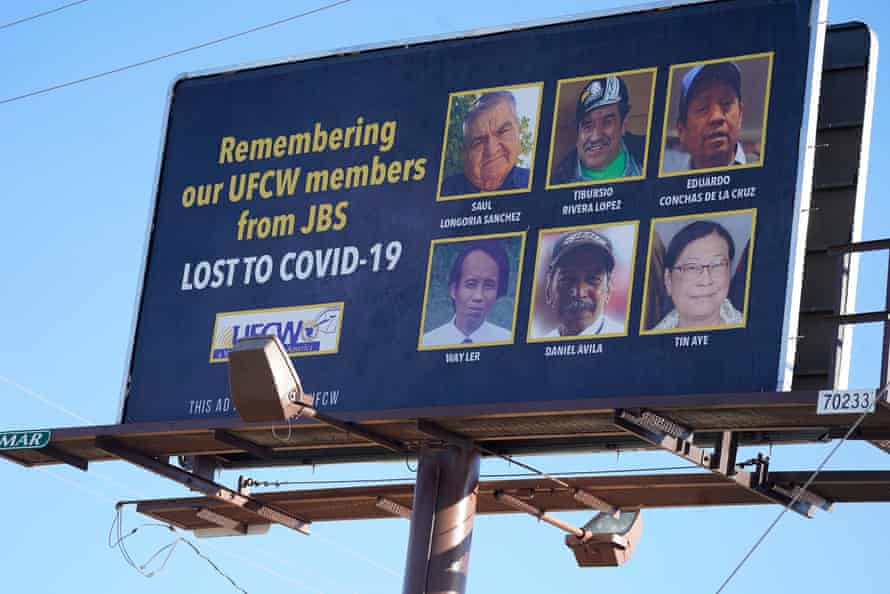
At least 59,000 workers at five of the largest meatpacking companies – Tyson Foods, JBS USA Holdings, Smithfield Foods, Cargill and National Beef Packing Company which are the subject of the congressional inquiry – contracted Covid in the first year of the pandemic, of whom at least 269 died.
According to internal communications, the companies were warned about workers and their families falling sick within weeks of the virus hitting the US. Despite this, company representatives enlisted industry-friendly Trump appointees at the USDA to fight their battles against Covid regulations and oversight.
A Tyson Foods employee adds a second bandana for Covid protection outside the company’s meat processing plant in Waterloo, Iowa, on 22 April 2020. Photograph: USA Today Sports/Reuters
In addition, company executives intentionally stoked fears about meat shortages in order to justify continuing to operate the plants under dangerous conditions.
The fears were baseless – there were no meat shortages in the US, while exports to China hit record highs.
Yet in April 2020, Trump issued an executive order invoking the Defense Production Act to keep meat plants open following a flurry of communication between the White House chief of staff, Mark Meadows, the vice-president’s office, USDA allies and company executives.
The order, which was proposed by Smithfield and Tyson (whose legal department also wrote the draft), was an overt attempt to override health departments and force meat plant workers – who are mostly immigrants, refugees and people of color – to keep working without adequate protections while shielding the industry from lawsuits.
James Clyburn, chairman of the subcommittee, condemned the conduct of the industry executives and their government allies as “shameful”.
“Trump’s political appointees at USDA collaborated with large meatpacking companies to lead an administration-wide effort to force workers to remain on the job during the coronavirus crisis despite dangerous conditions, and even to prevent the imposition of commonsense mitigation measures. This coordinated campaign prioritized industry production over the health of workers and communities, and contributed to tens of thousands of workers becoming ill, hundreds of workers dying, and the virus spreading throughout surrounding areas.”
Workers from the JBS meatpacking plant in Hyrum, Utah, protest on 9 June 2020. Photograph: Eli Lucero/AP
The meatpacking industry, which includes slaughterhouses and processing plants – is one of the most profitable and dangerous in the US. It is a monopoly business, with just a handful of powerful multinationals dominating the supply chain which, even before Covid, was bad news for farmers, workers, consumers and animal welfare.
As Covid spread, the industry was warned about the high risk of transmission in their plants. For example, a doctor near the JBS facility in Cactus, Texas, wrote to a company executive in April 2020 saying “100% of all Covid-19 patients we have in the hospital are either direct employees or family member[s] of your employees”, warning that “your employees will get sick and may die if this factory continues to be open”.
In late May 2020 – well after the importance of prevention measures such as testing, social distancing and personal protective equipment was widely recognized – an executive told an industry lobbyist that temperature screening was “all we should be doing”. The lobbyist agreed, replying: “Now to get rid of those pesky health departments!”
The report, Now to get rid of those pesky healthy departments!, reveals how USDA Trump appointees did the industry’s bidding in order to carry on with business as usual. The report is based on more than 151,000 pages of documents collected from meatpacking companies and interest groups, as well as interviews with meatpacking workers, former USDA and CDC officials, and state and local health authorities among others.
The documents show that:
In March 2020, the industry aggressively lobbied USDA officials, who in turn escalated their wishes to Vice-President Mike Pence’s office, to ensure states were advised to designate meatpacking workers as “critical infrastructure” employees who could be exempt from social distancing and stay at home orders. This conduct was “particularly egregious considering that the nation’s meat supply was not actually at risk”, the subcommittee found.
Mindy Brashears, the undersecretary of food safety, was considered the go-to fixer, who could stop health departments enforcing Covid safety measures at local plants. Brashears “hasn’t lost a battle for us”, said one lobbyist.
Career USDA staff told the congressional subcommittee how they were sidelined, while Brashears and her deputies communicated with industry officials on their personal phones in order to avoid leaving a paper trail.
Meatpacking companies also successfully lobbied USDA officials to advocate for Department of Labor policies that deprived their employees of benefits if they missed work or quit, while also seeking insulation from legal liability if workers then fell ill or died.
A billboard stands across from the JBS meatpacking plant near Greeley, Colorado, on 12 October 2020. Photograph: David Zalubowski/AP
As reports of Covid clusters at meatpacking plants increased, industry officials and the USDA jointly lobbied the White House to dissuade frightened workers from staying home or quitting. For instance in April 2020 the CEOs of JBS, Smithfield and Tyson among other companies asked the secretary of agriculture, Sonny Perdue, during a call to “elevate the need for messaging about the importance of our workforce staying at work to the POTUS or VP level”.
It worked. At a press briefing soon after, Mike Pence told meatpacking workers that “we need you to continue … to show up and do your job”, admonishing recent “incidents of worker absenteeism”.
The report concludes: “Meatpacking companies knew the risk posed by the coronavirus to their workers and knew it wasn’t a risk that the country needed them to take. They nonetheless lobbied aggressively – successfully enlisting USDA as a close collaborator in their efforts – to keep workers on the job in unsafe conditions, to ensure state and local health authorities were powerless to mandate otherwise, and to be protected against legal liability for the harms that would result.”
The trade association for meat and poultry packers and processors rejected the report’s findings and accused the subcommittee of “cherry-picking data”.
“The report ignores the rigorous and comprehensive measures companies enacted to protect employees and support their critical infrastructure workers,” said Julie Anna Potts, president and CEO of the North American Meat Institute.
In addition, a spokesperson for JBS said the company “did everything possible to ensure the safety of our people who kept our critical food supply chain running”. In a statement Cargill said: “We’ve worked hard to maintain safe and consistent operations to feed families during the pandemic, yet we did not hesitate to temporarily idle or reduce capacity at processing plants in the interest of our employees’ wellbeing.”
A spokesman for Smithfield said: “The concerns we expressed were very real and we are thankful that a food crisis was averted and that we are starting to return to normal … Did we make every effort to share with government officials our perspective on the pandemic and how it was impacting the food production system? Absolutely.”
Tyson said collaboration with the government was crucial to the supply chain and for worker safety: “Over the past two years, our company has been contacted by, received direction from, and collaborated with many different federal, state and local officials – including both the Trump and Biden Administrations – as we’ve navigated the challenges of the pandemic.”
The subcommittee investigation into the meatpacking industry’s response to the pandemic was launched in February 2021 following reports that meat companies had refused to take adequate safety measures precautions to protect workers during the first year of the pandemic. Last year, the subcommittee found that the illness and death toll at plants owned by the five big meatpackers had been grossly underestimated, and that the companies put profits over worker safety.
The Guardian has contacted the USDA and former Trump administration officials for comment.
Farmer Jim Medeiros holds one of his chickens during an interview at his farm Wednesday, April 20, 2022, in Wilsons, Va. Medeiros owns a 143-acre dairy and poultry farm and has had issues with hunting dogs on his property killing chickens. (AP Photo/Steve Helber)
WILSONS, Va. (AP) — Soon after Jim Medeiros bought his 143-acre (58-hectare) cattle and poultry farm in rural Virginia a decade ago, he and his wife were startled by the sounds of 20 hunting dogs barking and howling as they circled their house and chased their chickens.
When Medeiros confronted a hunter nearby, the man told him he had permission to hunt on Medeiros’ property. In disbelief, Medeiros called the agency that enforces a state law allowing hunters to retrieve their hunting dogs from private property, even when the property owners object.
“He told me, you can’t prohibit people from coming onto your land,” recalled Medeiros.
He then pointed out that his land was posted with no trespassing signs.
“I said, ‘You don’t understand. My land is posted,’” Medeiros said.
“You don’t understand,” the official responded. “You can’t stop them.”
After years of putting up with baying dogs and dead chickens, Medeiros and several other property owners are suing the state over its “right to retrieve” law, arguing that allowing hunters to go on their property without permission amounts to an uncompensated taking of their land and violates the state and federal constitutions.
ADVERTISEMENT
A number of states allow hunters to retrieve their dogs without permission from property owners under certain circumstances, such as properties that do not have “no trespassing” signs. But Virginia’s law says hunters are allowed to retrieve dogs even when the property owner has specifically denied access.
A 2016 report prepared by the Virginia Department of Game and Inland Fisheries, (now the Department of Wildlife Resources), said only one other state, Minnesota, had a similar law. Minnesota’s law says a person can enter private land to retrieve a hunting dog without permission of the owner, but cannot have a firearm when doing so and must immediately leave after recovering the dog.
Virginia’s law prohibits hunters from carrying guns or bows and arrows while retrieving their dogs from private property. It also says hunters must identify themselves when asked by the landowner. If they refuse, they can be charged with a misdemeanor.
The Virginia property owners are suing the Department of Wildlife Resources, which enforces the law. They are represented by the Pacific Legal Foundation, a conservative legal organization that won a major property rights case at the U.S. Supreme Court last year. The high court found that a California regulation requiring agricultural businesses to allow union organizers onto their property for up to three hours a day, 120 days per year, amounts to the government appropriating “a right of access to private property” and “constitutes a per se physical taking” under the court’s precedents.
Daniel Woislaw, a lawyer with the Pacific Legal Foundation, said he believes Virginia’s “right to retrieve” law amounts to a similar physical taking of private property.
“When Jim has to let deer dogs and deer dog hunters enter his property, and he’s not allowed to tell them to stay away, and when they’re killing his livestock and disrupting his operations, that’s a taking of a valuable property interest,” Woislaw said.
ADVERTISEMENT
The law itself was first put on the books in 1938, but the tradition of hunting with dogs dates back 400 years to colonial times, said Kirby Burch, a bear hunter who owns eight hunting dogs and is the chief executive officer of the Virginia Hunting Dog Alliance, a political action committee that represents about 90,000 hunters in the state. Burch said most hunters try to be considerate of land owners and quickly retrieve their dogs when they cross onto private property.
“A lot a people who move here from other states are offended by the notion of hunting with dogs so when a dog runs across their property, they’re offended, and I understand that, but I think the vast majority of hunters with dogs try in every way possible to avoid irritating their neighbors,” said Burch, 75, who has been hunting with dogs since he was 5.
Burch’s group estimates that more than half of the 254,000 licensed hunters in Virginia hunt with dogs.
The lawsuit asks the court for a judgment declaring that the law takes the plaintiffs’ private property without compensation for public use, a violation of the state constitution and the Fifth Amendment to the U.S. Constitution.
ADVERTISEMENT
Multiple attempts have been made in the legislature to overturn the law, but none have succeeded.
Ryan Brown, executive director of the Department of Wildlife Resources, declined to comment on the lawsuit. Brown said hunters and private landowners have been able to peacefully co-exist for the most part, but as more rural land has been developed and Virginia has become more suburbanized, the two groups have been at loggerheads over the hunting dog issue.
“Both sides of the debate have vested interests, with the hunters being very interested in the protection of their hunting dogs and real property owners being interested in protection of their rights as land owners,” Brown said.
“Both sides have been very passionate about their views.”
Former Russian president Dmitry Medvedev has warned of the risk of “open conflict” between Moscow and NATO, which could escalate into a nuclear war, just as Finland announced plans to join the alliance.
Although he did not mention Russia’s neighbor by name, Medvedev, who is the deputy chairman of his country’s Security Council, raised the threat of nuclear war in a Telegram post which was published less than an hour after Helsinki announced its NATO intentions.
The Russian foreign ministry said on Thursday that, following Finland’s move, it will be “forced to take retaliatory steps, both of a military-technical and other nature to stop the threats to its national security,” RIA Novosti reported.
Earlier, Medvedev had described how there was “endless talk by foreign analysts about NATO’s war with Russia,” which in his view was “becoming more and more forthright.”
“They are trying with all their power to push the line that Russia is scaring the world with a nuclear conflict,” he wrote.
“Even Trump has recently come out with this… just to spite Biden,” Medvedev said of the former U.S. president, who in March said if he were still in power, he would deploy nuclear submarines to pressure Vladimir Putin.
Medvedev said that the supplies and training provided to Ukraine by NATO countries, as well as the alliance’s exercises, “near our borders, increase the likelihood of a direct and open conflict between NATO and Russia instead of their ‘proxy war.'”
“Such a conflict always has the risk of turning into a full-fledged nuclear war,” he said, “this will be a catastrophic scenario for everyone.”
“Do not lie to yourself and others. You just need to think about the possible consequences of your actions,” wrote Medvedev as he decried “paroxysms of Russophobia.”
Medvedev posted the comments soon after the announcement by Finnish President Sauli Niinistö and Prime Minister Sanna Marin that Helsinki must apply to join the alliance “without delay.” They said in a joint statement that NATO membership “would strengthen Finland’s security.”
Russia has railed against NATO expansion towards its borders and used the presence of the alliance near its borders as one of the justifications for its invasion of Ukraine.
Finland shares a border of more than 800 miles with Russia and has faced threats from Moscow over joining the alliance. In April, lawmaker Vladimir Dzhabarov from Russia’s upper house, the Federation Council, said that Helsinki joining NATO would be a “strategic mistake.”
Richard Shirreff, the former deputy Supreme Allied Commander Europe, said that faced with the prospect of Finland’s accession to the alliance he expected Russia “will kick off” and “make a lot of noise.”
“There will be a lot of intimidation, bullying,” he told BBC Radio’s Today program and this would include “trying to manipulate media,” as well as attempting to “undermine the integrity of the state through cyber attacks.”
Kremlin spokesman Dmitry Peskov said “the next expansion of NATO does not make our continent more stable and secure,” Tass reported.
He added that Russia will further analyze Finland’s prospective entry into the alliance, and that there would be “measures in order to balance the situation and ensure our security.”
Update 05/12/05, 7.30 a.m. ET: This article has been updated with a statement from the Russian foreign ministry.
This week, the World Meteorological Organization warned that the world has a 50 percent chance of seeing warming of 1.5 degrees above preindustrial levels in the next five years. Even those who view the glass as half full tend to agree that efforts undertaken so far by the world’s countries to combat the climate crisis, while significant in some respects, are not enough. Indeed, the global economy continues to rely extensively on fossil fuels, which still provide about 80 percent of the energy supply.
The warnings about an impeding climate catastrophe included in the second and third segments of the United Nations Intergovernmental Panel on Climate Change (IPCC) latest review of climate science, which were released on February 28 and April 4, 2022, respectively, went completely ignored amid the war in Ukraine and soaring energy costs.
In the United States, the Biden administration’s response to soaring gas prices was to renew oil and gas drilling on federal lands and to announce “the largest-ever release of oil from the strategic petroleum reserves.” The rest of the world has also responded with short-term thinking to the consequences of the war in Ukraine.
Don’t miss a beat
Get the latest news and thought-provoking analysis from Truthout.
Email
World-renowned scholar-activist Noam Chomsky grapples with the consequences of this short-term thinking amid escalating military tensions, in this exclusive interview for Truthout. Chomsky is the father of modern linguistics and one of the most cited scholars in modern history, and has published some 150 books. He is institute professor and professor of linguistics emeritus at the Massachusetts Institute of Technology and currently laureate professor at the University of Arizona.
The following transcript has been lightly edited for length and clarity.
C.J. Polychroniou: Noam, the war in Ukraine is causing unimaginable human suffering, but it is also having global economic consequences and is terrible news for the fight against global warming. Indeed, as a result of rising energy costs and concerns about energy security, decarbonization efforts have taken a back seat. In the U.S., the Biden administration has embraced the Republican slogan “drill, baby, drill,” Europe is set on building new gas pipelines and import facilities, and China plans to boost coal production capacity. Can you comment on the implications of these unfortunate developments and explain why short-term thinking continues to prevail among world leaders even at a time when humanity could be on the brink of an existential threat?
Noam Chomsky: The last question is not new. In one or another form, it has arisen throughout history.
Take one case that has been extensively studied: Why did political leaders go to war in 1914, supremely confident of their own righteousness? And why did the most prominent intellectuals in every warring country line up with passionate enthusiasm in support of their own state — apart from a handful of dissidents, the most prominent of whom were jailed (Bertrand Russell, Eugene Debs, Rosa Luxemburg and Karl Liebknecht)? It wasn’t a terminal crisis, but it was serious enough.
The pattern goes far back in history. And it continues with little change after August 6, 1945, when we learned that human intelligence had risen to the level where it soon would be able to exterminate everything.The policy of escalating the war in Ukraine, instead of trying to take steps to end it, has a horrific impact far beyond Ukraine. Perpetuation of the war is, simply, a program of mass murder throughout much of the Global South.
Observing the pattern closely, over the years, a basic conclusion seems to me to emerge clearly: Whatever is driving policy, it is not security — at least, security of the population. That is at best a marginal concern. That holds for existential threats as well. We have to look elsewhere.
A good starting point, I think, is what seems to me to be the best-established principle of international relations theory: Adam Smith’s observation that the “Masters of Mankind” — in his day the merchants and manufacturers of England — are the “principal architects of [state] policy.” They use their power to ensure that their own interests “are most peculiarly attended to” no matter how “grievous” the effects on others, including the people of England, but most brutally the victims of the “savage injustice of the Europeans.” His particular target was British savagery in India, then in its early stages, already horrifying enough.
Nothing much changes when the crises become existential. Short-term interests prevail. The logic is clear in competitive systems, like unregulated markets. Those who do not play the game are soon out of it. Competition among the “principal architects of policy” in the state system has somewhat similar properties, but we should bear in mind that security of the population is far from a guiding principle, as the record shows all too clearly.
You are quite right about the horrific impact of the criminal Russian invasion of Ukraine. Discussion in the U.S. and Europe focuses on the suffering in Ukraine itself, quite reasonably, while also applauding our policy of accelerating the misery, not so reasonably. I’ll return to that.
The policy of escalating the war in Ukraine, instead of trying to take steps to end it, has a horrific impact far beyond Ukraine. As widely reported, Ukraine and Russia are major food exporters. The war has cut off food supplies to populations in desperate need, particularly in Africa and Asia.
Take just one example, the world’s worst humanitarian crisis according to the UN: Yemen. Over 2 million children face imminent starvation, the World Food Program reports. Almost 100 percent of cereal [is imported] “with Russia and Ukraine accounting for the largest share of wheat and wheat products (42%),” in addition to re-exported flour and processed wheat from the same region.
The crisis extends far beyond. Let’s try to be honest about it: Perpetuation of the war is, simply, a program of mass murder throughout much of the Global South.
That’s the least of it. There are discussions in purportedly serious journals about how the U.S. can win a nuclear war with Russia. Such discussions verge on criminal insanity. And, unfortunately, US-NATO policies provide many possible scenarios for quick termination of human society. To take just one, Putin has so far refrained from attacking the supply lines sending heavy weapons to Ukraine. It won’t be a great surprise if that restraint ends, bringing Russia and NATO close to direct conflict, with an easy path to tit-for-tat escalation that could well lead to a quick goodbye.
More likely, in fact highly probable, is slower death through poisoning of the planet. The most recent IPCC report made it crystal clear that if there is to be any hope for a livable world, we must stop using fossil fuels right now, proceeding steadily until they are soon eliminated. As you point out, the effect of the ongoing war is to end the far-too-limited initiatives underway, indeed to reverse them and to accelerate the race to suicide.
There is, naturally, great joy in the executive offices of the corporations dedicated to destroying human life on Earth. Now they are not only freed from constraints and from the carping of annoying environmentalists, but they are lauded for saving the civilization that they are now encouraged to destroy even more expeditiously. Arms producers share their euphoria about the opportunities offered by the continuing conflict. They are now encouraged to waste scarce resources that are desperately needed for humane and constructive purposes. And like their partners in mass destruction, the fossil fuel corporations, they are raking in taxpayer dollars.
What could be better, or from a different perspective, more insane? We would do well to recall President Dwight D. Eisenhower’s words in his “Cross of Iron” speech in 1953:
Every gun that is made, every warship launched, every rocket fired signifies, in the final sense, a theft from those who hunger and are not fed, those who are cold and are not clothed. This world in arms is not spending money alone. It is spending the sweat of its laborers, the genius of its scientists, the hopes of its children. The cost of one modern heavy bomber is this: a modern brick school in more than 30 cities. It is two electric power plants, each serving a town of 60,000 population. It is two fine, fully equipped hospitals. It is some fifty miles of concrete pavement. We pay for a single fighter with a half-million bushels of wheat. We pay for a single destroyer with new homes that could have housed more than 8,000 people…. This is not a way of life at all, in any true sense. Under the cloud of threatening war, it is humanity hanging from a cross of iron.
These words could hardly be more appropriate today.
Let’s return to why “world leaders” pursue this mad course. First, let’s see if we can find any who deserve the appellation, except in irony.
If there were any, they would be devoting themselves to bringing the conflict to an end in the only way possible: by diplomacy and statecraft. The general outlines of a political settlement have long been understood. We have discussed them before and have also documented the dedication of the U.S. (with NATO in tow) to undermine the possibility of a diplomatic settlement, quite openly, and with pride. There should be no need to review the dismal record again.
A common refrain is that “Mad Vlad” is so insane, and so immersed in wild dreams of reconstructing an empire and maybe conquering the world, that there’s no point even listening to what Russians are saying — that is, if you can evade U.S. censorship and find some snippets on Indian state TV or Middle East media. And there is surely no need to contemplate diplomatic engagement with such a creature. Therefore, let’s not even explore the only possibility for ending the horror and just continue to escalate it, no matter what the consequences for Ukrainians and the world.
Western leaders, and much of the political class, are now consumed with two major ideas: The first is that Russian military force is so overwhelming that it may soon seek to conquer Western Europe, or even beyond. Thus, we have to “fight Russia over there” (with Ukrainian bodies) so that “we don’t have to fight Russia here” in Washington, D.C., or so we are warned by House Permanent Select Committee on Intelligence Chair Adam Schiff, a Democrat.We will either act to show that our moral capacity reaches as far as to control our technical capacity to destroy, or that it does not.
The second is that Russian military force has been shown to be a paper tiger, so incompetent and frail, and so poorly led, that it can’t conquer cities a few kilometers from its border defended largely by a citizens’ army.
The latter thought is the object of much gloating. The former inspires terror in our hearts.
Orwell defined “doublethink” as the capacity to hold two contradictory ideas in mind and to believe them both, a malady only imaginable in ultra-totalitarian states.
Adopting the first idea, we must arm ourselves to the teeth to protect ourselves from the demonic plans of the paper tiger, even though Russian military spending is a fraction of NATO’s, even excluding the U.S. Those suffering memory loss will be delighted that Germany has finally gotten the word, and may soon surpass Russia in military spending. Now Putin will have to think twice before conquering western Europe.
To repeat the obvious, the war in Ukraine can end with a diplomatic settlement, or with the defeat of one side, either quickly or in prolonged agony. Diplomacy, by definition, is a give-and-take affair. Each side must accept it. It follows that in a diplomatic settlement, Putin must be offered some escape hatch.
We either accept the first option, or we reject it. That at least is not controversial. If we reject it, we are choosing the second option. Since that is the near-universal preference in Western discourse, and continues to be U.S. policy, let’s consider what it entails.
The answer is straightforward: The decision to reject diplomacy means that we will engage in an experiment to see whether the irrational mad dog will slink away quietly in total defeat, or whether he will use the means that he certainly has to destroy Ukraine and set the stage for terminal war.
And while conducting this grotesque experiment with the lives of Ukrainians, we will ensure that millions starve from the food crisis, we will toy with the possibility of nuclear war, and we will race on enthusiastically to destroying the environment that sustains life.
It is of course conceivable that Putin will just surrender, and that he’ll refrain from using the forces at his command. And perhaps we can simply laugh off the prospects of resort to nuclear weapons. Conceivable, but what kind of person would be willing to take that gamble?
The answer is: Western leaders, quite explicitly, along with the political class. That has been obvious for years, even stated officially. And to make sure that all understand, the position was forcefully reiterated in April at the first monthly meeting of the “Contact Group,” which includes NATO and partner countries. The meeting was not held at NATO headquarters in Brussels, Belgium. Rather, all pretenses were dropped, and it was held at the U.S. Ramstein Air Base in Germany; technically German territory, but in the real world belonging to the U.S.
Defense Secretary Lloyd Austin opened the meeting by declaring that “Ukraine clearly believes it can win and so does everyone here.” Therefore, the assembled dignitaries should have no hesitation in pouring advanced weapons into Ukraine and persisting in the other programs, proudly announced, to bring Ukraine effectively within the NATO system. In their wisdom, the attending dignitaries and their leader guarantee that Putin will not react in ways they all know he can.
The record of military planning for many years, in fact centuries, indicates that “everyone here” may indeed hold these remarkable beliefs. Whether they do or not, they are, clearly, willing to carry out the experiment with the lives of Ukrainians and the future of life on Earth.
Since we are assured on this high authority that Russia will passively observe all of this with no reaction, we can take further steps to “integrate Ukraine into NATO de facto,” in accord with the goals of the Ukrainian defense ministry, establishing “full compatibility of the Ukrainian army with the armies of NATO countries” — thereby also guaranteeing that no diplomatic settlement can be reached with any Russian government, unless Russia is somehow turned into a U.S. satellite.
Current U.S. policy calls for a long war to “weaken Russia” and ensure its total defeat. The policy is very similar to the Afghan model of the 1980s, which is, in fact, now explicitly advocated in high places; by former Secretary of State Hillary Clinton for example.It is within our power to bring about the answer that we all hope for, but there is no time to waste.
Since that is close to current U.S. policy, even a working model, it is worthwhile to look at what actually happened in Afghanistan in the ‘80s when Russia invaded. Fortunately, we now have a detailed and authoritative account by Diego Cordovez, who directed the successful UN programs that ended the war, and the distinguished journalist and scholar Selig Harrison, who has extensive experience in the region.
The Cordovez-Harrison analysis completely overthrows the received version. They demonstrate that the war was ended by careful UN-run diplomacy, not by military force. Soviet military forces were fully capable of continuing the war. The U.S. policy of mobilizing and funding the most extremist radical Islamists to fight the Russians amounted to “fighting to the last Afghan,” they conclude, in a proxy war to weaken the Soviet Union. “The United States did its best to prevent the emergence of a U.N. role,” that is, the careful diplomatic efforts that ended the war.
U.S. policy apparently delayed the Russian withdrawal that had been contemplated from shortly after the invasion — which, they show, had limited objectives, with no resemblance to the awesome goals of world conquest that were conjured up in U.S. propaganda. “The Soviet invasion was clearly not the first step in an expansionist master plan of a united leadership,” Harrison writes, confirming the conclusions of historian David Gibbs based on released Soviet archives.
The chief CIA officer in Islamabad, who ran the operations directly, put the main point simply: The goal was to kill Russian soldiers — to give Russia their Vietnam, as proclaimed by high U.S. officials, revealing the colossal inability to understand anything about Indochina that was the hallmark of U.S. policy for decades of slaughter and destruction.
Cordovez-Harrison wrote that the U.S. government “was divided from the start between ‘bleeders,’ who wanted to keep Soviet forces pinned down in Afghanistan and thus to avenge Vietnam, and ‘dealers’, who wanted to compel their withdrawal through a combination of diplomacy and military pressure.” It’s a distinction that shows up very often. The bleeders usually win, causing immense damage. For “the decider,” to borrow W. Bush’s self-description, it is safer to look tough than to appear to be too soft.
Afghanistan is a case in point. In the Carter administration, Secretary of State Cyrus Vance was a dealer, who suggested far-reaching compromises that would have almost certainly prevented, or at least sharply curtailed, what was intended to be a limited intervention. National Security Adviser Zbigniew Brzezinski was the bleeder, intent on avenging Vietnam, whatever that meant in his confused world view, and killing Russians, something he understood very well, and relished.
Brzezinski prevailed. He convinced Carter to send arms to the opposition that was seeking to overthrow the pro-Russian government, anticipating that the Russians would be drawn into a Vietnam-style quagmire. When it happened, he could barely contain his delight. When asked later whether he had any regrets, he dismissed the question as ridiculous. His success in drawing Russia into the Afghan trap, he claimed, was responsible for the collapse of the Soviet empire and ending the Cold War — mostly nonsense. And who cares if it harmed “some agitated Muslims,” like the million cadavers, putting aside such incidentals as the devastation of Afghanistan, and the rise of radical Islam.
The Afghan analogy is being publicly advocated today, and more importantly, is being implemented in policy.
The dealer-bleeder distinction is nothing new in foreign policy circles. A famous example from the early days of the Cold War is the conflict between George Kennan (a dealer) and Paul Nitze (a bleeder), won by Nitze, laying the basis for many years of brutality and near destruction. Cordovez-Harrison explicitly endorse Kennan’s approach, with ample evidence.
An example close to Vance-Brzezinski is the conflict between Secretary of State William Rogers (a dealer) and National Security Adviser Henry Kissinger (a bleeder) over Middle East Policy in the Richard Nixon years. Rogers proposed reasonable diplomatic solutions to the Israel-Arab conflict. Kissinger, whose ignorance of the region was monumental, insisted on confrontation, leading to the 1973 war, a close call for Israel with a serious threat of nuclear war.
These conflicts are perennial, almost. Today there are only bleeders in high places. They have gone as far as to enact a huge Lend Lease Act for Ukraine, passed almost unanimously. The terminology is designed to evoke the memory of the enormous Lend-Lease program that brought the U.S. into the European war (as intended) and linked the European and Asian conflicts into a World War (unintended). “Lend Lease tied together the separate struggles in Europe and Asia to create by the end of 1941 what we properly call World War II,” writes Adam Tooze. Is that what we want in today’s quite different circumstances?
If that is what we want, as seems to be the case, let us at least reflect on what it entails. That is important enough to repeat.
It entails that we reject out of hand the kind of diplomatic initiatives that in reality ended the Russian invasion of Afghanistan, despite U.S. efforts to impede them. We therefore undertake an experiment to see whether integration of Ukraine into NATO, total defeat of Russia in Ukraine, and further moves to “weaken Russia,” will be observed passively by the Russian leadership, or whether they will resort to the means of violence they unquestionably possess to devastate Ukraine and set the stage for possible general war.
Meanwhile, by extending the conflict instead of seeking to end it, we impose severe costs on Ukrainians, drive millions of people to death by starvation, hurtle the burning planet even more rapidly to the sixth mass extinction, and — if we are lucky — escape terminal war.
No problem, the government and political class tell us. The experiment carries no risk because the Russian leadership is sure to accept all of this with equanimity, passing quietly into the ash heap of history. As for the “collateral damage,” they can join the ranks of Brzezinski’s “agitated Muslims.” To borrow the phrase made famous by Madeleine Albright: “This is a very hard choice, but the price — we think the price is worth it.”
Let’s at least have the honesty to recognize what we are doing, eyes open.
Global emissions rose to record high in 2021, so the world went back to a “business-as-usual” approach once the worst of the COVID-19 pandemic subsided — for now. How hardwired is human behavior? Are we capable of having moral duties toward future people?
It is a deep question, the most important question we can contemplate. The answer is unknown. It may be helpful to think about it in a broader context.
Consider Enrico Fermi’s famous paradox: In simple words, where are they? A distinguished astrophysicist, Fermi knew that there are a huge number of planets within the reach of potential contact that have the conditions to sustain life and higher intelligence. But with the most assiduous search, we can find no trace of their existence. So where are they?
One response that has been seriously proposed, and cannot be dismissed, is that higher intelligence has developed innumerable times, but has proven to be lethal: It discovered the means for self-annihilation but did not develop the moral capacity to prevent it. Perhaps that is even an inherent feature of what we call “higher intelligence.”
We are now engaged in an experiment to determine whether this grim principle holds of modern humans, a very recent arrival on Earth, some 200,000-300,000 years ago, a flick of an eye in evolutionary time. There is not much time to find the answer — or more precisely, to determine the answer, as we will do, one way or the other. That is unavoidable. We will either act to show that our moral capacity reaches as far as to control our technical capacity to destroy, or that it does not.
An extraterrestrial observer, if there were one, would unfortunately conclude that the gap is too immense to prevent species suicide, and with it the sixth mass extinction. But it could be mistaken. That decision is in our hands.
There is a rough measure of the gap between capacity to destroy and capacity to contain that death wish: the Doomsday Clock of the Bulletin of Atomic Scientists. The distance of the hands from midnight can be regarded as an indication of the gap. In 1953, when the U.S. and Soviet Union exploded thermonuclear weapons, the minute-hand was set to two minutes to midnight. It did not reach that point again until Donald Trump’s term in office. In his last year, the analysts abandoned minutes and switched to seconds: 100 seconds to midnight, where the clock now stands. Next January it will be set again. It’s not hard to make a case that the second-hand should move closer to midnight.
The grim question arose with brilliant clarity on August 6, 1945. That day provided two lessons: 1.) human intelligence, in its glory, was approaching the capacity to destroy everything, an achievement reached in 1953; and 2.) human moral capacity lagged far behind. Few even cared, as people of my age will remember very well. Viewing the hideous experiment to which we are enthusiastically committed today, and what it entails, it is hard to see improvement, to put it mildly.
That doesn’t answer the question. We know far too little to answer it. We can only observe closely the one case of “higher intelligence” that we know of, and ask what it suggests about the answer.
Far more importantly, we can act to determine the answer. It is within our power to bring about the answer that we all hope for, but there is no time to waste.
ATLANTA – Nathan Horton has been sentenced for illegally trapping and exporting thousands of freshwater turtles in Georgia in violation of the Lacey Act.
“Horton robbed public lands by using illegal traps that can cause significant harm to aquatic animals and birds,” said U.S. Attorney Ryan K. Buchanan. “This tough but fair sentence should be a warning to anyone who would consider violating our nation’s wildlife protection statutes.”
“Wildlife trafficking negatively impacts our native natural resources and could possibly lead to a species’ extinction,” said the U.S. Fish and Wildlife’s Office of Law Enforcement Assistant Director Edward Grace. “Our agents worked closely with Georgia’s Department of Natural Resources and the U.S. Attorney’s Office to ensure this trafficker faced prosecution for his serious crime. This work is important so future generations of Americans may enjoy our nation’s wildlife treasures.”
“Our Law Enforcement Division is tasked with protecting Georgia’s wildlife population…