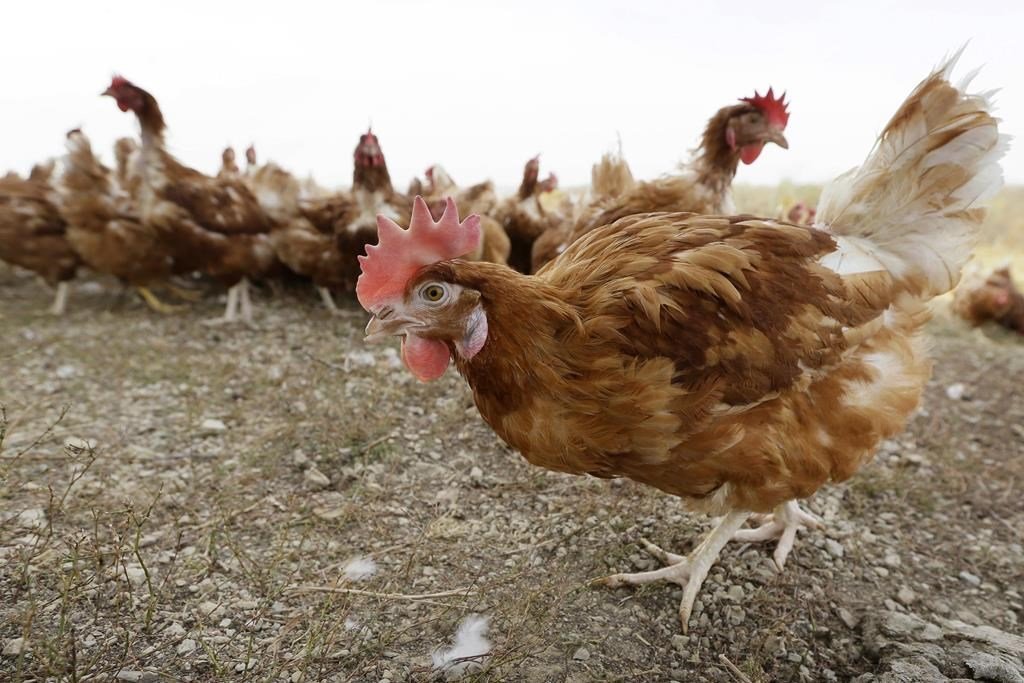
As cases ofbird flucontinue to be detected inOntario, and now in Quebec, one expert says containing the virus is critical to preventing a large-scale outbreak.
According to the Canadian Food Inspection Agency (CFIA), theH5N1strain has been detected in a backyard flock in the Township of Chippewas of Nawash, and in poultry flocks in Woolwhich, Zorra and Guelph.
A new case of avian influenza has been confirmed in Kelowna, B.C.
The Canadian Food Inspection Agency has confirmed that a small backyard poultry flock tested positive for the highly pathogenic H5N1 avian influenza virus.
The property has been quarantined by the CFIA, and the ministry has notified producers within a 12-kilometre radius.
A lymph node sample for chronic wasting disease testing. (Wyoming Game and Fish)
CASPER, Wyo. — The Wyoming Game and Fish Department said in a news release Monday that its Wildlife Health Laboratory tested 6,884 big game animal samples for chronic wasting disease in 2021, with 831 samples coming back positive.
The department said that 829 of 6,486 samples were positive for chronic wasting disease in 2020 after 568 of 5,067 samples tested positive in 2019. While the number of positive cases has increased, Wildlife Health Laboratory supervisor Hank Edwards cautioned against drawing too many conclusions because the department’s chronic wasting disease surveillance program focuses on different deer and elk herds each year.
“That said, we can say the prevalence of CWD is slowly increasing…
According to the analysis, about 700,000 sheep would need to be lost in order for Northern Ireland to meet its new climate targets. Photograph: EyeEm/Alamy
Northern Ireland will need to lose more than 1 million sheep and cattle to meet its new legally binding climate emissions targets, according to an industry-commissioned analysis seen by the Guardian.
The large-scale reduction in farm animals comes after the passing of the jurisdiction’s first ever climate act, requiring the farming sector to reach net-zero carbon emissions by 2050 and reduce methane emissions by almost 50% over the same period.
About a third of human-caused methane emissions come from livestock, mostly from the burps and manure of beef and dairy cattle. Analysis by KPMG, commissioned by industry representatives including the Ulster Farmers’ Union (UFU), estimates more than 500,000 cattle and about 700,000 sheep would need to be lost in order for Northern Ireland to meet the new climate targets.
Separate analysis by the UK government’s climate advisers suggests chicken numbers would also need to be cut by 5 million by 2035. Both the pig and poultry sectors in Nothern Ireland have seen rapid growth in the past decade.
Agriculture accounts for about 27% of Northern Ireland’s greenhouse gas emissions, with the vast majority coming from livestock. Photograph: Bernard O’Kane/Alamy
Northern Ireland has for some years been the only devolved administration without dedicated climate legislation and targets for emissions reduction. The region’s agrifood industry and associated farming groups have long raised concerns about the expected impact of emissions reductions.
Agriculture accounts for about 27% of Northern Ireland’s greenhouse gas emissions, with the vast majority coming from livestock. Its heavily export-driven meat industry principally supplies Great Britain, but it also exports to China and North America.
The country’s principal poultry processor, Moy Park (a subsidiary of the Brazilian meat giant JBS), has grown into one of Europe’s biggest such firms and Northern Ireland’s largest company, while the Armagh-based JMW Farms pig producer saw its gross turnover nearly treble to £54m between 2011 and 2020.
A spokesperson for KPMG said: “Under the [Climate Change Act’s] net-zero target, we have assumed that ‘beef and other cattle’, ‘dairy’ and ‘sheep’ do the most work to decarbonise due to these sectors accounting for the largest livestock-related impact on NI’s carbon emissions.
“Both the ‘pig’ and ‘poultry’ sectors have a minor impact on agriculture carbon emissions (2% and 1%, respectively) and, therefore, any effort to decarbonise can be assumed to have a minor impact on total carbon emissions.”
Ewa Kmietowicz, head of the land use mitigations team at the Climate Change Committee (CCC), said: “If you look at the evidence on the lifecycle of greenhouse gas emissions, the red meat livestock sources – beef, dairy, sheep – have the highest emissions because they’re ruminant and they have high methane emissions.
“But pigs and poultry also have a lot of indirect emissions through fodder growth and supply. A lot of food for pigs is imported in the UK, which wouldn’t necessarily impact on UK territorial emissions, but it’s still important because we don’t want to increase consumption emissions for the UK.”
Chris Stark, CCC chief executive, told the Guardian that a switch to arable farming would probably be necessary if food production levels are to remain the same in Northern Ireland. “A condition in our modelling is that we produce the same amount of food per head in 2050,” he said. “But it’s very difficult to do this unless you see a change in farming practice, and especially unless you see a shift in arable farming versus livestock.
Advertisement
“So it’s a big challenge – and I’m interested to see what the executive comes up with now, since the majority of emissions come from animals. That will very soon come home to roost for Northern Ireland.”
The devolved Department of Agriculture, Environment and Rural Affairs has been contacted for comment.
Hulton Archive/Getty ImagesBY LUKE HOLDEN/APRIL 26, 2022 4:44 PM EDTComedy’s most prized trio of neurotic numbskulls managed to make a career out of ruthlessly hurting each other. For 48 years strong, “The Three Stooges” reigned supreme over the grand domain of slapstick insanity and marvelous stupidity, in short films, features and, later, television. That’s an astoundingly long time for any show business act to stay together, but the trio’s popularity never wavered and it remains one of the most monumental entities of comedic entertainment in modern history (via IMDb). However, unlike the unprecedented “Jackass” phenomenon where guys like Johnny Knoxville and Steve-O resort to actually hurting themselves (and one another), Larry, Moe, and Curly kept their painful ploys within the realm of artificiality.
Whatever Happened To The Man With The Golden Voice
All the same, pain does hold a place deep in the Stooges’ history. Long before they were major…
‘The plaintiff was lawfully hunting in the Municipality of Foothills … when suddenly and without warning he was shot by shotgun buckshot discharged negligently by the defendant,’ the lawsuit claims
The lawsuit, filed on behalf of Okotoks resident Chris Rusk, said he suffered multiple, life-altering injuries after being struck in the face with buckshot.
The claim, against Calgarian Viktor Safronov, alleges the defendant was negligent in discharging his firearm and striking Rusk.
The United States is out of the Covid-19 pandemic phase, said Dr. Anthony Fauci, President Joe Biden’s chief medical adviser and the director of the National Institute of Allergy and Infectious Diseases.
“We are certainly, right now, in this country, out of the pandemic phase,” Fauci said on PBS NewsHour Tuesday.
“Namely, we don’t have 900,000 new infections a day and tens and tens and tens of thousands of hospitalizations and thousands of deaths. We are at a low level right now. So, if you’re saying are we out of the pandemic phase in this country? We are,” he said.
Covid-19 cases in the US have tumbled dramatically over the past couple of months as the Omicron wave receded.
But daily cases are still two times higher than they were for most of last summer.
New cases are ticking back up in most states, and hospitalizations have started to rise over the past week too.
Fewer people are dying of Covid-19 now than during most of the pandemic, but with more than 400 deaths a day, the past two months of Covid-19 have been more deadly than most recent flu seasons.
Fauci said that while coronavirus won’t be eradicated, the level of virus in society could be kept very low if people are intermittently vaccinated, possibly every year.
Currently, local health officials on the ground across the US are still working to get more people fully vaccinated and boosted against Covid-19.
Enter your email to subscribe to the CNN Five Things Newsletter.
The Covid-19 situation in the United States also doesn’t necessarily reflect what’s happening in the rest of the world, Fauci noted.
“Pandemic means a widespread, throughout the world infection that spreads rapidly among people,” Fauci said. “So, if you look at the global situation, there is no doubt this pandemic is still ongoing.”
Shifting out of the pandemic is not language that Lori Tremmel Freeman, chief executive officer of the National Association of County and City Health Officials, has heard in conversations within local health departments, she said on Wednesday.
But there has been a subtle shift on the ground with local health officials now returning some focus to non-Covid areas, such as maternal health, childhood immunizations, tuberculosis, HIV and other public health concerns.
“I think there are subtle shifts being made at the local level health departments to normalize the pandemic response in a way that allows them to get back to the core work of their public health departments,” Freeman said. “But those words that were used about the pandemic ending are not well circulated in the public health area right now.”
CNN’s Jacqueline Howard and Deidre McPhillips contributed to this alert.
By Karen Davis, PhD, President of United Poultry Concerns
*”I hear the universal cock-crowing with surprise and pleasure, as if I never heard it before. What a tough fellow! How native to the earth!”* – Henry David Thoreau1
Chickens are indeed native to the earth. Despite centuries of domestication – from the tropical forest to the farmyard to the factory farm – the call of the wild has always been in the chicken’s heart. Far from being “chicken,” roosters and hens are legendary for bravery. In classical times, the bearing of the rooster – the old British term for “cock,” a word that was considered too sexually charged for American usage2 – symbolized military valor: the rooster’s crest stood for the soldier’s helmet and his spurs stood for the sword. A chicken will stand up to an adult human being. Our tiny Bantam rooster, Bantu, would flash out of the bushes and repeatedly attack our legs, lest we should disturb his beloved hens.3
An annoyed hen will confront a pesky young rooster with her hackles raised and run him off. Although chickens will fight fiercely, and sometimes successfully, with foxes and other predators to protect their families, with humans such bravery usually does not win. A woman employed on a chicken “breeder” farm in Maryland, berated the defenders of chickens for trying to make her lose her job, threatening her ability to support herself and her daughter. For her, the “breeder” hens were “mean” birds who “peck your arm when you are trying to collect the eggs.” In her defense of her life and her daughter’s life, she failed to see the comparison between her motherly protection of her child and the exploited hen’s courageous effort to protect her own offspring.
In an outdoor chicken flock, as in our 12,000 square-foot predator-proof sanctuary in rural Virginia, ritual and playful sparring and chasing normally suffice to maintain peace and resolve disputes without bloodshed. Even hens will occasionally have a spat, growling and jumping at each other with their hackles raised; but in more than 30 years of keeping chickens, I have never seen a hen-fight turn seriously violent or last for more than a few minutes. Chickens have a natural instinct for social equilibrium and learn quickly from each other. An exasperated bird will either move away from the offender or aim a peck, or a pecking gesture, which sends the message: “Back off!”
Bloody battles, as when a new rooster is introduced into an established flock, are rare, short-lived, and usually affect the comb – the crest on top of a chicken’s head – which, being packed with blood vessels, can make an injury look worse than it is. It is when chickens are crowded, confined, frustrated or forced to compete at a feeder that distempered behavior can erupt. By contrast, chickens allowed to grow up in successive generations, unconfined in buildings, do not evince a rigid “pecking order.” Parents oversee their young, and the young contend playfully, among many other activities. A flock of well-acquainted chickens is an amiable social group.
Sometimes chickens run away; however, fleeing from a bully or hereditary predator on legs designed for the purpose does not constitute cowardice. At the same time, I’ve learned from painful experience how a rooster who rushes in to defend his hens from a fox or a raccoon usually does not survive the encounter.
Though chickens are polygamous, mating with more than one member of the opposite sex, individual birds are attracted to each other. They not only “breed”; they form bonds, clucking endearments to one another throughout the day. A rooster does a courtly dance for his special hens in which he “skitters sideways and opens his wing feathers downward like Japanese fans.”4 A man once told me, “When I was a young man I worked on a chicken farm, and one of the most amazing things about those chickens was that they would actually choose each other and refuse to mate with anyone else.”
Sadly, the eggs of these parent flocks are snatched away and sent to mechanical incubators, so the parents never see their chicks. “Breeder” roosters and hens are routinely culled (killed) for low fertility, and because “if a particular male becomes unable to mate, his matching females will not accept another male until he is removed.”5
Little more than a year later, the parents who have survived their miserable life are sent to slaughter just like the chicks they never got to see, raise or protect, as they would otherwise have chosen to do if they were free.
I hope this essay will encourage you to do an Action of Compassion for Chickens in May in honor of International Respect For Chickens Day May 4, 2022 <http://www.upc-online.org/respect>. Most of all, let us please respect the lives of chickens every day and encourage our friends, family and coworkers to join us in sticking up for chickens and, of course, not eating them.
Notes 1 William Crain, *Forever Young: How Six Great Individuals Have Drawn upon the Powers of Childhood and How We Can Follow Their Lead*. Turning Stone Press, 2021, p. 23.
2 Page Smith and Charles Daniel, *The Chicken Book*. Little, Brown and Co., 1975, p. 51.
3 Although we do not allow our chickens to hatch chicks, in May 2018 a hen and a rooster rescued from a cockfighting operation produced a surprise family, the hen having camouflaged herself in a wooded area of our sanctuary. When one day their five little chicks, at the time so tiny, got stuck on the other side of the wire fencing, the mother hen was so distraught, wild and shrieking that she flew straight up into my face and scratched me with her claws. We quickly reunited her and her babies and fixed it so that those chicks could never again squeeze through the wires!
4 Rick and Gail Luttmann, *Chickens in your Backyard*. Rodale Press, 1976, pp. 456-46.
5 Donald D. Bell and William D. Weaver, Jr., eds. *Commercial Chicken Meat and Egg Production*, 5th ed. Kluwer Academic Publishers, 2002, p. 641.
KAREN DAVIS, PhD <http://www.upc-online.org/karenbio.htm> is the President and Founder of United Poultry Concerns, a nonprofit organization that promotes the compassionate and respectful treatment of domestic fowl including a sanctuary for chickens in Virginia. Inducted into the National Animal Rights Hall of Fame for Outstanding Contributions to Animal Liberation, Karen is the author of numerous books, essays, articles and campaigns. Her books include *A Home for Henny; Instead of Chicken, Instead of Turkey: A Poultryless ‘Poultry’ Potpourri; Prisoned Chickens, Poisoned Eggs: An Inside Look at the Modern Poultry Industry; More Than a Meal: The Turkey in History, Myth, Ritual,* and Reality; and *The Holocaust and the Henmaid’s Tale: A Case for Comparing Atrocities*. Karen’s latest book is *For the Birds: From Exploitation to Liberation – Essays on Chickens, Turkeys, and Other Domesticated Fowl.*
Workers vaccinate chicks with the H9 bird flu vaccine at a farm in Changfeng county, Anhui province, China, April 14, 2013. REUTERS/Stringer
Register now for FREE unlimited access to Reuters.com
Register
BEIJING, April 27 (Reuters) – China has recorded its first human infection with the H3N8 strain of bird flu, but the risk of its spread among people is low, the health authority said.
The variant was found in a four-year-old boy from the central province of Henan province who showed fever and other symptoms on April 5, the National Health Commission said in a statement on Tuesday.
The child had been in contact with chickens and crows raised at his home, it added in a statement.Report ad
The H3N8 variant is common in horses and dogs and has even been found in seals. No human cases of H3N8 have been reported, said…