Even though spring is struggling to break free from the grasp of winter, I have started to notice some distinct changes in some wildlife patterns. One of the most obvious changes is coming from our turkey population.
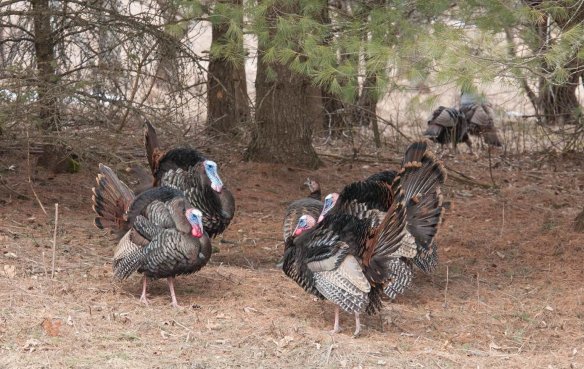
It was about two weeks ago that we started to see turkeys on a regular basis. Small groups of them would roam through the yard as they scratched and pecked at residual seeds on the ground.
Although the turkeys we observe in the winter months come as bachelor groups or all hens, the latest flocks are a mixture. Mating season is coming which means it is time to think turkey hunting.
It has already been nearly 50 years ago that Minnesota imported 29 turkeys from Missouri. This swap involved an exchange of Minnesota ruffed grouse for Missouri wild turkeys.
One of the bigger opening days on the Michigan hunting calendar arrives in just 10 days: the start of the spring turkey hunting season.
Across a little more than five decades, Michigan wild turkeys have increased from small, lightly hunted flocks to birds seen almost everywhere and which almost anyone can hunt.
Odds were once long against drawing a spring license in the annual lottery, but today, every would-be Midland turkey hunter has opportunities a short drive from home, with plenty of turkeys and licenses available in a variety of formats.
And it all gets underway when the first wave of licenses becomes good on Saturday, April 23.
In 1969-70, Vermont Fish and Wildlife re-established native wild turkeys with the release of 31 wild birds from New York. Today, Vermont has an estimated wild turkey population of more than 45,000. Vermont Fish and Wildlife photo by John Hall
Spring turkey hunting season gets underway soon with youth and novice turkey hunting weekend April 23-24 and the regular spring turkey season open for the entire month of May.
“The youth and novice turkey hunting weekend provides an excellent opportunity for experienced hunters to teach young or new hunters how to safely and successfully hunt wild turkeys,” said Chris Bernier, Vermont’s wild turkey biologist.
A youngster must be age 15 or younger to participate in the youth hunting weekend. They need to complete a hunter education course and possess a hunting license, and a turkey hunting license with a free youth turkey…
Across the country, most residents are in favour of eating animals (72%) and hunting animals for sport (62%).
Vancouver, BC [April 8, 2022] – More than four-in-five Canadians are against hunting animals for sport, a new Research Co. poll has found.
In the online survey of a representative national sample, 81% of Canadians are opposed to trophy hunting, down seven points since a similar Research Co. poll conducted inSeptember 2020.
Almost four-in-five Canadians (79%, +3) oppose killing animals for their fur, while more than three-in-five (61%, -1) are against using animals in rodeos.
In Saskatchewan and Manitoba, 23% of residents are in favour of killing animals for their fur. The proportion is smaller…
An expedition to the forests of Louisiana say extinction of bird, last definitively seen in 1944, has been exaggerated
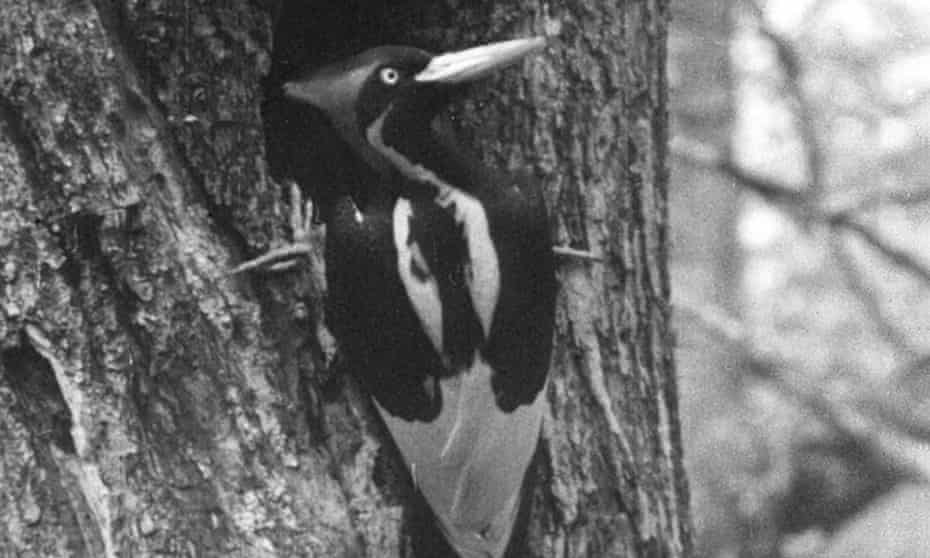
This photo taken from movie footage recorded by Arthur Allen in Louisiana in 1935 shows an ivory-billed woodpecker. Photograph: Arthur Allen/Cornell Lab of Ornithology/AFP/Getty Images
In terms of elusiveness, it is the Bigfoot or Loch Ness monster of the bird world, so rare and undetectable that the US government declared it extinct last year. But the ivory-billed woodpecker is, in fact, still alive and pecking in the forests of Louisiana, a team of researchers has claimed.
A series of grainy pictures and observations of the bird, which had its last widely accepted sighting in 1944, show that the scrupulously furtive woodpecker is still holding on in the swampy forests of the US south, according to the team’s new research, which is yet to be peer-reviewed.
A three-year quest to find the woodpecker involved scientists trudging through an undisclosed portion of Louisiana woodland to observe the bird and take audio recordings. Unmanned trail cameras, set up to take pictures on a time lapse, and a drone were used to capture photos of the creature.
Steve Latta, the director of conservation at the National Aviary in Pittsburgh who led the effort, said each member of the team had encounters with the ivory-billed woodpecker and often heard its call, which has been described like hearing a child puff into a tin trumpet.
Latta himself saw the bird fly upwards in front of him, showing the distinctive white edges to its wings. “It flew up at an angle and I watched it for about six to eight seconds, which was fairly long for an ivory-billed woodpecker,” he said. “I was surprised. I was visibly shaking afterwards. You realize you’ve seen something special that very few people had the opportunity to see.”
The size and the markings of the bird captured in the photos is strong evidence that it is not another woodpecker, such as a pileated or red-headed woodpecker, Latta said. “It reinforced to me that, yes, this bird does exist and left me feeling a sense of responsibility to protect it for the future,” he said.
Ivory-billed woodpeckers were once relatively common, stretching from the Carolinas through the south-east US to Texas. They were, or are, the largest woodpeckers in the US, with the males sporting a distinctive red crest on their heads. They enjoy feasting on insects that accumulate in the bark of recently deceased trees.
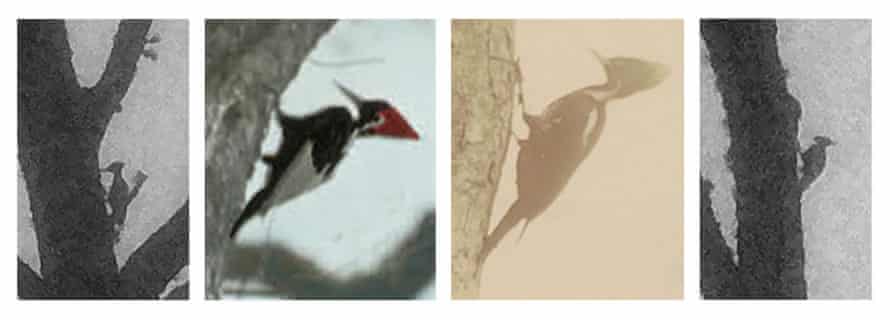
Comparison of photographs taken of apparent ivory-billed woodpeckers in Louisiana from this study (A, D), with a colorized ivory-billed woodpecker, also from Louisiana (B), and a pale-billed woodpecker taken in Central America (C). Photograph: The Guardian
Advertisement
Their numbers started to drop sharply in the 19th century due to human interference with their habitat and overhunting, with their scarcity spurring collectors to hunt them further as valuable specimens. They were also eaten by poverty-stricken people of the time who turned to devouring the woodpecker, wild turkeys, gopher tortoises and other wildlife.
With just a few of the birds occupying largely inaccessible forests, confirmed sightings, let alone clear pictures, became almost impossible. Last year, the US Fish and Wildlife Service (FWS), after years of listing the woodpecker as critically endangered, declared the species extinct.
“No one has held a camera and got a picture of one in years because it’s a scarce bird in tough swampy habitat and they don’t want people close to them because they’ve been shot at for 150 years,” said Geoffrey Hill, a biologist at Auburn University who took part in another, largely frustrating, trip to find the bird in Florida in 2005.
“They have better eyes than we do, they are high in the trees and actively flee people. They aren’t great thinkers but they have developed a pretty simple strategy to avoid people.”
Hill said Latta’s research was “very interesting” and that he thought it likely that the bird pictured is indeed an ivory-billed woodpecker. He added that the FWS was premature to decide the species was extinct and that several dozen could still be holding on in forests across the south.
“Some people cannot believe a bird can defy documentation by modern humans because we have such dominion over nature but it is endlessly interesting because if it has done that, it’s one pretty impressive bird,” Hill said.
“People who are into birds are fascinated by them. Ivory bills couldn’t care less, though. They hate all people.”
A pack of wolves in Yellowstone National Park are spotted from a wildlife tracking plane
Courtesy of Yellowstone National Park
This winter saw the most wolves from Yellowstone National Park killed in about a century. That’s because states neighboring the park changed hunting rules in an effort to reduce the animals’ numbers. At the same time, wolf biologists inside the park are finding out what losing the animals means.
“This was the winter of my discontent,” Yellowstone National Park senior wolf biologist Doug Smith says while driving over a washboarded dirt road near the park’s northern border.
“The park line’s right over here, and that’s where a lot of the controversy occurred,” he says, gesturing to the unmarked edge of the park just in front of us.
A line of buses placed by Ukrainian Azov Battalion defenders to impede the advance of Russian / pro-Russian forces as they fight deeper into the city is seen on March 23, 2022, in Mariupol, Ukraine.
LONDON (Reuters) -President Vladimir Putin said on Tuesday peace talks with Ukraine had hit a dead end, using his first public comments on the conflict in more than a week to vow his troops would win and to goad the West for failing to bring Moscow to heel.
Addressing the war in public for the first time since Russian forces retreated from northern Ukraine after they were halted at the gates of Kyiv, Putin promised that Russia would achieve all of its “noble” aims in Ukraine.
In the strongest signal to date that the war will grind on for longer, Putin said Kyiv had derailed peace talks by staging what he said were…
In case you are not aware, hydrogen as a source of energy has become controversial. It is promoted as a clean replacement for fossil fuels, without greenhouse gases at the tailpipe. Even so, producing and storing hydrogen is energy-consuming, questioning its potential as a green solution. A new study shows that hydrogen has another big problem, as it becomes itself a greenhouse gas when released into the atmosphere. Long term, it might be 11 times worse than CO2 for the climate.
6 photos
Light-duty vehicles have passed the phase when hydrogen can be a viable solution. Battery-electric vehicles have already proved better and gained traction with consumers. But for other areas like maritime transport, heavy trucks, trains, and industrial applications, hydrogen still promises to be aclean alternative to fossil fuels. Not to…