Civilian volunteers from the new group of Territorial Defense Units set up by veterans of the Azov Regiment train in a secret location in Dnipro, Ukraine, on March 6, 2022.
They don’t fully control the skies, despite possessing one of the world’s most advanced air forces. Their ground assault on the capital has been inching along for days, with a miles-long convoy marooned by supply problems. And all the while, they are taking heavy losses — both in equipment and personnel, as estimates suggest more dead troops than America suffered during 20 years of war in Afghanistan.
Two weeks after Russian forces streamed into neighboring Ukraine following months of buildup, evidence is mounting that the invasion has not gone to plan — and that Russia’s much-vaunted military may not be the formidable force once feared.
“The word I’m hearing from everybody in the government who is watching…
They don’t fully control the skies, despite possessing one of the world’s most advanced air forces. Their ground assault on the capital has been inching along for days, with a miles-long convoy marooned by supply problems. And all the while, they are taking heavy losses — both in equipment and personnel, as estimates suggest more dead troops than America suffered during 20 years of war in Afghanistan.
Two weeks after Russian forces streamed into neighboring Ukraine following months of buildup, evidence is mounting that the invasion has not gone to plan — and that Russia’s much-vaunted military may not be the formidable force once feared.
“The word I’m hearing from everybody in the government who is watching this is ‘surprising.’ My own word is ‘shocking,’” said Barry Pavel, a former top Pentagon official who is now senior vice president at the Atlantic Council. “It’s shocking how incompetent they are in the basics of joint military operations by an advanced country.”
That doesn’t mean Russia won’t ultimately seize Kyiv and topple the Ukrainian government. And it doesn’t mean Ukraine won’t pay a horrific price in both military and civilian casualties, as it continues to do daily.
Pause
Loaded: 100.00%LQCaptionsFullscreenUnmute
Russia’s war in Ukraine enters a third week
But the stumbling pace of Russia’s assault since President Vladimir Putin ordered troops into Ukraine late last month — marked by apparent confusion among commanders plus viral images of downed Russian planes and tanks set alight — has reset expectations for how the conflict will unfold.
And it probably has raised the ultimate cost — to both Ukraine and Russia — of any eventual Russian victory, especially as Moscow appears to have abandoned plans for a lightning advance, relying instead on shelling besieged cities and launching unguided bombs from the sky.
“What’s the number of civilians killed by days and days and days of artillery? What’s the number that leads to a more favorable Russian position?” Pavel asked. “I’m really worried about that.”
While the invasion has turned into a bloody slog in the face of a fierce Ukrainian resistance, Russian forces have continued to make slow advances around multiple cities — particularly in the south, where several major cities appear in danger of falling in the coming days. Only one major city, Kherson, has so far been taken by the Russians.‘No off-ramps’: U.S. and European officials don’t see a clear endgame in Ukraine
In the north, progress has been tougher to discern.
The British Defense Ministry said Friday that Russia appeared to be repositioning its troops north of the capital and could soon launch new operations against Kyiv, after a protracted stretch in which a long column of Russian vehicles had stalled. Satellite images, meanwhile, appeared to show the column breaking up into smaller contingents.
A senior U.S. defense official, who spoke on the condition of anonymity because of the sensitivity of the issue, had said Thursday that leading elements of that advance were nine miles from the center of Kyiv, down from about 12 miles for the prior several days.
The official described the movement of the column as “creeping” and said it was “very difficult” to predict how long it could take for Russian forces to make a more serious movement. Another advance on Kyiv from the east was just under 20 miles from the city center.
Airstrikes, meanwhile, targeted sites in western Ukraine, authorities said Friday, signaling the possible expansion of the war beyond the country’s east and center. As of Thursday, the Russians had launched 775 missiles at Ukraine since the invasion began, the senior defense official said. The number continues to climb by a few dozen per day.
But Britain’s Defense Ministry said Thursday that there had been a “notable decrease” in Russian air activity over Ukraine in recent days. In an intelligence briefing, officials said the slowdown probably was due to the “unexpected effectiveness and endurance of Ukrainian air defense forces.”
Officials added that the large Russian column north of Kyiv had “made little progress in over a week and is suffering continued losses.”
British Defense Secretary Ben Wallace told Parliament on Wednesday that Russia had nearly twice the number of battalion tactical groups at its disposal than did Ukraine when the war began, and that air superiority tilted the balance even further toward an “overwhelming” Russian advantage. But Wallace said nearly all of Moscow’s objectives in Ukraine have remained unfulfilled.
“President Putin’s arrogant assumption that he would be welcomed as a liberator has deservedly crumbled as fast as his troops’ morale,” Wallace said.
Ukrainian officials have held a series of news conferences in recent days in which captured Russian soldiers have said they regretted their parts in the war and did not know they would be invading Ukraine until a day before the attack began.
Assessing the exact number of Russian losses in combat has been complicated by the fog of war and the difficulty of interpreting a steady string of photos and videos flashing across social media that depict weapons and vehicles that were seized by Ukrainian forces, destroyed or abandoned.
The Ukrainian military posted on Facebook on Wednesday that since the invasion began, the Russians had lost 12,000 people, 526 vehicles, 335 tanks, 123 artillery systems and 81 helicopters. If those numbers are accurate, the Russians have lost nearly 7 percent of the 190,000 troops they had arrayed at Ukraine’s border before the invasion began.
It was not immediately clear whether the losses of soldiers include both dead and wounded troops, as well as those taken as prisoners of war.
On Tuesday, senior U.S. intelligence officials said they assessed that 2,000 to 4,000 Russian soldiers have been killed, while adding the caveat that they have “low confidence” in those numbers based on the limited information they have.
Even the lower American estimate would mark an extraordinary loss of life for the Russian military, which was expected to overwhelm Ukrainian forces. During the entire 20-year U.S. war in Afghanistan, 2,461 U.S. troops died. About an additional 4,500 U.S. troops were killed in the U.S. war in Iraq from March 2003 to December 2011, according to Defense Department statistics.
Michael Kofman, director of Russia studies at CNA, a think tank outside Washington, said the U.S. figure probably is closer to the truth than the Ukrainian one, which he said appears to be exaggerated. Still, he said, that scale of loss is significant — especially when coupled with the loss of hundreds of vehicles, including about 160 tanks, according to open-source reporting he has reviewed.
“Probably we’re going to start looking at exhaustion of their force in the next several weeks,” Kofman said. “They’re probably going to reorganize and replenish.”
Replenishing is something Russia can still do. After an erratic showing by the Russian military during a brief war in the republic of Georgia in 2008, Putin went on a spending binge. Moscow has spent about $154 billion annually on defense in recent years, according to Russian state media, though analysts caution that both corruption and a lack of transparency in the Kremlin make it difficult to assess that figure.
“Yeah, they’ve lost a lot of equipment. But they have a tremendous amount of equipment to begin with, and many of the things they’ve lost are actually pretty replaceable,” Kofman said, noting that Russia still possesses the majority of its best jets, all of its submarines and a variety of other weapons.
The senior U.S. defense official said Thursday that Russia has “greater than 90 percent of their available combat power” still available for use in Ukraine. The official added that the Pentagon has seen no signs of the Russians sending reinforcements.
The past two weeks have shown that just because Russia has the tools of war, that does not mean commanders know how to effectively use them.
François Heisbourg, a French political analyst who used to advise President Emmanuel Macron on national security, said the Russian advances have been strikingly limited.
“They’ve only taken one regional capital out of the 26 which were free of Russian influence before Feb. 25,” Heisbourg said.
And with a fight looming against dug-in Ukrainian troops in each of the cities that remain, it is unclear whether Russia has the capacity — or the will — to succeed.
“The logistics are pathetic. The soldiers are definitely not motivated,” he said. “It’s not what you would call a steady advance. There is actually very little terrain occupied.”
Dominique Trinquand, a retired French general and former head of the French military mission to the United Nations, said the Russians are primarily gaining ground in the south of Ukraine, where there appear to be fewer Ukrainian troops.
The Russians have a strong footprint in that part of the country, including an accumulation of tanks, artillery and protected infantry. “And they are attacking from two sides, from Crimea and from Donbas,” Trinquand said.
He said he expects the Ukrainian city of Mariupol to fall to the Russians within the next four or five days. Other Ukrainian cities in the south, including Odessa, are also at risk of Russian advances. “In Odessa, they will be able to attack from the sea, from the land and from the air,” he said.
Trinquand said Kyiv — where a large-scale evacuation of civilians is underway — will be far trickier. He does not expect Kyiv to be bombed in the same way as Syria’s Aleppo was destroyed. It is more likely, he said, that Russia will use the military pressure it’s already putting on the capital as a bargaining chip in negotiations with Ukraine, “meaning: ‘We’ve captured the south, we are putting pressure on the capital, and now let’s talk,’” he said.
After a call between Macron and Putin last week, a senior French official said his country’s assessment is that Putin wants to take control of the entire country.
But Trinquand said he is not sure that is the Russians’ aim.
Nor, apparently, do they have the dominance in the skies that had been widely forecast.
Malcolm Chalmers, deputy director general of RUSI, a London-based think tank, said he’s been surprised at the “very poor performance” of the Russian air force, which has yet to knock out all Ukrainian air assets and defenses — something he had thought would take a matter of days.
The Russian air force, although old, consists of several hundred high-end fixed-wing aircraft that are roughly equivalent to their Western counterparts. But the Russians, he said, “don’t seem to be able to coordinate the use of them together, and deconflict them and ensure they aren’t shooting each other.”
Still, he cautioned against underplaying Russia’s strength. It may not have taken the skies or advanced quickly on the ground, but Russia does have the firepower to do immense damage to Ukraine.
“Having painted the Russians as 10 feet tall compared with Ukrainians, now some people are painting them two feet tall,” Chalmers said. “It’s somewhere in between. They are still a formidable adversary.”
Rather than getting pigs out of crates for their entire 16-week pregnancy, as it had committed to doing, McDonald’s decided to let its suppliers continue to lock pigs in gestation crates for the first four to six weeks and only then move them into group housing. The HSUS
For decades, the Humane Society of the United States has led the charge against the cruel confinement of animals on factory farms. It’s a big fight, one of the biggest, and it involves hundreds of millions of animals locked in cramped spaces all across this country, from egg-laying hens locked in cages to veal calves. Mother pigs are locked in crates so small, they are unable to turn around or take a step in any direction. It’s not uncommon to find these crates bloodied as pigs desperately chew on the metal bars that are inches from their faces, day in and day out.
There has been tremendous movement away from these practices already. Our public awareness campaigns have educated and engaged millions of consumers. Our legislative campaigns have produced groundbreaking laws to prohibit intensive confinement practices in our states. We’ve also worked with hundreds of food companies to support their establishment of policies to eliminate this systematic cruelty at immense scale from their supply chains. And that includes the world’s largest fast-food chain, McDonald’s.
Ten years ago, in February 2012, McDonald’s and the HSUS jointly announced the company’s commitment to end this cruelty and chart a better and more responsible course with a press release about ending gestation crates in its pork supply. In May that same year, the company issued a second press release stating that it would end these crates for pregnant sows by 2022—this year.
In both releases, the company’s language was crystal clear:No gestation crates for pregnant pigs.
In 2017, McDonald’s reached out to the HSUS to let us know that it was only buying pork from suppliers who shared that goal. That sounded great, but given that there were no major pork suppliers who’d pledged to end gestation crates, we were puzzled as to how it could be true. So we pressed McDonald’s for details. And that’s when it became clear to us that McDonald’s was not actually “ending” gestation crates for pregnant pigs, as it had publicly declared, but merely reducing their use.
Here’s how it works:A pig’s pregnancy lasts 16 weeks. Rather than getting pigs out of crates for that entire time, McDonald’s decided to let its suppliers continue to lock pigs in gestation crates for the first four to six weeks and only then move them into group housing. That amounts to a reduction of gestation crate confinement—but certainly not the endof it. And because pigs in these settings endure several pregnancies a year, McDonald’s approach means they still spend much of their lives locked up.
From 2017 to 2020, we privately challenged McDonald’s on this, but the company refused to budge. We eventually made its remarkable double-speak public in our 2020 Food Industry Scorecard (McDonald’s earned an “F” grade), but McDonald’s still wouldn’t move. Meanwhile, the company continued issuing misleading statements about its progress—maintaining that it was “phasing out” gestation crates.
At a certain point, we’d seen enough. We decided to elevate our concerns through shareholder advocacy, where we have a lot of experience and a record of success. Since 2005, the HSUS has owned stock in many major companies whose business decisions and practices touch animal welfare concerns, so that we may use our influence as stockholders to bring about change. Through our shareholder advocacy efforts, we’ve gained a number of allies and a lot of goodwill. Most importantly, we’ve moved companies to implement cage-free egg policies, gestation crate-free pork policies, fur-free policies and make other important reforms for animals.
In November 2021, as stockholders of McDonald’s, the HSUS filed a shareholder proposal with the company (which will be voted on at the company’s annual meeting this spring) about its misleading gestation crate claims.
McDonald’s spring meeting promises to be something of a double reckoning on animal welfare. First, there is our shareholder proposal, which points out the inconsistencies between what McDonald’s says it’s doing about gestation crates and the reality for pigs in its supply chain, and which calls for disclosure that would give shareholders the truth. and which calls for disclosure that would give shareholders the truth.
Second, we expect that there will be two independent candidates for the McDonald’s board, qualified people who we think could help the company straighten course and deliver in earnest on the promises it has made in the past:Maisie Ganzler and Leslie Samuelrich. Ms. Ganzler is a senior executive at Bon Appetit Management Company, a food service company with a stellar track record on animal welfare. Ms. Samuelrich is president of Green Century Capital Management, a socially responsible investment firm that’s taken strong stands in favor of better animal treatment in the food industry. The HSUS will be proud to vote our McDonald’s shares in favor of their candidacies.
It is pretty simple to comprehend what has occurred here:McDonald’s broke its promise to eliminate gestation crates for these mother pigs, who continue to suffer in the company’s supply chain—day after day, week after week. We think it’s time for their misery to end, and we’ll continue pressing McDonald’s to eliminate gestation crates once and for all. We have never shied away from a fight for what’s right for animals and will continue fighting for them in the public arena, in corporate contexts, in state legislatures, in the courts and beyond.
March 4 (Reuters) – Almost a third of people report at least one ongoing symptom between 6 and 12 months after their coronavirus infection, a survey of 152,000 people in Denmark has found.
The study includes one of the largest groups yet of people who were not hospitalised with COVID, and followed them for longer than other major studies, the researchers from Denmark’s State Serum Institute (SSI) said.
The questionnaire-based study suggested that the most commonly reported long-term symptoms were changes in sense of smell and taste, as well as fatigue.
Conducted between September 2020 and April 2021, well before the recent Omicron variant surge, the survey compared the responses of 61,002 people who had tested positive for the coronavirus six, nine or 12 months before with…
An example of a losing plant species not useful to humans is Araucaria muelleri, a New Caledonian endemic conifer threatened by habitat loss, forest fires and nickel-mining activities.Photograph: Joey Santore, (CC-BY-NC)
Researchers have categorised more than 80,000 plant species worldwide and found that most of them will “lose” in the face of humanity – going extinct because people don’t need them.
This means that plant communities of the future will be hugely more homogenised than those of today, according to the paper published in the journalPlants, People, Planet.
The findings, which paint a stark picture of the threat to biodiversity, cover less than 30% of all known plant species, and as such are a “wake-up call”, say the researchers, highlighting the need for more…
As western governments untangle themselves from Russian oil and gas, Svitlana Krakovska notes that the roots of the climate crisis and invasion are in fossil fuels
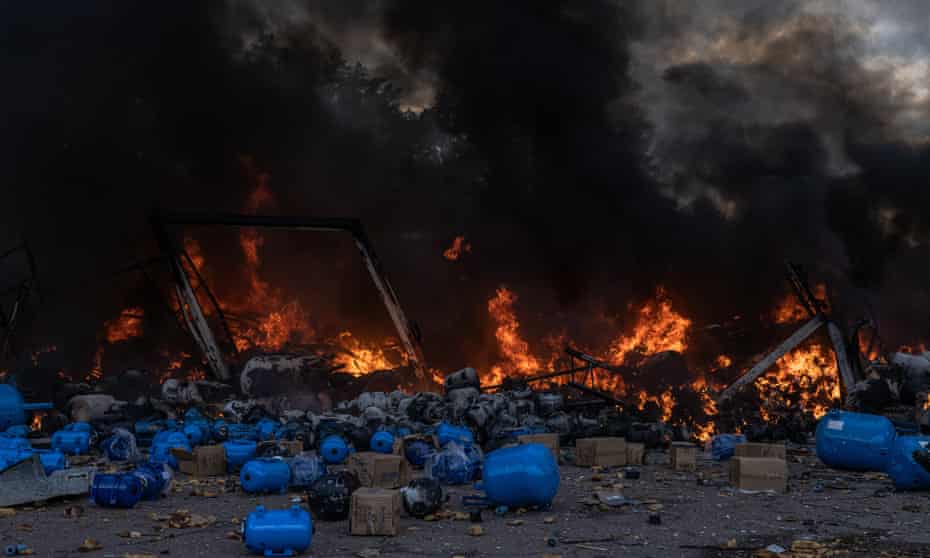
A fire at a warehouse after a Russian Kalibr missile was shot down over Kalynivka village in Ukraine on 8 March. Photograph: Roman Pilipey/EPA
For Svitlana Krakovska, Ukraine’s leading climate scientist, it was meant to be the week where eight years of work culminated in a landmark UN report exposing the havoc the climate crisis is causing the world.
But then the bombs started to crunch into Kyiv.
Krakovska, the head of a delegation of 11 Ukrainian scientists, struggled to help finalize the vast Intergovernmental Panel on Climate Change (IPCC) report ahead of its release on 28 February even as Russian forces launched their invasion. “I told colleagues that as long as we have the internet and no bombs over our heads we will continue,” she said.
But her team, scattered across the country, started to peel away – one had to rush to an air raid shelter in Kharkiv, others decided to flee completely, internet connections spluttered, one close friend of a delegate was killed in the fighting. International colleagues had to express their sympathies and press on with the report.
Krakovska’s four children sheltered with her in their Kyiv home as a missile struck a nearby building, emitting an ear-splitting roar. A fire from a separate strike sent up a plume of smoke that blotted the sky. “This blitzkrieg by [Vladimir] Putin is unbelievable, it is terrorism against the Ukrainian people,” she said.
Both the invasion and IPCC report crystallized for Krakovska the human, economic and geopolitical catastrophe of fossil fuels. About half of the world’s population is now acutely vulnerable to disasters stemming from the burning of fossil fuels, the IPCC report found, while Russia’s military might is underpinned by wealth garnered from the country’s vast oil and gas reserves.
“I started to think about the parallels between climate change and this war and it’s clear that the roots of both these threats to humanity are found in fossil fuels,” said Krakovska.
“Burning oil, gas and coal is causing warming and impacts we need to adapt to. And Russia sells these resources and uses the money to buy weapons. Other countries are dependent upon these fossil fuels, they don’t make themselves free of them. This is a fossil fuel war. It’s clear we cannot continue to live this way, it will destroy our civilization.”
The IPCC report, described by António Guterres, the UN secretary general, as an “atlas of human suffering and a damning indictment of failed climate leadership”, is the most comprehensive catalogue yet of the consequences of global heating. Extreme heat and the spread of disease is killing people around the world, about 12 million people are being displaced by floods and droughts each year and the viability of food-producing land is shrinking.
But it is the conflict in Ukraine that has caused western governments to hastily attempt to untangle themselves from a reliance upon Russian oil and gas. The EU, which gets about 40% of its gas supply from Russia, is working on a plan to rapidly upscale renewable energy, bolster energy efficiency measures and build liquified natural gas terminals to receive gas from other countries.
It’s clear we cannot continue to live this way, it will destroy our civilization
Joe Biden, meanwhile, has relented to pressure from US lawmakers to ban imports of Russian oil. The ban, the US president said on Tuesday, will deliver a “powerful blow to Putin’s war machine. We will not be part of subsidizing Putin’s war.” Biden said the US will work with Europe on a long-term plan to phase out Russian oil and gas.
The halting of imports was urged in an emotional appeal to members of Congress by Volodymyr Zelenskiy, the Ukrainian president, and is backed by a bipartisan majority of lawmakers. “It’s basically foolish for us to keep buying products and giving money to Putin to be able to use against the Ukrainian people,” said Joe Manchin, the centrist Democratic senator.
Others see the ban as a moment to decisively break from fossil fuels altogether. “This moment is a clarion call for the urgent need to transition to domestic clean energy so that we are never again complicit in fossil-fueled conflict,” said Ed Markey, a progressive Democratic senator who was a driving force behind the Green New Deal agenda.
But in a stark demonstration of how deeply embedded fossil fuels remain in decision making, Biden’s administration has awkwardly attempted to extol its efforts to confront the climate crisis while also boasting that the US is now drilling more oil than even under Donald Trump to show it is cognizant of public anguish over rising gasoline prices, a perennial political headache for presidents.
“We don’t have a strategic interest in reducing the global supply of energy,” Jen Psaki, the White House press secretary, said last week. “That would raise prices at the gas pump for the American people, around the world, because it would reduce the supply available.”
While the US takes a relatively small amount of oil from Russia – only about 3% of all oil imports – experts say it is telling that an administration vocal about the need to reduce fossil fuels has found it difficult to cut itself from its dependency on oil and gas.
“It’s a crude oversimplification to call this a fossil fuel war, that’s a little too glib,” said Jonathan Elkind, an expert in energy policy at Columbia University and a former energy adviser to Barack Obama’s administration. “But it’s an undeniable reality that Russia gets a significant share of its revenues from oil and gas and that America’s gasoline habit contributes towards the global demand for 100m barrels of oil each day.
“Do we want to find ourselves 10 years from now where we’ve bent the curve on oil consumption and emissions towards decarbonization, or do we want to sit there and think ‘where did the last 10 years go?’ If the US isn’t a part of the solution we will put in peril our influence on the world stage and the fate of everyone, both here and around the globe.”
While Europe belatedly attempts to wean itself off Russian gas, efforts to phase down fossil fuels in the US have faltered. Biden’s legislative plan to drastically ramp up renewable energy is moribund in Congress, largely thanks to Manchin, while the conservative-leaning supreme court is mulling whether to weaken the administration’s ability to regulate coal-fired power plants.
The invasion of Ukraine has also triggered a push by the US oil and gas industry and its allies in Congress to loosen regulations to allow more domestic drilling. Manchin, chair of the Senate energy committee, has said that delaying new gas pipelines when “Putin is actively and effectively using energy as an economic and political weapon against our allies is just beyond the pale”. Even Elon Musk, founder of the electric vehicle company Telsa, has said that “we need to increase oil and gas output immediately. Extraordinary times demand extraordinary measures.”
The White House has pointed out that the industry is already sitting on a huge number of idle drilling leases – a total of 9,000 unused permits covering 26m acres of American public land – while environmentalists argue the crisis highlights the dangers of being at the mercy of a volatile global oil price, now near an all-time high, rather than shifting towards solar, wind and other sources of clean energy.
“The fossil fuel industry’s so-called solution to this crisis is nothing more than a recipe to enable fossil-fueled fascists like Vladimir Putin for years to come,” said Jamal Raad, executive director of Evergreen Action. “As long as our economy is dependent on fossil fuels, we will be at the mercy of petro-dictators who wield their influence on global energy prices like a weapon.
“American-made clean energy is affordable, reliable and free from the volatility of oil and gas markets. The best way to weaken Putin’s grip on the global energy market is to get America off of fossil fuels.”
In Kyiv, Krakovska has said that she will stay in her home city as the Russian army advances, having declined offers to relocate to foreign research institutions. “I know that’s what Putin wants, for us to flee Ukraine so they can have our beautiful country,” she said.
“I have told scientists in other countries I will collaborate with them, but from an independent and free Ukraine. I couldn’t be in another place knowing that Kyiv was in the hands of those barbarians.”
Man receives pig heart in 1st successful transplant of its kind
Surgeons at the University of Maryland successfully transplanted a modified pig heart in…Read More
Byron Dillard via AP
The first person to receive a heart transplant from a pig has died, two months after the groundbreaking experiment, the Maryland hospital that performed the surgery announced Wednesday.
David Bennett, 57, died Tuesday at the University of Maryland Medical Center. Doctors didn’t give an exact cause of death, saying only that his condition had begun deteriorating several days earlier.
Bennett’s son praised the hospital for offering the last-ditch experiment, saying the family hoped it would help further efforts to end the organ shortage.
“We are grateful for every innovative moment, every crazy dream, every sleepless night that went into this historic effort,” David Bennett Jr. said in a statement released by the University of Maryland School of Medicine. “We hope this story can be the beginning of hope and not the end.”
Doctors for decades have sought to one day use animal organs for life-saving transplants. Bennett, a handyman from Hagerstown, Maryland, was a candidate for this newest attempt only because he otherwise faced certain death — ineligible for a human heart transplant, bedridden and on life support, and out of other options.
After the Jan. 7 operation, Bennett’s son told The Associated Press his father knew there was no guarantee it would work.
Prior attempts at such transplants — or xenotransplantation — have failed largely because patients’ bodies rapidly rejected the animal organ. This time, the Maryland surgeons used a heart from a gene-edited pig: Scientists had modified the animal to remove pig genes that trigger the hyper-fast rejection and add human genes to help the body accept the organ.
At first the pig heart was functioning, and the Maryland hospital issued periodic updates that Bennett seemed to be slowly recovering. Last month, the hospital released video of him watching the Super Bowl from his hospital bed while working with his physical therapist.
Bennett survived significantly longer with the gene-edited pig heart than one of the last milestones in xenotransplantation — when Baby Fae, a dying California infant, lived 21 days with a baboon’s heart in 1984.
“We are devastated by the loss of Mr. Bennett. He proved to be a brave and noble patient who fought all the way to the end,” Dr. Bartley Griffith, who performed the surgery at the Baltimore hospital, said in a statement.
Other transplant experts praised the Maryland team’s landmark research and said Bennett’s death shouldn’t slow the push to figure out how to use animal organs to save human lives.
“This was a first step into uncharted territory,” said Dr. Robert Montgomery of NYU Langone Health, a transplant surgeon who received his own heart transplant. “A tremendous amount of information” will contribute to the next steps as teams at several transplant centers plan the first clinical trials.
“It was an incredible feat that he was kept alive for two months and was able to enjoy his family,” Montgomery added.
The need for another source of organs is huge. More than 41,000 transplants were performed in the U.S. last year, a record — including about 3,800 heart transplants. But more than 106,000 people remain on the national waiting list, thousands die every year before getting an organ and thousands more never even get added to the list, considered too much of a long shot.
The Food and Drug Administration had allowed the dramatic Maryland experiment under “compassionate use” rules for emergency situations. Bennett’s doctors said he had heart failure and an irregular heartbeat, plus a history of not complying with medical instructions. He was deemed ineligible for a human heart transplant that requires strict use of immune-suppressing medicines, or the remaining alternative, an implanted heart pump.
Organ rejection, infections and other complications are risks for any transplant recipient. Experts hope the Maryland team quickly publishes in a medical journal exactly how Bennett’s body responded to the pig heart.
From Bennett’s experience, “we have gained invaluable insights learning that the genetically modified pig heart can function well within the human body while the immune system is adequately suppressed,” said Dr. Muhammad Mohiuddin, scientific director of the Maryland university’s animal-to-human transplant program.
One next question is what evidence, from Bennett’s experience and some other recent experiments with gene-edited pig organs, may persuade the FDA to allow a clinical trial — possibly with an organ such as a kidney that isn’t immediately fatal if it fails.
Twice last fall, Montgomery’s team at NYU got permission from the families of deceased individuals to temporarily attach a gene-edited pig kidney to blood vessels outside the body and watch them work before ending life support. And surgeons at the University of Alabama at Birmingham went a step further, transplanting a pair of gene-edited pig kidneys into a brain-dead man in a step-by-step rehearsal for an operation they hope to try in living patients possibly later this year.
Patients may see Bennett’s death as suggesting a short life-expectancy from xenotransplantation, but the experience of one desperately ill person cannot predict how well this procedure ultimately will work, said ethics expert Karen Maschke of The Hastings Center. That will require careful studies of multiple patients with similar medical histories.
Transplant centers should start educating their patients now about what to expect as this science unfolds, said Maschke, who with funding from the National Institutes of Health is developing ethics and policy recommendations on who should be allowed in the first studies of pig kidneys and what they need to know before volunteering.
Pigs have long been used in human medicine, including pig skin grafts and implantation of pig heart valves. But transplanting entire organs is much more complex than using highly processed tissue. The gene-edited pigs used in these experiments were provided by Revivicor, a subsidiary of United Therapeutics, one of several biotech companies in the running to develop suitable pig organs for potential human transplant.
in The southwest African country denies it violated an international wildlife treaty.
BYDINA FINE MARON PUBLISHED MARCH 9, 2022 • 5 MIN READ
Today, at a France-based global summit on the international treaty that regulates the wildlife trade, numerous countries condemned Namibia for its recent international sale and export of 22 wild African elephants.
Namibia says it has more than 24,000 elephants and that roundups of elephants are essential to alleviate potentially lethal encounters with humans and to raise money for conservation and wildlife management. Last year, elephants killed three people, and there have been numerous claims of crop damage in recent years, according to data the Namibian government shared with National Geographic.
The United Kingdom, among others, raised a number of questions about Namibia’s elephant export which appears to violate the Convention on International Trade in Endangered Species of Wild Fauna and Flora (CITES). That’s…







 Top Articles


