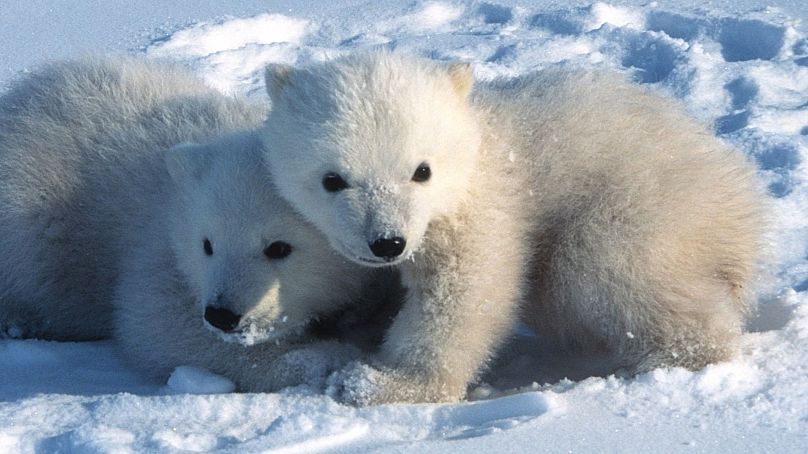
27 February is International Polar Bear Day, created to draw attention to the many threats the iconic species is facing.
The event was created by NGO Polar Bears International in 2011, to raise awareness of female polar bears and their cubs, which are currently denning across the Arctic.
The polar bear is labelled vulnerable by the International Union for Conservation of Nature (IUCN)’s red list, which estimated that there are 20-25,000 bears in 5 countries. It is very hard to get exact data about the population because of the severity of the circumstances.
Protecting the most vulnerable of them is crucial in order to secure the future of the species, which is already threatened by global warming and habitat loss. The disappearing sea ice means that the bears’ hunting and denning territory is rapidly disappearing.
The latest study published in Nature Climate Change in 2020 projects that if there is no change in greenhouse gas emission levels, all but a few populations will be wiped out by the year 2100.
about:blank
Protecting the cubs is key to protecting the species
Keeping mother and cubs safe, while also addressing a warming climate, is a critical part of polar bear conservation. A stable, uninterrupted denning process is essential to the survival of polar bears.
Right now, scientists from Polar Bears International and partner organisations are in Svalbard, Norway, conducting research and working on locating and monitoring dens in order to protect them from human activities.
Polar bear cubsPolar Bears International/Steven C. Amstrup
“It can really disturb the mothers and if they are disturbed too much, or at the wrong period of time the mum may actually leave the den and leave the small cubs behind,” says scientist at Polar Bears International, Dr. Thea Bechshoft.
“Studies have shown that polar bear cub mortality can be incredibly high, upwards of 50 to 75 per cent.”
Geopolitical tensions could have an impact on global warming
The ongoing war in Ukraine could have a huge impact on worldwide efforts to mitigate climate change and global warming, warns the scientist.
“This war may create a shift in energy use that could either go towards more fossil fuels or it could go towards a quicker, greener transition. Time will tell, ” says Bechshoft.
Watch the video to learn more about saving polar bears.
Two men, aged 34 and 49, were fined a total of €1,000 in separate cases of possession and use of an illegal device which mimics bird sounds to attract prey, police said on Thursday.
The older man was booked €500, after he was found by a patrolling game service officer using of the specific device while hunting in Kamenes area at Neo Chorio in Paphos around 8.40am on Wednesday.
Authorities confiscated six killed wild birds, his hunting shotgun and 20 full cartridges.
Later that day, a 34-year-old man was also booked the same amount as he was found hunting in the ‘Mahouzis’ in Lemonas area with a device mimicking various bird sounds in his possession.
A lone bull bison saunters down a Yellowstone National Park road in December 2021. The Park Service has begun the process of creating a new management plan for bison. Photo courtesy Jacob W. Frank, NPS
Yellowstone National Park announced Tuesday that bison trapping has begun near the park’s northern border, meaning efforts to cull the population through shipment to slaughter are underway.
Trapping at the Stephens Creek administrative area began late last week, according to the park. Bison are captured at the corrals near Gardiner as they migrate beyond the park’s boundaries in search of food.
Park officials did not confirm how many bison have been trapped at Stephens Creek so far this year. After bison are trapped, those animals that aren’t enrolled in a quarantine program are slaughtered. Meat and hides are distributed to tribes.
Buffalo Field Campaign, a group that advocates for free-roaming wild bison on the landscape, wrote last Friday that their patrol witnessed the capturing of 23 adult bison at the Stephens Creek facility last Wednesday.
Another 11 adult bison were seen captured there on Thursday, according to the group.
During an interagency meeting in Missoula last December, park biologists estimated that the Yellowstone bison population numbered at around 5,400 animals.
Officials who manage Yellowstone bison under the Interagency Bison Management Plan agreed to reduce the population by between 600 and 900 animals last year.
Up Next – Trotter tells story of Gayle Benson responding to young girl who applied to be Saints’ head coach
Up Next – Trotter tells story of Gayle Benson responding to young girl who applied to be Saints’ head coachclose
Up Next – Trotter tells story of Gayle Benson responding to young girl who applied to be Saints’ head coach
NFL Network’s Jim Trotter tells story of Gayle Benson responding to young girl who applied to be New Orleans Saints’ head coach.
Cynthia Frelund reveals who NFL’s highest-paid player of 2022 is (as of now)
NFL
|
0:25
Trotter tells story of Gayle Benson responding to young girl who applied to be Saints’ head coach
NFL
|
0:39
Wolfe reveals why Tagovailoa is wearing a Georgia Bulldogs shirt on 2-2-22
NFL
|
0:32
Doug Pederson: ‘You see flashes’ of talent on this Jaguars roster
NFL
|
0:51
Stafford celebrates Super Bowl LVI win with daughters on field
NFL
|
0:09
Van Jefferson finds out wife is in labor after Rams’ Super Bowl win
NFL
|
0:17
Cooper Kupp waves to fans at Rams parade wearing Kobe Bryant jersey
NFL
|
0:07
Matthew Stafford throws passes to fans from Rams parade bus
NFL
|
0:13
Aaron Donald goes shirtless at Rams parade
NFL
|
0:17
Is Russell Wilson a good fit for the Washington Commanders?
Football
|
3:00
Bison aren’t tolerated much in Montana due to the risks that brucellosis pose to the livestock industry, so the population must be culled annually to keep numbers steady in the park.
Shipment to slaughter is one of three methods that bison managers use to cull Yellowstone’s population. Animals are also removed through tribal and state hunting and the Bison Conservation Transfer Program — a brucellosis quarantine program meant to produce disease-free animals that can be released elsewhere.
Last winter, there was no trapping of bison at Stephens Creek because the animals’ annual migration did not occur ahead of calving season. Migrations are influenced by multiple factors, but cycling between low and high temperatures likely delayed the one last year.
Carteret County Sheriff Asa Buck speaks with reporters in Carteret County, N.C., on Monday, Feb. 14, 2022. Authorities say four teenagers and four adults returning from a hunting trip were on board a small plane that crashed off the coast of North Carolina over the weekend.
TEL
Law enforcement get ready for a search after a small plane crash in Carteret County, N.C., on Monday, Feb. 14, 2022. Authorities say four teenagers and four adults returning from a hunting trip were on board a small plane that crashed off the coast of North Carolina over the weekend.
A plane carrying eight people — including four teenagers — had issued no distress calls and made no declarations of an emergency before it crashed off the North Carolina coast, the National Transportation…
Published at8:39 am, February 26, 2022|Updated at8:39 am, February 26, 2022
SHARE THIS
The Cache Creek Pack, west of Missoula, is pictured on March 26, 2013. | Montana Fish, Wildlife and Parks viaHelena Independent Record
HELENA, Montana (AP) — Despite a recent interpretation of Montana state law that aerial hunting of wolves is not prohibited, doing so runs afoul of federal law.
Montana Fish, Wildlife & Parks argued in the state District Court recently that state law does not prohibit aerial hunting of wolves. FWP’s arguments came as legal justification for the agency removing language from the state’s wolf regulations that had stated hunting wolves from aircraft was barred. The agency says that inclusion of that language in the regulations for a decade was an error.
In response to media reporting on the case, a number of readers pointed to federal law addressing aerial…
The Chinese government has made clear that it will remain a strategic ally of Russia despite President Vladimir Putin being viewed globally as the aggressor in the war.
Chinese President Xi Jinping and Russian President Vladimir Putin enter a hall for talks in the Kremlin in Moscow, Russia in 2019. | Alexander Zemlianichenko, Pool, File/AP Photo
As the war between Russia and Ukraine intensifies, China is betting that it comes out the winner. In the past week, Beijing has carefully calibrated its position, opening in neutral then going all-in behind Moscow.
The Chinese government has demonstrated its alignment with Putin in recent days by blaming the U.S. for Russia’s assault on Ukraine, parroting Russia’s Orwellian description of the invasion as a “special military operation” and rationalizing that aggression as an expression of the Kremlin’s “legitimate” perceptions of regional insecurity.
Lionel de Lange flew to Ukraine on Monday as part of a relocation project for a bear. Image: SUPPLIED
Gqeberha wildlife rescuer Lionel de Lange, who flew to Ukraine on Monday as part of a relocation project for a bear named Masha, finds himself amid the country’s tense conflict with Russia and with his rescue plans temporarily placed on hold.
ADVERTISEMENT
Despite the volatile situation, De Lange committed to a project in partnership with Free the Wild, and opted to take the risk and left his Ukrainian wife, Anya, at the Gqeberha-based Simbonga Game Reserve near Thornhill.
He is staying at Anya’s parents’ house in the city of Kherson in southern Ukraine.
In That Weekend Feeling with Daron Mann this week, De Lange describes what is unfolding in the country — his home for 11 years — and his exit plan.
Experts are increasingly concerned about long COVID and long COVID symptoms.
Thecoronavirus pandemicis slowing down at the moment as coronavirus cases continue to drop across the world.
However, doctors are still expressing concern over another type ofCOVID-19 symptoms— long COVID.
What’s happening:COVID-19 survivors across the world are feeling long-term side effects from their coronavirus infection, which has been deemed “long COVID.”
What they’re saying:“Many people with mild symptoms recover fully from COVID-19 after a few weeks, especially those who are vaccinated,”Sean Marchese, a registered nurse withThe Mesothelioma Center, toldEat This, Not That!Report ad
Roughly a decade ago, a team of biologists glued audio recording devices onto the backs of a handful of elephant seals on the California coast. They wanted to know if the seals — identified as males by their cartoonish faces with trunk-like noses — make noises as they swim out to sea in search of food.
The recordings they brought back caught the researchers by surprise. There was no evidence of seals vocalizing while foraging, but the devices did pick up something else: the eerie, clicking calls of sperm whales, which sound like someone walking up a creaky staircase. Some of the calls also seemed to get louder, leading the researchers to believe that the seals were swimming toward the whales, and maybe even eavesdropping on them to find food.
Nothing much came of that discovery, but it has inspired marine biologists to use seals as a tool to eavesdrop on other marine life. Elephant seals spend about nine months each year at sea and travel across far reaches of the Pacific that would otherwise be difficult for scientists to survey. And like migratory birds, the seals return to the same spot year after year, so researchers can equip them with recording devices and retrieve them relatively easily.
As soon as next week, marine biologists at the University of California Santa Cruz (UCSC) will test out this slippery technique. They’ll attach acoustic monitors to a few northern elephant seals before the animals depart for a little over two months.
If all goes as planned, it will be the first time scientists use animals — rather than a network of underwater microphones — to spy on marine life in the deep ocean for longer than a few days. What they overhear could help scientists unlock the mysteries of elusive marine mammals, such as beaked whales, and understand how poorly known ecosystems are changing as the planet warms.
Why seals make such good spies
Scientists have used audio recording devices to monitor marine life for decades. It’s a common way to survey species like the rare vaquita porpoise. What makes this project unique, however, is that these devices won’t be fixed in place or dangling from a boat — they’re attached to living, breathing, moving animals.
Elephant seals might look clumsy on land, but they’re agile underwater creatures that make ideal marine sentinels. They spend months at a time foraging far offshore, not even returning home to sleep. The animals likely take naps while drifting a few hundred meters underwater, said Roxanne Beltran, an assistant professor at UCSC who’s co-leading the project.
Elephant seals descend as much as a mile underwater when hunting for small fish, squid, and even sharks, and that brings them within earshot of whales and other marine mammals. Conveniently enough, seals themselves don’t make much noise. “They’re not contaminating the data,” said Holger Klinck, an expert in bioacoustics at Cornell University who’s co-leading the project with Beltran. “They’re really only measuring what’s going on in their surroundings.”
Perhaps most importantly, the seals return to the same beach each year, which reduces the risk of losing equipment. For the project at UCSC, each recording device is roughly the size of an old cellphone and costs about $5,000. It isn’t capable of beaming acoustic data back to shore, Beltran said, so if you lose the device, you lose everything.
A mother and baby elephant seal at Año Nuevo, a beach in Northern California.Elephant seals at Año Nuevo State Park in California.
Using an epoxy adhesive, Beltran and Allison Payne, a doctoral researcher at UCSC, will glue recording devices onto three female seals at Año Nuevo Reserve in Northern California. (Females have a much higher survival rate and reliably head out to sea right after weaning their pups.) Beltran is building on research led by UCSC’s Dan Costa, who heads a project to monitor local seals that dates back to the 1960s.
Then they’ll wait. The seals will make it about a quarter of the way to Japan before turning back, in a trip that takes roughly 75 days. The device will record about 40 days of audio before the batteries run out, while other tags measure things like location, depth, and water temperature, leaving the scientists with lots of clues to what’s happening in a largely unknown stretch of ocean.
Uncovering mysteries of the deep
When the animals return, scientists will meet them on the beach and retrieve the devices before sending the seals on their way. (The devices don’t harm the seals or change their behavior, Beltran said.) Then they’ll run the audio through computer algorithms that separate out the unique sounds made by each species. A humpback whale can sound a bit like a whining puppy crossed with Chewbacca, for example, while orcas often sound like a metal detector gone haywire.
Payne will be listening closely for the echolocating clicks of beaked whales. This group of toothy marine animals, often gray or black and white, have eluded scientists for decades. “We know almost nothing about them,” she told Vox.
Beaked whales make up more than a quarter of living cetaceans (a group that includes dolphins, porpoises, and whales), but scientists don’t know where they go in the ocean or what they do, she said. They spend most of their time deep underwater and rarely surface for air, Payne added. There are more than 20 species of beaked whales, and much of what we know about them comes from carcasses that occasionally wash up on shore.
A Cuvier’s beaked whale in the Bay of Biscay, in the northeast Atlantic Ocean.
It’s hard to protect a species you don’t understand, Payne said. For example, researchers thinkthatnoise from shipping traffic harms beaked whales, but scientists can’t say for sure — because they simply don’t know what these animals are doing.
Researchers also hope to build an auditory archive of the ocean over years to understand how marine communities are changing, especially as the planet heats up. How, for example, is the giant patch of warm water in the Pacific Ocean, dubbed “the blob,” affecting marine communities? “The elephant seals can help us collect information where we have little to no data,” Klinck told Vox.
For now, Beltran and her team are just trying to prove that it can work. If it does, she hopes to scale it up and start collecting sounds in all kinds of marine environments — not just far offshore, but near the coast and even under Arctic ice. Perhaps in the future, legions of elephant seals will unwittingly survey the ocean in the name of science.