Kyiv and Lviv, Ukraine (CNN)Russian President VladimirPutin has ordered troopsinto separatist-held parts of eastern Ukraine in what the Kremlin called a “peacekeeping” mission, just hours after he signed decrees recognizing the independence of the Moscow-backed regions.
It is unclear if Russian troop movements marked the beginning of an invasion of Ukraine thatWestern leaders have warnedabout for weeks. But multiple US and Western officials cautioned Monday’s move could serve as the opening salvo of a larger military operation targeting the country.
US Ambassador to the UN Linda Thomas-Greenfield told an emergency meeting of the UN Security Council Monday evening that Putin’s recognition of the pro-Moscow regions was an “attempt to create a pretext for a further invasion.”
She said his claim that Russian forces are entering those regions as “peacekeepers” is “nonsense.”
“We know what they really are,” Thomas-Greenfield…
The steamy, jungle-covered tropical island of Borneo was once considered one of the remotest, wildest places on earth. A place where orangutans and headhunters lurked undisturbed.
Together with neighboring Sumatra, it’s one of just two places in the world where the orangutan lives in the wild.
For decades, forestry and agriculture have whittled away orangutans’ forest home, placing them in great peril, according to the WWF.
As deforestation accelerates and more species are lost and threatened, now more trouble lurks.
Almost three years after announcing it, the Indonesian government is moving ahead with its plans to relocate the nation’s capital to the dense but dwindling jungles of East Kalimantan province.
That is, 730 miles (about 1,175 kilometers) away from sinking, overcrowded Jakarta to a new “forest capital,” as President Joko Widodo calls it, in Borneo’s hilly hinterland.
With the move now enshrined in law, work on Nusantara may begin this year, while relocation will start in 2024.
About an hour’s drive north of seaport Balikpapan, the location picked for the new capital straddles the North Penajam Paser and Kutai Kartanegara Regencies — or administrative districts.
An orangutan eats a pineapple at the Samboja Lodge eco-tourism resort, operated by the Borneo Orangutan Survival Foundation.
Dimas Ardian/Bloomberg/Getty Images
Orangutans’ habitat continues to shrink
The government envisages the “smart city in the forest” as an innovation hub.
But alongside the excitement, there’s also deep concern for the shrinking lowland tropical rainforest and its wildlife. The UN says humans are driving the orangutan to extinction.
Without a “transformative change” in human behavior, the critically endangered animal could be extinct within a few decades, it warns.
This has led to fears that while securing a future for the sinking megalopolis, Indonesian officials are sinking the future of one of the planet’s most remarkable creatures.
“The move will bring a large population but also big demands for changes to land-use to accommodate new housing and office complexes, even food production centers,” says Anton Nurcahyo, deputy CEO of the Indonesian non-profit Borneo Orangutan Survival Foundation (BOS).
A juvenile orangutan plays at the Samboja Lodge eco-tourism resort.
Dimas Ardian/Bloomberg/Getty Images
“This inevitably will create huge changes to the surrounding habitats.”
The foundation’s orangutan rehabilitation work began in East Kalimantan in 1991.
Since 2006, its orangutan sanctuary, Samboja Lestari, has been caring for injured and orphaned orangutans, rescued from jungle destroyed by logging and palm oil crops.
It lies precisely in the area of the new capital.
Today, staff here take care of over 120 rescued orangutans in a conservation area of regenerating forest. The idea is to release them back into “areas of safe, secure natural habitat” if they regain their health. But what if the fruit-rich forests suffer further losses?
“The neighboring Sepaku and Samboja districts (earmarked for Nusantara) do not have wild orangutan populations,” Nurcahyo says.
“But the orangutan rehabilitation center is located here, on 1,850 hectares of forest, which needs to be preserved in its current condition.”
NGOs and locals worry that a new city of some 1.5 million residents may be disastrous for the environment.
The influx, mostly of civil servants and their families from Jakarta, could force the dispossession of people and animals.
This aerial picture taken on August 28, 2019 shows the area around Sepaku, where Indonesia’s new capital is set to be built.
STR/AFP/AFP/Getty Images
The extent of the threat to rare wildlife will depend on the ongoing planning and surveys, says BOS.
“With the unique ecosystems in East Kalimantan, it is vital to have a mitigation plan in place tailored to these specific environmental needs,” Nurcahyo insists.
“That plan is still being developed. The first step will be to evaluate and map the impact of the move.”
Local government promises environment will be protected
Kalimantan has already seen vast habitat loss and the killing of 2,000-3,000 orangutans a year since the 1970s, according to the International Union for Conservation of Nature (IUCN). The orangutan is on its red list of critically endangered species.
In a century, total populations have almost halved, says the WWF — from 230,000 to about 112,000.
Nurcahyo says about 57,350 orangutans survive in Borneo, “spread into 42 pockets of wild population.”
The big worry is that most orangutans in Kalimantan exist outside of protected areas. Or, as the WWF puts it, “in forests that are exploited for timber production or are in the process of being converted to agriculture.”
Kato — a large male orangutan — is carried in a cage from a small boat from the River Bemban to his release site in Bukit Baka Bukit Raya National Park in Central Kalimantan, Borneo, Indonesia in 2017.
Jonathan Perugia/In Pictures/Getty Images
Officials have moved to allay fears about the impact of the new capital on the environment.
The Indonesian government has pledged no protected forests will be touched in the $32 billion megaproject.
It will be “a smart city, with green technology and friendly to the environment,” promised the president while discussing the move with journalists.
East Kalimantan Governor Isran Noor told media he admits some trees will fall to make way for the 256,000-hectare (2,560 square kilometers) site, which is almost four times the size of Jakarta.
“Of course, there will be a few sacrifices, but ultimately, we aim to achieve forest revitalization,” he told local papers. “When finished it will boast at least 70% open green space.”
Poor infrastructure along with continuing logging activity even in nature reserves has so far kept mainstream orangutan tourism at bay here.
Now the government is eager for the new capital to lure foreign tourists and investments. But it’s also aware of the importance of ecotourism, and that most visitors will come to see the wildlife.
Vehicles crowd a main road leading out Jakarta during the early evening rush hour on November 30, 2021.
Bay Ismoyo/AFP/Getty Images
Forest reserves surrounding Nusantara will play a pivotal role in ensuring conservation efforts and sustainability, Governor Noor told media.
So too will the orangutan sanctuaries.
“Nature and urbanization will coexist here,” Aswin, chief of East Kalimantan’s Regional Development Planning Agency, Bappeda Kaltim, told local media.
He noted strategic environmental studies are underway to ensure the forests are taken care of.
“The important thing is that our area can become an economic, tourist and other destination.”
But he’s also boasted of the huge profits to come. Investment in East Kalimantan is set to soar by 34.5% compared to a national rise of 4.7%, he said. And economic growth will double with the relocation.
Even the buffer zone around Nusantara — from Samrinda to Balikpapan — must benefit from the move, he said.
“We need East Kalimantan to be bright and sparkling.”
The Kalimantan Rainforest in Borneo, Indonesia is one of the most biodiverse spots on Earth. Bustling with life, the dense greenery is home to orangutans, all kinds of birds, frogs, you name it. But the rainforest won’t stay that way if mining and logging continues unchecked. Which is why The Nature Conservancy’s Dr. Eddie Game is listening to the sounds of the rainforest to measure the impact of human activity on the area’s wildlife.
Amid concerns that all that will come at a cost, the regional arm of the National Development Planning Agency, Bappenas, is reportedly busy consulting local communities about ecological conservation of the jungle tract.
Kalimantan’s Heart of Borneo forests must be preserved as Nusantara takes shape, said acting chief Muhammad Raudo. (Something local officials feel could take decades, not years.) The handling of protected forests and prevention of floods and forest fires are a concern, he told local community representatives.
Glimmers of hope
Beyond the rhetoric of Borneo’s jungles being the “Paru-Paru Dunia” — “lungs of the earth” — forest burning continues. Many fires are deliberately lit to clear land for agriculture.
Some worry that logging, land-clearing and fires will only worsen as construction takes off.
“These ecosystems are already hit by large-scale coal mining, logging and monoculture oil palm plantations,” said Sophie Chao at the University of Sydney, an expert in ecology and indigeneity in Southeast Asia.
She believes the move spells more strife for indigenous populations and thousands of species of flora and fauna.
“The region of East Kalimantan is immensely rich in biodiversity, with over 133 mammals, 11 primates species and 3,000 types of trees. These are found across a diverse mosaic of karst landscapes, peat marsh, mangrove, flatland dipterocarp forest and humid forest.”
Set against that specter, there are glimmers of hope.
Nurcahyo does not rule out the chance that shifting Indonesia’s capital to Borneo could bring more attention to the orangutan’s plight and bolster conservation efforts.
“All that depends on the mitigation plan and potential ecological ramifications of the move. We, meantime, will dedicate ourselves tirelessly to the conservation of the Bornean orangutans and their habitat.”
SOUTH PADRE ISLAND, Texas, February 18, 2022 (ENS) –“They’ll come into U.S. waters, they’ll fish, they’ll grab as much snapper as they can and they’ll go head back south before we can detect ’em. The average catch they’ll have on board is 1,000 to 3,000 pounds of snapper,” commanding officer of Coast Guard Station South Padre Island, Lieutenant Commander Dan Ippolito told reporters last year.
The station plays a critical role in preventing threatened fish species from being poached by unregulated foreign fishing vessels along the U.S./Mexico maritime boundary line.
Mexican fishing vessels now are prohibited from landing in U.S. Gulf of Mexico ports in a U.S. government effort to pressure the Mexican government to take action against illegal Mexican fishing of prized…
The Punjab Wildlife Department has imposed a ban on the hunting of wild birds and water birds across the province.
The ban will remain in force for eight months. Cases will be registered against poachers for violating the ban, arrests will be made, and poaching equipment will be confiscated.
The ban has been imposed with the start of the breeding season of wild animals to increase the breeding of wild birds and water birds – for which a formal notification has also been issued by the government of Punjab.
The ban focuses on black and white partridges, quails, ducks, rabbits and chicks. To enforce the ban, teams of wildlife inspectors and wildlife watchers have been constituted to protect hunting grounds and dense forests across the province.
Entrances and exits to forest hunting grounds will…
This is the horrifying moment a huntsman picks up a fox’s HEAD after the animal was ripped in half by a pack of dogs.
Footage shows a dozen hounds chase the fox through woods before tearing into the cornered animal.
The sickening scenes were filmed during the Warwickshire Hunt meeting in Walton and Combrook, Warks., on Wednesday (16/2) afternoon.
While members of the hunt watch, a man dressed in a green jacket and wearing riding boots, approaches the hounds and picks up the dead fox’s head and torso.
He then walks a few yards and picks up the mauled animal’s lower body before walking away. The remains were then collected by a terrierman on a quad bike.
The young woman died on Saturday afternoon while she was walking with her companion in a town near Aurillac, mortally wounded by a gunshot during a wild boar beat.
The public prosecutor in Aurillac, Paolo Giambisi, told AFP that the author of the shot, a 17-year-old young woman, was placed in custody on Sunday morning on the charge of manslaughter.
Tested negative for narcotics and alcohol, she was hospitalized on Saturday in shock.
“A young woman died after being hit by a bullet during an afternoon hunt. Thoughts to his loved ones. We need more regulation of this activity, it is urgent!“, insisted on Saturday the environmental candidate for the presidential election, Yannick Jadot.
“Prohibition of hunting on weekends and school holidays, at least“, added Sandrine Rousseau, finalist of the environmental primary.How many more deaths before we decide to…
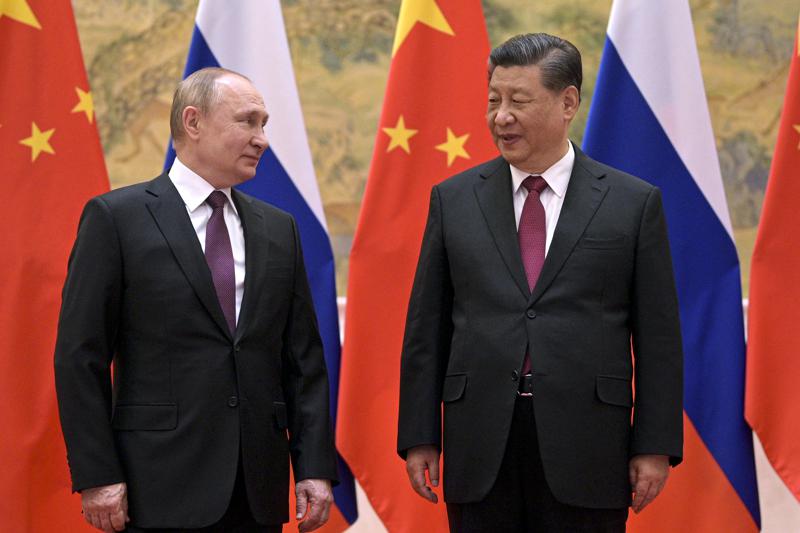
FILE – Chinese President Xi Jinping, right, and Russian President Vladimir Putin talk to each other during their meeting in Beijing, Friday, Feb. 4, 2022. Following this month’s meeting in Beijing between Russian leader Vladimir Putin and China’s Xi Jinping, speculation has risen over whether a new alliance could form between the two superpowers locked in competition with the U.S. (Alexei Druzhinin, Sputnik, Kremlin Pool Photo via AP, File)
BEIJING (AP) — Russia’s military buildup along its border with Ukraine is testing the possibility of a Moscow-Beijing axis lining up against the U.S. and its allies.
Russian leader Vladimir Putin’s meeting with Chinese counterpart Xi Jinping in Beijing this month fed speculation that a new alliance could form between the two great powers as they face off with the U.S. over a range of issues.
Russia and China have backed each other’s positions on opposing a NATO expansion in former Soviet republics and buttressing China’s claim to the self-governing island of Taiwan.
But the relationship remains lopsided. China’s confident rise as an economic and political force contrasts with Russia’s growing isolation and reversion to Cold War tactics of intimidation and bullying.
China also remains opposed to actions that could damage its territorial ambitions, from the South China Sea and Taiwan to the Indian border.
Here are some of the main factors driving, and blocking Russo-Chinese relations:
___
WHERE DOES CHINA STAND ON THE UKRAINE CRISIS?
China has not criticized Russia over its moves against Ukraine, and has joined in verbal attacks on Washington and its allies. Addressing the Munich Security Conference over the weekend, Chinese Foreign Minister Wang Yi lashed out against the U.S., accusing “a certain power” of “stirring-up antagonism.”
However, in response to a question from conference Chairman Wolfgang Ischinger, Wang said the “sovereignty, independence and territorial integrity of any country should be respected and safeguarded, because this is a basic norm of international relations.”
“Ukraine is no exception,” Wang added.
He also stated that major powers should act in defense of global peace and no country should “repeat the past mistake of forging rival alliances.”
That chimes with China’s longstanding opposition to military alliances and often invoked — but often breached in practice — policy of non-interference in other countries’ internal affairs.
The comments were also in keeping with Beijing’s quest to replace a global order underpinned by alliances it considers threatening to its own development. Those include NATO and newer groupings joining the U.S. with Japan, India, Australia and other states with which China has substantial foreign policy disputes.
___
WHAT DID THE XI-PUTIN SUMMIT ACHIEVE?
Xi and Putin met ahead of the opening ceremony of the recently concluded Winter Olympics in Beijing, after which they issued a lengthy joint communique seen as announcing a new and closer relationship.
The two sides said they “strongly support each other” in confronting what Xi called “regional security threats” and “international strategic stability,” without directly naming the U.S.
The meeting between the leaders marked their 38th contact in person and by phone, a number touted by Beijing as a sign of closeness between the countries that had been rivals for leadership in the Cold War’s socialist bloc.
The fall of the Soviet Union remains an obsession among Chinese Communist leaders, along with Putin, a former officer in the Soviet KGB who shares Xi’s authoritarian leanings and has aligned his foreign policies with those of Beijing while courting China’s market for Russian energy resources and military hardware.
In its own readout of the Xi-Putin meeting, however, China held back on making a full-throated endorsement of Russia’s strategy of attacking alleged Western threats to its security.
___
IS THERE A LINK BETWEEN UKRAINE AND TAIWAN?
China’s Communist Party leadership is believed to be watching the U.S. response to Russia’s actions closely for signs of how Washington would behave if Beijing were to move against Taiwan.
China has been dispatching military aircraft and holding threatening war games in hopes of undermining support in Taiwan for the self-governing island’s de facto independence.
Washington provides Taiwan with fighter jets, warships and other arms and is legally required to consider threats to the island as matters of “grave concern.” That doesn’t obligate the U.S. to intervene militarily on Taiwan’s behalf, but the possibility has not been ruled out, with allies such as Australia and Japan potentially joining in a conflict.
___
WHERE IS AMERICA LEFT IN THE DEBATE?
China is not putting its weight behind Russia’s foreign policy gambits, but the frostiness in relations with Washington shows no sign of thawing, said Shi Yinhong, a professor of international relations and director of the Center on American Studies at Beijing’s Renmin University of China.
“I believe that the Chinese government will continue to take care of China itself in the first place rather than take care of Russia,” Shi said. In the meantime, relations with Washington will remain fraught, particularly over the issue of Taiwan.
Beijing blames heightened tensions with the U.S. on what it calls a false depiction of China as a strategic rival.
This week marks the 50th anniversary of Richard Nixon’s visit to China that led to the establishment of formal diplomatic ties in 1979 and a new era of trade and economic relations. No joint celebrations have been announced.
Sharing a meal with a greedy tablemate makes for fraught relations, especially when there are claws and fangs involved.
For wolves and grizzly bears in Yellowstone National Park, competition over a dead elk dinner has some unexpected results. When a bear steals a meal from a wolf pack, the wolves kill less often.
“What we did was break down the wolf foraging sequence,” University of Montana researcher Matthew Metz told the Missoulian. “We studied their searching time and their handling time – the amount of time they spend eating and digesting their kills.”
A wolf in Yellowstone National Park follows a grizzly bear in early spring 2005. New research from the University of Montana shows that wolves reduce their kill rates in spring when grizzlies pressure them for their prey. DOUG SMITH / AP
And especially in spring, when Yellowstone’s elk herds are birthing thousands of wobbly calves throughout the Lamar Valley and every predator around cruises for fresh protein, grizzly bears lean on wolves in ways that change the wolves’ behavior. The reduction in wolf kills when grizzlies are around was also seen in a paired study of Scandinavian predators.
“Wolves put extra food on the landscape for bears,” said Norwegian Institute for Nature Research scientist Aimee Tallian, who collaborated with Metz through UM’s Yellowstone Wolf Project. “But bears are antagonistic for wolves. They take part of the supply of shared prey, and they usurp wolf kills. So wolves are kind of helping bears, but bears aren’t necessarily helping wolves a lot.”
The Greater Yellowstone Ecosystem surrounding Yellowstone National Park has the second-largest concentration of grizzlies in the Lower 48 states. Its estimated 1,000 grizzlies pack themselves between five and 13 per 100 square kilometers.
By comparison, Scandinavia has about 3,000 brown bears (the same species as U.S. grizzly bears). But they are dispersed at about three bears per 100 square kilometers across Norway and Sweden. And they feed on moose, which don’t herd like elk but do exist in similar numbers in the Scandinavian forests.
“They’re controversial there, too,” Tallian said of bear relations on the far side of the Atlantic Ocean.
Scandinavia also has a sizable wolf population, which inhabits regions with and without brown bears. That added complexity to the study, because the researchers could contrast wolf behavior with and without ursine competition.
“The fact we’re seeing patterns in multiple places suggests these patterns exist where wolves and bears persist together,” Tallian said. “Which is a lot of their habitat.”
Comparing American and Scandinavian meat-eaters has other complications. In Yellowstone, the wolves and grizzlies also have to compete with black bears, which don’t exist in Europe.
While grizzly competition tends to reduce wolf kill rates, it has an opposite effect on mountain lions. Metz said lions in bear country also get driven off their kills by grizzlies, and then have to kill more to stay nourished.
The relationship can change from place to place. Along Alaska salmon streams, for example, Kodiak brown bears tend to eat only the heads of spawning fish, leaving a bounty of body meat for following wolves.
Exactly why and how these inter-species kill rates balance out remains to be discovered. But Tallian and Metz agreed the opportunity to study several top predators at work on the same landscape was enlightening.
“Relatively little had been known about how bears affected the foraging dynamics of wolves,” Metz said. “Our work starts to fill in the gap by demonstrating that the dynamics do differ and provides another reminder of how changes in ecosystem complexity – in this case the presence of bears – affects the behavior of other species.”
“One cool way to think about this is the historical context,” Tallian added. “This is likely what these systems looked like for thousands of years, with this dynamic interplay of competitors on the landscape. There are very few places that feel that untouched these days, where ecosystems are allowed to play out on their own.”
A 17-year-old girl has been arrested in connection with the shooting.
Terrible tragedy that happened during the wild boar hunt. On Saturday, February 19, a 25-year-old woman was killed by a bullet. The victim was walking with his companion when he was shot by a wild boar while hunting in the territory of a town near Arylock.
The teacher, who is suspected of being responsible for the deadly shooting, is a 17-year-old man. The latter was arrested on Sunday, February 20.An investigation into the “arson” has opened. As a reminder, in France, a minor from the age of 15 practices hunting in the presence and responsibility of a guide.
The victim was walking with his companion in the woods, on a marked sidewalk, in La Bécarie.As reported by France Blue. According to Aurillock’s lawyer, the bullet struck “on the…
Conservation Officers Tyler Cole, left, and Matt Page are seen in this October 2021 photo with the heads of eight deer poached by Justin Ernst. Two days later, officers found a ninth deer. (Photo: WWMT via Michigan Department of Natural Resources)
VAN BUREN COUNTY, Mich. (WWMT) — A Michigan man received prison time, a large fine and a lifetime ban from hunting in Michigan after he poached nine trophy bucks.
Justin Ernst, of Decatur, pleaded guilty Monday to three counts of illegal taking/possessing of whitetail deer, one count of obtaining a hunting license when ineligible and one felony count for possession of a firearm, said the Michigan Department of Natural Resources.
The 33-year-old was sentenced to serve 18 months to five years in prison. In addition, he was ordered to pay a $25,000 fine and received a lifetime loss of hunting privileges.
“We’re satisfied that this criminal will be imprisoned for robbing ethical hunters, damaging crops and endangering others by recklessly driving through fields and shooting deer at night,” said David Shaw, assistant chief of the Michigan Department of Natural Resources Law Enforcement Division. “We hope this serious sentence serves its intended purpose and are grateful for the strong message rendered by the 36th Circuit Court.”
On Oct. 17, 2021, Michigan State Police were investigating a domestic violence complaint involving Ernst, officials said. Troopers contacted conservation officers after they saw several deer in a nearby barn that Ernst frequented. Conservation officers then seized eight illegal bucks from the barn, including five 10-pointers and three eight-pointers.
Two days later, officials said they received an anonymous tip stating Ernst had taken another deer. Conservation officers later confirmed Ernst had indeed poached his ninth trophy buck.
Ernst was previously convicted in 2018 for illegally taking or possessing whitetail deer, department officials said.




 by