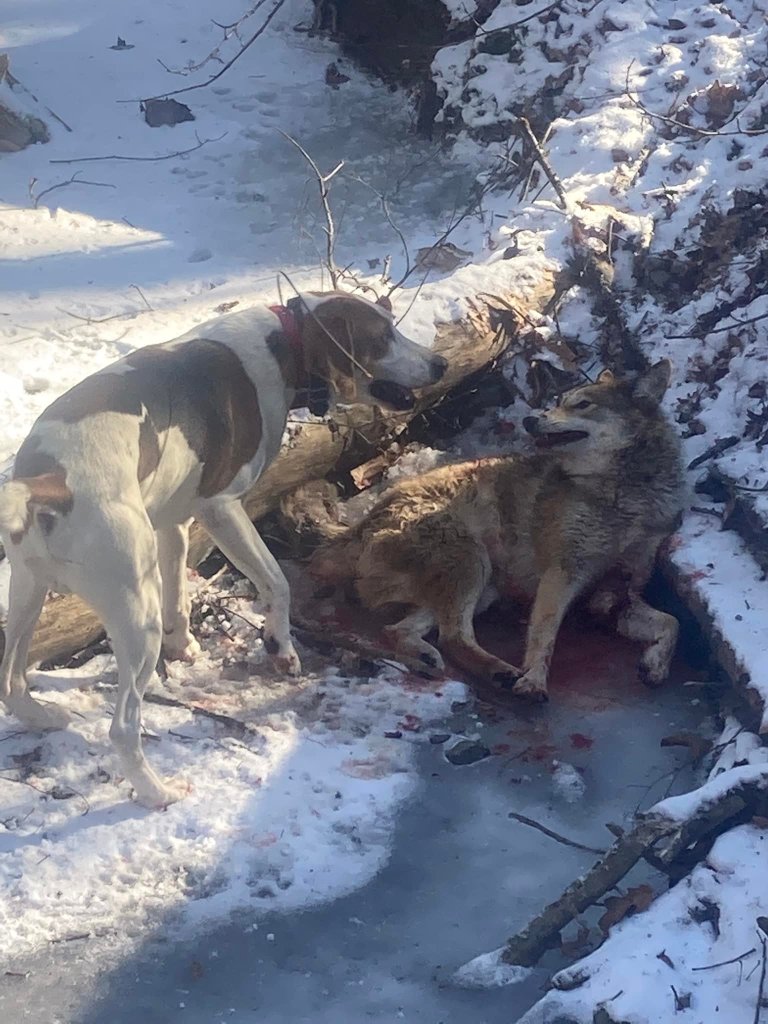
Every winter, hound hunters across America turn their dogs loose to chase, torment and fight other dogs. Make no mistake, just because their prey are coyotes, doesn’t change the fact that it is still a form of legalized dog-fighting. Whether in Vermont (as this video depicts) or Wisconsin, Michigan, New York, Pennsylvania, Maine, Ohio or any of the dozens of other states where this horrendous practice is happening right now, hunting coyotes with hounds is a cruel practice that no ethical sportsman or human being should support.
Terance Wilbur of Willington, Vermont shared this picture on Facebook on January 16, 2022
These aren’t animals being killed to feed families, they are being killed for the simple pleasure hound hunters derive from watching their dogs run down other dogs. At best, some of the coyotes will have their pelts taken and sold on the international fur market where they often end…
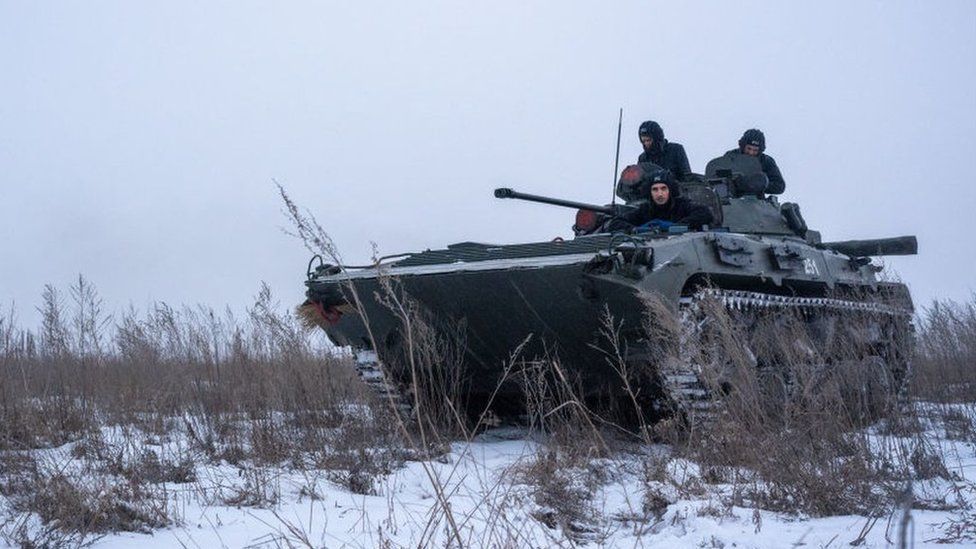
Image caption,Ukrainian soldiers are facing some 100,000 Russian soldiers massed on their borders
The US has threatened to halt the opening of a key pipeline that would send Russian gas to Western Europe, if Russia invades Ukraine.
Nord Stream 2 would run from Russia to Germany, and on Thursday officials in Berlin said the project could face sanctions if Russia attacks.
Western allies say they will target Russia’s economy if it invades, and the latest comments signal a hardening of their stance on the lucrative pipeline.
Russia denies it is planning an attack.
But the build-up of tens of thousands of Russian troops on Ukraine’s borders in recent weeks has stoked tensions and escalated fears of an invasion.
“I want to be very clear: if Russia invades Ukraine one way or another, Nord Stream 2 will not move forward,” US state department spokesman…
Airmen from the 4th Fighter Wing at Seymour Johnson Air Force Base, N.C. and the 48th Fighter Wing, Royal Air Force Lakenheath, England, arrive at Amari Air Base, Estonia, January 24, 2022. U.S. Air Force Photo/Staff Sgt. Megan Beatty/Handout via REUTERS
Register now for FREE unlimited access to Reuters.com
Register
BRUSSELS, Jan 27 (Reuters) – NATO allies are putting forces onstandbyand sending reinforcements to eastern Europe in response to Russia’s buildup of more than 100,000 troops on Ukraine’s borders.
Here are some of the dilemmas about NATO’s next steps.
In this undated photo, a Popa langur moves along a forest floor. The Popa langur is among 224 new species listed in the World Wildlife Fund’s latest update on the Mekong region. The conservation group’s report released Wednesday, Jan. 26, 2022, highlights the need to protect the rich biodiversity and habitats in the region, which includes Vietnam, Cambodia, Laos, Thailand and Myanmar. (World Wildlife Foundation via AP)ASSOCIATED PRESSMoreELAINE KURTENBACHTue, January 25, 2022, 4:07 PM·3 min read
BANGKOK (AP) — A monkey with ghostly white circles around its eyes is among 224 new species listed in the World Wildlife Fund’s latest update on the greater Mekong region.
The conservation group’s report, released Wednesday, highlights the need to protect the rich biodiversity and habitats in the region, which includes Vietnam, Cambodia, Laos, Thailand and Myanmar.
The species listed were found in 2020 but last year’s report was delayed. The monkey is called the Popa langur, for it lives on the steep hillsides of the extinct Mt. Popa volcano in Myanmar. It was the only new mammal. There are also dozens of newly identified reptiles, frogs and newts, fish and 155 plant species, including the only known succulent bamboo species, found in Laos.- ADVERTISEMENT -https://s.yimg.com/rq/darla/4-10-1/html/r-sf-flx.html
The Mekong region is a biodiversity hotspot and home to tigers, Asian elephants, saola — an extremely rare animal also called the Asian unicorn or spindlehorn — and thousands of other species.
Including this latest list, scientists have identified more than 3,000 new species in the region since 1997, the WWF said.
Scientists used measurements and samples from museum collections to compare and identify key differences with features of the newly discovered animals and plants, the report said.
Studying such differences can help determine the range of species and threats to their survival, Thomas Ziegler, a curator at the University of Cologne’s Institute of Zoology, said in introducing the report.
Identifying new species is tricky, though, and sometimes can only be determined using a variety of methods, such as frog calls and genetic data used to distinguish the Cardamom leaf little frog, found high up in the Cardamom mountains in a wildlife refuge.
Some species are found in more than one country, including the bright orange twin slug snake, which consumes slugs.
The Popa langur was identified based on genetic matching of recently gathered bones with specimens from Britain’s Natural History Museum collected more than a century ago, the report said. Two main distinguishing characteristics were the broad white rings around its eyes and its front-pointing whiskers.
The WWF, working with Fauna and Flora International, caught images of the monkeys using camera traps in 2018. FFI reported the discovery late last year.
The monkey is a candidate to be listed as a critically endangered species on the Red List of the International Union for the Conservation of Nature, the report said, since only 200-250 are thought to survive in the wild, in a handful of places.
Underscoring the urgency of such work, more than 38,000 of the 138,000 species the IUCN tracks are threatened with extinction.
A new type of begonia with reddish flowers and a berry-like fruit also was found in the uplands of Myanmar, where illegal mining and logging have become an increasingly dire threat in the country, which is in the midst of political turmoil following a military takeover a year ago.
Despite human encroachments on tropical forests and other wild zones, much of the Greater Mekong is still little explored and each year dozens of new species are found — a glimmer of hope as so many species go extinct.
Not all new species are found deep in jungles. One of the new plant species is a ginger plant called “stink bug” for its pungent odor similar to big beetles Thais use to make a kind of chili dipping paste served with rice, the report said.
It was found in northeastern Thailand, in a plant shop.
A Jan. 20 public meeting on proposed black bear hunting in three Western North Carolina bear sanctuaries brought out dozens of residents ahead of a Feb. 24 vote from the North Carolina Wildlife Resources Commission, some citing flawed data used by the commission as the basis for its proposal, while others claimed extra hunting is needed to control the burgeoning bear population.
The wildlife commission is proposingto openPanthertown-Bonas Defeat, Pisgah and Standing Indian bear sanctuaries to permit hunting for the 2022-23 season.
All in-person meetings over theproposedrule changeswere canceled, leaving only the Jan. 20 virtual meeting and ability for residents to comment either online, or by mail or email.
Famed paleontologist and conservationist Richard Leakey died on January 2nd, 2022 at the age of 77.
Leakey made his mark on the field of wildlife conservation after he assumed the helm of Kenya’s Wildlife Service in 1989.
Leakey cracked down aggressively on poachers and fortified the country’s national parks, arresting the ongoing decline in wildlife populations in the country and revitalizing the tourism sector.
But his approach proved controversial, leading him to step down from the head of the agency in 1994. Leakey continued to be active in conservation and paleontology through the last years of his life.
On July 19th, 1989, Kenyan President Daniel arap Moi lit the match on twelve tons of elephant tusks soaked in gasoline. The elephants had been the victims of a relentless poaching spree in Kenya, and the ensuing blaze was meant to send a message: Kenya was putting new muscle behind the fight to save its elephants—and it wanted the world to do the same by banning the ivory trade.
The brains behind the burning—which made press around the world—was Richard Leakey, the new head of Kenya’s Wildlife Conservation and Management Department (WMCD), soon to be resurrected by Leakey as Kenya’s Wildlife Service (KWS).
Leakey was, arguably, an odd choice. The Kenyan was world famous, but not for preserving species or places. Instead, it was for digging up new fossils that helped prove that humans evolved in Africa, a continuation of his parents’ groundbreaking work.
But in 1989 Leakey gave up digging in the dirt and was now burning tusks in an escalating battle to save Africa’s megafauna from obliteration.
Leakey—who leaves behind a massive and, at times, controversial legacy—died on January 2nd, 2022.
Richard Leakey. Photo credit: Stony Brook University
Origin in Africa
As the son of famed archeologists, Louis and Mary Leakey, Richard was practically born and raised in Kenyan archeology and paleoanthropology. Louis and Mary had become renowned after finding numerous fossils of early hominins, helping to prove that the human species started in sub-Saharan Africa. For example, Mary found the first australopithecine in East Africa, classified today as Paranthropus boisei.
The elder Leakeys were also instrumental in jumpstarting great ape research, including supporting three young women doing groundbreaking studies in the field: Jane Goodall (chimpanzees), Dian Fossey (gorillas) and Birute Gladikas (orangutans).
Despite initial misgivings, Richard eventually got caught up in the family business. In the late 1960s Leakey, along with his wife zoologist Maeve Epps and operations manager Kamoya Kimuea—who would become a great paleontologist in his own right—turned their attention to fossils near Lake Turkana in Kenya.
It was here that Richard Leakey would uncover the fossils of early hominid species that would make him as famous as his parents. In 1984, Leakey excavated the nearly complete skeleton of a young male Homo ergaster discovered by Kimuea. Turkana boy, as the discovery was later dubbed, remains the most complete skeleton ever found of an early hominin.
Leakey’s work helped cement the story his parents started. It was arguably the most important discovery in archeology: that humans evolved in Africa from a motley crew of bipedal great apes.
Elephants in Kenya. Photo credit: Nancy Butler
Elephants and rhinos
In 1989, despite his renowned success as a paleontologist, Leaked accepted the invitation to become the head of Kenya’s Wildlife Service extended by President Moi. He took on an immediate crisis.
“They say that desperate times call for desperate measures,” Niall McCann, the Conservation Director at National Park Rescue which focuses on protected areas in Africa, said of Leakey’s conservation career. “When Leakey took over… the organization was riddled with corruption and wildlife numbers were dropping off a cliff. Well-armed and well-funded poachers had decimated Kenya’s elephant population.”
“Leakey chose to fight fire with fire,” he added.
On taking command, Leakey ordered rangers to shoot poachers on sight, a hugely controversial decision.
But Leakey’s decision wasn’t just about the safety of rhinos and elephants. In the summer of 1989, poachers gunned down three tourists in Kenya’s wildlife parks. Armed bandits also murdered renowned lion conservationist George Adamson in August 1989. The government feared that such incidents would lead to the collapse of its tourism industry, one of its most important sources of revenue.
“Leakey was at the forefront of the professionalization—sometimes pejoratively termed the militarization—of conservation…His tactics were successful at reducing poaching in the short-term, and many other conservation departments and NGOs followed in his footsteps, said McCann. “But they were also highly controversial, with little consideration for the human rights of poachers.”
Before he could save Kenya’s tourism industry, Leakey had to get his rangers back on their feet. His notoriety and charismatic approach helped Leakey raise desperately needed funds. Donors and the World Bank invested around $150 million during Leakey’s tenure, according to The New York Times.
”The rangers were totally demoralized,” Leakey told The New York Times in 1990. ”They had very old equipment, little ammunition, ragged clothes and gym shoes…We raised some funds, re-equipped them with automatic rifles, ammunition, boots, uniforms and daily allowances.”
At the same time, Leakey convinced the government to burn its stockpile of elephant tusks, sending a message to the world. Leakey hoped the gesture would help build pressure for banning the ivory trade. It did. CITES banned the ivory trade in 1990 for the first time and the ban resulted in—at least for a while—a decline in elephant poaching.
“The armed defense of nature is still often necessary, just as the armed defense of banks is still often necessary,” notes McCann, “but force must be used proportionately, and local communities must be involved in the management and protection of threatened protected areas.”
In October 1989, KWS killed poaching kingpin Mohamed Hussein Omar, a man believed to be responsible for the deaths of two of the tourists that summer.
“If Richard Leakey hadn’t been around then, we’d have probably lost our wildlife by now,” an unnamed conservationist told Newsweek in 2014.
105 tons of ivory and 1 ton of rhino horn burn in Nairobi National Park on 30th April 2016. Photo credit: Mwangi Kirubi
Brush with Death and New Careers
In 1993, Leakey’s plane crashed. He survived, but lost both of his lower legs. Leakey believed that the crash was deliberate sabotage and an attempt to kill him, though this was never proven. But with his anti-corruption and muscular approach, Leakey had certainly made enemies.
In 1994, a number of government officials accused Leakey himself of corruption, racism and mismanagement. He responded that he was being “vilified” by politicians, but resigned his position nonetheless.
“Leakey’s idea of ‘fortress conservation’, of excluding people from protected areas, is now largely considered both unwise and unjust,” McCann says. “Conservation must be inclusive, and it is generally agreed that local people must be involved in the conservation of their natural heritage for conservation to be sustainable in the long-term.”
Leakey’s focus on both militarization and fortress conservation—he initially wanted to fence off a number of Kenya’s largest and most famous parks—was, at least in part, a product of the time. The idea of sharing resources and revenue with locals—today commonly referred to as “community-based conservation”—was very much in its infancy thirty years ago. Still, it was often reported that Leakey had good rapport with many local groups, including the Maasai.
A year after leaving KWS, Leakey joined others in forming the Safina Party in an attempt to win at the ballot box. The effort struggled to take off, and Leakey was brought back into government in 1999 to deal with corruption as the head of the civil service.
Richard Leakey speaking at the Progressive Forum in 2010. Photo credit: Ed Schipul
Last Decades
Despite a number of deviations, Kenya’s wildlife continued to be a draw for Leakey.
In 2004, Leakey founded WildlifeDirect, a Kenya-based wildlife NGO, focused on raising funds via blogs by local conservationists and rangers. Its CEO, Paula Kahuumbu has become one of the best-known conservationists in Kenya by building a community of concerned citizens advocating for wildlife and the protection of natural resources.
In 2015, Leakey was appointed chairman of KWS, again taking on a direct role to protect the nation’s wildlife. During his time as chairman, he helped push through the idea of a raised railway over Nairobi National Park.
The railway will connect Nairobi with Mombasa, but many conservationists fear it will also decimate Nairobi National Park. Sitting just south of Kenya’s capital, the park is famous for still housing lions, giraffes, rhino and many other megafauna despite being on the doorstep of one of Africa’s biggest cities.
“In my many conversations with [Leakey], it is clear that he is convinced that, like it or not, Kenya will continue to develop and therefore change is inevitable, especially in one of Africa’s fastest growing cities,” Kahumbu wrote in 2016.
The government eventually accepted Leakey’s compromise: An elevated rail allowing animals to pass underneath, rather than ground-level infrastructure.
“Leakey’s support for a raised train line in Nairobi National Park surprised and angered many conservationists in Kenya, who considered the proposal as entirely at odds with conservation,” says McCann, who noted that it was “perhaps a sign that he had come to realize that the African landscape belongs to both people and wildlife, and that we must find ways of accommodating both.”
Even at the end of his life, Leakey was still undertaking new projects. At one time the director of the National Museums of Kenya, Leakey planned a new museum, called Ngaren, that would not only look back on Africa as the crucible of our evolution, but also explore our current problems of “overpopulation…war, disease and climate change,” according to the website.
“Ngaren is not just another museum, but a call to action,” Leakey said of the project. “As we peer back through the fossil record, through layer upon layer of long extinct species, many of which thrived far longer than the human species is ever likely to do, we are reminded of our mortality as a species.”
Architect Daniel Libeskind, who also designed the reconstruction of the World Trade Center in New York, is the museum’s designer. It is scheduled to open in 2024.
“Like most leaders, [Leakey’s] legacy is complex, and we should not shy away from engaging with the complexity of his actions,” McCann said.
“He stood for integrity, hard work and excellence in all areas,” Kahumbu, who knew Leakey since she was a child, wrote for WildlifeDirect. “When [he] started the Kenya Wildlife Service he ignited a new approach to conservation in Kenya. He created a proud visionary organization led by Africans that sought to provide excellence in conservation that had never been seen before.”
However one feels about his approach, there is little doubt that many of Kenya’s elephants, rhinos and other wildlife—and their progeny—owe their lives today to Leakey. We, in turn, know more about the world—and ourselves—due to Leakey’s digging in the dirt.
Leakey was buried on a hill overlooking the Great River Valley in Kenya.
Stephen Dowling let off up to nine shots of ammunition from a high-powered telescopic rifle in Glenties, Co Donegal, in the early hours of February 22nd, 2020, Letterkenny Circuit Court heard.
SHARE THIS ARTICLE25/01/2022 | 21:19 PM
STEPHEN MAGUIRE
A young deer hunter got high on cocaine and alcohol and roamed through a town shooting at gardaí, civilians and buildings, a court heard on Tuesday.
Stephen Dowling let off up to nine shots of ammunition from a high-powered telescopic rifle in Glenties, Co Donegal, in the early hours of February 22nd, 2020, Letterkenny Circuit Court heard.
He shot at gardaí, missing them by inches, shot through cars and also shot into the windows and walls of three different houses during an hour-long incident, the court was told.
The 25-year-old father of one appeared in court where he pleaded guilty to a range of charges on a night…
A frosty wolf trots down a groomed trail in Yellowstone National Park in December. A coalition of Montana businesses surrounding the park have called for the Montana Fish and Wildlife Commission to reduce the hunting and trapping quota near Yellowstone.Photo courtesy Jacob W. Frank, NPS
About 100 businesses have formed a coalition opposing Montana Fish, Wildlife & Parks’ higher wolf hunting and trapping quotas near Yellowstone National Park.
TheWild Livelihoods Business Coalition– comprised of business owners in the gateway communities of Gardiner, Livingston, West Yellowstone and Cooke City – has been pressing members of the Montana Fish and Wildlife Commission to revert to previous regulations in the hunting districts near the park’s northern boundary following the killing of180 wolvesacross Montana this season.
Comment period closes January 31Dear Anne,The Michigan Department of Natural Resources (DNR) is updating their 2015 Wolf Management Plan. This is an opportunity to speak up for wolves in Michigan and shape the DNR’s wolf management plan for the future protection of wolves. You do not have to be a Michigan resident to provide input.Let the DNR know you DO NOT support a wolf hunt!Here are 3 ways you can speak up:1. Submit comments through DNR’s online survey tool. The survey will start by asking you how satisfied you are with various goals and strategies of the plan. Suggested answers are below but if you feel differently, then please answer how you prefer. Following the satisfaction scale will be a text box for comments. We have provided suggested comments in the section below. There is no word limit on the text box, so please personalize the…
Families are grieving on Virginia’s Eastern Shore after a jon boat capsized in rough seas, sending four young men into the water Saturday morning. An 18-year-old died in the water and a 17-year-old is still missing, with a large-scale search underway.
Virginia Marine Police say four people went out duck hunting Saturday morning amid a winter storm. They were in Chincoteague Bay, near Curtis Merritt Harbor, when the 16-foot jon boat was struck by a wave and it took on water, causing it to capsize. All four went into the water. Two of them, ages 17 and 19, stayed with the boat and were rescued by a good Samaritan. They were taken to the hospital with non-life threatening injuries.
The Coast Guard recovered the body of the 18-year-old, Cory Alles of Bentonville, Va. Crews launched…