The U.S. military has replied to PETA’s letter about recent reports that dogs—including working dogs, animal companions of evacuated Americans, and rescued animals—were left in Afghanistan after the withdrawal of U.S. forces.
A spokesperson for the U.S. Army sent us this response:
I can report that the U.S. military did not leave any dogs in cages at the airport. … During the extremely complicated and dangerous final phases of the retrograde mission, U.S. forces went to great lengths to help the Kabul Small Animal Rescue facilitate the evacuation of more than 150 stray Afghan dogs. These dogs were not permitted on military evacuation flights due to regulations, but the Kabul Small Animal Rescue claimed to have arranged a chartered plane to rescue the animals. Unfortunately, that plane did not arrive, leaving no options to evacuate the dogs. U.S. forces identified that the only reasonable and humane course of action was to relocate the dogs to a former Afghan National Army compound on the airport grounds with appropriate supplies of food and water. This compound was relatively self-contained and provided for adequate space and grass area. Working tirelessly through the night of August 29 and into the morning of August 30, dedicated U.S. Soldiers transported more than 150 dogs in crates down the airfield to the compound—no easy task under the best of circumstances, but particularly challenging during the hazardous final stages of our withdrawal. Finally, before our forces’ departure from Kabul, our Soldiers showed the owner/operator of Kabul Small Animal Rescue where our forces had released the dogs, and she acknowledged that our forces had exercised the only option available at that point. She also indicated that she intended to return to the airport in the coming days to gather the dogs and get them on a charter plane to forever homes outside of Afghanistan, and it’s our sincere hope that she is successful in that effort.
PETA is in direct contact with Kabul Small Animal Rescue, which has verified that by the time the dogs were “released,” relocating them (as described above) was the only possible solution. But Kabul Small Animal Rescue maintains that its staff was trying to get animals out and needed more time, which was not granted. It remains committed to the welfare and safety of the many dogs in its charge and is continuing to work on the situation.
Thank you to all of you who took action! Please be aware that much of the information circulating online, while perhaps well intentioned, is not accurate. When updates of interest become available and can safely be shared, we will post them here. Thank you again for your compassion and action for animals.
Bear hunting season began Wednesday in New Hampshire, the beginning of a four-month stretch of the year’s most popular hunting seasons, leading up to rifle season for white-tailed deer in late November.
Susan Peter’s name would have emerged as one of the golden names from Hollywood’s silver-screen era, but a tragic accident not only cost her her career but also her will to live.
Susan Peters’ story would have ended differently if not a tragic accident that forced her career to a halt and brought her to misery. Years before her accident, the actress found her inspiration to study after befriending a disabled boy; little did she know she would meet the same fate as him.
At age 22, Peters had suddenly become an actress with promise in the 1940s. Although newcomers in the movie industry might find it hard to recall her name, it once offered great potential.
Pictures of Susan Peters | Photo:Wikimedia Commons / Schuyler Crail (Public Domain)https://be62ca3cde0ddd9d6edd91b66f476f58.safeframe.googlesyndication.com/safeframe/1-0-38/html/container.html
Her career began during her senior year in high school, where she…
This undated transmission electron microscope image shows SARS-CoV-2, also known as novel coronavirus, the virus that causes COVID-19, isolated from a patient in the U.S. Virus particles are shown emerging from the surface of cells cultured in the lab. The spikes on the outer edge of the virus parti(photo credit: NIAID-RML/FILE PHOTO/HANDOUT VIA REUTERS)AdvertisementThe World Health Organization (WHO) is closely monitoring the emergence of a new variant of the novel coronavirus, theMu variant, which has already been spreading through South America and has shown signs of possible vaccine resistance.First identified in January 2021 in Colombia, the Mu variant has seen sporadic cases emerge throughout South America and Europe. Globally, the variant accounts for less than 0.1% of…
It’s media malpractice not to mention that burning fossil fuels drives extreme weather events like Hurricane Ida
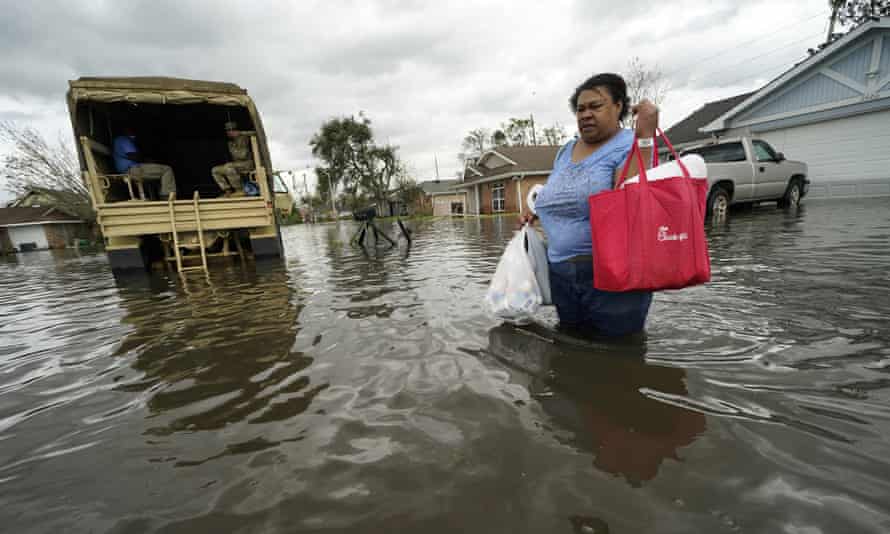
Jerilyn Collins returns to her destroyed home to retrieve medicine for herself and her father in the aftermath of Hurricane Ida in LaPlace, Louisiana.Photograph: Gerald Herbert/AP
The climate emergency is exploding in various parts of the world this week, but climate silence inexcusably continues to rein in much of the United States media.
Hurricane Ida has left more than a million people in Louisiana without running water, electricity or air conditioning amid a heat index topping 100F. The Caldor firedestroyed hundreds of housesand forced mass evacuations around Lake Tahoe in California. Abroad, vast swaths of Siberia were ablaze while drought-parched Madagascar suffered what a United Nations official called the first famine caused entirely by climate change.
The president promised to defend abortion rights but the White House was vague on what he can or will do.
President Joe Biden said the new law would “significantly impair women’s access to the health care they need, particularly for communities of color and individuals with low incomes.“ | Chip Somodevilla/Getty Images
President Joe Biden vowed Wednesday to defend abortion rights after the Supreme Court let stand a Texas abortion law that bans the procedure after six weeks of pregnancy.
PUBLISHED WED, SEP 1 20218:30 AM EDTLorie Konish@LORIEKONISHSHAREShare Article via FacebookShare Article via TwitterShare Article via LinkedInShare Article via EmailKEY POINTS
Individual investors are expressing increased interest in environmental, social and corporate governance, or ESG, investments.
ESG assets held by individual investors increased by 50% from 2018 to 2020.
Evaluating those potential investments is key. Here’s where to get started.
A member of a rescue team walks a flooded street in Laplace, Louisiana, after Hurricane Ida made landfall on Aug. 30, 2021.Marco Bello | Reuters
From Hurricane Ida to California wildfires, experts are pointing to signs of climate change.
Research shows individual investors are taking notice.
A recent survey conducted by professional services company Accenture found that 59% of investors who are working with financial advisors have asked them about ESG (environmental, social and corporate governance) or socially responsible investments.
By BRIAN KOBERLEIN, UNIVERSE TODAY SEPTEMBER 2, 2021
There are eight known planets in the solar system (ever since Pluto was booted from the club), but for a while, there has been some evidence that there might be one more. A hypothetical Planet 9 lurking on the outer edge of our solar system. So far this world has eluded discovery, but a new study has pinned down where it should be.
The evidence for Planet 9 comes from its gravitational pull on other bodies. If the planet exists, its gravity will affect the orbits of other planets. So if something seems to be tugging on a planet, just do a bit of math to find the source. This is how Neptune was discovered, when John Couch Adams and Urbain Le Verrier noticed independently that Uranus seemed to be tugged by an unseen planet.
In the case of Planet 9, we don’t have any gravitational effect on a planet. What we do see is an odd clustering of small icy bodies in the outer solar system known as Kuiper belt objects (KBOs). If there were no planet beyond the Kuiper belt, you would expect the orbits of KBOs to be randomly oriented within the orbital plane of the solar system. But instead, we see lots of KBO orbits are clustered in the same orientation. It’s possible that this is just due to random chance, but that isn’t likely.
The possible orbit of Planet Nine. Credit: CalTech/R. Hurt (IPAC)
Back in 2016, the authors looked at the statistical distribution of KBOs and concluded the clustering was caused by an undetected outer planet. Based on their calculations, this world has a mass of 5 Earths and is about 10 times more distant from the Sun than Neptune. The paper even calculated a broad region of the sky where the planet might be. But searches turned up nothing. This led some to conclude the planet doesn’t exist. Orbital oddness doesn’t prove a planet exists. Just ask Planet Vulcan. Others went so far as to argue Planet 9 does exist, but we can’t see it because it’s a primordial black hole.
This new study reexamines the original work in light of some of the criticism it received. One big criticism is that outer solar system bodies are difficult to find, so we look for them where it’s convenient. The clustering effect we see could just be due to biased data. Taking observational bias into effect, the authors find the clustering is still statistically unusual. There’s only a 0.4% chance of it being a fluke. When they recalculated the likely orbit of Planet 9, they were able to better localize where to look.
One interesting aspect of the study is that the newly calculated orbit puts Planet 9 closer to the Sun than originally thought. This is odd, because if it is closer then we should have already found it. The authors argue that observations thus far have ruled out the closest options for Planet 9, which helps narrow down its possible location even further. If the planet exists, it should be detectable by the Vera Rubin Observatory in the near future.
This study isn’t conclusive, and many astronomers still argue that Planet 9 doesn’t exist. But this study makes it clear that we won’t have to argue about it for much longer. Either it will be discovered soon, or observations will rule it out as an explanation for the KBO clustering effect.
Reference: “The orbit of Planet Nine” by Michael E. Brown and Konstantin Batygin, 22 August 2021, Astrophysics > Earth and Planetary Astrophysics. arXiv: 2108.09868
CARSON CITY, Nev. – Fire crews are anxiously awaiting better weather conditions over the next several days that will allow them to get a better handle on the massive blaze burning miles from scenic Lake Tahoe that spurred a mass exit from the region.
The Caldor Fire has continued to spread east but fire crews have been able to corral the blaze just south of Lake Tahoe, known for its picturesque beaches, emerald-blue waters, rocky shorelines and stunning landscapes in the Sierra Nevada. As of Wednesday evening, the blaze had spread through nearly 324 square miles and was only 23% contained, the California Department of Forestry and Fire Protection said.
“We’re battling what we can battle and waiting for those winds to subside so that we can get in there and actively engage these fires,” Steven Volmer, a fire behavior analyst at Cal Fire, said Wednesday evening.
As the fire threatens homes and the greater Lake Tahoe area late Wednesday, President Joe Biden approved an emergency declaration. The declaration, which was requested by California Gov. Gavin Newsom, offers federal assistance with the blaze.
The progress on the western side of the fire caused officials to allow some residents from the Pollock Pines and North Camino areas to return to their homes. But the eastern side of the blaze near Lake Tahoe and Nevada was still a concern. Residents in parts of Douglas County, Nevada, were told to leave the area as the fire grew.
The National Weather Service said low humidity and wind gusts up to 45 mph over ridgelines in the Sierra Nevada could help spark flames, but those conditions were expected to subside Thursday and Friday.
The powerful wind gusts were allowing embers from the blaze to travel about a mile, causing new small fires to spark and spreading resources thin. At times, the gusts and conditions were allowing the fire to move at 200 feet a minute as the blaze hopped from treetop to treetop.
Firefighters had battled the blaze amid the poor conditions 3 miles outside South Lake Tahoe, but they were aided by better-than-expected weather overnight. “We lucked out a little bit yesterday,” Cal Fire Operations Section Chief Tim Ernst said.
Crews tried desperately to keep flames away from urban communities, where houses are close together and shopping centers, hotels and other structures would provide even more fuel for a fire that has been feeding on trees, grasses and scattered homes and cabins.
“We’re still not out of the woods. The fire is still moving,” Ernst added.
The South Tahoe Public Utility District asked people to turn off hoses, irrigation systems and sprinklers to ensure that wells can pump at full capacity. That means “the minute a firefighter hooks into a hydrant that they are getting full pressure, and as much water as possible is coming out,” said Shelly Thomsen, spokeswoman for the utility.
In Nevada, evacuation centers opened to take in 22,000 South Lake Tahoe residents and scores of others from the surrounding area. As the evacuation zone expanded, shelters in Carson City and Douglas County were near or at capacity Tuesday.
Nevada casino regulators said gambling was suspended at the Hard Rock Lake Tahoe, Montbleu Resort, Harrah’s and Harvey’s Lake Tahoe, where officials said their casinos were closed to the public but their hotels were housing firefighters and displaced employees.
The fire has destroyed nearly 600 homes and more than 180 other structures, and more than 32,000 other buildings are threatened, Cal Fire said.Get the Coronavirus Watch newsletter in your inbox.
Stay safe and informed with updates on the spread of the coronavirusDelivery: VariesYour Email
Ernst said firefighters had opportunities overnight to slow the fire’s growth.
Along the section of the fire threatening to move closer to Nevada, Ernst said, crews created lines to protect homes and other buildings. They also put up protective lines closer to South Lake Tahoe. “This whole community is looking really good right now,” he said.
“The fire burned through there extremely fast, extremely hot. And we did the best that we could,” Cal Fire Division Chief Erich Schwab said of firefighters’ efforts to protect remote cabins in one area of the blaze.
According to the National Interagency Fire Center, 83 large fires are burning in 10 states, affecting more than 3,900 square miles. In California, 13 large fires are burning more than 2,200 square miles.
Timothy Pritchard panicked when police knocked on his door. “I had to pack what I could,” the 64-year-old retiree said.
He grabbed important legal documents, credit cards and checkbooks. He left several sentimental items, including mementos of his late girlfriend.
“I just pray to God they’ll be there, but I had to do what I had to do,” he said.
Pritchard, who has lived at South Lake Tahoe for 13 years, was among the first evacuees to arrive in Reno, Nevada, after being turned away from a Carson City shelter that reached maximum capacity.
Tuesday, Nevada Gov. Steve Sisolak remained hopeful crews could keep the raging Caldor Fire from crossing the border but said the state is prepared to fight the blaze should it escape the natural bathtub created by Lake Tahoe.
Sisolak said he was pleased with the gains firefighters made in the one day since the National Guard was brought in to help battle the blaze.
“We’re using all of our resources, everything at our disposal,” Sisolak said as ash fell outside Nevada’s Emergency Operations Center in Carson City.
The other is the Dixie Fire, which started in late July and is still burning near Lassen Volcanic National Park. The second-largest in state history, the wildfire grew to 1,318 square miles as of Wednesday and was 52% contained, Cal Fire said. It prompted evacuation orders this week.
Heavenly and Kirkwood – owned by Vail Resorts – were not damaged as of Tuesday afternoon, spokesperson Susan Whitman said in an email, but all employees and guests were forced to leave.
As flames moved toward Heavenly, on the California-Nevada border, officials turned on the mountain’s snowmaking machines.
The fire burned through Sierra-at-Tahoe, a resort on the west side of the Tahoe Basin near Echo Summit, but initial reports indicated the base area, lodge, administration building and gear shop were saved, according to Michael Reitzell, president of Ski California, an organization that represents resorts throughout California and Nevada.
“We know there is going to be some damage,” Reitzell said.