Plant-based diet can fight climate change – UN

ADVERTISEMENThttps://3d6a0bd846ea611528d2b86cd52a3512.safeframe.googlesyndication.com/safeframe/1-0-38/html/container.html

By Roger Harrabin
BBC environment analyst, GenevaPublished8 August 2019commentsCommentsShareRelated Topics

Vegan burgers
image captionVegan burgers are now a fixture on many restaurant menus

Switching to a plant-based diet can help fight climate change, UN experts have said.

A major report on land use and climate change says the West’s high consumption of meat and dairy produce is fuelling global warming.

But scientists and officials stopped short of explicitly calling on everyone to become vegan or vegetarian.

They said that more people could be fed using less land if individuals cut down on eating meat.

The document, prepared by 107 scientists for the UN’s Intergovernmental Panel on Climate Change (IPCC), says that if land is used more effectively, it can store more of the carbon emitted by humans.

It was finalised following discussions held here in Geneva, Switzerland.https://buy.tinypass.com/checkout/template/cacheableShow?aid=tYOkq7qlAI&templateId=OTBYI8Q89QWC&templateVariantId=OTV0YFYSXVQWV&offerId=fakeOfferId&experienceId=EXAWX60BX4NU&iframeId=offer_0e763acc7b457c03340a-0&displayMode=inline&widget=template

How years compare with the 20th Century average

2019

10 warmest years

10 coldest yearsJFMAMJJASONDMonths-0.8-0.6-0.4-0.220th Centuryaverage+0.2+0.4+0.6+0.8+1.0+1.2ColderHotter

Source: NOAAREPLAY

“We’re not telling people to stop eating meat. In some places people have no other choice. But it’s obvious that in the West we’re eating far too much,” said Prof Pete Smith, an environmental scientist from Aberdeen University, UK.

We’re also wasting too much food. The panel estimates that greenhouse emissions associated with food loss and waste – from field to kitchen bin – is as high as 8-10% of ALL global emissions.

The report calls for vigorous action to halt soil damage and desertification – both of which contribute to climate change.

It also warns that plans by some governments to grow trees and burn them to generate electricity will compete with food production unless carried out on a limited scale.

The Earth’s land surface, and the way it is used, forms the basis for human society and the global economy.

But we are re-shaping it in dramatic ways, including through the release of greenhouse gases into the atmosphere. How the land responds to human-induced climate change is a vital concern for the future.media captionGases produced by livestock are a major factor in global warming, so should we change our eating habits?

How are climate change and food linked?

Climate change poses a threat to the security of our food supply. Rising temperatures, increased rain and more extreme weather events will all have an impact on crops and livestock.

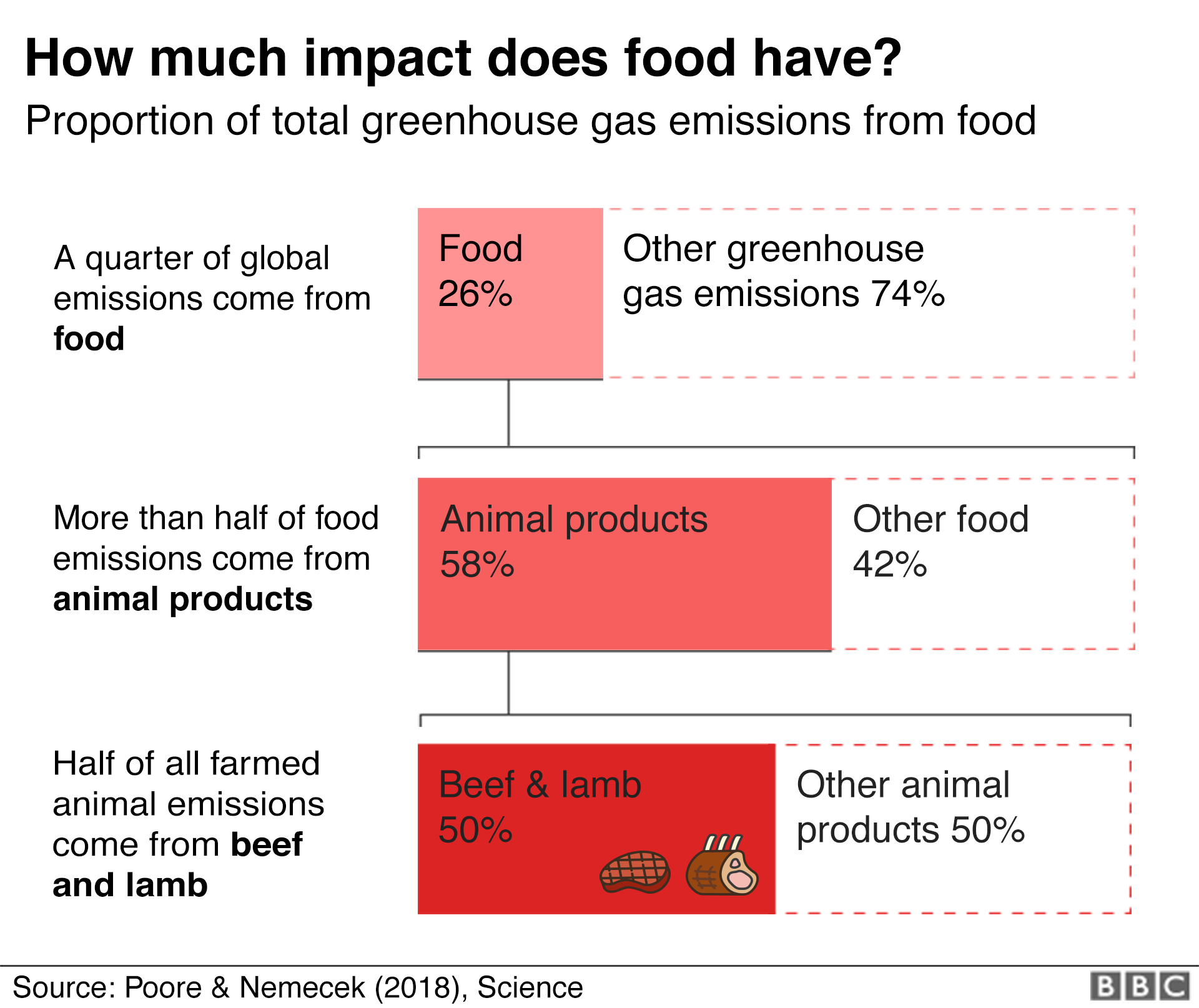
But food production also contributes to global warming. Agriculture – together with forestry – accounts for about a quarter of greenhouse gas emissions. Livestock rearing contributes to global warming through the methane gas the animals produce, but also via deforestation to expand pastures, for example.

The environmental impact of meat production is important to many vegetarians and vegans. A UK-based group called #NoBeef lobbies caterers to take beef and lamb off student menus.

In the US, vegan burger patties are made from plant-based meat substitutes said to taste like the real thing thanks to an iron-rich compound called heme.

Presentational grey line
Chart: A quarter of global greenhouse gas emissions come from food

Climate change food calculator: What’s your diet’s carbon footprint?

Presentational grey line

Peter Stevenson, from Compassion in World Farming, said: “A reduction in meat consumption is essential if we are to meet climate targets.”

But in some parts of the world, such as China, beef consumption is growing. This is despite attempts by the Chinese central government to promote traditional diets.

Can food waste be reduced?

Partage bike
image captionGeneva-based company Partage is helping tackle waste by taking in unsold food

The authors of the report encourage action to stop wasting food – either before or after its sale to consumers.

Waste food can sometimes be used as animal feed or, if suitable, redirected to charities to feed people in need.

One organisation here in Switzerland called Partage takes in unsold food discarded by shops and distributes it to local families.

It also collects stale bread and turns it into biscuits, dries fruit, and cans vegetables. All of this helps reduce the CO2 emissions involved in producing food.

July was ‘marginally’ world’s warmest month ever

Hungry nations add the least to global CO2

Stop abusing land, scientists warn

Road-testing the diet to save the world

Don’t trees absorb the CO2 we release?

trees
image captionExtra atmospheric carbon can nourish forests, but there comes a point where they are overwhelmed

The extra carbon that humans have put into the atmosphere is nourishing the growth of forests – especially in the Northern Hemisphere.

This can help to mitigate climate change, but it all comes down to a balance of factors. Experts say this effect on forests will be negated if the Earth heats up too much.

In fact, the report says areas near the equator may already be losing vegetation through heat stress.

Dr Katrin Fleischer, from the Technical University of Munich, Germany, warned that in some places a shortage of phosphorus in soil – a key ingredient for plant growth – would also hinder tree growth.

She said: “This would mean that the rainforest has already reached its limit and would be unable to absorb any more carbon dioxide emissions.

“If this scenario turns out to be true, the Earth’s climate would heat up significantly faster.”

Carbon cycle

How does soil fit in?

Soil is sometimes neglected as part of the climate system. But it’s the second largest store of carbon after the oceans.

Plants absorb CO2 from the atmosphere and lock the carbon away in the soil. But deforestation and poor farming practices can damage its ability to do this. When soil is degraded, carbon is released back into the atmosphere as CO2, while further plant growth is compromised.

Climate change is expected to speed this process up. Higher temperatures can help break down the organic matter in soil, boosting greenhouse emissions.

The report says reducing and reversing soil damage provides immediate benefits to local communities. Better land management, including controlled grazing by animals and tree planting, can boost soil fertility, helping to reduce poverty and boost food security.

“It’s really clear that the land’s being degraded through over-exploitation – and that’s making climate change worse,” said Prof Smith.

“The land is part of the problem but if we wise up about the way we use it, it can part of the climate solution.”

Can the problems be solved?

Changing the way humans use the land surface is a daunting challenge, especially as it will entail a major shift in farming methods.

Nevertheless, scientists say people need to:

  • Protect natural forest, particularly in the tropics
  • Eat less red meat and more vegetables
  • Safeguard and restore peatlands
  • Encourage “agroforestry”, where food crops are mixed in with trees
  • Improve crop varieties

But one practice touted as a climate change solution – bioenergy – has been treated with caution by IPCC experts.

Bioenergy involves burning vegetation as a substitute for fossil fuels.

To some countries, it appears to be an attractive option because CO2 emissions from the process can be captured.

Chomsky: Biden’s “Radical” Proposals Are Minimum Measures to Avoid Catastrophe

When Even the Conservative IEA Sounds an Alarm on Climate, the World Must Listen

Why Do People Enjoy Hunting?

Exposing the Big Game's avatarCommittee to Abolish Sport Hunting Blog

Hunting has been enjoyed as a sport by people for years, harking back to a simpler time when you had to live off the land and seek your food sources via this method. It has been considered a controversial sport by many, as it can there are a lot of people consider it to be a form of animal cruelty. Not only this, but it can be dangerous as using firearms and bow and arrows to hunt can and has injured people in the past. So, why then do people still enjoy hunting so much?

Below are some of the main reasons why people are still drawn to hunting as a hobby: https://t2conline.com/why-do-people-enjoy-hunting/


[They failed to mention that you can “spend time in nature,” “Learn skills” and “Be part of a community” (their 3 “main reasons”) without trying to kill anyone…]

View original post

North Dakota hunters shoot more grouse, pheasants and partridges in 2020

Exposing the Big Game's avatarCommittee to Abolish Sport Hunting Blog

https://www.grandforksherald.com/northland-outdoors/

The overall harvest likely was driven by increased production of upland birds and favorable weather conditions for hunters, said R.J. Gross, upland game biologist for the North Dakota Game and Fish Department in Bismarck.Written By:Brad Dokken|4:42 pm, Aug. 11, 2021

    More people hunted pheasants, sharptails and Hungarian partridges during the fall of 2020 in North Dakota, and they shot more birds, the Game and Fish Department said. (Contributed/ North Dakota Game and Fish Department)

    More people hunted pheasants, sharptails and Hungarian partridges during the fall of 2020 in North Dakota, and they shot more birds, the Game and Fish Department said. (Contributed/ North Dakota Game and Fish Department)

    More hunters went afield last fall in North Dakota, and they shot more pheasants, sharp-tailed grouse and Hungarian partridges than in 2019, the Game and Fish Department said this week in reporting results from hunter harvest surveys.

    The overall harvest likely was driven by increased production of upland birds and favorable weather conditions for hunters, said R.J. Gross, upland game biologist for Game and Fish in Bismarck.

    RELATED STORIES:

    View original post 433 more words

    Wisconsin sets 300-wolf limit after runaway spring hunt

    Exposing the Big Game's avatarCommittee to Abolish Sport Hunting Blog

    https://www.beloitdailynews.com/news/wisconsin-news/wisconsin-to-set-fall-wolf-limit-after-runaway-spring-hunt/article_839cef8c-7e30-5b5d-98b2-054706435097.html

    Wildlife officials in Wisconsin have set a 300-animal limit for this fall’s wolf hunt

    • By TODD RICHMOND – Associated Press
    • Aug 11, 2021Updated18 hrs ago

    Wolf Hunt
    FILE – This July 16, 2004, file photo, shows a gray wolf at the Wildlife Science Center in Forest Lake, Minn. Wisconsin wildlife officials will allow state-licensed hunters to kill scores of wolves this fall despite conservationists’ pleas to end wolf hunting completely after a wild spring season that saw hunters blow past their quota by almost 100 animals.Dawn Villella – stringer, AP

    MADISON, Wis. (AP) — Wildlife officials in Wisconsin set a 300-animal limit Wednesday for the state’s fall wolf hunt, exceeding biologists’ recommendations as they study the impact of a rushed spring season that saw hunters takealmost twice as many wolves as allotted.

    State Department of Natural Resources scientists asked its policy board to cap…

    View original post 994 more words

    Italy may have hit Europe’s hottest day on record as anticyclone ‘Lucifer’ sweeps in

    Exposing the Big Game's avatarThe Extinction Chronicles

    https://www.cnn.com/2021/08/12/europe/europe-weather-heat-record-climate-intl/index.html

    LIVE TVEdition

    By Monica Garrett andAngela Dewan, CNN

    Updated 10:53 AM ET, Thu August 12, 2021

    https://www.cnn.com/2021/08/12/europe/europe-weather-heat-record-climate-intl/index.html

    (CNN)Authorities in Italy say the island of Sicily may have setan all-time heat record for Europe, hitting a temperature of 48.8 degrees Celsius (119.8 degrees Fahrenheit).The city of Siracusa hit the blistering record on Wednesday afternoon, as an anticyclone — which Italian media reports are referring to as “Lucifer” — swept in and continues to moves north up the country. A persistent heat wave around the Mediterranean in Europe and North Africa has contributed tosome of the worst fires seen there in years.

    Why wildfires happen and how climate change plays a role

    Why wildfires happen and how climate change plays a roleThe hottest temperature ever recorded in Europe was 48.0°C (118°F) in Athens, Greece in 1977, according to the World Meteorological Organization…

    View original post 530 more words

    Nearly 2 In 3 Americans Are Dealing With Dangerous Heat Waves

    Exposing the Big Game's avatarThe Extinction Chronicles

    https://www.npr.org/2021/08/12/1026989502/much-of-the-u-s-to-bake-under-stifling-heat-before-expected-relief-this-weekend

    • Facebook
    • Twitter
    • Flipboard
    • Email

    Updated August 12, 202112:43 PM ET

    JACLYN DIAZ

    Children cool off in a misting pool at a park in Queens, N.Y., as temperatures reach into the 90s and with a heat index of over 100 degrees on Thursday.Spencer Platt/Getty Images

    Some195 million Americans— out of a population of more than 330 million — are facing dangerously high temperatures, as much of the mainland U.S.is under excessive heat advisories beginning Thursdayand expected to last until the weekend.

    Before relief arrives, temperatures are rise to levels that feel hotter than 100 degrees Fahrenheit, warns the National Weather Service.

    Just last month, a heat wave around the Portland, Ore., area and in Canada was blamed for the death of hundreds of people. This time around the oppressive heat will not onlyexacerbate drought conditions and wildfires on the West Coast, but will…

    View original post 651 more words

    Unprecedented Study of a Single Woolly Mammoth Shows Where It Roamed From Birth to Death

    Paleontologists have reconstructed the life history of a male mammoth who traveled across Alaska 17,000 years ago.

    ByJeanne Timmons2 hours agoComments (1)Alerts

    Illustration of a woolly mammoth

    We might not be able to study a walking, breathing woolly mammoth in real life, but what if we could track its movements and get a sense of where it traveled, from its birth to its death? For the first time ever, scientists have done just that.

    An international team of researchers published a paper this week in the journal Science that reveals the 28-year movement history of a male woolly mammoth. With exciting detail about where it roamed throughout northern Alaska, its seemingly favorite locations—as it returned time and time—and where it eventually died, this paper offers unparalleled insight into an animal that lived approximately 17,000 years ago.

    His movement, for the first two years of his life, was restricted to an area within the interior of northern Alaska. Between 2 and 16 years of age, when he was considered a juvenile, he started to move over a larger expanse of land. The authors believe this might reflect the movement of a herd, if mammoths had a similar social structure as today’s elephants. He began to travel considerable distances, however, when he matured at age 16 or so, and throughout his life, he often returned to specific areas within Alaska.

    Related Stories

    Just Two Robots Hanging Out on MarsYour Dune Collection Is About to Get So Much More ZendayaVenom: Let There Be Carnage Has Been Delayed a Few Weeks

    A view of the split mammoth tusk (foreground) in the Alaska Stable Isotope Facility at the University of Alaska Fairbanks. Karen Spaleta in the background prepares a piece of mammoth tusk for isotopic analyses.

    With an in-depth discovery such as this, it might be tempting to think these scientists had access to a complete woolly mammoth skeleton—lots of fossil material to help them form their hypotheses. But in truth, they had mere fragments: two complete tusks, parts of its skull, and some of its jaw with intact teeth.Top ArticlesREAD MORENASA Refines Threat Posed by PotentiallyHazardous Asteroid Bennuhttps://imasdk.googleapis.com/js/core/bridge3.474.0_en.html#goog_1276292969https://imasdk.googleapis.com/js/core/bridge3.474.0_en.html#goog_282781550https://imasdk.googleapis.com/js/core/bridge3.474.0_en.html#goog_1477104895

    But those scattered parts were enough. The team used a variety of scientific analyses to shed light on the travels of this ancient beast. Ancient DNA revealed its sex and its clade, a term meaning organisms with a common ancestor. The team sliced one entire tusk down the middle to both sample and examine it. To learn more about the mammoth’s migration, they used a neat trick called isotopic analysis.

    Isotopes are like chemical footprints, and they are in everything around us. Being able to read those chemical footprints in their various forms can help us understand more about diet, for example, or where an animal roamed. Some isotopes reflect the geology of specific environments; some reflect the type of precipitation and season within an environment. All of us—animals and plants—ingest them and incorporate them into our bodies. Scientists, if they have the appropriate samples and tools, can “read” them. It’s a highly complex type of science, but one that is growing in popularity across paleontology and archaeology because it can reveal so many fascinating details.“You can almost see the animal dying. You can really feel it.”

    The bulk of the work centered around one of the tusks. Proboscideans—mammoths, mastodons, elephants, and their relatives—are one of the rare types of animal uniquely suited for understanding an entire life history. Those histories are stored in their tusks, where daily growth increments, information about diet, seasons, and even pregnancy, can be read from the moment they are born to their death. It is therefore no surprise that the authors chose this as their starting point. What is surprising is how they went about doing it.

    Close-up view of the split mammoth tusk with a blue stain used to reveal the growth lines. Also shown are some of the sampling locations along the middle of the tusk.

    Matthew Wooller, co-lead and senior author of the new paper, is a professor at the College of Fisheries and Ocean Sciences and Institute of Northern Engineering at the University of Alaska Fairbanks. He is also director of the Alaska Stable Isotope Facility, which has a relatively new, high-tech instrument crucial to this study (its full name: a Laser Ablation Multi-Collector Inductively Coupled Plasma Mass Spectrometer).

    It’s not enough to have the technology. Understanding both how to set up the equipment and then knowing how to use it will impact the results. Co-authors Johanna Irrgeher and Thomas Prohaska are experts in isotope ratio analysis, and they helped Wooller and his team in the initial set-up. Obtaining accurate isotope ratio measurements, said Irrgeher, research scientist at Montanuniversität Leoben in Austria, is “still an art.”

    Irrgeher reflected on the type of research typically done with this kind of technology: the study of ear bones in fish. Consider, for a moment, an ear bone in a fish versus a woolly mammoth tusk. “We took that same high-resolution micro-technology and applied it on a macro scale,” said Wooller.

    Mat Wooller sits among mammoth tusks in the UA Museum of the North.

    Prohaska said he believes “you need to be crazy to be a good scientist,” and he means it in the best possible way: having the courage to think differently and to try things others might not even consider possible. He described the enormous size of this mammoth’s tusk—1.7 meters—and compared it to the very tiny space within the instrument they would be using to analyze it. He remembers thinking of his Alaskan colleagues, “You want to put samples of this tusk into a laser cell of this size?? You people are really crazy!”

    “Mat [Wooller] really brought this research to a very high level,” Irrgeher said.

    To help them understand where the mammoth traveled, the authors turned to strontium isotope geochemistry. Strontium isotopes, said Joshua Miller, paleoecologist and assistant professor at the University of Cincinnati who was not involved in the research, are “a geographically informative chemical marker sourced from the animal’s environment and local geology, and acquired by an animal as it eats and drinks.” In a nutshell, it’s almost like a tracking device. Strontium is in the ground; it is ingested by plants through their roots; herbivores eat the plants and therefore unknowingly ingest the strontium; the strontium is stored in the animal’s teeth (or, in this case, the tusk—which is actually a really long tooth); and then, thousands of years later, scientists can tell where the animal has been throughout its life.

    A view of the excavation of the mammoth tusk used in this research, from above the Brooks Range of mountains in northern Alaska. 

    To create the history of the mammoth’s life, they used something called isoscapes, which map the type of strontium found across a specific landscape. Two of today’s co-authors and others mapped the various kinds of strontium across Alaska by using the teeth of rodent specimens housed at the University of Alaska Museum Mammal Collection.

    They began where the mammoth died, an area they suspect was close to where the fossils were found in 2010, and worked backward, tracing its route from death back to the moment of birth. They applied certain logical inferences when mapping the mammoth’s movement to the isotopic data. For example, they assumed “that this mammoth couldn’t fly,” Wooller mentioned in a video interview, smiling, and therefore couldn’t travel over impossible terrain such as cliffs or other “extreme topography.”

    “This animal,” he continued, “was alive 17,000 years ago, pretty much at the height of the last Ice Age. A lot of people outside of Alaska assume that we were covered by ice during the Ice Age, but that’s not true. The majority of it was NOT covered by ice.”

    “We never really knew what we were going to see as each tusk section came off the mass spectrometer,” Wooller recalled. “We were plotting it up in real time to say, ‘ah, look! It stopped for a while!’ And ‘oh, look! It’s headed up north again!’”

    Remarkably, some of the mammoth’s most oft-traveled routes are used today by herds of caribou. Perhaps more interesting, some of these routes are not only close to locations where numerous other mammoth fossils have been found but to known sites of ancient humans. If all or even most mammoths in Alaska traveled as much as the one in this study, Wooller mentioned, this would have implications for potential contact with ancient humans when they later migrated to the area.

    “The general areas regularly used by this mammoth are also used by the earliest Beringian hunters,” wrote co-author and archaeologist Ben Potter in an email, “focused on the Yukon river basin and northwest Alaska, with relatively few occupations in the southwest, south-central, and far eastern unglaciated regions. In other words, the habitat likely favored both species, mammoths and humans.”

    But, for now, he wrote, “the exact nature of human-mammoth interactions remains tantalizingly ambiguous.”“We were plotting it up in real time to say, ‘ah, look! It stopped for a while!’ And ‘oh, look! It’s headed up north again!’”

    Katy Smith, associate professor of geology and curator of paleontology at Georgia Southern University who was not involved in the study, is a tusk specialist. She wrote in an email, “I think this is an amazing level of insight—it’s certainly something I would like to know about every tusk on every proboscidean.”

    Smith noted that paleontologists “can all do a lot of different things with the resources that we have,” whether that involves high-tech equipment or relying on more basic tools such as taking measurements and observing growth patterns in tusks, much like tree rings. It is, she said, “why science is a community. We all can bring our different skills and strengths to it.”

    “I’m fascinated to see that mammoths act like modern caribou!” she wrote. “Seeing patterns of behavior in extinct animals repeated in extant animals really puts life back into the extinct forms. This study infers that mammoths were successful until the environment changed, something that we see time and time again for extinct—and extant—animals.”

    “We often make these assumptions that these extinct animals behaved much like their living cousins do today,” Advait Jukar, Yale paleontologist who was not involved in the research, said in a video interview, “but there is no good way to test this unless we have direct evidence from the fossil record. And this [paper] is a great test of that.”

    One of the more poignant aspects of the paper was the description of the mammoth’s death. According to nitrogen isotopes in the tusk, evidence suggests that he died of starvation in late winter or spring. The authors wonder whether a harsh winter, which may have frozen the snow, would have prevented access to the vegetation underneath.

    “You can almost see the animal dying,” Miller expressed in a video interview. “You can really feel it. I mean, that kind of nitrogen excursion is really dramatic. To me, this suggests he may have even been suffering during the end of his life.”

    Jukar, noting the relatively young age of 28 when this mammoth died, said that he would like to see more research on other mammoths to see “if there are periods in the geological past when these animals were dying younger in a particular part of Alaska, as it can add more nuance to our understanding of how the environment is affecting their population dynamics.”

    Related: One of the Last Mammoths on Earth Was So Mutated, It Lost the Ability to Smell Flowers

    “For the first time, we’ve learned something specific about the behavior of an extinct animal!” Beth Shapiro, co-author and paleogeneticist, wrote in an email. “With more data like this from other individuals, we will begin to tease out how behavioral patterns like movement changed as the environment changed and habitats shifted, or even as people became increasingly present on the landscape. These sorts of data sets bring us closer to really understanding how shifting climates and habitats impacted species and, perhaps, drove them to extinction.”

    It took a multidisciplinary, international team over a year to interpret the migration of this one mammoth. One individual animal alone cannot offer insight into the eventual extinction of an entire species, but they hope this is a starting point. More than one author involved in this study mentioned the haunting connection of mammoth extinction to today’s troubling climate change.

    “In Alaska, we are very, very aware of the impact and changes associated with climate change right now,” Wooller said. “We are already seeing the impacts on the movement and behavior of existing megafauna such as polar bears and caribou. I think our work can help inform how things may or may not change in the future in response to some of the big changes the Arctic is facing today.”

    Jeanne Timmons (@mostlymammoths) is a freelance writer based in New Hampshire who blogs about paleontology and archaeology at mostlymammoths.wordpress.com.Subscribe to our newsletter!News from the future, delivered to your present.Type your emailSign Me UpBy subscribing you agree to our Terms of Use and Privacy Policy.

    Continue reading: https://gizmodo.com/unprecedented-study-of-a-single-woolly-mammoth-shows-wh-1847473420

    Corvallis-based nonprofit seeks to diversify hunting

    Exposing the Big Game's avatarCommittee to Abolish Sport Hunting Blog

    https://www.gazettetimes.com/news/local/corvallis-based-nonprofit-seeks-to-diversify-hunting/article_1343d98a-0744-5e1d-a68e-2a70eabc0747.html

    Subscribe: 6mos. only $1

    hunters
    Corvallis residents Lydia Parker (left) and Jimmy Flatt have founded Hunters of Color with former Oregon State University football player Thomas Tyner (not pictured).ANTHONY RIMEL, For Mid-Valley Media

    Anthony Rimel

    The United States Fish and Wildlife Service published a study in 2016 that Corvallis resident Jimmy Flatt could never quite let go of. It found that 97% of hunters in the country are white.

    Flatt, who identifies as Hispanic and Pacific Islander, said the study confirmed his own experiences growing up as a hunter and volunteering with Ducks Unlimited for seven years. He was often the only non-white person involved with hunting.

    Flatt, who was taught to hunt by a family friend, said he found himself frequently thinking and talking about the underrepresentation of people of color in hunting after seeing the study.

    “I think…

    View original post 877 more words