It’s Grim

https://www.theatlantic.com/science/archive/2021/08/latest-ipcc-report-catastrophe/619698/

The latest UN report is clear: Climate change is here, it’s a crisis, and it’s caused by fossil fuels.By Robinson Meyer
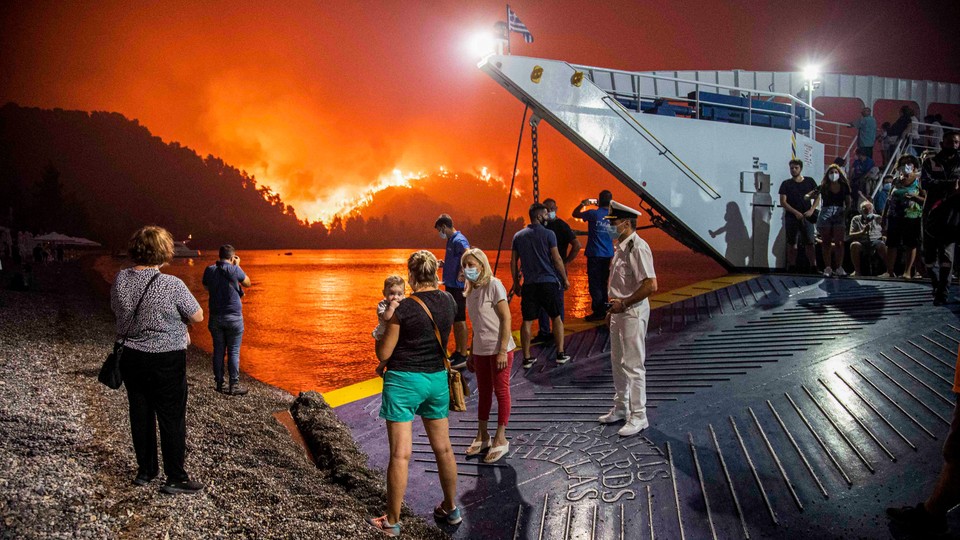
People board a ferry prior to an evacuation as a wildfire approaches the seaside village of Limni, on the island of Evia, Greece, on August 6, 2021.
NurPhoto / Getty

AUGUST 9, 2021SHARE

A new United Nations–led report from hundreds of climate scientists around the world makes it clear: The human-driven climate crisis is now well under way. Earth is likely hotter now than it has been at any moment since the beginning of the last Ice Age, 125,000 years ago, and the world has warmed 1.1 degrees Celsius, or nearly 2 degrees Fahrenheit, since the Industrial Revolution began—an “unprecedented” and “rapid” change with no parallel in the Common Era. What’s more, the recent spate of horrific heat waves, fire-fueling droughts, and flood-inducing storms that have imperiled the inhabited world are not only typical of global warming, but directly caused by it.

A NEW GUIDE TO LIVING THROUGH CLIMATE CHANGE

The Weekly Planet brings you big ideas and vital information to help you flourish on a changing planet.Email Address (required)Sign Up

THANKS FOR SIGNING UP!

Climate change has arrived, in other words, and it will keep getting worse until humanity reduces its greenhouse-gas pollution to zero, which can be accomplished only by dethroning oil, coal, and gas as the central energy sources powering the global economy.

But the speed of that transition matters—and preventing every last ton of carbon pollution, and averting every additional tenth of a degree of warming, will not only lessen the harm over the next few decades, but resound for centuries and even millennia to come.

These are the conclusions of the newest assessment report of the Intergovernmental Panel on Climate Change, a UN-sponsored body that has periodically released a synthesis of current climate science since its founding in 1988. The group’s reports tend to punctuate the otherwise slow immiseration of climate change; its previous synthesis report, released in 2013, helped inform international climate policy, including the writing of the Paris Agreement.

This is its sixth report and its most definitive. The group’s findings must be agreed to by 195 countries; this famously makes it more conservative than some scientists believe is prudent. But compared with previous reports, there is little restraint here. In its strongest statement of culpability ever, the IPCC declared that humanity is “unequivocally” responsible for climate change. “In past reports, we’ve had to make that statement more hesitantly. Now it’s a statement of fact,” Gregory Flato, a vice chair of the group that authored the report and a senior research scientist within the Canadian government, told me.

Some of the worst impacts of climate change can still be avoided. “There are still emissions pathways that would lead us to limiting warming to 1.5 degrees, but they require deep, rapid cuts in greenhouse-gas emissions,” Flato said. “That leaves a glimmer of optimism that we could limit warming to levels like that.” But it would require much more expedient action from the United States than is contemplated in, say, the bipartisan infrastructure bill that Congress is currently considering.

The report is 3,949 pages long and synthesizes the past eight years of advances in climate science; altogether, it cites some 14,000 studies. It would be folly to try to summarize all that work here. But the bottom line is that climate science, and the cataclysm of climate change, has lurched into the present tense. Where scientists once warned of disasters in the distant future, now they strive to understand what has already happened—and what is too late to save. Here are four takeaways:

1. Climate change is now a fact of modern life—and it will only get worse.

Climate change has been happening now nearly since before it first became a public issue. When James Hansen, the head of climate science at NASA, first warned Congress about climate change in 1988, he framed it in what might be called the tentative present tense, saying that the agency could now say “with a high degree of confidence” that global warming was under way.

And it was. As the new report notes: “Each of the last four decades has been successively warmer than any decade that preceded it since 1850.” Yet in the past few years, global warming has moved from a statistical property to an ambient condition of modern life. A mega-drought seems to grip the American West without end. A series of wildfires have passed, like a baton, from one part of the world to another, going from California to the Amazon to Australia to Greece to California again. And then there was the morning, a few weeks ago, when Americans on the East Coast and in the Midwest woke up, thousands of miles away from any wildfire, and smelled smoke in the air.

“We’re reaching a point where the impacts of climate change are becoming too hard to ignore for many people,” Zeke Hausfather, a climate scientist and a co-author of one of the report’s chapters, told me.

For the first time, the report establishes that those extreme events are happening because of climate change. Scientists’ ability to attribute individual events to the warming atmosphere is the “biggest advance” the field has seen in the past decade, Ben Cook, a climate-science professor at Columbia University, told me.

“Every inhabited region across the globe” has seen a well-documented increase in heat waves, heavy rain, or drought, the report says. Human activity is also behind the demise of glaciers since 1990, the hemorrhaging of the Greenland ice sheet, and the decline of snow cover in the Northern Hemisphere since 1950, the report says. No part of the world has been left untouched by humanity’s prodigious carbon pollution.

2. Sea-level rise will be worse than once thought—and could occur quickly and catastrophically.

In the past decade, climate scientists have arrived at more pessimistic views about sea-level rise, and those views are reflected in this report. Most researchers now believe that the oceans will rise roughly half a foot more than once projected. In a relatively optimistic “intermediate” emissions scenario, for instance, the IPCC once projected that oceans would rise about one and a half feet by 2100. The new report finds that just under two feet is more likely, and two and a half feet is not out of the question.

The authors could not eliminate from their models the small chance that some of the largest glaciers in West Antarctica could catastrophically collapse this century. In that scenario, humanity could see more than six and a half feet of sea-level rise by 2100 and perhaps as much as 16 feet of sea-level rise by 2150.

3. Sea-level rise is also essentially irreversible.

If humanity successfully learns how to remove carbon from the atmosphere, some of the impacts of climate change, such as ocean acidification and the rise in land temperatures, may be reversible.

But some will not. Sea-level rise is chief among them. “Once you have melting under way, it’s very hard to rein it in, even if you go full-scale into reversal of global warming,” Kim Cobb, a climate scientist at Georgia Tech and a co-author of the report, told me. The slow increase in sea levels could continue for millennia.

“When I say those words, it almost chokes me up. It scares the crap out of me, frankly,” Cobb said. “This is a horrific long-term consequence to the decisions we’ll be making this decade on our watch.”

4. The climate is now changing on political time.

If climate change is happening now, then its time scales—which once seemed distant—are suddenly ticking by at the speed of the political or business calendars. An earlier draft of this report cautioned that the world could see more than 1.5 degrees Celsius of warming by the early 2030s. Although that language was removed because researchers could not guarantee that a fluke event, such as a once-in-a-century volcanic eruption, would not briefly cool the planet and delay the inevitable for a few years, the broad point remains. The IPCC now warns that the world is likely to exceed 1.5 degrees Celsius of warming by 2040 even if humanity cuts carbon pollution as rapidly as is plausible. In fact, the agency estimates that enough greenhouse gas is already in the atmosphere today to raise the planet’s temperature by 1.5 degrees Celsius—only the cooling effects of smog and other forms of conventional air pollution are keeping temperatures depressed.

But humanity may still avoid warming the planet by 1.5 degrees Celsius by 2100. On all pathways, the world’s temperature will increase more than 1.5 degrees Celsius by the middle of the century; the only question is whether it then begins to cool down or keeps going up. Current policies suggest that the planet is set for 3 degrees Celsius, or more than 5 degrees Fahrenheit, of warming by the end of the century.

“We’re already seeing extreme rainfall, heat waves, and droughts that are all implicitly or explicitly tied to climate change—and this is just a 1-degree world,” Cook said. “I would not want to live in a 4-degree world. And a 3-degree world … would be quite challenging.”

UN report: Global warming is likely to blow past Paris limit

By Associated Press

August 9, 2021 | 4:56am | UpdatedEnlarge Image

A man carries bags of onions through flooded streets in Xinxiang in central China's Henan Province.

A man carries bags of onions through flooded streets in Xinxiang in central China’s Henan Province.AP

MORE ON:

CLIMATE CHANGE

‘Hours on a footnote’: Scientists felt joy, frustration in making UN climate report

Geoengineering marks scientific gains in UN report on dire climate future

Skies clear, allowing aircraft to help fight California fire

Drought brings hunger crisis in Afghanistan after US troop withdrawal

Earth’s climate is getting so hot that temperatures in about a decade will probably blow past a level of warming that world leaders have sought to prevent, according to a report released Monday that the United Nations calls a “code red for humanity.”

“It’s just guaranteed that it’s going to get worse,” said report co-author Linda Mearns, a senior climate scientist at the U.S. National Center for Atmospheric Research. “I don’t see any area that is safe … Nowhere to run, nowhere to hide.”

But scientists also eased back a bit on the likelihood of the absolute worst climate catastrophes.

The authoritative Intergovernmental Panel on Climate Change (IPCC) report, which calls climate change clearly human-caused and “unequivocal,” makes more precise and warmer forecasts for the 21st century than it did last time it was issued in 2013.

Each of five scenarios for the future, based on how much carbon emissions are cut, passes the more stringent of two thresholds set in the 2015 Paris climate agreement. World leaders agreed then to try to limit warming to 1.5 degrees Celsius (2.7 degrees Fahrenheit) since the late 19th century because problems mount quickly after that. The limit is only a few tenths of a degree hotter than now because the world has already warmed nearly 1.1 degrees Celsius (2 degrees Fahrenheit) in the past century and a half.

Under each scenario, the report said, the world will cross the 1.5 degrees Celsius warming mark in the 2030s, earlier than some past predictions. Warming has ramped up in recent years, data shows.

In three scenarios, the world will also likely exceed 2 degrees Celsius (3.6 degrees Fahrenheit) over pre-industrial times — the other, less stringent Paris goal — with far worse heat waves, droughts and flood-inducing downpours “unless deep reductions in carbon dioxide and other greenhouse gas emissions occur in the coming decades,” the report said.

“This report tells us that recent changes in the climate are widespread, rapid and intensifying, unprecedented in thousands of years,” said IPCC Vice Chair Ko Barrett, senior climate adviser for the U.S. National Oceanic and Atmospheric Administration. “The changes we experience will increase with further warming.”

The 3,000-plus-page report from 234 scientists said warming is already accelerating sea level rise, shrinking ice and worsening extremes such as heat waves, droughts, floods and storms. Tropical cyclones are getting stronger and wetter, while Arctic sea ice is dwindling in the summer and permafrost is thawing. All of these trends will get worse, the report said.

For example, the kind of heat wave that used to happen only once every 50 years now happens once a decade, and if the world warms another degree Celsius (1.8 degrees Fahrenheit), it will happen twice every seven years, the report said.

As the planet warms, places will get hit more not just by extreme weather but by multiple climate disasters that occur simultaneously, the report said. That’s like what’s now happening in the Western U.S., where heat waves, drought and wildfires compound the damage, Mearns said.

Some harm from climate change — dwindling ice sheets, rising sea levels and changes in the oceans as they lose oxygen and become more acidic — are “irreversible for centuries to millennia,” the report said.

SEE ALSO

35

Wildfires rage across Western US

The world is “locked in” to 15 to 30 centimeters (6 to 12 inches) of sea level rise by mid-century, said report co-author Bob Kopp of Rutgers University.

Nearly all of the warming that has happened on Earth can be blamed on emissions of heat-trapping gases such as carbon dioxide and methane. At most, natural forces like the sun or simple randomness can explain one- or two-tenths of a degree of warming, the report said.

The report described five different future scenarios based on how much the world reduces carbon emissions. They are: a future with incredibly large and quick pollution cuts; another with intense pollution cuts but not quite as massive; a scenario with moderate emissions; a fourth scenario where current plans to make small pollution reductions continue; and a fifth possible future involving continued increases in carbon pollution.

In five previous reports, the world was on that final hottest path, often nicknamed “business as usual.” But this time, the world is somewhere between the moderate emissions path and the small pollution reductions scenario because of progress to curb climate change, said report co-author Claudia Tebaldi, a scientist at the U.S. Pacific Northwest National Lab.

In a way, the world can stay at the 1.5-degree threshold with extreme and quick emission cuts, but even then, warming would hit 1.5 degrees in a decade, rise a tad and then come back down, said co-author Maisia Rojas Corrada, director of the Center for Climate and Resilience Research in Chile.

While calling the report “a code red for humanity,” United Nations Secretary-General Antonio Guterres kept a sliver of hope that world leaders could still somehow prevent 1.5 degrees of warming, which he said is “perilously close.”

“Anything we can do to limit, to slow down, is going to pay off,” Tebaldi said. “And if we cannot get to 1.5, it’s probably going to be painful, but it’s better not to give up.”

SEE ALSO

31

Scenes from the deadly floods in Germany and Belgium

In the report’s worst-case scenario, the world could be around 3.3 degrees Celsius (5.9 degrees Fahrenheit) hotter than now by the end of the century. But that scenario looks increasingly unlikely, said report co-author and climate scientist Zeke Hausfather, climate change director of the Breakthrough Institute. Both extremes are looking less likely, he said.

“We are a lot less likely to get lucky and end up with less warming than we thought. We won’t be able to meet Paris Agreement goals without rapid near-term reductions in our emissions,” Hausfather said. “At the same time, the odds of ending up in a much worse place than we expected if we do reduce our emissions are notably lower.”

The report said ultra-catastrophic disasters, commonly called “tipping points,” like ice sheet collapses and the abrupt slowdown of ocean currents are “low likelihood” but cannot be ruled out. The much talked-about shutdown of Atlantic ocean currents, which would trigger massive weather shifts, is something that’s unlikely to happen in this century, Kopp said.

The report “provides a strong sense of urgency to do even more,” said Jane Lubchenco, the White House deputy science adviser.

In a new move, scientists emphasized how cutting airborne levels of methane, a powerful but short-lived gas that has soared to record levels, could help curb short-term warming.

More than 100 countries have made informal pledges to achieve “net zero” human-caused carbon dioxide emissions sometime around mid-century, which will be a key part of climate negotiations this fall in Scotland. The report said those commitments are essential.

“It is still possible to forestall many of the most dire impacts,” Barrett said.

Climate crisis ‘unequivocally’ caused by human activities, says IPCC report

Exposing the Big Game's avatarThe Extinction Chronicles

https://www.theguardian.com/environment/2021/aug/09/climate-crisis-unequivocally-caused-by-human-activities-says-ipcc-report

Intergovernmental Panel on Climate Change states every corner of the planet is already being affected and it could get far worse

Submerged cars and other vehicles seen after flooding in Erftstadt, western Germany
Submerged cars and other vehicles seen after flooding in Erftstadt, western Germany, in July. Extreme weather events will become more frequent as the earth heats up.Photograph: Sébastien Bozon/AFP/Getty Images

Damian CarringtonEnvironment editor@dpcarringtonMon 9 Aug 2021 04.00 EDT

“​​It is unequivocal.” Those stark three words are the first in the Intergovernmental Panel on Climate Change’s new report. The climate crisis is unequivocally caused by human activities and is unequivocally affecting every corner of the planet’s land, air and sea already.

The report, produced by hundreds of the world’s top scientists and signed off by all the world’s governments, concludes that it could get far…

View original post 1,087 more words

Grand Junction man convicted in late-night poaching incident

Exposing the Big Game's avatarCommittee to Abolish Sport Hunting Blog

https://www.nbc11news.com/2021/08/09/grand-junction-man-convicted-late-night-poaching-incident/

Dylan Zuber pled guilty to willful destruction of wildlife and other misdemeanor counts on July...
Dylan Zuber pled guilty to willful destruction of wildlife and other misdemeanor counts on July 26 in Mesa County Court.(Colorado Parks and Wildlife)

ByMadelynn FelletPublished:Aug. 9, 2021 at 11:27 AM PDT|Updated:49 minutes ago

GRAND JUNCTION, Colo. (KKCO) – 23-year-old Dylan Zuber, was charged with 20 counts of wildlife violations, including willful destruction of wildlife and the illegal possession of three or more big game animals. Zuber pleaded guilty to one count each of willful destruction of wildlife, illegal possession of three or more big game animals and hunting with artificial light on July 26 in Mesa County Court.

He was ordered to donate $2,500 to Colorado Operation Game Thief and pay the $3,360.50 in fines and court costs. Zuber was also sentenced to a four-year deferred judgement for the felony charge of willful destruction of wildlife. This includes a court ordered prohibition of hunting and…

View original post 178 more words

Climate change: Five things we have learned from the IPCC report

Exposing the Big Game's avatarThe Extinction Chronicles

By Matt McGrath
Environment correspondentPublished6 hours agoShare

Satellite images of wildfires in Evia, Greece
image captionSatellite images of wildfires in Evia, Greece

TheUN report on the science of climate changeis set to make a huge impact. Our environment correspondent Matt McGrath considers some of the key lessons from it.

Climate change is widespread, rapid and intensifying – and it’s down to us

For those who live in the West, the dangers of warming our planet are no longer something distant, impacting people in faraway places.

“Climate change is not a problem of the future, it’s here and now and affecting every region in the world,” said Dr Friederike Otto from the University of Oxford, and one of the many authors on the UN’s Intergovernmental Panel on Climate Change (IPCC) report.

It is the confidence of the assertions that the scientists are now making that is the real strength of this new publication.

The phrase “very…

View original post 1,300 more words

Bill to Ban Deadly ‘Cyanide Bombs’ on Public Lands Introduced by Rep. Peter DeFazio

Exposing the Big Game's avatarCommittee to Abolish Sport Hunting Blog

FOR IMMEDIATE RELEASE: August 9, 2021
CONTACTS: Brooks Fahy, Predator Defense, (541) 520-6003, brooks@predatordefense.orgCollette Adkins, Center for Biological Diversity, (651) 955-3821, cadkins@biologicaldiversity.org  Marjorie Fishman, Animal Welfare Institute, (202) 446-2128, margie@awionline.org

EUGENE, OR — A bill introduced August 6, 2021 by Rep. Peter DeFazio (D-Oreg.) seeks to ban the use of wildlife-killing M-44 devices, commonly known as ‘‘cyanide bombs,’’ on federal public lands. These deadly devices — spring-loaded capsules armed with cyanide spray — have injured people and inhumanely killed thousands of animals every year. 
“Working closely with M-44 victims for almost 30 years, I have witnessed what these indiscriminate devices have done to families,” said Brooks Fahy, executive director of Predator Defense, a national wildlife advocacy group. “Countless people have lost beloved pets, and both children and adults have been poisoned. The emotional scars are permanent. Since M-44s can never be used safely, they must be banned. A…

View original post 511 more words

People and grizzly bears learn to live with each other in Montana

https://www.cbsnews.com/news/grizzly-bears-montana-returning-population-60-mintues-2021-08-08/

Montana’s grizzly and human populations have both risen substantially since 1975, when the bears were protected under the Endangered Species Act. Bill Whitaker reports on conservation efforts that have led to grizzly recovery, and the farmers, ranchers and residents now encountering these ferocious animals.

  • 2021Aug 08
  • CORRESPONDENTBill Whitaker
  • FACEBOOK
  • TWITTER
  • REDDIT
  • FLIPBOARD

https://www.cbsnews.com/embed/video/?v=16c9ed058a8632b3a0dc6f3c828cede6#vVlpb9tIEv0rAoHow1q0eImkNDAW8jXjmRxeOw4WaxlCkyxKPeIVNqnDhv77VjUpUZKdONnxzkwiNvuqqu5XVa%2BYJ4WVRZpFbKUMiryEjhLAnPugDLAhZjikdJQ5DyBVBk8KLyAWyuD%2BSSlWGc2ZpwGO8wCbhub7TA89VQPdVS1DD9S%2BY3tq6LhMA08D1%2FBxbpwtbyC8ohW%2FTpLY%2BbM%2Fm6wmv0%2F%2FffX5y7%2Fs2%2Bnyy3%2FuxmeLP%2FTYwtkiKic4c5Lzx8dopXrAcqHGaVKwhKk5FGWe8GSiZmlWRqzgaaLamhrzpChBqFJt1dAMXdVc%2FIP7FbyISO%2BzFJZcFLi2teDFtFUJ4CBaPGl9qPZX6CxmOBkbYRlFm7WXPAnkQrYSrSJt%2BdVeuxutWlLT%2Fc18lqQJ91n0%2BS9uVPAYRMHiTBnotuFatq3J%2F1DfMpenoAxcw2pe3zMPIhSomwOLTjWq3hM0Ci8vZhMQdLuCLmVaFJkYjLqjru%2BJBBbCPMYGqoU7%2Bcd%2BGo%2B609Ibdfmom4%2B6dLijruZWf10D%2BpZmO2oPbEAIGI7a1%2B1Q7WvMdAE1BRNXFtMy9hLGo1HXtrSlaWu42vEd5gRh4ASW5mq65TA%2FcLTAtU3f9QOb9sc7tDW827LAu11MecFmkKuO7RqIt3qn4z%2BzCRo4fdES4%2F9oiW642tIx0BQbDM3RWegZXuDpdl8HP9DxdkAzPYAw%2FClT1h0ly9EhYXGXR3s2iSxCNz1mcTQ55umoyzK0Y27gX0L9qPuac4269cajbuPhO%2FtneRoco3vLkeP6BKtTq19QFJ7bNBKHh6f3Ta1vG1a%2F37d7oy6ZZWhjOTFmooD8ODZLdyPV%2BNvFhmkeswLFsowOUbrIqLtU4wwmdzfvcUZ5cNiLxWJfl%2FqQ3yYuyRvg4irOUlJTGYQsEhiJMfhyX4ZdgrMTaoirnqWaPQNUXQdTdX3A9ZYTOJ7e8%2FoGNBGzEifxlTBUh4amHHKW%2B1MM9fc4oVVPwJHmpVXPfkDgsRyS4jMp8ZHFIDdtfdiu2e52uqqG7%2FfHm5fWx%2B2eLIqqiequ8ENVHxD2kHGRBrit5aBRwARFtZ5J7UmMeikDapcZoliI7ZHh%2FkPfx57TKPVn224u7gTkt6Un%2FJx7EGwHRJYmIs03sXAKy%2BE5hKyMCB5aB%2F9XZO9p02v2O1av0%2BvjAAvodsJF9TuOeDLbgw1emeMcz4%2FDRZzHxwkU6KYBogax%2Bk9f8OBkjqAa18Aa1%2Fl2vABvjB7QZiJZnPQMzdT1ts9w9msu3Q4jNjl5Z5yy2PfwAbGf40NERSYfsvNrIR%2BY4%2BkReiygsVXi4yMp5QIGBW%2FHUOQnumaY7UYLdM6wbr8zh7%2Bm6SSC8%2BHV2e3wajzXcHyeJyf3N8OP558%2BPLTxYrKTecwyneShB1ptsWPSPNuZ%2FMsYzy%2FhgJeSjNEtx2jutXamnZnO8Bxd5cxSrYtLRx1eGj319OL07FS3zy%2Fd3kUbTw3vNCMfG6PbnsjTR%2B3eGZf458Bx2%2FNJiTs%2Fyce6LR5Pnoj6QD4W%2FBHW7Sk64Cs7ZMR8cBk91m3poidP8rFuV9Tp5Kl6rtu4d0HBRkqRrXWbDOVijO8nT9Vz3X4KYzFGd2OxWP%2BiSM9jsUzJhBKiWd%2FBCeEQjxWdQ54r8Qz%2Bg%2ByK8IIzjwgvR4SWI8LKESHliHByRCg5IowcEUKOCB9HhA7icYgP5B8IkI6yK50wgntWr4NnGCHrECU4Y3P12ENIISsJK0cSKRTI9owitOwveo4YHP8hzEhit4ea7wV7ylMEF5xT44aUe6TXXexQnED0vLJTVvPmGj%2FKNsgrNYaUHQK%2BwRGtq%2FFTS62wVB9ChSIaqfEkWUOzYMPj19hd5MyfYWaS2Epj4acYbqmNWdjUtJ7m2gggixjy6e3HRm%2Ffxq5%2FUJDEl0SMRTGekIpkWtXDsjGjG%2Fo46g63c%2FxCglc3tj3yhHb3Jq18Jm9CvETa9G%2BSts2q17nOMQu88TIm3eNyeZ2nGeTF6g9YUdliORCwnm3qToDZtW%2F1dcM0mWkr6weJciapMR5cAZMVtbFvmgYVfYAkkBZIeOxltWd5mO66unyCTYQm7dQje5kTqRx2bUnGcop8Jwe8UMDk0Ww46vbMUddyRl18KAeXy8VFwryIUl1V1rEcDzCCYYnK51R%2B3SvQ9x3T0i3VZi4jRmGo%2FUA3VE3T3RCwatM8TSbt3aWbXO%2FxKGptqOvOLFnZeX2wwz54SIxCpM%2BeY6iM9Xw1NA3TYK4XIiFWtkuuS%2B8cjZM15IYTtQxzoPUGut5M25RNGWC9Ci2WBAdFUoS%2FCRVSEZ9DVUUB86ettJhCTiVUTdBaamuP%2FWz2r27Hx0nIL8Z179Yh6%2BGmKubiHOaktIzYk80EGaOpUCYQ4PM3TpTuRwgXzb4FvyrgXmRwNKMWQzETwS8tBW8TSK5%2BgikW%2B8zuQB%2BsEnnM0Vut7QHdpmUuAxN6ZKv2fC%2FHe7iug42UvklTpOu4OS1kZpJKih%2Fgf529gp%2FCj4djtUDE3bZkIoeuy2I6P8C7C1i%2BelHQswlXgZziOEw3PU9TnZ4bfMcLyJ76tGoT6QyBRbyMyeMo8fFoZ5gW4BRICCRU1yjrnY8Ah%2FXcsxKjqnX%2BtwrjoLaIIeDsOkWFcF6NH3SWoAbu36kKyatP8U33lbHyVUPeumxbb2qASVbQo2D5BIo6BNeZ%2Ff7tAP7Cp7mdPF%2BFgQ3D2A1DvkxPf%2FWc97A8ZlgMSfPP0iTk0mAscBZpPqNmQJHRNWwMHl%2FZpoVJnEhD9SIdQrbXnZ2USjxT5QmWUiCJ4aTiBfdPdRvnlDMyKS2TIucgXXhChod0WJxWPdJHMm%2BKP7MF%2FkgC85X6BP0wmsK%2FkjX0qWgly82d7Vl5uL3sSR4P5wnODmcK2jFe0TWQ%2BGJafRxFeCbED0lxnuA%2BlC6Du4QXtIpoRurJ0PG0200ZnVJ48bxffvvb6Xyqd7iMYImxTYaj2t1R0wopxFJp%2Fb1paJ2e9tC5R8LXMaqWoXdMnRqm3TFc6sLigEjvA2rnl6JI48%2B72EY%2BhFDG5DOTJMrXQg%2BB4kv7AlheLP0pSyZwiwCUScFwNNPVK7z6QPV71a3Rpz69LzlUYwKGKkNK%2BZ7KzzTtyGkW9tHHi635xtsZYH7DAEN7boD58wbsqW2%2Bndq9b6mtH6h9lfh%2FUWtUg5R5K82dQ83viSLaut2jCrFu9pqm3TSdpuk2zf62aWtNU2%2BaRtM0m2YjzW6k2Y00u5FmN9LsRprTSHMaaU4jzWmkOY00p5HmNNKcRprjYjSpAsItcrTZ6qX7278hUc17s0vqf8utDRPhJZXLsuch7EU65adRxDIBFzGmsXM%2B3xQvAoobCJHyTu8w2URY1txGadF89sPxM2L%2FB6P1P2hxQWH0CoVzFr1PWfP57%2FnQWRpnLKmSTrUcZB11iycUwQ18xZxY7A8NKWfdYCUIuTzGzT%2BjyQ%2BGN9t0sZAfDD%2FlgSwHHjarf0MeBvkpD4LdxZVe0qbtBX1KSM9vW1WfEMqS1inbOcMAHTuH6qtpbXkl%2FAYyoLJyGGzOkigqMQPMv7JKVGxdJx8zmG2AzKF4tF%2BQQOwlfIXyuPLDl6rom%2FJD7BU6yAg3%2FOil7xd0fjV7Jb5Fr7hdTeNZoAZ8rvJAZXnOVvIbsp%2BmM36g0FjS3mrkFnIiVNesmEo%2BSh9ncZ9qUNJKAUjj6f6IvpTe7c5rKeCS56K4ptKvcSK6nfX6vw%3D%3D

When Lewis and Clark first encountered grizzly bears, there may have been a hundred thousand of them in the American West, from what is now Canada all the way down to Mexico. Grizzlies are among the most fearsome predators on the planet so, for the next 150 years, they were systematically exterminated by settlers, ranchers and farmers who saw them as a threat to their lives and livelihoods. By the 1960s there were just a few hundred left in the lower 48 states.

In 1975, grizzly bears were among the first animals to be protected under the Endangered Species Act. And as we reported last year, what’s happened since – especially in the state of Montana – is a story both of conservation and conflict. Ever been face-to-face with a grizzly? Neither had we.

dsc07326.jpg
The bear the 60 Minutes crew came upon  ERIC KERCHNER/CBS NEWS

In the Swan Mountains of northwestern Montana, we’re carrying bear spray and following state bear specialist Erik Wenum and his colleague Milan Vinks deep into the woods.

Wenum’s checking one of several traps – called snares – that he has baited with beaver meat.

Erik Wenum: Oh, there’s a bear. Grizzly bear.

Bill Whitaker: Hear that????

Erik Wenum: The closer we get, the more agitated she’s going to become, so we’ll kind of be quiet– get a good weight assessment on her, and then we’ll just drift right back out, okay?

Bill Whitaker: I’m with you.

Erik Wenum: Alright.

Erik Wenum (speaking to bear): You’re okay. (GROWL) You’re alright, you’re okay, you’re okay. (GROWL & CHARGE) You’re alright. You’re alright. 

After the wire snare around its wrist stops the first charge at Wenum, the grizzly makes another effort to get at our cameraman, Don Lee.  

Erik Wenum: (GROWL & CHARGE) Yeah, you’re alright. All right, we’ll drift out.

Bill Whitaker: You have an estimate of how big that bear is? How much do you think she weighs?

Erik Wenum: I think it’s right around 300 pounds.

That’s mid-sized for a grizzly. They can weigh as much as a thousand pounds and stand nine feet tall on their hind legs.

Erik Wenum: We’re going to mix a little bit of medetomidine.

grizzlies-erikwenum0.jpg
Erik Wenum

Wenum and Vinks mix a cocktail of veterinary sedatives and load them into a dart gun. 

Bill Whitaker: You have the dart, I have the bear spray, we’re ready—

Erik Wenum: There you go, we are set.

Vinks carries a shotgun loaded with lethal ammunition, just in case.

Wenum insists that neither the tranquilizer nor the snare do any lasting harm, and that he needs both as part of a project to attach radio collars to grizzlies and track their population’s recovery. 

Hilary Cooley: To me, having a grizzly bear population means that the ecosystem is intact.

Hilary Cooley is the wildlife biologist in charge of grizzly bear recovery for the U.S. Fish and Wildlife service.

Hilary Cooley: Grizzly bears were listed in 1975 as a threatened species in the lower 48 states.

Bill Whitaker: Thought their survival was in jeopardy?

Hilary Cooley: Yeah. Their range had been reduced by about 98%.

grizzlies-hilarycooley00.jpg
  Hilary Cooley

Two places grizzlies hadn’t been wiped out were Glacier and Yellowstone National Parks, where a few hundred were protected from eradication. So, starting 45 years ago, the recovery effort focused on millions of acres around those two parks.

Hilary Cooley: They’ve probably more than tripled their numbers, and their range now is more than double what it was at the time of listing.

Since listed as an endangered species back in 1975, the grizzly bear population in this region has made a remarkable comeback – a true success story. But at the same time, another population has also been growing around here – the human population – with houses and subdivisions built right next to the wilderness. And that’s often where the trouble starts.

Montana’s human population has grown by 250,000 since grizzlies were protected in 1975. Most of those people live on valley floors or in foothills not far from bear country.

Bryce Andrews: When you can look at the telemetry from their collars, you realize that at night this valley belongs to bears. A bear has walked, I’ve seen the telemetry, through the spot where you and I are sitting right now. And we are within 100 feet of my house.

Bryce Andrews is a rancher, author, and field director for a non-profit called People and Carnivores, which tries to minimize human-bear conflict. He’s seen all the videos of grizzlies going through trash cans, raiding chicken coops and backyard bird-feeders, even the fridge. They are true omnivores, and really hungry from the moment they emerge from hibernation each spring.

Bryce Andrews: Anything with caloric value, a bear will turn it into what they need to survive. 

Bill Whitaker: So they will eat any and everything.

Bryce Andrews: Any and everything. They’ll come for bird seed. They’ll come for the residue on a barbecue.

Bill Whitaker:  It’s their appetites that get them into trouble with humans.

Bryce Andrews: Absolutely.

grizzliesbryceandrews0.jpg
  Bryce Andrews

The greatest trouble comes when grizzlies go after livestock or crops that ranchers and farmers count on for their livelihood.

Hilary Cooley: Bears can be really hard to live with. They kill livestock. There are producers who have 20, 30 cows a year killed by grizzly bears. And so, for those–

Bill Whitaker: Sounds like a lot.

Hilary Cooley: –folks– it’s a lot. It’s a big impact.

Greg Schock: The bears probably knocked down between 20 and 25% of my corn that I couldn’t harvest every year.

Greg Schock farms in Montana’s Mission Valley. He says grizzlies live in the woods about a mile from his home.

Greg Schock: We had 18, several years in a row in our cornfield and nobody believed that I had that many until they put cameras up and– and actually had footage of them.

Bill Whitaker: Eighteen in your cornfield?

Greg Schock: In a hundred-acre cornfield, yeah.

With so many grizzlies around – now nearly 2,000 – the federal government has considered removing some populations from the endangered species list. So far, court challenges from environmental groups and Native Americans have prevented that.

Bill Whitaker: You think it is possible to coexist?

Greg Schock: I think we have to. If we don’t coexist, what’s– who’s leaving? The bears aren’t leaving and we aren’t leaving. So…

grizzliesgregschock0.jpg
  Greg Schock

So Bryce Andrews’ organization does things like install high-voltage electric fences around fields like this 30-acre melon farm. Grizzlies are smart enough to “test” the fences, and sometimes even get around them.

Bryce Andrews: We’ve got an electrified gate, here, which is off right now.

Andrews has an electric fence around his backyard chicken coop. But not all of his neighbors do. 

Bryce Andrews: Generally, when there are unprotected chickens in grizzly habitat, it’s only a matter of time before something goes wrong.

Bill Whitaker: The grizzly bear will win. 

Bryce Andrews: They’ll win, and see, they have these phenomenal noses. They smell everything. 

Including neighborhood trash cans. If a grizzly develops a taste for garbage, gets accustomed to being near people, and then teaches those bad habits to her cubs, it can prove fatal. 

Bears that get into such trouble are often trapped by state bear managers. At first, they’re relocated to remote regions and released. But if they keep coming back, federal official Hilary Cooley may need to authorize killing them.

Hilary Cooley: Ultimately, that’s my decision.

Bill Whitaker: What’s that like?

Hilary Cooley: It’s the worst part of the job. It’s– but it’s necessary. 

Bill Whitaker: Why “necessary”?

Hilary Cooley: If we think it’s a threat to human safety, for example a food-conditioned bear, bears can kill people. And it’s something we don’t mess with. If there’s a threat to human safety, we remove it right off the bat.

Bill Whitaker: And remove, you–

Hilary Cooley: Euthanize.

Bill Whitaker: Euthanize. 

She had to authorize the killing of nearly 50 grizzlies in 2019. Just last year, she had to authorize the killing of nearly 50 grizzlies. The grizzly bear we saw Erik Wenum tranquilize in the swan mountains may never have seen a human being before, let alone gotten into trouble.

Bill Whitaker: Do you know, is it a male or a female?

Erik Wenum: I don’t yet.

Bill Whitaker: How long will this grizzly be out?

Erik Wenum: About an hour and– 20 minutes–

Bill Whitaker: About an hour. 

Erik Wenum: Argh!

Milan Vinks: It’s a male.

Bill Whitaker: Why, why were you hoping for a female?

Erik Wenum: We want to radio collar females. Females drive the system. They– they really do.

Bill Whitaker: Will you collar him?

Erik Wenum: We collar some males. We’re not gonna collar this guy though.

Bill Whitaker: Boy, look at those claws.

dsc07487.jpg
The paw of the grizzly the 60 Minutes crew came upon.  ERIC KERCHNER/CBS NEWS

The forest becomes a field hospital as they attach monitors and even an oxygen bottle to the grizzly.

Erik Wenum: So he’s at 88% oxygen. I like it when it’s 90– 95, so I want to get him up. 

We measured every part of the bear. Blood is drawn, tufts of hair pulled for DNA analysis. 

Erik Wenum: I’m gonna call him a 5-year-old bear, okay? So you can see these are his incisors, and if you run your fingernail over the top, you can still feel some cusping.

Bill Whitaker: Tell me I can do this? Stick my hand in a grizzly bear’s mouth.

Erik Wenum: I’m tellin’ you you can do that.

Bill Whitaker: Oh yeah. How about that.

Less than an hour after being darted – a bit ahead of schedule – the grizzly starts to stir.

Bill Whitaker: So he’s starting to wake up–

Erik Wenum: Okay. Everybody we’re ready to go. You guys head on out. Everybody go.

We didn’t need to be told again. As we hustled out, Wenum removed the hood from the bear’s head, and hurried out himself.

Erik Wenum: Your first question’ll be, “Does that happen often?” (LAUGHTER)

Bill Whitaker: Yeah, when he was sniffing up, that was time to go–

Erik Wenum: When he was lifting his head, it’s time to go.

Bill Whitaker: It’s time to go.

We had about as safe an encounter with a grizzly bear as is possible to have. But with more people going deep into bear country – to hike or bike or camp or hunt – there are several decidedly unsafe encounters every year. 

grizzlies-andersbroste0.jpg
Anders Broste

Anders Broste: I didn’t really get a warning, and– all of a sudden there’s a grizzly bear running at me. And in about probably less than a second– it was on me.

Anders Broste was hunting for deer and elk with a friend in the wilderness north of his Montana home on November 11, 2018, when he stumbled upon a grizzly who’d been dozing in the snow.

Anders Broste: It bit my arm here, kinda thrashed it around. And then bit my leg here. Started pulling on me and kind of tossing me around. And then it just dropped my foot and ran off.

Bill Whitaker: Do you have any idea why he didn’t just finish you off or drag you off?

Anders Broste: Nope.

Broste’s hunting partner Dan reached him within a minute or two. Luckily, they had a cellphone signal to call 911. State bear specialist Erik Wenum was one of the first responders on the scene, and he snapped a photo of a very large pawprint in the snow.

Bill Whitaker:  They had to chopper you out?

Anders Broste: Two choppers.

Bill Whitaker:  How long were you in the hospital?

Anders Broste:  I was in the hospital for six days. In that six days, I had three different surgeries. My arm was broken, my thumb was broken, and my hand was dislocated. My foot was basically held to my, my ankle with soft tissue.

This is the grizzly that attacked Anders Broste, in a photo taken four years earlier when state bear managers trapped and released him. DNA samples proved the match.

Bill Whitaker: So– the bear that attacked you is still out there.

Anders Broste:  Yep.

Bill Whitaker: Does that bother you? You okay with that?

Anders Broste:  I’m okay with it. I was intruding. So, to me, the bear’s response was not any more inappropriate than what somebody else’s response would be if I trespassed into their home.

Broste, who’s the co-founder of a company that makes mountain bikes, is back on his, after many months of tough rehab. And he says he and his friend Dan plan to go hunting again this November 11th, the anniversary of the attack.

Anders Broste: I think it’s part of what makes Montana wild. If we didn’t have grizzly bears, like, it’d be a little less wild. They’re a part of our ecosystem. They play a role in everything that’s going on around here. And I think that’s kind of cool. I’d– I’d prefer not to see one that close again though. (LAUGH)

Two people have been killed by grizzlies in Montana so far this year, a man attacked in April while fishing and, just last month, a woman who was pulled out of her tent by a bear. Both grizzlies were found and killed by authorities.

What Is a Sentient Being? Here’s Why the Definition Is So Important

What Is a Sentient Being? Here’s Why the Definition Is So Important

ByGrace HussainAugust 6, 2021

sentient being

Read Next
Protected: Announcing the Sentient Media Journalism Fund

Humans have long insisted on believing that we are different from other animals, and somehow better. This idea, however, is slowly starting to change. Animals have moved into our homes as companions. We spend hours watching their antics on social media. We throw birthday parties on their behalf and spend millions every year on their care. And while our relationships with our pets are changing, research is also increasingly demonstrating sentience in nonhuman animals, challenging the idea that humans and animals are separated by an insurmountable gap. 

Who Is a Sentient Being? 

There are a number of different definitions for sentience, and thus sentient beings. Most of the disagreements surrounding who qualifies are about different animals and where they fall on the scale of sentience. 

In Buddhism, a sentient being includes every conscious creature. There are several classes of sentient beings. Amongst these are a class for humans and one for animals. The class of animals includes all species whether mammal, bird, fish, or insect. The classes are ranked, however, with people ranking above animals. Plants are the only living thing excluded from consideration as a sentient being, because Buddhists do not see them as conscious. 

Animals have also been recognized as sentient beings in many legal systems around the world, due to their ability to feel pain. The European Union (EU) recognizes animals as sentient beings in Article 13 of the Treaty on the Functioning of the EU, which is relevant in particular to the welfare of farmed animals. This classification is the reasoning given for protecting their welfare. 

Within the United States, there is no federal legal recognition that animals are sentient beings, though there are several laws that reference animals’ ability to suffer. The definition of animal in some legislation, however, has several glaring exceptions including rats, mice, and birds. Individual states within the union have taken the step and recognized animals as sentient beings. One such state is Oregon. 

There are other governments, such as India, that implicitly recognize animal sentience by recognizing animals’ ability to suffer both physically and mentally. India goes further by applying this standard to all living creatures and, in its constitution, requiring that all people “have compassion for living creatures.” 

What Makes a Creature Sentient? 

Though there has been disagreement between legal systems, religions, and individual scholars about sentience and what it means to be sentient, there are a few standards that are broadly accepted. The Sentience Institute put forward the idea that sentience is simply the ability to have both positive and negative experiences. This definition is recognizable in many laws pertaining to animal sentience which discuss animals’ ability to feel pain as a means of demonstrating sentience. 

Which Animals Are Sentient Beings? 

When following a broad definition of sentience, almost every animal, human and nonhuman, would qualify as a sentient being. A few examples of different species that are sentient beings can be found below. 

Dogs

Anyone who has had a relationship with a dog can attest to their sentience. They get extraordinarily happy when they see their person after a long day of being apart; they tuck their tail and whine when visiting the veterinarian; they sulk when they don’t get what they want. Leading scientists researching neuropsychology and dogs have recognized that canines share many of the same emotions and experiences as humans. The study of the brain structure of not only dogs, but a variety of other species including dolphins and bats, shows striking similarities with human brains, supporting the idea of shared emotions and experiences. 

Sheep

Though being a sheep has been associated with an inability to think for one’s self, being compared to this species should really be considered a compliment. Research has demonstrated that sheep have the ability to plan and make judgments based on remembered information. They also have excellent learning and memory abilities and are able to recognize faces and expressions. Sheep are also able to experience both positive and negative emotions, fulfilling the definition of sentience set forth above. 

Fish 

When considering animal sentience, it might be surprising to learn that fish are also considered sentient beings. Yet this becomes less surprising given the amazing tricks and skills that fish can learn through positive reinforcement training techniques. This process of learning suggests that fish have significant memories. Also suggesting sentience are the many studies that demonstrate that fish feel pain and will seek ways of alleviating it. 

Which Animals Are Not Sentient? 

While the vast majority of animals can be recognized as sentient beings, there are a small number of animals that, as far as scientists can presently tell, do not have the ability to experience sensory phenomena whether positive or negative. One example of such a species is the oyster. While oysters do have a heart and organs, they lack a central nervous system, making it unlikely that they experience pain.

Another example of an animal lacking a nervous system and thus likely unable to experience pain is the silkworm. In both these species, however, scientists cannot rule out the possibility that they do experience some form of pain or unpleasant sensation or emotion when they come into contact with negative phenomena, such as being eaten or boiled alive for the production of fabric.

For this reason, it is still important for their welfare to be considered when using them for food, textiles, or any other purpose. Instead of assuming that no suffering occurs when we lack conclusive evidence, the more humane stance is to act as though creatures might suffer as a result of their use by humans, and take the steps necessary to limit or eliminate discomfort. 

Are Plants Sentient Beings? 

There is an ongoing debate in the academic community over whether plants can be considered sentient or not. Some scientists argue that because plants do react to stimuli such as sunlight they should be considered sentient. Others argue that applying terminology used to talk about animal’s experiences, such as sentience and consciousness, is inaccurate due to the difference in physiology between plants, which lack organs and the ability to move, and animals (including humans). 

Research Supporting Animal Sentience

There is a wealth of research pertaining to animal sentience. The publication Animal Sentience provides publicly available essays, reviews, and other formats of academic inquiry for those interested in the topic. Below are just a sample of the many articles that can be found pertaining to animal sentience. Many may only be available through an academic institution or library; consider reaching out to such an entity if there is an article that you would like to read but to which you lack access. 

Animal Sentience

Farm Animals

Companion Animals

Wildlife

Freedom Is the Right of All Sentient Beings

There is a wealth of information and research establishing sentience in animals. Though it is not new, the idea of animals forming relationships, experiencing emotions, and learning has become sufficiently mainstream that it has begun to be included in the law around the world. Despite this, humans are still causing animals to suffer for their own needs. In order to consume cows’ milk, we separate calves from their mothers, despite the distress it causes to both. We engineer chickens so that they grow too large to live comfortably within a matter of weeks, just to increase the efficiency with which we can harvest their flesh. These animals do not deserve to suffer.

With plant-based alternatives to all the products that they provide to us becoming ever more accessible, the practice of keeping these animals confined becomes less and less justifiable. These animals deserve a life worth living, a life during which they can create and maintain relationships, play, learn, and be free. All sentient beings do.Read More

Animals Are More Sentient Than You Think

Do Cows Play? What Cows Can Teach Us About Friendship

Climate change: Time running out to stop catastrophe – Alok Sharma

Exposing the Big Game's avatarThe Extinction Chronicles

Climate change: Time running out to stop catastrophe – Alok Sharma

By Francesca Gillett
BBC NewsPublished9 hours agoShareRelated Topics

Alok Sharma being interviewed
image captionFormer Business Secretary Alok Sharma is now leading COP26, the climate summit in Glasgow in November

The world is “dangerously close” to running out of time to stop a climate change catastrophe, the UK government’s climate chief Alok Sharma has said.

Mr Sharma – who is leading COP26, the climate summit hosted by the UK this year – said the effects were already clear with floods, fires and heatwaves.

“We can’t afford to wait two years, five years, 10 years – this is the moment,”he told the Observer.

But he did not condemn the government for allowing more fossil fuel projects.

And he defended his decision to travel tomore than 30 countries in seven months.

Mr Sharma’s interview with the Observer comes ahead ofa major report…

View original post 798 more words