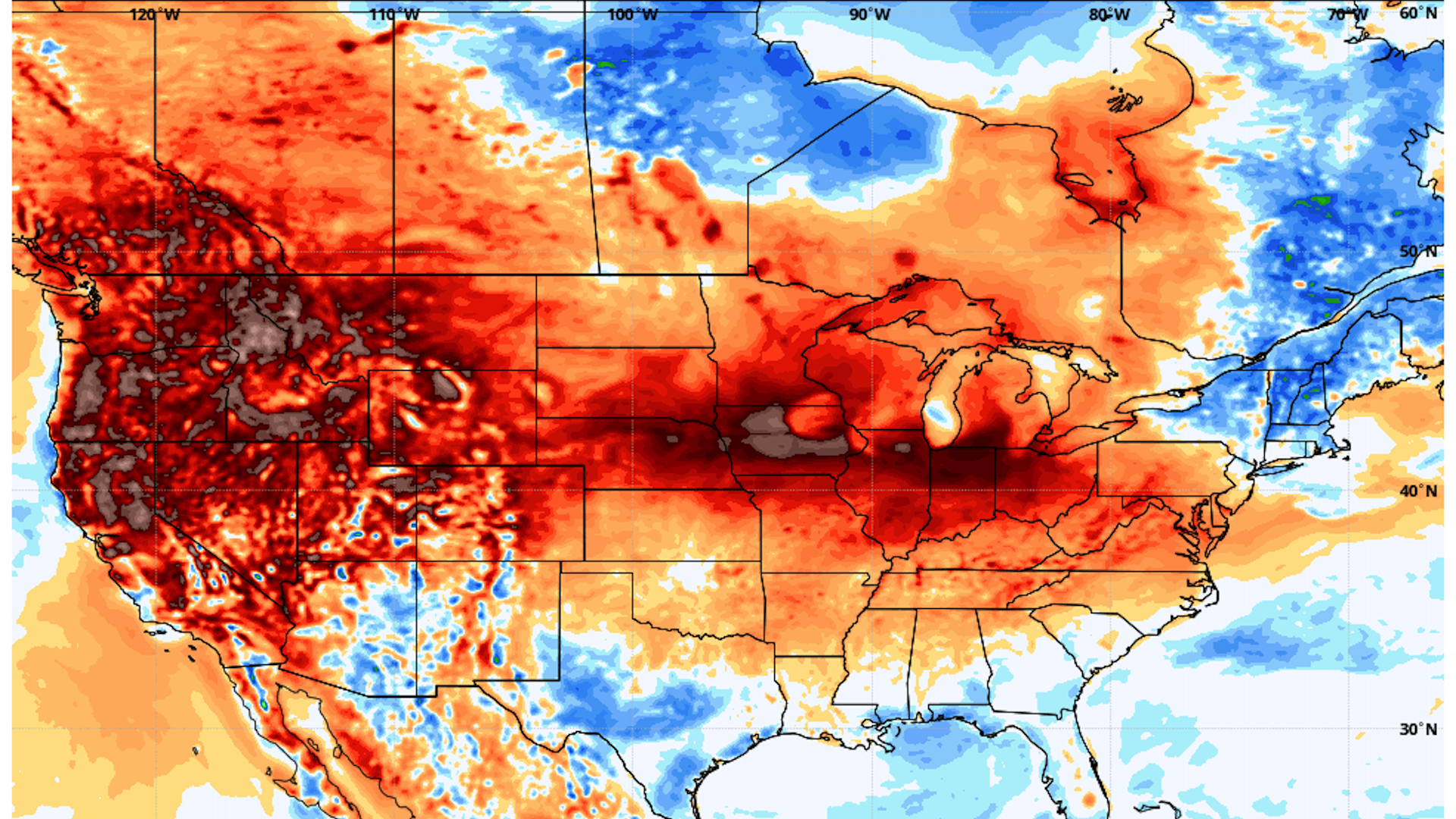
Computer model projection for temperature departures from average on July 28, 2021. (WeatherBell.com)
A significant and far-reaching heat wave is poised to build across much of the continental U.S. during the next few weeks, and it could be the most expansive in the country so far during this unusually hot summer, aggravating drought and wildfires.
The big picture:Forests across the West are already burning at a scope andintensity that’s unusualfor this time of year. Drought data released Thursday showed that what is already the worst Western drought so far this century is only intensifying. Any additional heat will aggravate an already dire situation.
The U.S. Drought Monitor shows that 65.4% of the Western U.S. is in “extreme” to “exceptional” drought conditions, the two worst categories on the scale, up from 52.8% on June 1.
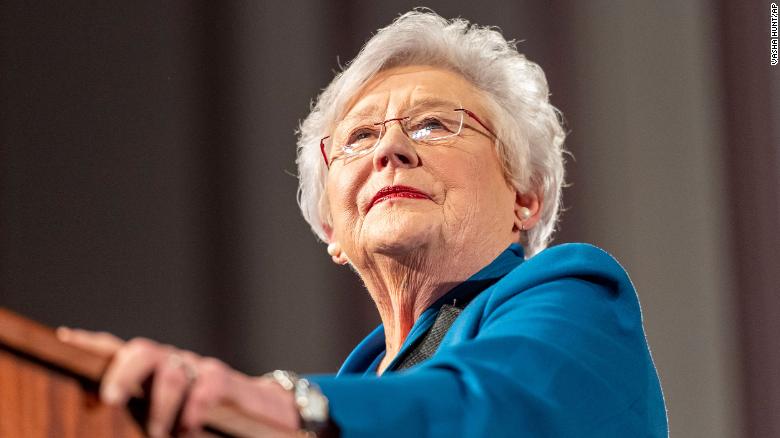
Washington (CNN)Alabama Republican Gov. Kay Ivey on Thursday called out “the unvaccinated folks” for therise in Covid-19 casesin her state, a remarkable plea at a time when many GOP leaders are refusing to urge people toget vaccinatedeven as Covid-19 cases surge in many parts of the country.”Folks are supposed to have common sense. But it’s time to start blaming the unvaccinated folks, not the regular folks. It’s the unvaccinated folks that are letting us down,” Ivey told reporters in Birmingham.Alabama is theleast vaccinated statein the country, with roughly 33.9% of residents fully vaccinated, according to data from the US Centers for Disease Control and Prevention. Average daily Covid-19 cases in Alabama are nearly double what they were a week ago, and more than four times higher than they were two weeks…
Bruce A. ScrutonNew Jersey Herald1:591:59https://imasdk.googleapis.com/js/core/bridge3.472.0_en.html#goog_1798866157
There will be no bear hunt in New Jersey in 2021.
Department of Environmental Protection Commissioner Shawn M.LaTourette has not signed off on the updated Comprehensive Black Bear Management Plan and without such a plan, the Fish and Game Council cannot set a hunting season.
In mid-afternoon Wednesday, the Division of Fish and Game, part of DEP, postedon its website that on June 21, 2021, New Jersey’s Comprehensive Black Bear Management Policy (CBBMP) expired, “and as such, there is no black bear hunt in 2021.”
The message read that in accordance with the Supreme Court ruling on Sept.27, 2007, no black bear hunt may occur without a “properly-promulgated CBBMP proposed by the New Jersey Fish and Game Council and approved by the Commissioner of the New Jersey Department of Environmental Protection.”Story fromHelloSignTech solution growing businesses globallyA signature means a lot, both…
LITTLE ROCK — Thirty-three hunters drew permits to pursue alligators on public land during the 2021 season, but many opportunities remain for those who didn’t draw for public hunts.
Hunters who have access to private land in the alligator zones of south Arkansas can hunt through a quota-based system similar to bear hunting and private land elk hunting.
The season dates are Sept. 17-20 and Sept. 24-27. The application period was June 15-30.
Mark Barbee, wildlife biologist at the AGFC’s Monticello office who coordinates the hunts, says last year was the first using a quota system for private-land alligator hunting, and the transition proved beneficial for hunters.
“Anyone can obtain the private land alligator permit through the AGFC’s online licensing system for $5 in addition to their hunting license,” Barbee said. “They will be able to participate in the alligator…
Have a tip for the newsroom, press release, local event listing or digital content to share? Send ithere. Support our mission by visitingpatreon.com/fl1and becoming a monthly subscriber.
Ontario County will follow suit with many other local counties in lowering the age for deer hunting this season.
Before counties made the decision to lower the age, New York only allowed 12 and 13-year-olds to hunt with a bow and arrow. It was the only state with those rules.
In order to participate, the kids under the age of 14 must be supervised by a licensed hunter 21 or older who has minimally three years of hunting experience, they must remain on the…
Methow Valley fires forced the closure of a portion of state Route 20, the North Cascades Highway. It’s closed from milepost 165 and 185, about 8 miles west of Winthrop. Above, the Cedar Creek Fire is seen from Highway 20 on Monday, July 12, 2021.WASHINGTON STATE DEPARTMENT OF TRANSPORTATIONPostedThursday,July 22, 20212:33 pmBy Eli Francovich / The Spokesman-Review
Hunters are anxiously waiting to see how this year’s fires impact fall hunting seasons, some of which start as soon as Aug. 1.
“This is terrible what’s happening in Eastern Washington,” said Mark Pidgeon, the president of the Hunters Heritage Council. “Sure, it’s going to have an impact on hunting access. Especially on mule deer territory. (But) the most important thing is that those firefighters are safe.”
News earlier this week that the Washington Department of Natural Resources and the Washington Department of Fish and Wildlife are limiting access to their lands…
Duration: 00:18 42 mins agoLikeComments|3Conservationists say that a plan for a new oil field in Namibia and Botswana is threatening the ecosystems and communities in the Kavango Basin and the Okavango Delta, a UNESCO-protected World Heritage Site. The Canadian oil and gas company behind the proposed oil field, ReconAfrica, has leased more than 13,000 sq miles of land and begun seismic exploration. While the Namibian government says that it won’t have an impact on the surrounding wildlife, conservationists believe that the exploration and development will disturb elephants and open the area up to more poaching. According to the International Energy Agency, if the world wants to reach net-zero emissions by 2050 there can be no new oil and gas development after this year. Environmentalists are worried this new project would not only jeopardize that goal, but could trigger more development in southern Africa. ‘Every element of this process — from new roads to drilling sites, refineries to terminals — will devastate the ecosystem and the local communities that depend on it for farming and fishing,’ said Nnimmo Bassey, director at the Health of Mother Earth Foundation and chair of Oilwatch Africa, to The Guardian. Two members of Congress in the U.S. are urging an investigation into the exploratory development, citing National Geographic articles that describe whistleblower complaints that ReconAfrica misled investors and did not obtain the proper permits and approval from local authorities. SHORTENED COPY FOR FUTURE RUNS Conservationists say that a plan for a new oil field in Namibia and Botswana is threatening the ecosystems and communities in the Kavango Basin and the Okavango Delta, a UNESCO-protected World Heritage Site, and could disturb elephants and open the area up to more poaching.
Bruce A. ScrutonNew Jersey Herald1:161:16https://imasdk.googleapis.com/js/core/bridge3.472.0_en.html#goog_1632181709
There will be no bear hunt in New Jersey in 2021.
Department of Environmental Protection Commissioner Shawn M.LaTourette has not signed off on the updated Comprehensive Black Bear Management Plan and without such a plan, the Fish and Game Council cannot set a hunting season.
In mid-afternoon Wednesday, the Division of Fish and Game, part of DEP, postedon its website that on June 21, 2021, New Jersey’s Comprehensive Black Bear Management Policy (CBBMP) expired, “and as such, there is no black bear hunt in 2021.”
The message read that in accordance with the Supreme Court ruling on Sept.27, 2007, no black bear hunt may occur without a “properly-promulgated CBBMP proposed by the New Jersey Fish and Game Council and approved by the Commissioner of the New Jersey Department of Environmental Protection.”https://774cd21ddf1ea8e50a944cc6a5c65345.safeframe.googlesyndication.com/safeframe/1-0-38/html/container.html
Not only has he not signed off on the updated plan…
According to a study published July 14 in Nature, the Brazilian Amazon is emitting more carbon than it captures.
This study is the first to use direct atmospheric measurements, across a wide geographic region, collected over nearly a decade that account for background concentrations of atmospheric gases.
Eastern Amazonia is emitting more carbon than western Amazonia, and southern Amazonia is a net carbon source; Southeastern Amazonia, in particular, switched from being a carbon sink to a carbon source during the study period. The reason: a disruption in the balance of growth and decay and emissions from fires.
These results have important implications for policy initiatives such as REDD+ that rely on forests to offset carbon emissions: Because different regions of the Amazon differ in their ability to absorb carbon, schemes that use one value for the carbon-capturing ability of the whole Amazon need to be reexamined, scientists say.
The Amazon has long done its part to balance the global carbon budget, but new evidence suggests the climate scales are tipping in the world’s largest rainforest. Now, according to a study published July 14 in Nature, the Amazon is emitting more carbon than it captures.
“The Amazon is a carbon source. No doubt,” Luciana Gatti, a researcher at Brazil’s National Institute for Space Research (INPE) and lead author of the study, told Mongabay. “By now we can say that the budget for the Amazon is 0.3 billion tons of carbon per year [released] into the atmosphere. It’s a horrible message.”
Southeastern Amazonia, in particular, switched from being a carbon sink to a carbon source during the study period. Emissions were high in 2010 because of a dry El Niño year, Gatti says, and she expected to see emissions return to normal afterward. But this never happened. The reason: emissions from fires.
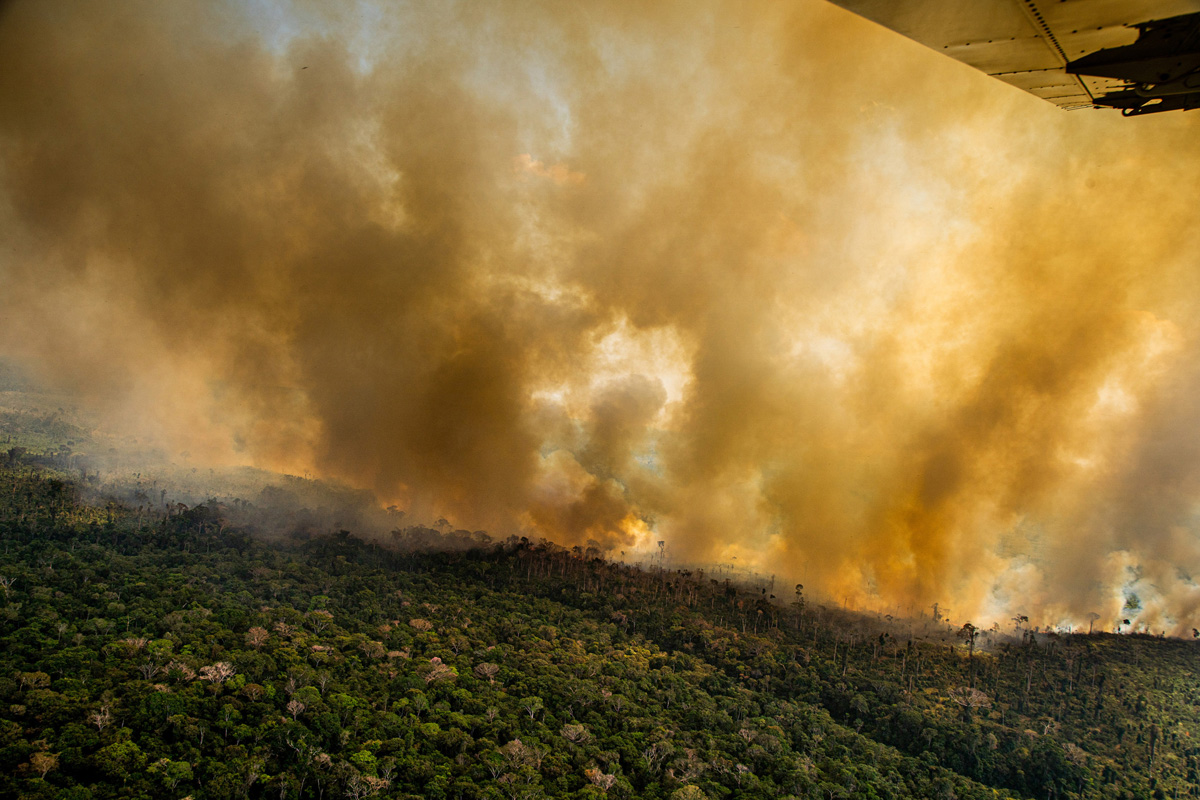
Fires burning in the Amazon on Aug. 17, 2020, next to the borders of the Kaxarari Indigenous Territory, in Labrea, Amazonas state. Felled forests are intentionally lit in the Amazon to clear land for cattle ranching. Credit: Christian Braga/Greenpeace
In the Amazon, forests are often cut during the wet season and burned during the dry season to make way for agribusiness, particularly cattle pasture. According to the study, fire emissions in the southeastern Amazon are three times larger than the net biome exchange (NBE), a measure of the forest’s carbon uptake plus all emissions from decomposition and human sources such as burning fossil fuels.
Without emissions from fires, Gatti says, the Amazon would be a carbon sink. “In other words, the Amazon is a source because of biomass burning.”
Using a small aircraft, Gatti and colleges measured carbon dioxide, carbon monoxide, and other gases above four locations across the Brazilian Amazon. Between 2010 and 2018, they collected air samples seasonally from near the treetops up to 4,500 meters (14,800 feet) above sea level, creating nearly 600 vertical profiles of CO2 levels.
Their conclusion: Eastern Amazonia is emitting more carbon than western Amazonia, and southern Amazonia is a net carbon source.
Other studies have noted a decline in the carbon uptake of forests based on on-the-ground measurements. But this study is the first to use direct atmospheric measurements, across a wide geographic region, collected over nearly a decade, while accounting for background concentrations of atmospheric gases.
“Gatti et al were able to establish seasonal and regional differences in carbon balance and attribute them to drought, fire, deforestation, and forest degradation,” Scott Denning, a professor of atmospheric science at Colorado State University who was not involved in the study (but wrote about it for Nature News & Views), told Mongabay in an email.
Deforestation rates have been higher under Brazil’s current president, Jair Bolsonaro, than any past president and they show no sign of halting. In 2020, Brazil lost 158 hectares (390 acres) of forest per hour—an area half the size of New York City’s Central Park—according to a report by MapBiomas, a network of NGOs, universities, and tech firms that include Google.
In May of this year, forest clearing in the Brazilian Amazon increased 67 percent over May 2020, according to INPE’s satellite-based deforestation tracking system, DETER. This puts deforestation in 2021 on pace with last year’s rate.
“If you’re thinking a tipping point [for] the Amazon [is when] it becomes a carbon source, this region is at a tipping point,” Gatti said. “My question is if we stop now with fires and deforestation and start the very important repair process for forests, could we reverse the picture? I don’t know.”
Aerial view of deforestation in the Brazilian Amazon taken from a small aircraft used to measure carbon emissions. Credit: Luciana Gatti
Decades of deforestation and fires in the Amazon coupled with the global climate crisis have caused the dry season to get longer and made mega droughts more common, contributing to a feedback loop that degrades forests. These degraded conditions mean trees are dying at a faster rate. As more plants and trees die, the Amazon’s ability to absorb carbon from the atmosphere is declining.
“The Amazon is like a bubble … if the trees are intact, it keeps moisture under the canopy in the forest,” Ernesto Alvarado, a professor of wildland fire sciences at the University of Washington, told Mongabay last year. Deforestation, roads, and fires can puncture this moisture bubble. “You open the canopy, right? It’s like a bunch of holes in the bubble, and now the moisture is better escaping and the forest becomes drier.”Play00:00-05:50MuteSettingsEnter fullscreenhttps://www.youtube-nocookie.com/embed/m07iKzx1QHs?autoplay=0&controls=0&disablekb=1&playsinline=0&cc_load_policy=0&cc_lang_pref=auto&widget_referrer=https%3A%2F%2Fsentientmedia.org%2Fbrazils-amazon-now-emits-more-carbon-than-it-captures%2F&noCookie=true&rel=0&showinfo=0&iv_load_policy=3&modestbranding=1&enablejsapi=1&origin=https%3A%2F%2Fsentientmedia.org&widgetid=1Play
The results of the Nature study have important implications for policy initiatives such as REDD+ that rely on forests to offset carbon emissions. The Amazon is not homogenous; different regions have different types of soil, humidity, and tree species. And as this study shows, they also differ in their capacity to absorb or emit carbon.
For example, the eastern Amazon, mainly in the states of Pará and Mato Grosso, is 30 percent deforested and emits 10 times more carbon than other regions. So schemes that use one value for the carbon-capturing ability of the whole Amazon, Gatti says, need to be reexamined.
“Forests might not be able to sequester enough carbon to provide a net benefit for climate mitigation,” Ruth DeFries, a professor of sustainable development at Columbia University who was not involved in the study, told Mongabay in a 2020 interview. “[This] suggests that efforts to reduce emissions of greenhouse gases depend on alternatives to fossil fuel burning—the largest and well-quantified source of anthropogenic greenhouse gases.”
“Worldwide, plants have been growing faster than they’re dying for decades, providing a priceless emissions reduction,” Denning said. “Now we’re seeing the limits of that process. It means society will have to work harder to eliminate fossil fuels from the world economy since we won’t be able to rely on tropical forests to clean up after ourselves.”Read More




 Victor Moriyama / Greenpeace