Differing effects under severe, extreme, and exceptional droughts

D2 – Severe Drought

  • Grazing land is inadequate
  • Fire season is longer, with high burn intensity, dry fuels, and large fire spatial extent
  • Trees are stressed; plants increase reproductive mechanisms; wildlife diseases increase

D3 – Extreme Drought

  • Livestock need expensive supplemental feed; cattle and horses are sold; little pasture remains; fruit trees bud early; producers begin irrigating in the winter
  • Fire season lasts year-round; fires occur in typically wet parts of state; burn bans are implemented
  • Water is inadequate for agriculture, wildlife, and urban needs; reservoirs are extremely low; hydropower is restricted

D4 – Exceptional Drought

  • Fields are left fallow; orchards are removed; vegetable yields are low; honey harvest is small
  • Fire season is very costly; number of fires and area burned are extensive
  • Fish rescue and relocation begins; pine beetle infestation occurs; forest mortality is high; wetlands dry up; survival of native plants and animals is low; fewer wildflowers bloom; wildlife death is widespread; algae blooms appear

Found at :https://www.drought.gov/topics/snow-drought

Wildfires Threaten Big Game Hunting Opportunities in Idaho and Washington

Popular public hunting areas closed due to wildfires or the threat of wildfires could remain off limits into the fall

BY TOM KEER | UPDATED JUL 16, 2021 6:54 PM

Wildfires Threaten Big Game Hunting Opportunities in Idaho and WashingtonAccess to some hunting areas in Washington and Idaho may be in jeopardy due to wildfires.SHARE 

The wildfires spreading through Washington State and Idaho are forcing agencies to shutter popular recreational areas, andthere is a strong possibility that some may not reopen in time for the fall hunting sea. 

The wildfires spreading through Washington State and Idaho are forcing agencies to shutter popular recreational areas, andthere is a strong possibility that some may not reopen in time for the fall hunting sea. 

Washington Department of Fish and Wildlife Eastern Region Director Steve Pozzanghera told the Spokesman-Review, “While these closures may be inconvenient to some, we feel it is the safest and most responsible action we can take to keep members of the public and first responders safe. Other public lands agencies are also closing areas to the public and we support their efforts to fight this fire and make safety a top concern.”https://c7a34e72e2655b1a2423743de974ad37.safeframe.googlesyndic

Washington Department of Fish and Wildlife Eastern Region Director Steve Pozzanghera told the Spokesman-Review, “While these closures may be inconvenient to some, we feel it is the safest and most responsible action we can take to keep members of the public and first responders safe. Other public lands agencies are also closing areas to the public and we support their efforts to fight this fire and make safety a top concern.”https://c7a34e72e2655b1a2423743de974ad37.safeframe.googlesyndication.com/safeframe/1-0-38/html/container.html

An entire ranger district in Washington’s Blue Mountains, a popular big-game hunting area, closed on Monday, according to a Umatilla National Forest news release. Early archery deer season opens on September 1 in most units, with the archery elk season opening in most units on September 11. Other areas recently closed are the W.T. Wooten Unit of the W.T. Wooten Wildlife Area, the 4-0 Ranch and Grouse Flats units in the Chief Joseph Wildlife Area, and the Asotin Creek and Weatherly units of the Asotin Creek Wildlife Area. Closures are estimated to last a month or until conditions improve.

Idaho is also experiencing closures. “While this type of restriction is not necessary during most fire seasons, this year is extraordinary in terms of wildfire risk for Idaho and all neighboring western states,” said Pete Stegner on behalf of the North Idaho Timer Group. “This precautionary closure is in the best interests of the community and the environment, and we appreciate everyone’s cooperation with this request during these highly unusual times.”

Drought combined with summer heat has dramatically increased the risk of wildfires. It is likely that closures will remain at least until it rains.

China Confirms Another Avian Influenza Case

https://www.precisionvaccinations.com/2021/07/15/china-confirms-another-avian-influenza-case?fbclid=IwAR3L41GA20wV6x_Q3aI-TB8m93VWcotaL1Tq_WIM3wEtxKH7Lm0ZKaTNmOo

July 15, 2021 • 2:45 pm CDT

(Precision Vaccinations)

The Centre for Health Protection (CHP) of the Department of Health in Hong Kong issued a press statement on July 14, 2021, confirming it is monitoring a human case of avian influenza A(H5N6) in Sichuan Province, China. The patient had contact with live domestic poultry before the onset of symptoms.

The Zoonotic Influenza case involves a 55-year-old man who is in critical condition.

“All novel influenza A infections, including H5N6, are notifiable infectious diseases in Hong Kong,” a spokesman for the CHP commented.

From 2014 to date, there have been thirty-two human cases of avian influenza A(H5N6) reported by the Mainland China health authorities.

As of July 8, 2021, a total of 239 cases of human infection with avian influenza A(H5N1) virus have been reported from four countries within the WHO’s Western Pacific Region since January 2003. Of these cases, 134 were fatal, resulting in a case fatality rate (CFR) of 56%. The last case was reported from Lao PDR.

Travelers to the Mainland or other affected areas must avoid visiting wet markets, live poultry markets, or farms. In addition, they should be alert to the presence of backyard poultry when visiting relatives and friends. They should also avoid purchasing live or freshly slaughtered poultry and avoid touching poultry/birds or their droppings.

And, they should strictly observe personal and hand hygiene when visiting any places with live poultry.

Furthermore, travelers returning from affected areas should consult a doctor promptly if symptoms develop and inform the doctor of their travel history for prompt diagnosis and treatment of potential diseases.

The WHO says Zoonotic influenza refers to diseases caused by animal influenza viruses, such as Bird Flu and Swine Flu. People can be infected with influenza viruses such as avian influenza virus subtypes A(H5N1) and A(H9N2) and swine influenza virus subtypes A(H1N1) and (H3N2). 

Previous Zoonotic Influenza reports are listed on this webpage.

Note: annual flu shots do not prevent Zoonotic influenza, says the U.S. CDC.—Don Ward Hackett

Need Public Comments MT Wolf & Trapping Proposals

We apologize for the delay in getting this important request for public comment out to you for wolf, otter, and other trapping proposals. We have been researching and consulting with experts on how best to try and proceed with the Montana wolf proposals, in particular. No, we do not like them, but our recommendations are to try to reduce the unjust war on wolves and the horrific impact on all creatures it will have.

The deadline for submitting comment is Monday July 26 5pm MST. Even if you have already done so, please review our recommendations below and email the Montana Fish and Wildlife Commission, accordingly:

Email: FWcomm@mt.gov

The bills that passed and were signed into law by Governor Gianforte, were Rep. Paul Fielder’s, HB225, designed to lengthen the wolf trapping season, his HB224, allow snaring of wolves, Senator Bob Brown’s wolf killer, SB267 reimbursement bill, and the killing of more wolves through unethical means with his, SB314, such that the Commission shall set wolf hunting and trapping with the intent to reduce wolves down to the bare minimum but to avoid re-listing. With these, far more than wolves will be cruelly and unnecessarily destroyed.

Montana Fish Wildlife and Parks has made proposals for the 2021 wolf season based on what they say must be allowed and what are at the Commission’s discretion. With the passage of HB224, wolf trapping seasons must allow for the use of snares.

Therefore, to help try and reduce the mass and indiscriminate carnage that will unfold, based on our findings and outreach, we urge you to submit public comment regarding Montana Wolf Proposals to:

  • Require 24 hour trap checks.
  • Prohibit the use of snares on public lands.
  • Obtain written permission from landowner for the use of snares.
  • Require wolf trapping certification inclusive of snaring for anyone trapping for wolves.
  • Require snares have diverters, relaxing lock, 275 lb. rated breakaway, a stop for a minimum loop size of 10″, and the bottom of the loop a minimum of 18″ above the surface.
  • Limit the number of wolves who can be snared to one per certified trapper.
  • Limit the number of snares and leghold traps a trapper can set.
  • Require trappers keep maps of their snare locations. 
  • Prohibit power snares and the use of drags on traps and snares.
  • Require disclosures and warning signs for traps and snares on block management areas.
  • Revise wolf trapping season dates to January 2 – Feb 28 to try to avoid incidental trapping of grizzlies and upland game bird dogs.
  • Prohibit the use of snares on high use areas of wintering elk and deer.
  • Apply setback of minimum 150’ to all public roads for traps and snares.
  • Require trapping warning signage at trailheads and high use recreational areas.
  • Establish 1 wolf quota or closure of wolf season in units over elk management objectives, where elk shoulder seasons occur, where chronic wasting disease has been detected.
  • Maintain a maximum quota of 1 wolf in units adjacent to national parks. Overage comes off the following year/s or adjacent applicable wolf management units.
  • Allow1 wolf per license.
  • Present the hide and skull of all trapped or shot wolves in an unfrozen condition to designated FWP. 
  • Prohibit the use of bait and night hunting of wolves.
  • Require the reporting of all non-target catches.
  • Require annual reimbursement reports (SB267) for wolf trapping and hunting.

FOR RIVER OTTER TRAPPING PROPOSALS

Montana Fish Wildlife and Parks claims as a result of meeting with the Montana Trappers Association, Montana Fur Harvesters, and other trappers, FWP proposes increasing the trapping quotas on river otters:

Region 1, Northwestern Montana, by 43% from 28 to 40 river otters.

Region 2, Western Montana, by 60% from 25 to 40 river otters.

Increase river otter quota from 3 to 4 per trapper.

The proposal states, “Why is this proposed change necessary?”  Per FWP, “A change in the harvest regulation for otters is not necessary; however, anecdotal information suggests that we could harvest without negatively impacting the otter population.” In other words, as usual, because the trappers want it and to kill more.

Submit opposition to the increased otter quotas on the basis:

  • Otter pelts averaging $15 failed to even sell in the largest fur auction in 2020. 
  • Montana otter populations are based on harvest reports and anecdotal information.
  • Otter harvest reports provided by FWP are inconsistent in numbers.
  • Passage of the increased otter quota equals the approximate trapping total currently for the entire state.
  • Montana has been declared in a state of emergency for drought. Temperatures are up and water is down statewide. Wildlife are struggling. Otters will be dying and should not be subjected to increased mortality through increased trapping.
  • The otter trapping season, Nov 1 – April 15, runs concurrent to periods of gestation and dependent young. The collateral damage from trapping is ignored.
  • River otter are an indicator species of water pollution. Their presence or absence is noteworthy and should be respected not exploited.
  • River otter are commonly caught in traps set for beaver. Trapping season on beaver runs 5 1/2 – 9 months out of the year. The incidental catches are not factored in and do not come off the next year’s quota.
  • The majority of incidental trapped otter that were reported were from Region 1 and Region 2. 
  • Annually, less than 60 trappers kill otters in Region 1 and Region 2. Several dozen trappers should not be held in charge of the fate of otters who under the public trust belong to all U.S. citizens.
  • FWP has failed to delineate whether the otter proposals apply to region or districts 1 and 2. There is a difference.

ADDITIONAL COMMENTS for Submission REGARDING TRAPPING:

  • Swift fox are increasingly threatened especially now with drought and climate change. The trapping season on this 5-7 pound imperiled species, which are trapped and killed for notoriety purposes, must cease before it is too late or they will wind up on the ESA. They were wiped out before in Montana.
  • Beaver need to be respected and protected more than ever. They are critical for water resources, wildlife habitat, agriculture, and fire mitigation.
  • It is morally and scientifically reprehensible for the continuation of the   unlimited and unreported trapping of beaver for 5 1/2 – 9 months out of the year in Montana, with most of the state being the latter.
  • The checkoff for non-game proposals is devoid of species who FWP reports have not been seen, i.e. spotted skunk, porcupine, and listed species of concern, swift fox. Wildlife management needs to be all inclusive of species. All are interconnected. What happens to one impacts the other.
  • The public’s safety continues to be ignored and the wishes and whims of licensed trappers’,  < 1% of the population, take precedence. This is a setup for disaster and for lawsuits.
  • Per the Montana 2021 legislature and FWP Director Worsech’s assurance, trapping of dogs would be properly assessed through Montana FWP Citizen’s Advisory Councils. There is no evidence this is coming to fruition.

In your public comments, it is best to include the proposal issue, i.e. wolf, otter, swift fox, etc. in the subject line of the email. Please try to personalize your comment.
Again send your public comment to the Montana Fish and Wildlife Commission:
Email: FWcomm@mt.gov
We appreciate you sending us a copy. Use Bcc and email: info@tfmpl.org

Public comment period closes Monday July 26th at 5:00 pm MST.

The Commission will hold a public meeting, in person, on August 20th to make final decisions on the proposals. We hope to see many of you in Helena! Stay tuned.
As we continue to do what we can, we urge you to be a voice for the voiceless and help us anyway you can! Your public comments do matter!

Chinese man hospitalized with H5N6 bird flu

https://medicalxpress.com/news/2021-07-chinese-hospitalized-h5n6-bird-flu.html

Chinese man hospitalized with H5N6 bird flu

A man in China has been hospitalized with the H5N6 strain of avian flu, which is one of several potentially dangerous strains that can infect humans.https://googleads.g.doubleclick.net/pagead/ads?client=ca-pub-0536483524803400&output=html&h=189&slotname=7587637799&adk=2703772767&adf=625945176&pi=t.ma~as.7587637799&w=753&fwrn=4&lmt=1626564836&rafmt=11&psa=0&format=753×189&url=https%3A%2F%2Fmedicalxpress.com%2Fnews%2F2021-07-chinese-hospitalized-h5n6-bird-flu.html&flash=0&wgl=1&uach=WyJXaW5kb3dzIiwiMTAuMCIsIng4NiIsIiIsIjkxLjAuNDQ3Mi4xNjQiLFtdLG51bGwsbnVsbCxudWxsXQ..&dt=1626564422826&bpp=42&bdt=2606&idt=543&shv=r20210712&ptt=9&saldr=aa&abxe=1&cookie=ID%3De140c1fae1710d01-2244b2c153c90090%3AT%3D1626564423%3ART%3D1626564423%3AS%3DALNI_Mb2VXc90hXe4J6arxwpKtO351HXpw&prev_fmts=0x0%2C1123x537&nras=2&correlator=3269651380447&frm=20&pv=1&ga_vid=249638689.1626564423&ga_sid=1626564424&ga_hid=987278962&ga_fc=0&ga_wpids=UA-73855-15&rplot=4&u_tz=-420&u_his=1&u_java=0&u_h=640&u_w=1139&u_ah=607&u_aw=1139&u_cd=24&u_nplug=3&u_nmime=4&adx=263&ady=1040&biw=1123&bih=537&scr_x=0&scr_y=0&eid=21066431%2C31060972%2C31060974%2C31061746&oid=3&pvsid=3287773169186380&pem=641&ref=https%3A%2F%2Fwww.google.com%2F&eae=0&fc=896&brdim=0%2C0%2C0%2C0%2C1139%2C0%2C1139%2C607%2C1139%2C537&vis=1&rsz=%7C%7Cpebr%7C&abl=CS&pfx=0&fu=128&bc=31&ifi=1&uci=a!1&btvi=1&fsb=1&xpc=cXBBzKAmjx&p=https%3A//medicalxpress.com&dtd=M

The 55-year-old man came down with a fever and tested positive for the virus on July 6. He was hospitalized in Bazhong, a city in the province of Sichuan, according to the state-run China Global Television Network, The New York Times reported.

In response to the case, local officials “activated an emergency response and sterilized the area,” the broadcaster said.

It added that unnamed experts said there was a low risk of large-scale transmission among humans, the Times reported. There was no mention of whether the man was involved in work handling poultry.

The H5N6 virus was first detected eight years ago in Laos, later spreading to China and other countries. Since 2014, 32 cases of human infection with the virus and 19 deaths in Asia have been reported to the World Health Organization, the Times reported.

The last human case before this latest one had an onset date of May 13.

Mutations are common in bird flu viruses, so scientists strive to track them closely for indications they’re becoming more deadly or contagious, the Times reported.

Last year, a team of scientists reported that a new strain of the H1N1 swine flu virus was spreading silently in workers on China’s pig farms and should be “urgently” controlled to avoid another pandemic, even though the strain had not caused disease in the people it infected, the Times reported.


Explore furtherChina confirms first human case of H10N3 bird flu strain

No ban on sale, sacrificing of animals on Eid-ul-Adha in JK, says Admin

https://freepresskashmir.news/2021/07/16/no-ban-on-sacrificing-of-animals-in-jk-says-admin/

ByNews DeskPosted on July 16, 2021

COMMENTS

Srinagar: Divisional Commissioner Kashmir P K Pole on Friday said that there is no ban on the sale and slaughter of sacrificial animals in the Valley as it’s a religious obligation done in memory of Prophet Ismail (AS).

The Divisional Commissioner said that the administration is providing full support to facilitate the import of sheep, goat, and poultry to Kashmir on the eve of Eid-ul-Adha.

“There is no ban on slaughter and sale of sacrificial animals. It’s a religious obligation done in memory of Prophet Ismail (AS) and we need to respect it,” Pole said. He said the administration facilitates entry of sacrificial animals at Lower Munda into Kashmir after proper testing etc. “We also test poultry birds for bird flu before allowing them to enter into the Valley,” Pole said.

He said that as far as bovine animals are concerned, there is already a ban on killing such animals. “It is not done in Kashmir and if it is done, action will be taken,” he said.

On the letter issued by the Director Planning Animal and Sheep Husbandry calling for the ‘ban on slaughtering of bovine and sacrificial animals’, the divisional commissioner said that letter is not above the rule position and the act is supreme.

“We need to see whether the letter has been issued keeping in view the legal aspect,” he said.

Interestingly, the letter had gone viral on social media evoking sharp criticism from the netizens and also from the Mutahida Majlis-e-Ulema (MMU), an amalgam of Kashmiri Ulemas. Many netizens had termed it as direct interference into religious affairs.https://googleads.g.doubleclick.net/pagead/ads?client=ca-pub-6939648741200667&output=html&h=280&slotname=6471025184&adk=541713248&adf=856918318&pi=t.ma~as.6471025184&w=714&fwrn=4&fwrnh=100&lmt=1626533277&rafmt=1&psa=0&format=714×280&url=https%3A%2F%2Ffreepresskashmir.news%2F2021%2F07%2F16%2Fno-ban-on-sacrificing-of-animals-in-jk-says-admin%2F&flash=0&fwr=0&fwrattr=true&rpe=1&resp_fmts=3&wgl=1&uach=WyJXaW5kb3dzIiwiMTAuMCIsIng4NiIsIiIsIjkxLjAuNDQ3Mi4xNjQiLFtdLG51bGwsbnVsbCxudWxsXQ..&dt=1626564520463&bpp=17&bdt=12010&idt=912&shv=r20210714&ptt=9&saldr=aa&abxe=1&prev_fmts=0x0&nras=1&correlator=7487086977592&frm=20&pv=1&ga_vid=1739638435.1626564521&ga_sid=1626564521&ga_hid=1348857856&ga_fc=0&u_tz=-420&u_his=1&u_java=0&u_h=640&u_w=1139&u_ah=607&u_aw=1139&u_cd=24&u_nplug=3&u_nmime=4&adx=47&ady=1607&biw=1123&bih=537&scr_x=0&scr_y=287&eid=42530671&oid=3&pvsid=1982899482880288&pem=610&ref=https%3A%2F%2Fwww.google.com%2F&eae=0&fc=1920&brdim=0%2C0%2C0%2C0%2C1139%2C0%2C1139%2C607%2C1139%2C537&vis=1&rsz=%7C%7ClEebr%7C&abl=CS&pfx=0&fu=128&bc=31&ifi=2&uci=a!2&btvi=1&fsb=1&xpc=V11M76P7oE&p=https%3A//freepresskashmir.news&dtd=946

“Care must be taken before passing any information which involves religious aspects and as every religion should be honored and respected”, he added.

Director Animal, Sheep Husbandry department Kashmir Purnima Mittal said, first of all, she didn’t issue any order and it was just an advisory. “This is an advisory issued in response to the Animal Welfare Board of India. These are just norms for the animals for sacrificial animals,” she said.

“This is an advisory issued to prevent cruelty against the animals. This calls for banning the slaughter of animals that are three months old or in case the animal is pregnant.”

She said that there is no ban on sacrificing animals on “Bakra Eid” and the letter issued by the department only focuses on the norms to be followed while transporting animals meant for sacrifices on Eid eve. (KNO)

US, Northwest pushing limits of firefighting resources: ‘Worst possible conditions’

Exposing the Big Game's avatarThe Extinction Chronicles

https://www.oregonlive.com/wildfires/2021/07/us-northwest-pushing-limits-of-firefighting-resources-worst-possible-conditions.html

Today 7:30 AM43

Bootleg fireFacebook ShareTwitter ShareByJack Forrest | The Oregonian/OregonLive

U.S. Forest Service leaders got a message from their top boss Wednesday.

Chief Vicki Christiansen, the agency’s leader, announced that all Forest Service workers should immediately refocus their time and energy to address the country’s worsening wildfire season.

Fires were resisting control efforts, she said, and the West was bracing for more extreme weather in the coming months.

“We expect demand for resources to outpace resource availability, and our workforce remains fatigued and in need of recovery following last year’s record-setting fire season, an active hurricane season, and strenuous efforts to respond to the COVID-19 Pandemic,” Christiansen said in theletter.

It came the same day officials in the Northwest escalated their wildfire preparedness to the highest level, signaling they were using nearly all of their available firefighting resources.

The National Multi-Agency Coordinating Group followed suit with…

View original post 1,325 more words

What is causing the floods in Europe?

https://www.theguardian.com/environment/2021/jul/16/what-is-causing-floods-europe-climate-change

Scientists believe climate disruption will bring more extreme weather, and humans are making things worse

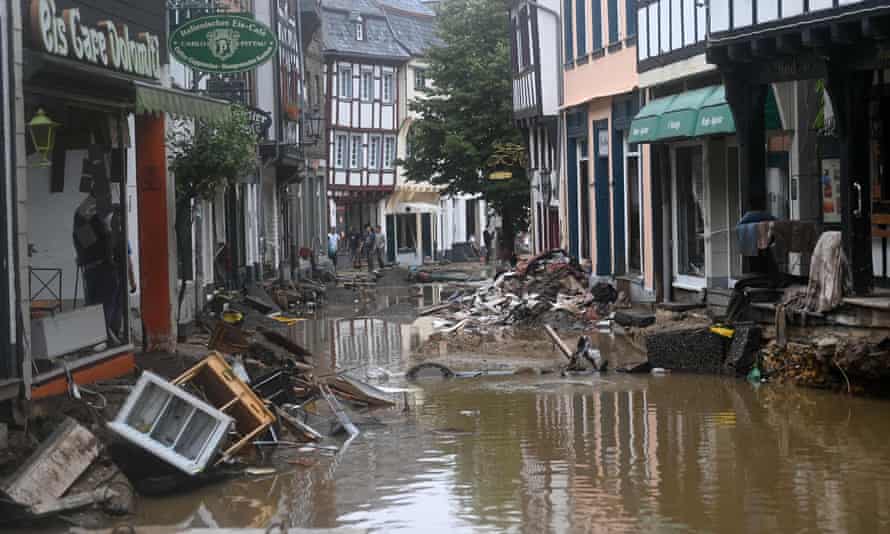
A flooded street in Bad Münstereifel, western Germany
A flooded street in Bad Münstereifel, western Germany, after heavy rain hit parts of the country. Photograph: Ina Fassbender/AFP/Getty Images

Jonathan Watts@jonathanwattsFri 16 Jul 2021 12.18 EDT

Are the European floods linked to the climate crisis?

Almost certainly. Scientists have long predicted climate disruption will lead to more extreme weather, such as heatwaves, droughts and floods. Human emissions from engine exhaust fumes, forest burning and other activities are heating the planet. As the atmosphere gets warmer it holds more moisture which brings more rain. All the places that recently experienced flooding – Germany, Belgium, the Netherlands, London, Edinburgh, Tokyo and elsewhere – might have had heavy summer rain even without the climate crisis, but the deluges were unlikely to have been as intense.

But there have always been floods and heatwaves. What is the evidence that humans are making them worse?

First, more records are being broken more often; the world’s seven hottest years in recorded history have all come since 2014. Second, scientists can now use statistical analysis and computer models to calculate how much more likely particular weather events have become as a result of the extra stress that humans have put on the climate system. For example, human emissions made the deadly “heat dome” in Canada and North America last month at least 150 times more likely and the prolonged heatwave in Siberia last year more than 600 times more probable.

Richard Betts, the head of climate impacts research at the Met Office Hadley Centre, says such calculations take away the argument that “extreme weather happens anyway, so we don’t need to worry about it”. There has not yet been an attribution study for the latest floods in Europe because the analysis takes several days.

Some reports suggest the floods may be linked to a disruption of the jet stream. Is that confirmed?

Advertisementhttps://15b8a21cdc90d5445b369f6276409ebf.safeframe.googlesyndication.com/safeframe/1-0-38/html/container.html

This is an important unknown. Climate scientists are looking at this as one of several possible explanations for the previously unimaginable spike in some recent records. The 24-hour rainfall at Cologne’s Stammheim station on Wednesday of 155mm (6.1in) smashed the city’s previous daily rainfall high of 95mm. Two weeks ago, temperatures at Lytton beat the previous Canadian daily heat record by a staggering 5C. These numbers are outside worst-case scenarios, which could be the result of freak bad luck or knock-on effects from other areas of climate disruption. One theory is the loss of ice in the Arctic has made the jet stream more erratic. There is not yet a scientific consensus on this topic, but experts are increasingly concerned the world could be in for a bumpier ride than previously thought.

Will the UK have more floods and heatwaves?

Yes. The flash floods in London, Edinburgh and elsewhere last week were unusual compared with the past, but they will be more common in future. Over the course of this century, the Met Office Hadley Centre predicts “warmer, wetter winters and hotter, drier summers along with an increase in the frequency and intensity of extremes”. If emissions are not cut, it says severe heatwaves, such as that of 2018, would be likely every other year by 2050. Although summers would generally be drier, there would be an increase in intensity of heavy rainfalls.

Why do so many news reports about extreme weather underplay the climate connection?

In some media organisations, this appears to be part of a deliberate strategy to undermine climate science and the political impetus to reduce emissions. Habit also plays a part. For decades, journalists have depicted heatwaves as a good news story to be casually illustrated with pictures of sunbathers, ice creams and swimming pools. Excess caution can also make reporters timid about making the link with the climate crisis. On Wednesday, the climate scientist Ed Hawkins took the BBC to task for this and for failing to keep up with the science. From now on, he suggested journalists use the phrase: “Experts say that climate change is already increasing the frequency of extreme weather events, and many single events have been shown to have been made worse by global warming.”

One Major Side Effect of Eating Plant-Based Meat, Says New Study

Don’t skip the veggie burger—just keep this in mind.

BYELIZABETH MILLARDJULY 17, 2021FACT CHECKED BYCHEYENNE BUCKINGHAM

plant based burger

Every year brings a fresh wave of food trends, and 2021 seems to be shaping up as the year plant-based meats finally caught hold. Despite veggie burgers being on the market for decades, the wave of fast-food choices is highlighting these alternatives—from Burger King’s Impossible Whopper to Panda Express trying out a plant-based orange chicken with Beyond Meat products.

But a new study in Scientific Reports suggests that when it comes to nutrition, they’re not exactly an even swap.00:51 / 01:42

Researchers at Duke University noted that when you look at nutrition labels, the amount of vitamins, fats, and protein are very similar to real beef. However, using an approach known as “metabolomics,” they were able to examine the biochemistry for 18 plant-based meat products and assess their metabolites.

RELATED: Delicious Foods You Can Eat on a Plant-Based Diet

Metabolites are essential for signaling between cells and converting food into energy, and about half of them come from our diet. When the researchers compared samples of plant-based meat with grass-fed ground beef, they found significant differences between the two in terms of metabolite content—up to 90% in some cases.

grass fed ground beef
Shutterstock

The beef contained 22 metabolites that were lacking in the plant substitute, including several amino acids and vitamins. Several of these are known to have important anti-inflammatory roles in the body, the researchers noted, such as omega-3 fatty acids, glucosamine, and creatine, which were all found in larger quantities in the real beef samples.

They aren’t suggesting avoiding plant-based meat altogether—in fact, the plant-based products contained 31 metabolites that were missing in the meat. These included vitamin C and phytosterols, which are naturally occurring compounds found in plant cell membranes. These compounds are particularly important for lowering cholesterol, which is why plant-based eating is regularly touted for heart health.

In general, that means adding in these alternative meat options could be helpful for getting a full range of beneficial metabolites.

Unless you prefer to eat only plant-based foods, including both plant and animal meats in your diet could yield more nutritional advantages, says lead researcher Stephan van Vliet, Ph.D., a researcher at Duke Molecular Physiology Institute.

“The takeaway is that there are large differences between meat and a plant-based meat alternative,” he states. “However, plant and animal foods can be complementary, because they provide different nutrients.”

At least 70 large wildfires burning in US west as fears mount over conditions

Exposing the Big Game's avatarThe Extinction Chronicles

https://www.theguardian.com/us-news/2021/jul/17/us-west-wildfires-bootleg-fire-oregon

Bootleg is now the largest US forest fire at 281,208 acres and just 22% contained as ‘excessive heat’ forecast

Flames and smoke rise from the Bootleg fire in southern Oregon on 14 July.
Flames and smoke rise from the Bootleg fire in southern Oregon on 14 July.Photograph: John Hendricks/AP

Victoria BekiempisSat 17 Jul 2021 15.41 EDT

At least 70 large wildfires are burning across the US west and nearby states – engulfing more than 1m acres in flames – as fears mount that shifting conditions can worsen an already dire situation. Significant areas of these states are in the grips of droughtconditionsthat are considered “extreme” and “exceptional” – the most severe categories.Heat exhaustion, apocalyptic scenes: what it’s like fighting the US’s biggest wildfireRead more

Authorities in Oregon have said that these arid, windy and unstable conditions will continue fueling the 281,208-acreBootleg fire, which is just 22% contained, according toNational Interagency Fire Centerand InciWeb. The smoke…

View original post 460 more words