Bezos, Gates back fake meat and dairy made from fungus as next big alt-protein

https://www.cnbc.com/2021/07/03/bezos-gates-back-fungus-fake-meat-as-next-big-alt-protein-.html

PUBLISHED SAT, JUL 3 202110:00 AM EDTBob WoodsSHAREShare Article via FacebookShare Article via TwitterShare Article via LinkedInShare Article via EmailKEY POINTS

  • Chicago-based Nature’s Fynd has meatless breakfast patties and hamburgers, dairy-free cream cheese and yogurt, and chicken-less nuggets scheduled to hit grocers’ shelves later this year.
  • The alternative foods sector grew U.S. retail sales 27% in 2020, and bringing the total market value to $7 billion.
  • Nature’s Fynd is building a 35,000-square-foot factory on the site of Chicago’s former Union Stockyards, the epicenter of the 20th-century meatpacking industry.
Unearthed by co-founder Mark Kozubal as a microbe from volcanic hot springs in Yellowstone National Park, Fy is the fermented, versatile, protein-rich source that Nature's Fynd and its CEO Thomas Jonas are hoping becomes the next big thing in alternative meat and dairy.

Unearthed by co-founder Mark Kozubal as a microbe from volcanic hot springs in Yellowstone National Park, Fy is the fermented, versatile, protein-rich source that Nature’s Fynd and its CEO Thomas Jonas are hoping becomes the next big thing in alternative meat and dairy.Nature’s Fynd

As consumers become increasingly comfortable eating faux-meat burgers that look, cook and taste like the real thing, a food-tech start-up backed by Jeff Bezos and Bill Gates is using fungus as the primary ingredient to create alt-meat foods.

Nature’s Fynd, based in Chicago, has raised $158 million in funding from investors including Bezos, Gates, and Al Gore. The company’s meatless breakfast patties and hamburgers, dairy-free cream cheese and yogurt, and chicken-less nuggets are scheduled to hit grocers’ shelves later this year.

The alternative foods sector skyrocketed in 2020, growing U.S. retail sales 27%, and bringing the total market value to $7 billion, according to the Plant-Based Foods Association (PBFA), a trade group comprising more than 200 member companies. Meanwhile, shipments of alt-protein products from food service distributors to commercial restaurants rose 60% year-over-year in April, according to research firm NPD Group.

The ascendant industry is headlined by Beyond Meat and Impossible Foods, whose alt-meat burgers, chicken and sausage products have disrupted the $733 billion U.S. food manufacturing industry. That has prompted Tyson Foods, Purdue, Hormel, Cargill and other traditional meat producers to launch their own products in the category.

Some alt-meat sales growth slowed amid the pandemic and restaurant closures. A recent report from J.P. Morgan claims that Dunkin’ has dropped its breakfast sandwich using a Beyond sausage patty from most restaurants, though that has not been confirmed by either company (Dunkin’ and Beyond Meat did return calls by press time.) Still, plant-based and cultured foods are projected to take a 60% market share of global meat sales by 2040, according to consulting firm AT Kearney.WATCH NOWVIDEO00:59Alt-meat loses steam as sales growth slows during the pandemic

Having lost 1% of its overall market to-date probably doesn’t rattle meat producers much, but looking at the declining costs of alt-meat should raise their eyebrows. In mid-June, Beyond Meat was selling for $6.40 per pound, bringing it closer to the price of traditional beef, making some progress on a long-term goal of Beyond Meat CEO Ethan Brown to reach cost parity with traditional meat. Beef patties were then selling for $5.26 per pound, according to the U.S. Department of Agriculture. Impossible Foods has cut its restaurant prices twice in the past year, and in February, the company slashed retail prices by 20%, lowering the price of two quarter-pound patties to $5.49.

Nature’s Fynd was co-founded in 2012 — initially as Sustainable Bioproducts — by Thomas Jonas and Mark Kozubal, now chief executive and chief science officers, respectively. A few years earlier, Kozubal had unearthed a microbe, Fusarium strain flavolapis, from volcanic hot springs in Yellowstone National Park. He led an R&D team that formulated the microbe into what the company calls Fy, the fermented, versatile, protein-rich source for Nature’s Fynd’s products.

Fermentation has been used in making bread, beer, wine, cheese and other products for millennia, and is now emerging as a key alt-protein platform with major potential to align science with entrepreneurship, policy and investment, according to the Good Food Institute. Even so, Nature’s Fynd has some catching up to do. U.K.-based Quorn, founded in 1985, has been offering its fungus-based meatless products in the U.S. since 2002. It was acquired by Philippine food maker Monde Nissin for about $830 million in 2015, according to Reuters. And the field of other potential competitors is growing.I don’t know anyone over 40 who is saying, ‘I should eat more meat.’Thomas JonasCO-FOUNDER AND CEO

Much as cows, chickens and pigs were domesticated centuries ago as protein sources, “now is the time for this second domestication,” Jonas said in a recent interview. “The farming of this microbe is an efficient way of producing protein that is just as good.”

Bringing the evolution full circle, Nature’s Fynd is building a 35,000-square-foot factory on the site of Chicago’s former Union Stockyards, the epicenter of the 20th-century meatpacking industry.

The climate-conscious food consumer

Beyond fungus, Nature’s Fynd also is representative of the food sustainability movement, whose mission is to reduce the carbon footprint of global food systems, which generate 34% of greenhouse emissions linked to climate change.

“The challenge for this and future generations is to learn to do more with less,” Jonas said. “Because with eight billion people, the Earth is not getting any bigger, its resources are dwindling and climate change is making it even more difficult to find land to grow crops to feed animals. The math just doesn’t work. So, the whole goal of our new protein system is to increase the efficiency of the complete protein chain.”

Consumer acceptance, of course, is paramount to Nature’s Fynd business model. In February, the company launched a limited, direct-to-consumer sampling of its patties and cream cheese exclusively online. Chief marketing officer Karuna Rawal said the formal product rollout will focus first on retailers, with food service partnerships to follow. “It’s important that we start with retail and be able to tell our story to the consumer in a way we can control the narrative,” she said.

In that vein, Nature’s Fynd packaging is emblazoned with a “Fy” badge, a la “Intel Inside,” to create brand recognition and loyalty.

With $158 million in funding from Jeff Bezos, Bill Gates, Al Gore and other investors, Nature's Fynd meatless breakfast patties and hamburgers, dairy-free cream cheese and yogurt, and nuggets, minus chicken, are scheduled to hit grocers' shelves later this year.

With $158 million in funding from Jeff Bezos, Bill Gates, Al Gore and other investors, Nature’s Fynd meatless breakfast patties and hamburgers, dairy-free cream cheese and yogurt, and nuggets, minus chicken, are scheduled to hit grocers’ shelves later this year.Nature’s Fynd

Not surprisingly, the greatest appeal for alt-meat products is among younger consumers.

“Gen Zers and millennials are the largest purchasers in the plant-based space,” said Sabina Vyas, director of strategic initiatives and communications at the PBFA. “As their purchasing power builds, [food] companies are going to have to adapt accordingly.”

Sixty-three percent of U.S. consumers between ages 24 and 39 believe their nutritional needs can be fully met with a plant-based diet, according to research from One Poll.

“I don’t know anyone over 40 who is saying, ‘I should eat more meat,’” Jonas said.

Chris Rivest, a senior climate-tech investor at Breakthrough Energy Ventures, established in 2016 by Gates and a coalition of private investors concerned about the impacts of climate change, said food is a commodity, with purchases based on taste, nutrition and cost.

He is a fan of the fungus, saying he was “blown away” by products he taste-tested (Gates was similarly impressed during a “60 Minutes” segment) and its nutritional value.

The company says the veg­an pro­tein includes all 20 amino acids, includ­ing the 9 essen­tial amino acids, and good lev­els of fiber, vit­a­mins and min­er­als, with no cho­les­terol or trans fats. It says Fy has one-tenth the fat of ground beef and 50% more pro­tein than tofu; twice as much pro­tein as raw peas.

Rivest also thinks the business can compete on cost. “We think the Nature’s Fynd model can undercut costs of traditional protein sources,” he said. “That’s what really sold us on this opportunity.”

Like many start-ups, scale is going to be critical for Nature’s Fynd’s success.

“We expect to have a lot of demand versus our [manufacturing] capacity, so we have to move fast and raise additional capital to move forward,” Jonas said. “We’re competing against the meat industry, which has been working on its supply chain for 300 years, so we have big catching up to do.”

Fireworks detonate on Ocean City beach, 1 injured

https://www.wbaltv.com/article/fireworks-detonate-on-beach-ocean-city-maryland/36922204#

No beach or boardwalk patrons were injured, police say

Share

WBALUpdated: 1:11 PM EDT Jul 4, 2021Infinite Scroll EnabledGreg Ng Digital Media ManagerPlay Video SHOW TRANSCRIPT

GET LOCAL BREAKING NEWS ALERTS

The latest breaking updates, delivered straight to your email inbox.SUBMITPrivacy NoticeOCEAN CITY, Md. —

Fireworks detonated Sunday morning on the Ocean City beach, injuring an employee who was setting up for July Fourth festivities.

Several videos of the explosion were tweeted around 10:30 a.m. Sunday. Video obtained by 11 News courtesy of Gilly Gene, who was on the beach, shows the explosion.https://5baca50aabba4a81e11fd88b3526ff9c.safeframe.googlesyndication.com/safeframe/1-0-38/html/container.htmlAdvertisement

According to Ocean City police, the Ocean City Fire Department was alerted for a vehicle fire at Dorchester Street and the beach.

“Firefighters arrived to find that no vehicle was on fire; however, there was an unintentional discharge of fireworks that were being set up on the beach for the town’s fireworks show,” police said.

Police said an employee of the fireworks company suffered minor injuries and refused to be taken to a hospital. No beach or boardwalk patrons were injured, police said.

“Our fire marshals are on the scene and will investigate the cause of the unintentional discharge,” Ocean City Fire Chief Richie Bowers said in a statement posted on Facebook. “Prior to the fireworks being off loaded from the vehicle, fire marshals secure a safe zone around the fireworks and put other safety protocols in place. It is this very zone and safety protocols that kept anyone else from being injured.”

Ocean City had planned to have fireworks at two locations Sunday. Town fire marshals are conducting safety inspections at both fireworks locations. The cause of the fireworks discharge was not immediately known.

A perimeter around the fireworks site has been established and will remain in place until the safety inspections are complete, which could take several days. Areas of the Boardwalk have also been closed to pedestrian traffic until a thorough safety inspection has been completed.

Due to an abundance of caution, all firework shows in Ocean City have been canceled.

The Maryland State Fire Marshal tweeted that it is “monitoring the fireworks explosion in @OCMaryland. Ocean City Fire Marshals Office is the lead agency and will be conducting the investigation into the incident.”

This report will be updated.

smoke seen before fireworks explosion on beach

David

UPDATE: Defendant in fatal hunting incident that killed boy testifies

Exposing the Big Game's avatarCommittee to Abolish Sport Hunting Blog

https://www.thetimesherald.com/story/news/2021/07/01/mother-slain-11-year-old-boy-speaks-john-varndell-jr-s-trial/7824502002/

Laura FitzgeraldPort Huron Times HeraldView Comments

Family members of Zachary Rock comfort each other as Heather Rohn, Zachary's mother, testifies during John Varndell Jr.'s trial Thursday, July 1, 2021, in the St. Clair County Courthouse in Port Huron.

Taking the stand in his own defense in his trial Thursday, John Varndell Jr. said he was “100%” surehe was shooting at a deer when he shot and killed his 11-year-old stepson in a hunting incident.

Varndell said he went into the woods with Zachary Rock, his stepson, and five other relatives onthe evening of Sept. 13. They were on a relative’s property in the 6300 block of Benoit Road in Clay Township to search for a deer he had shot earlier in the day.

John Varndell Jr. gets emotional while testifying during his trial Thursday, July 1, 2021, in the St. Clair County Courthouse In Port Huron. Varndell is facing charges related to allegedly killing his 11-year-old stepson.

Varndell said he had split off with three other relatives to search for a deer blind, while Zachary went with another child and an adult relative towardthe house.

Varndellwent off by himself because he said he thought he saw a deer. He shot eight times from a handgun.

“Do you agree with me as a hunter…

View original post 805 more words

Then and now: Arctic sea-ice feeling the heat

Exposing the Big Game's avatarThe Extinction Chronicles

https://www.bbc.com/news/science-environment-57650226

By Mark Kinver
Environment reporterPublished1 day agoShare

In our monthly feature, Then and Now, we reveal some of the ways that planet Earth has been changing against the backdrop of a warming world. The shrinking sea-ice in the Arctic is not only a sign of climate change, it is causing the planet to warm more quickly. This is because more sunlight is being absorbed by the darker ocean, rather than being reflected back into space.https://flo.uri.sh/visualisation/6397277/embed?auto=1

Arctic sea-ice plays an important role in controlling the planet’s temperature, and any problem with this natural thermostat is a cause for concern.

Figures from the US space agency (Nasa) suggest the loss of the minimum Arctic sea-ice extent is in the region of 13.1% per decade, based on the 1981 to 2010 average.

Amajor report on climate change in 2007linked the growing concentration of greenhouse gases in the atmosphere, caused…

View original post 654 more words

‘A scourge of the Earth’: grasshopper swarms overwhelm US west

https://www.theguardian.com/environment/2021/jul/04/grasshopper-swarms-us-west-drought

The drought has created ideal conditions for grasshopper eggs to hatch and for the insatiable eaters to survive into adulthood

Oregon and Montana have been the hardest hit by the grasshopper swarms, particularly in the arid eastern flank of both states.
Oregon and Montana have been the hardest hit by the grasshopper swarms, particularly in the arid eastern flank of both states. Photograph: AP

Lee van der Voo in PortlandSun 4 Jul 2021 06.00 EDT

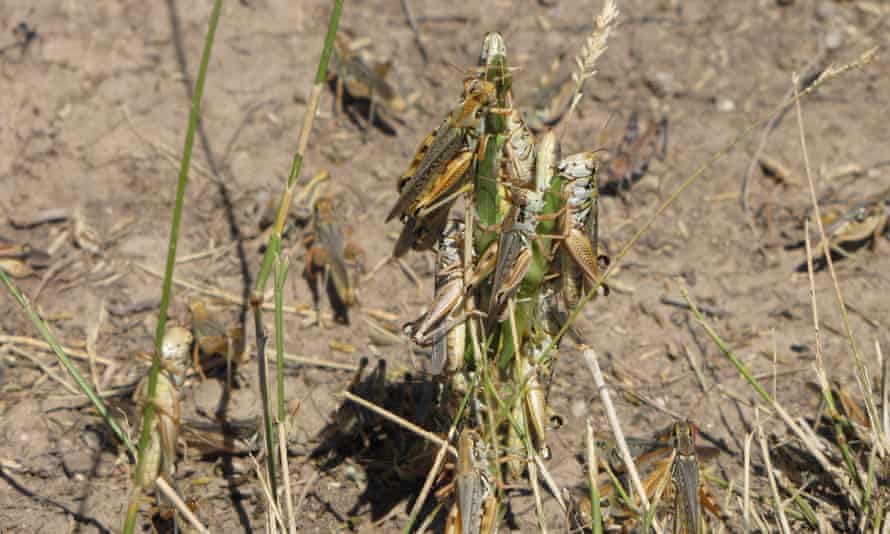
They’re arriving in swarms so dense it can appear the earth is moving. They’re covering roads and fields, pelting ATV riders, and steadily devouring grains and grass to the bedevilment of farmers and ranchers.

A massive population of grasshoppers is proliferating in the sweltering American west, where a deep drought has made for ideal conditions for grasshopper eggs to hatch and survive into adulthood.

“I can only describe grasshoppers in expletives,” said Richard Nicholson, a cattle rancher in Fort Klamath, a small community in southern Oregon, who once recalled seeing grasshopper bands eat 1,000 acres a day and cover the ground like snow. The insects cause innumerable headaches for farmers and ranchers, competing with cattle for tough-to-find wild forage and costing tens of thousands of dollars in lost crops and associated costs. “They are a scourge of the Earth … They just destroy the land, destroy the crops. They are just a bad, bad predator.”

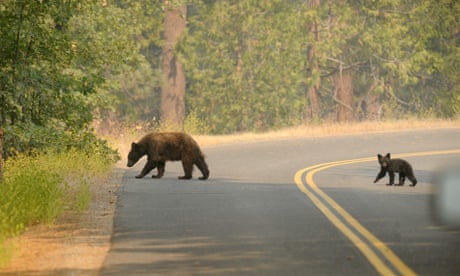
Wildlife vets have reported big changes in the numbers of abandoned babies or injured animals brought into their centers and sightings – especially of bears.

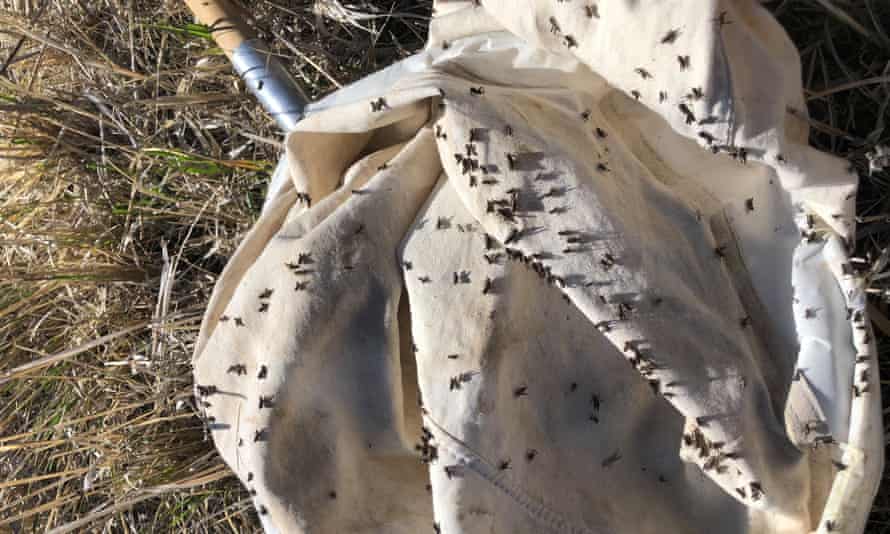
Prolific though they are, the grasshoppers are not interlopers. Native to the western lands, they have been there for millions of years, their populations typically in check. They hatch as tiny versions of adults, so small about 50 can fit on a coin the size of a quarter. In average years, most die off before becoming the winged grownups that now buzz the rural skies. They and their eggs are susceptible to pathogens, brutal winters and starvation while young. But grasshopper populations began ballooning in spring 2020, thanks to warmer and drier winters that favored survival, along with a lucky few rains that spur grass that feeds young grasshopper populations.

Oregon and Montana have been the hardest hit by the insatiable eaters, particularly in the arid eastern flank of both states. Thirteen other states are also facing grasshopper damage, according to hazard maps assembled by the animal and plant health inspection service at the US Department of Agriculture. The program helps contain grasshoppers on rangeland and also targets a close cousin, the Mormon cricket. The 17 states under the purview of this pest patrol have a combined agricultural value of $8.7bn, according to the most recent estimates. Last year the program spent more than $5m on suppression efforts and is presently steeped in more.

Grasshoppers in the Swan Lake area.
Grasshoppers in the Swan Lake area. Photograph: Courtesy of Helmuth Rogg

“The biggest biomass consumer in the country are not cattle, are not bison. They are grasshoppers,” said Helmuth Rogg, an entomologist and agricultural scientist who works for the Oregon department of agriculture. “They eat and eat from the day they get born until the day they die. That’s all they do.”https://bb7089c3f42a9acbe2db981f0edfdb8b.safeframe.googlesyndication.com/safeframe/1-0-38/html/container.html

“They basically ate all the forage,” said John O’Keeffe, a cattle rancher whose eastern Oregon ranch was besieged by grasshoppers a year ago. The ranch was recently treated with insecticide to avoid being menaced again. O’Keeffe estimates grasshoppers cost him $50,000 in lost forage, plus the price of hay to feed cattle once rangeland forage was gone.

According to Rogg, agricultural losses due to grasshoppers are often reported to be in the hundreds of thousands of dollars. In addition to grazing down rangeland forage, which also wipes out feed for wild antelope, grasshoppers eat the leaves off of fruit trees and bed down in the dry areas ringing crops, where they decimate grain by eating slowly inward. Capable of flying for miles, they can travel in bands to consume one area, then move on to the next.

They eat and eat from the day they get born until the day they die. That’s all they do

Helmuth Rogg

But controlling grasshoppers can be challenging. Because they molt like snakes, shedding skins as they grow, they are susceptible to the most targeted insecticide, dimilin, only when young and between molts. That window is small in places like Oregon, where grasshoppers tend to hatch early and mature fast, in part because the climate crisis is hastening the timing of their hatch. The adults, once spotted, are too old to suppress, except with chemicals that harm other insects. That means ranchers and farmers that spot infestations are often out of luck until the next year. That’s already the case in Oregon, where the grasshoppers are entering adult days. Not so in Montana, where officials have made the most requests for insecticide.AdvertisementDelta variant will cause US Covid surges, Fauci says, as poll reveals vaccine resistanceMiami condo collapse: reports reveal board’s long debate over repairsThe new circus comes to town: fiery support for Donald Trump at rain-soaked Florida rallyAfghanistan: America’s ‘longest war’ ends amid accusations of betrayalMassachusetts I-95 standoff was with Rise of the Moors militia, police saySkip Adhttps://imasdk.googleapis.com/js/core/bridge3.470.1_en.html#goog_1121852554https://imasdk.googleapis.com/js/core/bridge3.470.1_en.html#goog_1913869850https://imasdk.googleapis.com/js/core/bridge3.470.1_en.html#goog_2135906333

Based on initial data, the suppression campaign will be, like the grasshopper population, the first or second largest in 35 years. Left alone, the grasshopper populace would eventually shrink. Their population bursts tend to be cyclical, controlled after predator populations catch up to tamp them down. In addition to the pathogens that claim them, parasites and fungi also attack grasshoppers, while and they and their eggs are the mealtime fare of beetles, moths, lizards and birds. Their popularity as a prey base makes them key to ecological equilibrium most of the time. That is until population density turns them to pests.

“They’re kind of a neat bug, kind of like a pack, but when they go through a field, they will just completely wipe out everything that’s there,” said Tylor Lorenz, a sixth generation rancher near Oregon’s border with California. “The damage that they do when they come into crops is just absolutely horrific.”

https://www.theguardian.com/environment/2021/jul/04/grasshopper-swarms-us-west-drought

Leaked UN report warns of climate tipping points

Exposing the Big Game's avatarThe Extinction Chronicles

ttps://www.salon.com/2021/07/03/leaked-un-report-warns-of-climate-tipping-points_partner/

Here’s what they are and why they matter

ByALEXANDRIA HERR

PUBLISHED JULY 3, 2021 7:29AM (EDT)

Climate change and environmental disasters (Getty Images/Roy Scott)Climate change and environmental disasters(Getty Images/Roy Scott)FacebookTwitterRedditEmailsave

Gristis a nonprofit, independent media organization dedicated to telling stories of climate solutions and a just future.Grist

Adraft version of an upcoming report from the United Nations climate science advisory body, the Intergovernmental Panel on Climate Change, scheduled for release in February 2022,was leakedthis week to Agence France-Presse. It illustrates the existential risks posed by climate change to life on earth — and climate tipping points loom large.

Climate tipping pointsare the phenomenon by which small increases in temperature can trigger self-perpetuating loops in the natural world, “tipping” them towardsdramatic and widespread changeafter a certain temperature threshold is crossed — sometimes leading to even more emissions and warming. Examples of tipping points include the…

View original post 502 more words

Images from space show California’s forests and lakes drying out in a record mega-drought

https://www.businessinsider.com/satellite-images-show-california-mega-drought-drying-up-lakes-forest-2021-7

Morgan McFall-Johnsen 24 hours ago

california artificial lake green lawns trees oasis in dry desert
An artificial lake, Shadow Lake Estates, next to desert landscape in Indio, California on June 29, 2021. 

The climate crisis is bearing down hard on the western US.

Historic drought and heat are converging on western states to create the perfect storm for depleted reservoirs, strained power grids, and rampant wildfires later this summer. The effects are so stark, you can see them from space.

Satellite images show that the hills outside Los Angeles are significantly more parched, brown, and dry than they were this time last year. Drag the slider back and forth on the below image to see the difference.https://flo.uri.sh/visualisation/6618439/embed?auto=1Interactive content by Flourish

“I’m worried about this summer,” Kathleen Johnson, a paleoclimatologist at the University of California, Irvine, told The Guardian. “This current drought is potentially on track to become the worst that we’ve seen in at least 1,200 years. And the reason is linked directly to human-caused climate change.”

In the US Drought Monitor’s 20-year history of tracking drought, the West and Southwest are drier than they’ve ever been. California Gov. Gavin Newsom has now declared drought emergencies in 41 of the state’s 58 counties, encompassing 30% of California’s population.

Shasta Lake is the largest reservoir in California and, like many western lakes, it has receded significantly over the past few months. NASA satellite images below show a bathtub ring — white layers of calcium carbonate and other minerals exposed when the water level drops — along the lake’s shorelines.https://flo.uri.sh/visualisation/6619466/embed?auto=1Interactive content by Flourish

The reservoir is at just 38% of its full capacity — 48% of the historical average, according to California’s Department of Water Resources.

California’s second-largest reservoir, Lake Oroville, has fallen to historically low levels, too. Normally, the lake’s water pumps through the Edward Hyatt Power Plant to generate electricity for 800,000 homes. But officials told CNN that they expect the low water levels will force the plant to close in late summer.https://be0c2d3ea18438746b68f84fcb758a2b.safeframe.googlesyndication.com/safeframe/1-0-38/html/container.html

lake oroville full june 2019 and dry receding june 2021
Lake Oroville, California’s second-largest reservoir, on June 4, 2019 (left) and June 9, 2021 (right). 

“A lot of the slack in our system has already been used up,” Roger Pulwarty, a senior scientist in the National Oceanic and Atmospheric Administration (NOAA), told The Guardian.

A climate emergency is raising temperatures, straining power grids, and sparking fires

An ever-growing body of research shows that drought events are becoming more common and more severe as human activity fills the atmosphere with heat-trapping pollutants like carbon dioxide and methane. 

Rising global temperatures are changing the western US profoundly: Warmer air causes more moisture to evaporate, drying out soil. That raises the risk of drought and leaves forests full of tinder-dry foliage, primed for wildfires.

wildfire smoke plumes over dry hills and a highway road
Smoke plumes rise from a wildfire in Arizona on June 7, 2021. 

Heat waves only make the situation worse. They’re occuring three times more often and lasting about a day longer than they did in the 1960s, according to records of such waves across 50 US cities. They also start earlier and continue later into the year — the heat-wave season is 47 days longer than it was in the 1960s.

Two record-shattering heat waves struck western states in June. The first one washed over the Southwest and strained California’s power grid. Temperatures reached 116 degrees Fahrenheit in Las Vegas, Nevada; 115 degrees in Phoenix, Arizona; and topped 110 degrees for eight days straight in Tucson, Arizona.

heat map shows heat wave across US southwest
Air temperatures across the continental US during the afternoon of June 15, 2021. 

The most recent heat wave rolled over the Pacific Northwest last weekend and sat there for several days.

Many of the cities that were hit hardest, including Seattle and Portland, have never experienced such temperatures — in some cases breaking their previous records by double digits. Temperatures in Lytton, a town in British Columbia, hit 116 degrees Fahrenheit — the highest temperature ever recorded in Canada. The town broke that record the following day, when temperatures climbed to 118 degrees.

It’s not yet clear how many people died from heat-related illness during the Pacific Northwest heat wave, but the Associated Press reported that the death toll is likely in the hundreds.https://be0c2d3ea18438746b68f84fcb758a2b.safeframe.googlesyndication.com/safeframe/1-0-38/html/container.html

Fire department helps man in Oregon amidst heat wave
Emergency personnel help treat a man experiencing heat exposure at a cooling center during a heat wave in Salem, Oregon on June 26, 2021. 

“Much of the western United States will continue the trend of hot and dry weather, much like the summer of 2020,” Brandon Buckingham, a meteorologist at AccuWeather, told Insider last month. “Each and every western heat wave throughout the summer will only heighten wildfire risks.”

Heat waves also prompt people to crank up air conditioners, causing energy demand to spike. This can strain the power grid and lead to rolling blackouts.

U.S. proposal would ban mink farming to stem COVID-19 mutation

Exposing the Big Game's avatarThe Extinction Chronicles

MEG KINNARD

THE ASSOCIATED PRESS

PUBLISHED 16 HOURS AGO

A bipartisan proposal in the U.S. House would ban the farming of mink fur in
the United States in an effort to stem possible mutations of the
coronavirus, something researchers have said can be accelerated when the
virus spreads among animals.

The bill introduced this week is an effort from Reps. Rosa DeLauro, D-Conn.,
and Nancy Mace, R-S.C. It would prohibit the import, export, transport, sale
or purchase of mink in the United States.

Researchers have said that spread of COVID-19 among animals could speed up
the number of mutations in the virus before it potentially jumps back to
people.

Last year, the European Centre for Disease Prevention and Control issued new
guidance to curb the spread of the coronavirus between minks and humans. The
agency warned that when COVID-19 starts spreading on a mink farm, the large
numbers of animal…

View original post 299 more words