Two Tennessee men accused of hunting violations

Exposing the Big Game's avatarCommittee to Abolish Sport Hunting Blog

https://www.bgdailynews.com/news/two-tennessee-men-accused-of-hunting-violations/article_b00e459b-1073-599a-843b-b1a7fe88bdd3.html

State wildlife officials investigating a shooting complaint have brought charges against two men suspected of committing hunting violations in multiple states.

According to the Kentucky Department of Fish and Wildlife Resources, a state conservation officer investigated a shooting from the road complaint in April in Simpson County, receiving information from witnesses about a vehicle believed to have been involved in the incident.

The information led to evidence of suspected poaching activity by Sid Herring, 51, of Murfreesboro and Stefan Brownlie, 38, of Portland, Tenn., which resulted in misdemeanor charges of taking wildlife from a vehicle and illegal take/pursue a deer/wild turkey against both men.

Herring is additionally charged with third-degree criminal trespassing, discharge of a firearm/other device upon/across a public road and entry on land to shoot/hunt/fish/trap without consent.

State fish and wildlife officials following…

View original post 245 more words

Letter: Sign petition to oppose hunting with hounds in wildlife refuge

Exposing the Big Game's avatarCommittee to Abolish Sport Hunting Blog

Don’t miss the big stories. Like us on Facebook. https://www.facebook.com/v6.0/plugins/like.php?action=like&app_id=2257877631166536&channel=https%3A%2F%2Fstaticxx.facebook.com%2Fx%2Fconnect%2Fxd_arbiter%2F%3Fversion%3D46%23cb%3Df301873559b0eac%26domain%3Dwww.reformer.com%26origin%3Dhttps%253A%252F%252Fwww.reformer.com%252Ff3193faf8c6c65%26relation%3Dparent.parent&container_width=709&href=https%3A%2F%2Fwww.facebook.com%2Fbrattlebororeformer%2F&layout=button_count&locale=en_US&sdk=joey&share=false&size=small&width=

To the editor: The Silvio O. Conte National Wildlife Refuge is seeking public comment on its recreational hunting and fishing plan in the Nulhegan Basin Division and the Putney Mountain Unit. Protect Our Wildlife, a Vermont-based advocacy group, initiated a petition to ban hounding from the Refuge. Public commentary will be accepted on the plan until July 5.

The mission of this Refuge is to protect native plants, fish, wildlife, and ecosystems, within this river watershed. Hunting with dogs is currently permitted and should concern all wildlife supporters. Hounding should not be allowed on any wildlife refuge/sanctuary where non-target animals are at risk and fragile ecosystems are threatened.

Hunting wildlife with packs of hounds endangers a multitude of species, including ground nesting birds, fawns, moose calves, pets, humans, and the hounds…

View original post 181 more words

Major appliances stolen from hunting camp, two men charged with burglary

Exposing the Big Game's avatarCommittee to Abolish Sport Hunting Blog

Johnny Jackson (L), Patrick Kelly (R)
Johnny Jackson (L), Patrick Kelly (R)(Jefferson County Sheriff’s Department)

https://www.wlbt.com/2021/06/23/major-appliances-stolen-hunting-camp-two-men-charged-with-burglary/

By WLBT.com StaffPublished: Jun. 23, 2021 at 7:16 AM PDT|Updated: 7 hours ago

JEFFERSON CO., Miss. (WLBT) – Jefferson County deputies have arrested and charged two men with burglary.

Investigators say Johnny Jackson and Patrick Kelly stole major appliances, including a stove, refrigerator, hot water tank, televisions, and barbecue grill from Woodburn Hunting Camp.

The camp is a cabin-like home where hunters stay when they go to the area to hunt deer.

Deputies say the deer camp’s owner recently reported missing items to Jefferson County Sheriff’s Department.ADVERTISEMENT

The department says they’re currently running a search to see if the men were involved in any other similar crimes.https://www.facebook.com/v11.0/plugins/post.php?app_id=&channel=https%3A%2F%2Fstaticxx.facebook.com%2Fx%2Fconnect%2Fxd_arbiter%2F%3Fversion%3D46%23cb%3Df174cdb06864c0c%26domain%3Dwww.wlbt.com%26origin%3Dhttps%253A%252F%252Fwww.wlbt.com%252Ffdbe03cdb3e49%26relation%3Dparent.parent&container_width=761&href=https%3A%2F%2Fwww.facebook.com%2Fpermalink.php%3Fstory_fbid%3D330274171874691%26id%3D100914371477340%26locale%3Den_US&locale=en_US&sdk=joey&width=552

Copyright 2021 WLBT. All rights reserved

View original post

Letter: Opposes deer hunting around Lake Springfield

Exposing the Big Game's avatarCommittee to Abolish Sport Hunting Blog

https://www.sj-r.com/story/opinion/letters/2021/06/23/letter-deer-hunting-around-lake-springfield-shouldnt-allowed/5308789001/

Kay Cooper WattSpringfieldView Comments

A buck emerges from the tree line near Lake Springfield with a family of deer foraging the the forest floor at Lincoln Memorial Garden in Springfield, Ill., Wednesday, February 3, 2021. [Justin L. Fowler/The State Journal-Register]

How to divide Lake Springfield?Create an ordinance that permits deer hunting on unleased lake property owned by the City of Springfield and CWLP and you’ll succeed.Fliers about deer hunting recently were delivered to certain lake resident homes.Others were excluded.

How safe are lake residents going to be with hunters combing the woods in search of deer? Wooded areas that are unleased parcels of land surround and/or are adjacent to lake leased properties.Too many people are packed around the lake for deer hunting to be safe. People walk dogs in the woods.Children play in the woods.Birdwatchers look for birds in the woods.

The ordinance opens a door for people who do not like nature.Which animals are next?Already there is talk about killing geese at the lake.Big yards with grass growing up to the shoreline are what geese like.Geese are not fond of yards with bushes…

View original post 87 more words

DNR estimates Wisconsin had 1,136 wolves before hunt last winter, a 5% decline from previous year

Exposing the Big Game's avatarCommittee to Abolish Sport Hunting Blog

https://www.jsonline.com/story/sports/outdoors/2021/06/21/dnr-estimates-wisconsin-5-percent-wolf-decline-previous-winter/7776421002/

Paul A. SmithMilwaukee Journal SentinelView Comments

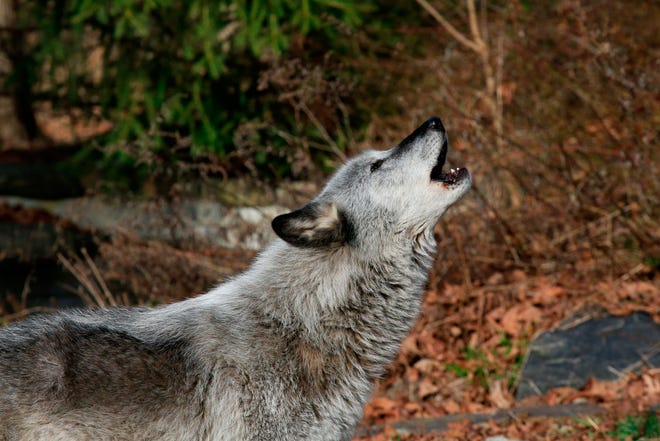
A wolf howls at a Wolf Conservation Center on December 6, 2020 in South Salem, New York.

Wisconsin had 1,136 wolves prior to the controversialhunting and trapping season last winter, according a preliminaryestimate released Monday bythe Department of Natural Resources.

The number represents a 5% decline from the previous winter.

The state’s population of wolves was further reduced in late February by at least 218, or 20%, during a court-mandated wolf hunting and trapping season.

The agency released the wolf population estimate as it prepares to convene the second and final meeting of its Wolf Harvest Advisory Committee on Tuesday.

However, the DNR did not providea post-hunt or early-summer wolf population estimate,critical data as it works to recommend a wolf kill quota for the state’s next scheduled wolf season in November.

Keith Warnke, DNR administratorof fish, wildlife and parks, has already stated the agency’s objective for the fall 2021wolf season is “no substantive change to the wolf population…

View original post 415 more words

Research shows similarities in hunters, animal rights advocates

Exposing the Big Game's avatarCommittee to Abolish Sport Hunting Blog

Shared moral values could be key for wildlife, nature conservancy support

JUNE 21, 2021

Animal rights advocates and hunters may have more in common than they think when it comes to nature conservancy, according to a newly published study by aTexas A&M AgriLiferesearcher.

Doe and fawn in a green forested environment.
Hunters and animal rights advocates may share more in common when it comes to conservation of natural ecology, according to new research. (Stock photo)

The research studied whether an individual’s empathy level toward wildlife predicted their support for conservation efforts. Researchers believe the study can be used to identify individuals and how they view the intrinsic value of nature in ways that can be leveraged to promote wildlife conservation.

Measuring and understanding people’s commitment to nature conservancy based on personal morals will be key to combatting wildlife losses and ecosystem disruptions in the short- and long-term, said

View original post 1,391 more words

Ground Temperatures Hit 118 Degrees in the Arctic Circle

Exposing the Big Game's avatarThe Extinction Chronicles

https://news.yahoo.com/explainer-delta-variant-coronavirus-k417n-094930268.html

The ongoing climate crisis is not going to spare Siberia.

Isaac SchultzYesterday 8:30AM611Alerts

Ground temperatures across Siberia have reached record highs during the region’s heatwave.

Newly publishedsatellite imagery shows the ground temperature in at least one location inSiberia topped 118 degrees Fahrenheit (48 degrees Celsius) going into the year’s longest day. It’s hotSiberiaEarth summer, and it certainly won’t be the last.

While many heads swiveled to the American West as cities like Phoenix and Salt Lake City sufferedshockingly hot temperaturesthis past week, a similar climatological aberrance unfolded on the opposite side of the world in the Arctic Circle. That’s not bizarre when you consider that the planet heating up is a global affair, one that isn’t picky about its targets. We’re all the target!

The 118-degree-Fahrenheit temperature was measured on the ground in Verkhojansk, in Yakutia, Eastern Siberia, by the European Space Agency’s…

View original post 331 more words

Explainer: What is the Delta variant of coronavirus with K417N mutation?

Exposing the Big Game's avatarThe Extinction Chronicles

https://news.yahoo.com/explainer-delta-variant-coronavirus-k417n-094930268.html

Reuters

Shilpa Jamkhandikar and Bhargav AcharyaWed, June 23, 2021, 2:49 AM·3 min read

By Shilpa Jamkhandikar and Bhargav Acharya

(Reuters) – India said on Wednesday it has found around 40 cases of the Delta coronavirus variant carrying a mutation that appears to make it more transmissible, and advised states to increase testing.

Below is what we know about the variant.

WHAT IS DELTA PLUS?

The variant, called “Delta Plus” in India,was first reported in a Public Health Englandbulletin on June 11.

It is a sub-lineage of the Delta variant first detected in India and has acquired the spike protein mutation called K417N which is also found in the Beta variant first identified in South Africa.

Some scientists worry that the mutation, coupled with other existing features of the Delta variant, could make it more transmissible.

“The mutation K417N has been of interest as it is present in the…

View original post 386 more words

A ‘Record-Breaking and Dangerous’ Heat Wave Is About to Hit the West Coast

Exposing the Big Game's avatarThe Extinction Chronicles

https://gizmodo.com/a-record-breaking-and-dangerous-heat-wave-is-about-to-h-1847157954

The record-obliterating heat wave will hit California, Oregon, and Washington amid a megadrought.

Brian KahnToday 1:20PM92AlertsLooks bad.Gif:Earth Wind Map

The West hasn’t totally cooled off, but the region has gotten a slight reprieve from the heat that hasdried up reservoirs,curtailed hydropower, and otherwisewrought havocon the megadrought-afflicted region. Unfortunately, all good(ish) things must come to an end.

The National Weather Service iswarning ofa “Record-Breaking and Dangerous Heatwave” hitting this weekend and early next week. Weather models are also coalescing around blistering heat. If the forecasts come to fruition, we’re not just talking about a few daily records falling here and there. We’re talking about a heat wave for the ages that could absolutely destroy all-time records from Washington to California as well as parts of Canada.

In what’s becoming an all-too-familiar pattern for those in the western half…

View original post 694 more words

Sustainable Fisheries, a Contradiction

https://www.seashepherdglobal.org/latest-news/sustainable-fisheries-contradiction/?fbclid=IwAR2Egs1DS_TuEWruDKmQNyuBPD3gpo-fMTdrSlrSqPb9DcPG7i9wybqFN34

DonateEnglish

Commentary

Wednesday, Mar 24, 2021

Commentary by Sea Shepherd CEO Captain Alex Cornelissen

Over the past five years Sea Shepherd has focused on Illegal, Unreported and Unregulated fishing (IUU fishing). Our campaigns, primarily in West Africa, have given us a wealth of information regarding the impact of both IUU fisheries as well as large scale industrial fisheries on the ocean.Photo from Operation Albacore in Gabon, by Melissa Romao/Sea Shepherd.

It’s clear that mankind is killing all life in the ocean, and for some reason that goes largely unnoticed.

Life forms in the ocean continue to be objectified:

  • * Species of fish are being referred to as “stock”
  • * Extraction of life forms is being described as “harvest”
  • * Quantities are measured in weight instead of individual organisms
  • * All species are simply referred to as “seafood”
  • * And most importantly, the myth that fish don’t feel pain
  •  

Obviously, this is carefully chosen language so potential consumers don’t question the way we extract fish and other creatures from our ocean. But our crew out on the water see this destruction every day when they interact with fishing vessels.

We see the amount of bycatch of species that aren’t commercially exploitable simply killed and discarded back into the ocean.

We see sharks killed by the thousands by tuna boats that are so-called “dolphin friendly”.

We see dolphins killed by many fishermen who considered them a pest for eating “our fish”.

We see seals sharing the same fate as the dolphins because they’re competition for our fisheries.Dolphin killed in a driftnet in the Indian Ocean. Photo Eliza Muirhead/Sea Shepherd.

There is something fundamentally wrong with the way we look at the natural world, the way we have separated ourselves from the very ecosystem we are part of. This particularly applies to the way we see the ocean. We dump our waste there because we think it’s large enough that no one will notice. We take whatever we want because we think the ocean is an infinite source of protein.

Our appetite and demand for fish is now so great that we stop at nothing to get the deliverables. Habitat destruction and species extinction seem to be acceptable in this process.

But even global fisheries are beginning to see the end of the industry, they are well aware of the fact that if we continue at our current rate of extraction, we will have emptied out our ocean in less than three decades. Pressure is on the industry to keep up with demand and to keep the prices low, but with dwindling fish populations it is increasingly hard to maintain supply. Prices are kept artificially low through global subsidies favoring industrial large-scale fisheries. These then compete illegally with coastal subsistence and artisanal fisheries, causing further problems in regions already at risk due to food scarcity. Other operators don’t shy away from forced unpaid labor to lower their cost, treating workers as expendables.Photo from Operation Albacore in Gabon, by Tara Lambourne/Sea Shepherd.

And of course, there’s the perpetual lie that eating fish is a healthy choice for people’s diet. We have polluted the world’s ocean to the point that it affects the entire food chain, with pollutants concentrating as you move higher up the chain. For years, pregnant women have been warned not to eat tuna or swordfish due to the high levels of mercury, a situation that is only getting worse the more we pollute our natural world.

We are at a point in history where we will need to make a choice:

Do we stop supporting the destructive and unsustainable industry that is destroying our ocean or do we continue down our current path and find our ocean empty within our lifetime? Either choice leads to the same result: we will stop eating fish either now or in 30 years. Only the longer we wait, the more irreversible the situation will become. Our “infinite” source of protein has reached its limit, so it’s time we make the necessary choices to restore the balance in our ocean.Photo from Operation Sola Stella in Liberia, by Melissa Romao/Sea Shepherd.

We are seeing the results of our campaigns to stop IUU fishing in West Africa, with fish populations bouncing back and ecosystems recovering only after a few years. But these areas are not big enough to repopulate entire regions. Enforcing regulations and expanding the areas under protection against IUU fishing and large-scale industrial fishing are the base of Sea Shepherd’s current campaigns. Together with our government partners we are shutting down dozens of illegal operators every year, and in the process we are saving millions of lives.

It’s a matter of survival to stop the war against the ocean. It’s a fight that we cannot afford to lose. A fight that will intensify in the coming years when fish populations continue to decline. But also a fight that – with your support – we intend to win.