S. 1211 would allow trophy hunters and trappers to kill an unlimited number of wolves by shooting mothers and pups in their dens, poisoning the animals, and shooting them from helicopters or airplanes, among other extremely cruel methods.Photo by Jean Landry/iStock.com
A bill that would allow trophy hunters, trappers and private contractors hired at taxpayer expense to kill up to 90% of the state’s wolves is flying through the Idaho legislature, and we need to stop it in its tracks.
The bill, introduced Tuesday, has already passed the state Senate and the House Resources and Conservation Committee. It could receive a vote on the floor of the House as early as Monday.
This is a terrible and wrongheaded measure that shows neither compassion nor any understanding of science. S. 1211 would allow trophy hunters and trappers to kill…
This story is part of Covering Climate Now, a global journalism collaboration strengthening coverage of the climate story.
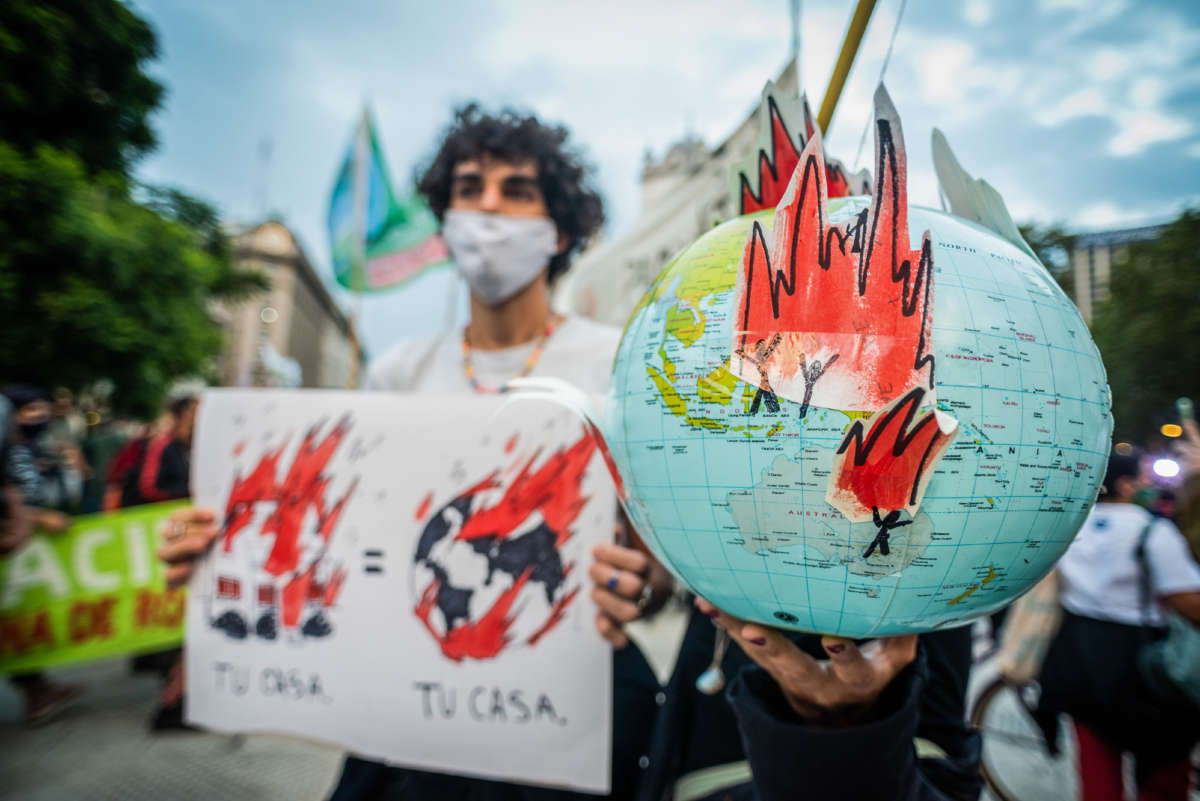
It’s a bleak sort of Earth Day today. All the major newspapers are carrying headlines about President Biden’s global eco-summit, about his pledge to cut greenhouse emissions in half by 2030, but so far as I have seen, none use the words “Earth Day” to mark the moment. This environmental holiday was created in 1970. I was created in 1971. We’re both 50-ish now, and feeling the mileage.
There has never been an Earth Day like this. As a kid, I remember huge gatherings on Boston Common to plead for politicians and industry leaders to find their conscience and realize there is no profit in a dead world. All too often, these pleas were met by the likes of James G. Watt, Ronald Reagan’s notoriously anti-environmental Interior Secretary, who never met a mine he didn’t love or a tree he didn’t hate.
As a member of Generation X, it has been my special fate to bear witness to the long and ever more visible arc of environmental dissolution that has led us to this moment. From acid rain to the ozone layer, my youth was suffused with a daily drumbeat of looming ecological doom. “What do you say, for instance, about a generation that has been taught that rain is poison?” asked Hunter S. Thompson in 1988. I read that when it came out, realized he was talking about me, and had to agree: There really was nothing to say.
Don’t miss a beat
Get the latest news and thought-provoking analysis from Truthout.
Email
That arc brought us here, and boy howdy, here really sucks. More than a year into a lethal pandemic that is nothing more or less than a global environmental calamity itself, some 3 million people have died worldwide. Somewhere around 315,000 people in India were diagnosed with COVID-19 just yesterday, a record likely to be broken either today or tomorrow. In the U.S., the death toll lurks close to 600,000 souls, with millions more infected. There were almost 65,000 new cases diagnosed here on Wednesday.
How, then, do we look on Earth Day in this grim context? For me, COVID is a microcosm of the larger issues that have made defending the environment such a frustrating and often futile endeavor. As with the environment, the people in power knew the dangers represented by COVID, but chose not to act in order to protect and defend capitalism. A segment of the population believed the lies being peddled by those in power, and now stand as an immotile barrier to progress. The roof is on fire, but they would rather burn than be convinced that the flames are real. The money is just too good.
As with the environment, it did not have to be this way. We had ample means to stifle the COVID crisis, but failed or actively chose not to time and again. Even today, with new infections exploding, governors are dropping their states’ mask mandates, because conservative peer pressure deems it time to do so. It’s as if we made a bizarre sort of suicide pact with people who don’t know what death is, even as they march resolutely into its maw.
Still, at long last, efforts are being taken to undo the catastrophe of the prior presidential administration, which spent its four critical years obliterating environmental protections while opening national parks to the strip miners and the pipeline layers. In its final year, the Trump administration almost completely ignored COVID, and now, most of the horses have left the barn.Rouse yourself in defense of this precious thing, for it is not all gone, not yet, and that which can be saved must be saved by us.
Because of that, because of the failure to thwart circumstances that give rise to viral variants, many of the things we are required to do today are permanent fixtures. COVID may always be with us in some form, much the way radioactive fallout from nuclear tests is now part of our DNA. That’s all of us, every single one.
The same can be said for the state of the environment: The damage that has been done is only now beginning to reveal itself in deadly storm seasons, endless droughts and terrifying infernos. Any actions we take will be on the level of mitigation only; the damage is baked in and inexorably coming no matter what we do.
The environment and COVID: They knew, they failed to act, and now the damage not only appears to be permanent, but we live under the ever-present threat of severe outbreaks capable of harming or killing untold numbers.
While it can be argued that we are within sight of bringing COVID under some semblance of control, the same is not true of the ongoing and worsening phenomenon of climate disruption. The climate crisis is, truly, only just beginning.
Several years ago, Truthout’s invaluable environmental reporter Dahr Jamail embarked upon a journey to the various environmental graveyards of the world. He sought out the places where climate disruption is not just happening, but where it has been visibly happening for a long time.
Jamail put his hand into the melted tears of a dying glacier and touched the corpse of the Great Barrier Reef. He smelled smoke in the rainforest, heard the ticking of methane bombs beneath the melting tundra, and watched the ocean as it slowly devoured a fishing village that had stood safely by the shore for generations.
“Writing this book is my attempt to bear witness to what we have done to the Earth. I want to make my own amends to the Earth in the precious time we have left, however long that might be. I go into my work wholeheartedly, knowing it is unlikely to turn anything around. And when the tide does not turn, my heart breaks, over and over again as the reports of each succeeding loss continue to come in. The grief for the planet does not get easier. Returning to this again and again is, I think, the greatest service I can offer in these times. I am committed in my bones to being with the Earth, no matter what, to the end.
Please take this Earth Day and do likewise. Be with the green and the blue, the astonishment of life we have been gifted to witness and be part of, for we are inseparable from that which created us on this small space-borne rock. Rouse yourself in defense of this precious thing, for it is not all gone, not yet, and that which can be saved must be saved by us.
The world came together to join the Montreal Protocol, and today the damage to the ozone layer is visibly diminished. The world came together to act on acid rain, and it was eradicated so thoroughly that some climate denialists argue it never existed. It did, and now it is all but gone, because of us. It can be done, because it has been done.
Knowing this, it’s time to reject greenwashing and false promises from the powerful when they are proffered. After 51 Earth Days, only a revolution of the mind, body and spirit can save what we have left.
Researchers fear increasing energy in these eddies could affect ability of Southern Ocean to absorb C02
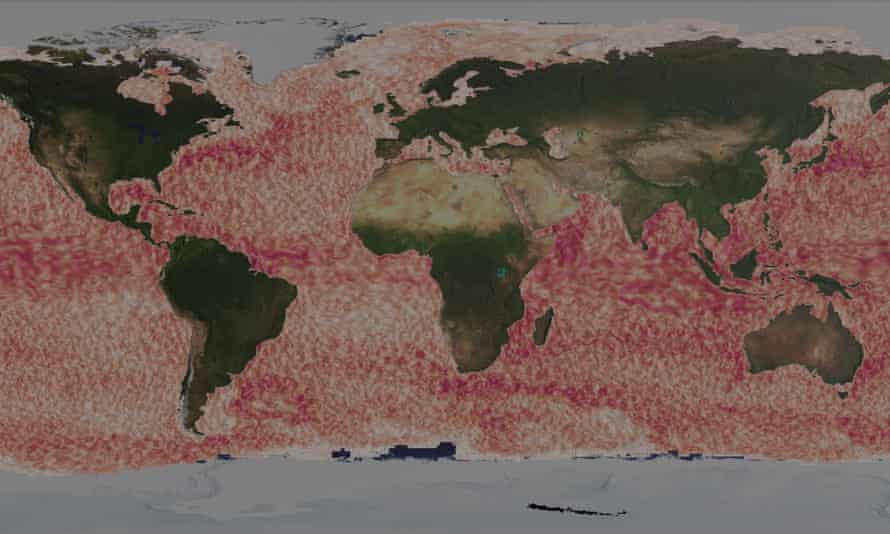
Giant eddies ranging from 10km to 100km across are intensifying in the South Ocean, one of the world’s biggest natural carbon stores. Researchers are concerned this could have grave effects for the world.Photograph: EKE
Swirling and meandering ocean currents that help shape the world’s climate have gone through a “global-scale reorganisation” over the past three decades, according to new research.
The amount of energy in these ocean currents, which can be from 10km to 100km across and are known as eddies, has increased, having as yet unknown affects on the ocean’s ability to lock-away carbon dioxide and heat from fossil fuel burning.
One expert said the changes described in the research could affect the ability of the Southern Ocean, one of the…
And the damage isn’t likely to have stopped there. Prunicki, director of air pollution and health research at Stanford University’sSean N. Parker Center for Allergy and Asthma Research, is studying the blood samples to understand what wildfire…
The explosion in the fourth reactor at the nuclear power plant in April, 26, 1986 left swathes of Ukraine and neighbouring Belarus badly contaminated and led to the creation of a no man’s land within a 30-kilometre (19-mile) radius of the station.
Dozens of villages and towns were evacuated, turning the area into a giant reserve unprecedented in Europe by its size.
More than three decades after the incident there has been an influx of visitors to the area, spurring officials to seek official status — and protection — from UNESCO.
– A ‘unique’ chance to save biodiversity –
Since the disaster, the area has become a haven for elk, wolves — and the stocky endangered breed of wild horse native to Asia, Przewalski’s horse.
“Paradoxically, this is a unique opportunity to preserve biodiversity,” Vyshnevsky said.
Under the right conditions, the Ukrainian herd could eventually increase to 300 or even 500 animals, said Sergiy Zhyla, Senior Researcher, Chernobyl Biosphere Reserve.
Researchers at the Prague zoo participating in the conservation efforts now say the global population of Przewalski’s horses has grown to some 2,700.Play VideoWild horses flourish in Chernobyl 35 years after explosionClick to expand
Following the success in Chernobyl, there is discussion over introducing other endangered species to Ukraine’s zone.
Vyshnevsky sees one potential candidate in the European bison — which already roams over the border in Belarus — and discussions are currently underway with the World Wildlife Fund, a global environmental NGO.
“We’ll be able to recreate the landscape that was here before humans began intensely exploiting the region,” he said.
The Intergovernmental Panel on Climate Change (IPCC) “Special Report: Global Warming of 1.5ºC” — the international community’s benchmark guide to averting climate disaster — says to reach the goal of staying below 1.5ºC of warming…
As early morning fog lifts off the Baja California coastline, Alushe Camacho steers a small fishing boat through a mangrove-lined estuary, his eyes fixed on the horizon. During most of the year, Camacho hunts grouper, sole, and hammerhead sharks. Today he’s in search of gray whales.https://products.gobankingrates.com/r/e48f149e71a19f66115d5f5c8edaefd8?subid=
After several minutes Camacho spies his target: a heart-shaped cloud of ocean spray erupting from the water. Suddenly an adult whale thrusts its tapered head straight through the surface, pausing for five long seconds before disappearing under the waves.
Encounters like these have for decades drawn tourists to this marshy stretch of Mexico, where each winter thousands of Eastern Pacific gray whales arrive from Alaska’s Arctic. Here the adults mate, and females give birth and rear their young in a network of tranquil lagoons.
But over the last three years, Camacho and others have noticed ominous changes. The whales are arriving in the estuary later in the year, and many appear malnourished, the jagged outline of vertebrae visible on their typically fatty backs. More whales than usual have been washing up dead along the shore.
Perhaps most concerning is the dramatic drop in births. On a normal early February morning like this one, Camacho would expect to see several pairs of mothers and calves. Today he spies only adults.
The changes observed in Mexico are evidence of a more widespread phenomenon, one brought to public attention in 2019 and 2020, when strandings of gray whales along the Pacific coast of North America surged dramatically. The National Oceanic and Atmospheric Administration (NOAA) declared an “unusual mortality event” and launched an investigation into the causes.
Between 2016 and 2020, the estimated population of eastern North Pacific gray whales plummeted by nearly a quarter, from almost 27,000 individuals to around 20,500. The origins of the decline are so far a mystery. Much of the early research points to climate change, which is rapidly warming the Arctic Ocean and may be reducing the quantity or quality of whales’ food supply. But scientists can’t rule out other factors, including the possibility that the whale population grew too large and is simply correcting itself.
“They’re sentinels for what’s going on in the North Pacific ecosystem writ large,” says Sue Moore, a research scientist at the University of Washington who is helping lead NOAA’s probe.
The question has taken on a special urgency in Mexico, where a string of villages on the Baja peninsula have come to rely economically on the annual arrival of the whales.
“Something is happening, and we don’t know what it is,” says Camacho. “If the whales don’t return, what will we do?”
Camacho has spent his entire life in Puerto Adolfo López Mateos, a dusty town of 2,000 five hours north of Cabo San Lucas. Living alongside a shallow lagoon that is home to dolphins, egrets, and pelicans, residents are closely connected to nature. Ospreys nest atop telephone poles, and coyotes slink down dirt streets, waiting for fishermen to dock with their daily catch.
But residents regard the whales with special reverence. A gray whale sculpture stands in front of the Catholic church, and whale murals adorn restaurants and the elementary school. Locals say that because they are born here, gray whales are Mexican. Each winter, the village celebrates their homecoming with a three-day festival, including concerts and a beauty pageant.
It wasn’t always this way.
In the 1800s and early 1900s, foreign whalers crowded these lagoons in search of blubber for producing lamp oil. Whalers had already, in the 1700s, hunted to extinction a separate stock of gray whales in the Atlantic Ocean. But with the rise of petroleum as lamp fuel, the establishment of the International Whaling Commission in the 1940s, and passage of the Marine Mammal Protection Act in 1972, the eastern North Pacific gray was able to bounce back.
While working as a fisherman April through December, Camacho brings in on average $170 a week. When the whales arrive, he can earn six times as much guiding for Pirata Tours, the company founded by his grandfather four decades ago.
Gallery: The most terrifying creatures in the sea (Espresso)
Omar García Castañeda is braced on the bow of a bumping motorboat, binoculars pressed to his face and a safety rope looped around his waist. It’s a blustery day to be out on the water, but time is precious: The gray whales inhabit their breeding grounds for about three months each year, and García and his colleagues must count and photograph as many of them as possible.
The marine biologists are part of the Laguna San Ignacio Ecosystem Science Program, a binational research group that has been monitoring whales along the Baja coast since 2007. Each year the group compiles photo catalogues of whales that allow them to track the movements of individuals, identified by their distinctive patterns of barnacles and scars. Crucially, in recent years the photographs have also been used to evaluate whale health.
The cetaceans are so huge—a healthy gray is 90,000 pounds and up to 50 feet long—that it can be difficult to determine from a boat deck whether they are malnourished. But photographs can reveal nuances: Do the whales have thick, rounded backs or a depression behind their heads? Are their scapulae protruding?
During the program’s first decade, the proportion of single adult whales deemed to be in poor body condition had remained steady, at around 6 percent. But that number began to rise in 2018. By 2020, it had hit 30 percent.
Drone photography confirmed the trend: between 2017 and 2020, a growing percentage of whales were much leaner than they should be.
All along their migration route, whales were stranding in record numbers. In 2019, 214 gray whales were found dead, including 122 in the United States—four times the nation’s annual average over the previous 18 years. Scientists believe that for each whale found on land, another five die at sea.
“We saw this coming, but there was nothing we could do about it,” says Steven Swartz, co-director of the Laguna San Ignacio program.
Necropsies—post-mortem exams on animals—are particularly difficult to conduct on whales because they often wash up on remote beaches, and they decompose rapidly. In a typical year, researchers at the Marine Mammal Center, in Sausalito, might necropsy between one and three gray whales, which don’t typically enter San Francisco Bay while migrating. But in 2019, the center examined 13.
Pádraig Duignan, the center’s chief pathologist, speculates that whales veered off their usual route and entered the bay because they were hungry and looking for food. Necropsies revealed around half the whales were malnourished, with very low stores of fat around their hearts and other organs. Their entry into the bay made them particularly susceptible to boat traffic: Most of the other whales examined had succumbed to ship and ferry strikes.
In 2020, 174 gray whales washed up along the migration route. But Covid-19 restrictions limited researchers’ ability to perform necropsies. The Marine Mammal Center completed just one.
Duignan didn’t know if whales were dying because of food shortages, disease, or possibly pollution, their bodies contaminated by the ingestion of microplastics. But it was clear, he said, that they were leaving the Arctic in a poor nutritional state. “They are not migrating with enough food ‘on board.’”
The starvation hypothesis has shifted investigators’ focus to Alaska’s Chukchi and Bering Seas, where whales binge during the summer and fall on bottom-dwelling shrimp-like amphipods, packing on stores of blubber for their eventual migration back south.
The Arctic seas, though, are changing. A warming climate means less sea ice, which disrupts the production of algae, which in turn feed amphipods. Could a shrinking ice cap be reducing the whales’ food supply?
That would be the simplest answer, but it is complicated by the fact that the gray whale population suffered another dramatic die-off in 1999 and 2000, a period when Arctic ice was far more abundant. Then, just like today, gray whales stranded up and down the coast, and scientists reported a 23 percent drop—from 21,000 whales in 1997 to 16,000 in 2000.
The whale population didn’t just recover after that event, it boomed, reaching 27,000 individuals in 2016.
Frances Gulland, who helped lead the NOAA team investigating the first die-off, doesn’t believe that climate change alone can explain two mass-casualty events two decades apart.
“Why was there 20 years between these die-off events when we know the changes in the Arctic have been continual?” the marine mammal veterinarian says. “It’s common sense that there must be problems with their feeding, and we also know that there are massive changes in the Arctic. But how those changes are connected is difficult to say.”
Others suggest that the gray whale population simply hit some sort of carrying capacity, then corrected itself—a process that may now be repeating.
Many believe it may be a combination of factors.
“I think we’re seeing an interaction of events,” says John Calambokidis, a biologist with the Cascadia Research Collective and with NOAA’s Unusual Mortality Event working group. An expanding population of whales would mean more competition for food. Paired with some other factor that may have triggered a decline in available prey—such as dramatic changes in the Arctic environment—starvation and death could follow.
In recent years, more gray whales have been veering a hundred miles off their migratory path and into Washington’s Puget Sound, where Calambokidis works, in search of food. It’s a sign that the whales are hungry, the researcher says, but it’s also a sign of their resilience. Whales can pack on serious weight in just a few weeks—not by eating amphipods on the ocean floor but by feasting in ghost shrimp beds in shallow parts of the sound.
Calambokidis is hopeful that the gray whale population will recover, just as it did after commercial whaling and after the die-offs of 1999 and 2000. “Maybe gray whales are this adaptive because they’ve had to be,” he said.
A glimpse of the future?
The COVID-19 pandemic, which brought tourism in López Mateos to a near standstill, has given the community a sense of what life would be like without whales. Guides at the town’s impressive modern pier spend much of their time these days listening to cumbia music and cracking jokes as they wait for customers. This year’s Gray Whale Festival was canceled.
Fernando Rojas Rodriguez, 56, came here in 1990 in search of work. The whale business helped him put his four children through school. Now he worries—about the future of tourism during a global pandemic and about the health of the whales.
It is too early to say how strandings in 2021 will compare to the previous two years. Early reports from scientists working in Baja this season showed high rates of skinny whales and low numbers of mothers and calves.
But on a recent morning, Rojas gets lucky. A woman and her daughter, tourists from Arizona, pull up in their rental car and ask to go out on the water.
As Rojas steers them slowly across the lagoon in his turquoise fishing boat, pods of dolphins arc in the distance, and pelicans cut through the moist air. And then he sees it: a cloud of mist erupting from a blowhole. Then another smaller spray shoots up next to the first.
Rojas cuts the engine. “It’s a mother and her calf,” he says excitedly.
The baby, which he estimates is about a week old, is already the length of a large sedan. It darts toward the boat with a toddler-like curiosity, gliding along the bobbing vessel before diving down and emerging on the other side. Rojas tells the tourists to splash their hands in the water. The calf comes closer, and for a brief moment the daughter caresses its smooth, slate-gray skin.
A few minutes later, the mother and calf peel off. The baby has feeding to do, and the mother, crucial weeks of child-rearing. Within a month or so they’ll set out on their daunting journey north. Rojas hopes they will make it, and that later in the year they will find their way back.
If progressive U.S. lawmakers were expecting encouragement from influential climate activist, the 18-year-old Greta Thunberg, she wasn’t delivering this Earth Day.
Thunberg was called to virtually address a House subcommittee, chaired by the Democrats in the majority, that is reviewing ending fossil-fuel subsidies. Her appearance — on an arguably much smaller stage considering that past tours for the Time Person of the Year included the United Nations — played against the 40-nation climate summit led by President Biden also taking place Thursday.
“Before Brian started this, he’d seen what he thought was evidence of real culture,” Cameron says. “Not just intelligence and not just that which natural selection has created.” (Read about James Cameron’s latest exploration project.)
Skerry’s work in photography and video makes it clear that different species have distinct ways of communicating and hunting. Also a National Geographic Explorer, Skerry gets incredibly close to these majestic creatures, such as that female orca. She had just stunned a stingray to feed her family but instead presents it to him.
Astonishment is audible in Weaver’s voice as we see, for the first time, a sperm whale nurse her calf, and when 2,000 belugas converge in Canada’s Cunningham Inlet for a raucous reunion.
Weaver typically narrates documentaries from a studio. During the pandemic, however, her New York City apartment had to do. Construction was being done just outside her building, so Weaver limited recordings to weekends, and, with her assistant, crafted makeshift sound buffers.
A longtime environmentalist, Weaver grew up near Long Island Sound and always loved the water. Cameron, who directed Weaver in Aliens and the Avatar movies, persuaded her to learn scuba diving. She recalls an amazing night dive. “We lay on the floor of the sea, and these beautiful manta rays glided right above us.”
Cameron’s enchantment with the aquatic world only grew with Secrets of the Whales. Well-versed in marine life, the Oscar-winning director and producer has logged thousands of hours underwater, even discovered dozens of species. Still, Cameron was enthralled by what Skerry’s film captured, such as the songs of humpback whales.
Watching this series may inspire viewers the way Jacques Cousteau did for Cameron and Skerry. The legendary underwater explorer was a TV staple when both were kids. Cousteau’s adventures encouraged them, and both learned to scuba dive at local YMCAs, which helped form their careers.
Quick to deflect credit for Secrets of the Whales, Cameron calls himself the “narrative guru,” there to frame the documentaries dramatically. These stories touch us because they’re universal: birth and death, playing and hunting, teaching and learning.
“There’s an intimacy to the way the camera got in there and the way Brian got in there with these animals,” Cameron says. “And I think there’s an emotional intimacy to the way she [Sigourney] describes what you’re seeing.”
“This one was a game-changer”
Skerry says the idea for this project, which took him to 24 locations worldwide, was percolating for a decade.
“I was looking for that narrative, and I looked for a number of things in a number of scientific papers,” Skerry says. “A big part of my career is on conservation. This one was a game-changer.” Science was revealing what could be called human traits in whales. With that, he says, “we might get people to see the oceans in a different way.”
He worked with National Geographic to create a magazine article that’s the cover story for the May issue, the television series, and a book. After decades of photographing marine life, logging more than 10,000 hours underwater, he knows what works, and how working with whales is different.
With most of his underwater photography, Skerry scuba dives. “With whales, scuba doesn’t work—the bubbles scare the whales,” he says. For this project, “95 percent of what I was doing is known as free diving.” It’s just a mask, snorkel, fins, and a wet suit. “You take a deep breath and maybe stay underwater for a couple of minutes.”
Sometimes whales appear to pose for him. Even after living this for three years, Skerry remains gobsmacked by his experiences.
The moment that stands out for him is “the newborn nursing from its mom,” he says, his voice catching with emotion. “I made the first picture of a sperm whale calf nursing.”
Like any mother doting on her newborn, it’s a tender scene. Weaver recognizes why we’re able to relate.
“To be able to move around in the water so close to the mothers and the babies and to do it in such a way as to never feel we are intruding on the whales or harming them,” she says. “I just feel the spirit this was shot in is a great gift to us because it is so respectful and admiring.”
Weaver reflects on how her narrator role evolved as the series progressed. “I was less a narrator of scientific facts—I was more of a storyteller. And it was as if I were saying, Come with me! I know this family I want to introduce you to,” she says. The emphasis was on “bringing the viewer along with me. The images are so amazing you want to present it in a matter-of-fact way.”






 © Provided by NBC News

 © Sergei SUPINSKY Przewalski’s horses wander near a forest road in the Chernobyl zone
 © Jean Christophe VERHAEGEN A potential candidate species for introduction to the Chernobyl area is the European bison
 © GENYA SAVILOV Chernobyl has also become a haven for elks, and other fauna including wolves
 © Sergei SUPINSKY Przewalski’s horses were at one time extinct in the wild but are now thriving in Chernobyl
 © Aleksndr Sirota Thirty-five years after the world’s worst nuclear disaster surging flora and fauna have taken over deserted tower blocks
 © Andriy PERUN Down an overgrown country road, three startled wild horses with rugged coats and rigid manes dart into the flourishing overgrowth of their unlikely nature reserve: the Chernobyl exclusion zone.


 © James MacDonald/Bloomberg via Getty ImagesOperations At A Carbon Engineering Direct Air Capture Pilot Facility

 © Photograph by Meghan Dhaliwal January 31, 2021 – An adult female gray whale, whose new calf swims below the surface, spy hops in the glassy waters of the Bahía Magdalena. According to the guides who work out of Puerto Adolfo Lopez Mateos, this whale’s calf is less than a week old and the spy-hopping is a form of vigilance for the mother trying to make sure her calf is in no danger. Image by Meghan Dhaliwal
 © Photograph by Meghan Dhaliwal February 6, 2021 – An adult grey whale swims in the calm waters just outside of the “Boca de Soledad,” the mouth where the Pacific ocean meets the series of bays known as the Bahía Magdalena. Grey whales migrate for six months a year—three months to travel down from their feeding grounds in Alaska to Baja Sur, Mexico, three months to calve in Baja Sur, three months to travel back north and three months of feeding in Alaska waters. Grey whales are baleen whales, meaning that they survive by eating tons of fat-rich microorganisms. Grey whales have been dying along their migration route at unexplainable rates (the NOAA is calling their deaths a UME, or an Unexplained Mortality Event) but scientists are beginning to theorize that warming seas are killing off the whale’s main food source in the north, leaving them malnourished on their migration. Image by Meghan Dhaliwal
 © None January 30 2021 – Tourists gather around a statue of a grey whale mother and calf pair in the center of the plaza just outside the whale watching docks of the “Sanctuario de la Ballena Gris” or Grey Whale Sanctuary in Puerto Adolfo Lopez Mateos. The town is a home to approximately 2100 people and for three months each year, a popular touristic space for people looking to see grey whales, which migrate to these waters from Alaska each year, staying from approximately January to March. Image by Meghan Dhaliwal
 © Photograph by Meghan Dhaliwal February 6, 2021 -The Camacho family and two visiting friends sit outside a home the family is constructing in Puerto Adolfo Lopez Mateos. The Camacho family runs whale tours through their company Pirata Tours out of Puerto Adolfo Lopez Mateos. The family is tight knit, running their business together and spending most of their time not working together as well. Image by Meghan Dhaliwal Contact for Alushe: +52 613 113 5159 Contact for Juan Manuel Camacho +52 613 137 3081 Contact for Jimmy +52 613 114 0761

 © AFP via Getty ImagesKEY WORDShttps://products.gobankingrates.com/r/d9360ea31bf06ea8b9d0ef49288e28fb?subid=

 © Photograph by Brian Skerry Off New Zealand an orca seemingly tried to share a stingray with photographer Brian Skerry, dropping it at his feet. The orca circled the photographer who remained still a few times, and then picked up the stingray, later sharing it with another whale.
 © Photograph by Brian Skerry and Nansen Weber Beluga Whales at Cunningham Inlet on Somerset Island in the Canadian Arctic. Female beluga whales come to this estuary region in summertime with their newborn calves to rest and play in the shallow water. It is essentially a beluga whale nursery and is unique with the whale world since here many moms and calves, sometime hundreds, gather in the same place at the same time. Other belugas are here too, juveniles and adult males. The adults without calves seem to gather a bit further away from the river, still rubbing on the shallow gravel bottom. The whales here rub their bodies on the gravel bottom, rubbing off old skin. This cultural aspect of beluga whale lives is a time to socialize in a place where they are mostly safe from predators (polar bears).
 © Photograph by Andrew H. Walker Variety REX Shutterstock Actress and narrator Sigourney Weaver
 © Photograph by MARK THIESSEN, NATIONAL GEOGRAPHIC On March 26, 2012, Filmmaker and National Geographic Explorer-in-Residence James Cameron made a record-breaking solo dive to Earth’s lowest point, successfully piloting a submarine nearly seven miles deep to the bottom of the Mariana Trench in the Pacific Ocean.
 © Photograph by Steve De Neef Brian Skerry photographs a pod of sperm whales (Physeter macrocephalus) during a social gathering of these incredible animals of the coast of Dominica.
 © Photograph by Brian Skerry Humpback whale male in the waters off the Cook Islands, singing at a depth of approximately 120-feet to attract a female for mating. Male humpbacks create complex songs and select specific locations in the ocean (typically near islands) where they sing. They most often invert their bodies vertically, with their heads pointed downward and tails upward and sing for up to twenty minutes before surfacing to breathe, then return to singing. The humpbacks songs have been studied f=by researchers for decades, but new information is being revealed about the complexity of the songs and how the most successful song (the ‘winning tune’) is adopted by other male whales and passed across the pacific ocean and even into the atlantic. Researcher Dr. Nan Hauser has worked here for 20 years and has documented thousands of individual animals, but rarely seems the same animal twice.
 © Photograph by Brian Skerry MOTHER’S MILK This is one of the first images of a sperm whale nursing. Scientists had wondered how these mothers gave milk to their long-jawed young. Females have slits that contain hidden nipples. When a calf is hungry, it pushes its jaw into the slit and milk is released, allowing it to feed.

