Descrease article font size-AIncrease article font sizeA+
You don’t have to believe in the coronavirus to get it, as musician Ted Nugent acknowledged with the revelation that he has tested positive for COVID-19.
“I was officially tested positive for COVID-19,” Nugent revealed on Facebook Live Monday. “I got the Chinese s—,” he added, in a nearly nine-minute video peppered with profanity, anti-Asian racism, conspiracy theories and false claims about the virus.
Nugent revealed that he had flu-like symptoms for 10 days, and that he finally got tested on Monday.
“I thought I was dying,” he said. He added that he could hardly crawl out of bed, and that the agony of the disease finally prompted him to get tested for it.
The revelation came less than a month after Nugent blasted lockdowns on social media.
“My common sense meter would demand the answer to: Why weren’t we shut down for COVID 1 through 18?” he said earlier this month on Facebook Live.
The number refers to 2019 — the year in which the disease was discovered. (There was no COVID 1-18.)
Nugent spent several months denouncing the pandemic as a hoax, often while voicing his support for ex-U.S. president Donald Trump. He suggested that the pandemic was “not real” and a “scam.” He also claimed that people who wore masks were “sheep.”
Despite testing positive, Nugent on Monday continued to cast doubt on the pandemic while pushing pro-Trump conspiracy theories.
His tirade was occasionally punctuated with a dry cough.
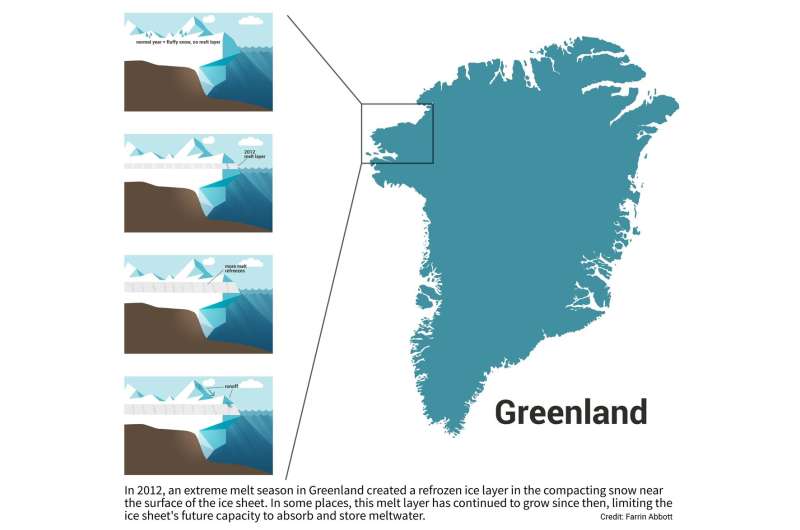
In 2012, an extreme melt season in Greenland created a refrozen ice layer in the compacting snow near the surface of the ice sheet. In some places, this melt layer has continued to grow since then, limiting the ice sheet’s future capacity to absorb and store meltwater. Credit: Farrin Abbott
Using a new approach to ice-penetrating radar data, Stanford University scientists show that this melting left behind a contiguous layer of refrozen ice inside the snowpack, including near the middle of the ice sheet where surface melting is usually minimal. Most importantly, the formation of the melt layer changed the ice sheet’s behavior by reducing its ability to store future meltwater. The research appears in Nature Communications April 20.
“When you have these extreme, one-off melt years, it’s not just adding more to Greenland’s contribution to sea-level rise in that year—it’s also creating these persistent structural changes in the ice sheet itself,” said lead study author Riley Culberg, a Ph.D. student in electrical engineering. “This continental-scale picture helps us understand what kind of melt and snow conditions allowed this layer to form.”
The 2012 melt season was caused by unusually warm temperatures exacerbated by high atmospheric pressure over Greenland—an extreme event that may have been caused or intensified by climate change. The Greenland Ice Sheet has experienced five record-breaking melt seasons since 2000, with the most recent occurring in 2019.
“Normally we’d say the ice sheet would just shrug off weather—ice sheets tend to be big, calm, slow things,” said senior author Dustin Schroeder, an assistant professor of geophysics at Stanford’s School of Earth, Energy & Environmental Sciences (Stanford Earth). “This is really one of the first cases where you can say, shockingly, in some ways, these slow, calm ice sheets care a lot about a single extreme event in a particularly warm year.”
Shifting scenarios
Airborne radar data, a major expansion to single-site field observations on the icy poles, is typically used to study the bottom of the ice sheet. But by pushing past technical and computational limitations through advanced modeling, the team was able to reanalyze radar data collected by flights from NASA’s Operation IceBridge from 2012 to 2017 to interpret melt near the surface of the ice sheet, at a depth up to about 50 feet.
Melting ice sheets and glaciers are the biggest contributors to sea-level rise—and the most complex elements to incorporate into climate model projections. Ice sheet regions that haven’t experienced extreme melt can store meltwater in the upper 150 feet, thereby preventing it from flowing into the ocean. A melt layer like the one from 2012 can reduce the storage capacity to about 15 feet in some parts of the Greenland Ice Sheet, according to the research.
The type of melt followed by rapid freeze experienced in 2012 can be compared to wintry conditions in much of the world: snow falls to the ground, a few warm days melt it a little, then when it freezes again, it creates slick ice—the kind that no one would want to drive on.
“The melt event in 2012 is impacting the way the ice sheet responds to surface melt even now,” Culberg said. “These structural changes mean the way the ice sheet responds to surface melting is going to be impacted longer term.”
In the long run, meltwater that can no longer be stored in the upper part of the ice sheet may drain down to the ice bed, creating slippery conditions that speed up the ice and send chunks into the ocean, raising sea levels more quickly.
Polar patterns
Greenland currently experiences change much more rapidly than its South Pole counterpart. But lessons from Greenland may be applied to Antarctica when the seasons shift, Schroeder said.
“I think now there’s no question that when you’re trying to project into the future, a warming Antarctic will have all these processes,” Schroeder said. “If we don’t use Greenland now to better understand this stuff, our capacity to understand how a warmer world will be is not a hopeful proposition.”
Last week, scientists conducting research on Western Australia’s Ashmore Reef became the first humans to lay eyes on a short-nosed sea snake at the site in more than two decades. Olive-colored and critically endangered, the snakes have been thought locally extinct for 23 years.
Like cobras, taipans, and death adders, the short-nosed sea snake is a member of the Elapidae family, meaning that it possesses short, hollow fixed fangs capable of injecting predominantlyneurotoxic venom.
In short, it’s not an animal you want to encounter in the course of a swim. Luckily for them, the scientists were safe inside…
Should humans try harder to protect even wild creatures from predators and disease? Should we care whether they live good lives? Some philosophers and scientists have an unorthodox answer.By Dylan Matthewsdylan@vox.com Updated Apr 21, 2021, 10:00am EDT
One study being funded by the wild animal suffering movement examines the effect of light in urban areas on the well-being of feral animals, particularly owls.
TheThe most emotionally difficult moment in Michelle Graham’s life was when five snakes in her lab died.
She had started a doctoral program studying jumping and flying snakes. There are several species of snakes that not only live in trees but can leap heroically from one to the next. Scientists still aren’t totally sure why they jump, but what Graham wanted to know was: How? How can an animal with no arms and no legs jump at all?
In hopes of observing them fly, her lab purchased from a reptile dealer several snakes collected in southeast Asia, then placed them in an improvised snake jungle gym fitted with GoPro cameras. The team wanted to learn how the snakes could curl up and then launch themselves toward tree branches and other targets, adjusting how they’re coiled to land each jump.
Graham loves animals. Horrified at the treatment of animals in factory farms and the torturous short lives they endured on their way to supermarkets and restaurants, she was, and still is, a vegan. She was comfortable, though, taking those snakes from the wild and putting them in her jungle gym, figuring that their life spent simply being observed would be no worse than in the wild. So she kept up her experiments.
And then, she recalls, it went “horribly wrong.”
Five snakes Graham’s research group purchased didn’t take well to life in captivity. One after another, they died, no matter what Graham and her colleagues tried to keep them going. “I felt like I killed them,” Graham says. The root biological cause of their deaths, whether starvation, stress, or illness, wasn’t important to her sense of guilt and responsibility. She bought them, and they died, and if she hadn’t bought them, they might have lived.
She was anguished by the loss. “I was thinking about quitting my PhD,” she recalls. She sought to figure out exactly what happened.“I needed to understand how stressed they were by the research I was doing,” Graham says. It was noninvasive, for the most part. “You still have to paint markers on the snake to track the body position over time, [which] involves holding them still. You have to move them around from one cage to another,” she explains. “How much does that bother them? What would their life have been like in the wild? Better or worse than it is in captivity?”
The short answer Graham got from the scientific literature was this: Nobody knows. Few people have studied what it’s like to be a wild animal. “I just felt really let down by how little the existing science told me about the welfare of these animals,” she says. “We know nothing about what their lives are like in the wild, from an animal-focused perspective.”
Graham is finishing up her PhD, but two years ago,she got a full-time job running a group called Wild Animal Initiative (WAI), which funds scientists interested in answering the questions that have long vexed her about animals in the wild: What brings them pain, and what brings them pleasure?
Agricultural scientists working in the industry or at research universities have learned tremendous amounts about how farmed animals live in captivity, mostly from the perspective of those farming them. Ecologists have learned a good deal about how wild animals interact with each other and contribute to overall ecosystem health, as well as why biodiversity is important for humanity and the overall fate of the planet.
But a genuinely animal-focused perspective toward wild animals — one where snakes and birds and fish and rodents warrant care not because of their contributions to their ecosystems, but because they are beings worthy of moral concern in their own right — is rare in both science and animal advocacy. And it’s often regarded as outright bizarre in the broader world.
But in the past decade or so, a smallmovement of philosophers and zoologists has coalesced around the idea that wild animal suffering is a very serious moral problem, that the pain suffered by a jumping snake plucked from the jungle matters the same as the pain of a chicken in a factory farm, the pain of a cat in an apartment unit, and even the pain of a human being. Once one accepts that pain matters, wild animal suffering advocates argue, what, if anything, can be done about it becomes an urgent concern.
Many of us are aware of threats to wild animals, particularly when they are threatened by human activity: Think of the koalas and bears dying or suffering in climate change-linked wildfires in Australia and California; or the wild turtle in Costa Rica with a plastic straw stuck up its nose.
But those who’ve adopted the cause of wild animal suffering believe we ought to address even the problems that exist when humans aren’t around. If humans suddenly vanished tomorrow, flesh-eating screwworms would still infest deer, slowly eating them alive from the inside. Lions would still hunt gazelles and violently wrench the meat from their still-moving bodies.
A koala expert in Sydney, Australia, tends to an animal rescued from the country’s 2020 bushfires. The fires burned for months, scorching tens of millions of acres.An animal rescuer in 2020 carries a wounded kangaroo from its habitat in a nature preserve. The fires leveled habitats, leaving surviving kangaroos, koalas, and more at risk of starvation.
The suffering of animals from predators, disease, and starvation is truly massive in scale. By one estimate, some 24 billion animals are alive and being raised for meat at any given time. We have only the vaguest idea of how many wild animals there might be in the world, but we know the number is high: anywhere from 100 billion to 1 trillion mammals, at least 10 trillion fish, and another 100 to 400 billion birds. Factory farms start to look almost like a rounding error next to the pain and suffering of all the fish in the sea.
“We should reduce the suffering of the literally trillions of animals living in the wild” is a utopian idea, one that flies in the face of ecologists’ general assumption that human intervention is a malevolent force in nature, and that we should leave natural habitats be. The wild animal suffering movement is aware of this reaction, and Wild Animal Initiative has taken a pragmatist turn.Graham and others want to answer more basic questions: What sort of factors make for a good life for a jumping snake? What’s it like to live as an owl in a city? They’re trying to do the groundwork for interventionsthat do more good than harm.
If Graham’s near-term goal is modest, the long-term project is not. The wild animal suffering movement wants nothing less than for humankind to totally reconceptualize its relationship with the natural world and fellow members of the Kingdom Animalia. It envisions a decades-long moral awakening that takes us from feeling sympathy and resignation when the baby chicks of March of Penguins starve to death, to feeling outrage.
It’s a project that, if successful, will end with the jumping snakes Graham loves leaping from branch to branch and feeling as little pain as possible.
WildWild Animal Initiative is a very small group, but it’s growing fast. It spent a little under $350,000 in 2019, and then nearly as much in just the first half of 2020. Its two main funders have been the Center on Long-Term Risk and the Centre for Effective Altruism, both groups affiliated with the broader effective altruism movement, which tries to bring rigor and evidence to bear in allocating charitable dollars. Effective altruists have long considered animal suffering — especially the suffering of animals in factory farms — a top priority, and it’s a movement with an unusually high tolerance for odd-sounding ideas and experimental nonprofits. Wild animal suffering very much fits the bill.
Graham doesn’t like it when I suggest that her group’s focus on improving the lives of wild animals is counterintuitive, or strikes most people as outlandish. Normal people like to help animals in the wild, she notes. They worry about endangered species and human encroachment on animal habitats.
But that worry often comes in the form of an urge to preserve the natural world, either for its own sake or for humans. “Traditional conservation might have this focus on maintaining the viability of species and preventing extinction, or maintaining these systems working for the sake of humans,” says Francisco Santiago-Ávila, an environmental ethicist at the University of Wisconsin Madison. “Whenever there has to be a decision made between the welfare and well-being of individual animals versus the viability of a certain population or human interests, the interests of individual animals usually get dismissed.”
American gray wolves, like this one pictured in Montana, were removed from the endangered species list in 2020. But their remarkable return has sparked calls for action as the animals prey on other animals, including elk and caribou.
Allowing culling with no consideration for how it affects the well-being of the wolf is wrong, Santiago-Ávila argues. “There’s no indication that the well-being of individual wolves, who might lose a pack member, a partner, an uncle — [is] taken into account in these decisions,” he tells me. “There’s no balancing of the interests of wolves with the interests of people.”
A newer approach to conservation ethics, fittingly dubbed “compassionate conservation,” has tried to take these concerns into account. Advocates urge conservationists to find ways to maintain stable populations and prevent damage from invasive species without killing. “Where foxes are being killed on a small Australian island because they are eating rare little penguins, the compassionate conservationist installs guard dogs to look after the penguins and scare away the foxes,” the Atlantic’s Emma Marris explained.
But even compassionate conservation doesn’t quite get at the point Graham and other wild animal suffering advocates are making. Their issue isn’t that the wild world can get along just fine without humans killing off living, feeling animals. The issue, these advocates say, is that even if humans did nothing at all, the wild world would be full of brutality and suffering.
This is an understanding many naturalists havecome tobefore. “There seems to me too much misery in the world,” Charles Darwin wrote in a letter to Harvard botanist Asa Gray in 1860, explaining his crisis of faith in the wake of developing the theory of natural selection. “I cannot persuade myself that a beneficent & omnipotent God would have designedly created the Ichneumonidæ with the express intention of their feeding within the living bodies of caterpillars, or that a cat should play with mice.”
The example of the Ichneumonidæ is instructive. A kind of parasitic wasp, the Ichneumonidæ spreads by female wasps planting their eggs in cocooning caterpillars. The larval wasps bide their time, nibbling at their host. Then, entomologists David Wahl and Ian Gauld have explained, “When the caterpillar is almost fully-grown, the ichneumonid consumes its insides entirely and breaks free from the caterpillar skin, subsequently spinning a cocoon under or next to the host larval remains.”
This kind of cruelty is more the rule than the exception in nature. But the idea that it could present an ethical problem for humans has been marginal in the modern animal rights debate. Critics of animal rights haveusedthe ostensible preposterousness of intervening on behalf of wild animals as an argument against protecting the welfare of any animals.
“Animals are not moral beings,” the conservative philosopher Roger Scruton wrote in 1998’s On Hunting. If they were, “Lions would be murderers, cuckoos usurpers, mice burglars, and magpies thieves.” If you’re not willing to string up Stuart Little on larceny charges, he essentially argued, you shouldn’t feel any guilt for your chicken McNuggets.
But even philosophers interested in the suffering of farmed animals have dismissed wild animal suffering as intractable, not worth worrying about even if wild animals suffered greatly in nature. Intervening by, say, giving antibiotics to wild animals suffering from bacterial diseases, could upset the balance of nature and do more harm than good,they argue.
Scientists have been even more dismissive. “Most commentators in the biological sciences simply assume that nature should not be policed, without offering any rationale,” economist Tyler Cowen noted in a 2003 paper on wild animal suffering. “Through casual conversation I have found that many believers in animal rights reject policing out of hand, though for no firm reasons, other than thinking it does not sound right.”
A blue pit viper in West Sumatra, Indonesia. The snakes are predators, injecting venom into their prey. Those concerned with wild animal suffering often consider the effects of predation.
InIn the past decade or so, however, this consensus has begun to shift, due in no small part to the efforts of Oscar Horta. A philosopher at the University of Santiago de Compostela in Spain, and a co-founder of the group Animal Ethics, Horta has spent the bulk of his career trying to get fellow philosophers and animal activists to reject their images of nature as an idyll in which we cannot interfere.
Our first mistake, Horta often notes, is thinking primarily of adult wild animals. We imagine happy adult gazelles roaming free in the savannah, fearful of lions, of course, but with plenty of sources of pleasure in life. That’s among the happiest existences that nature has to offer, Horta argues. Many animals, like turtles, frogs, and most fish, are born in huge batches of hundreds or thousands of animals, only a tiny fractionof which survive. That means that the typical member of those species lives a brief life, likely cut short by a painful death; living long enough to mate is the privilege of a select few.
“A typical individual is destined to starvation, capture, or struggling unsuccessfully for mating,” Yew-Kwang Ng, a Singaporean economist and one of the first researchers to try to estimate the extent of suffering in nature, observed in 1995. “It is difficult to imagine a positive welfare for such a life.” This is the core of Horta’s argument that most animals in the wild live awful lives.
Horta tells me that when he started making this case sometime around 2008, “It was basically just a few people, and by ‘a few people,’ I mean a few people all around the world. I could count with the fingers on one hand, probably, the number of people I knew who cared about this topic.”
But studying wild animal suffering as a discipline has grown dramatically in the subsequent decade or so, from the pet interest of three or four people to the focus of entire organizations. Horta founded Animal Ethics to promote the idea of “welfare biology,” a term coined by Ng for an interdisciplinary science of animal well-being. A younger generation of philosophers including Catia Faria, Eze Paez, and Ole Martin Moen has embraced the topic and turned it into a blossoming subfield of animal ethics.
Clare Palmer, a prominent environmental ethicist at Texas A&M who has argued against a general duty to help wild animals on the grounds that wild animals lack morally significant relationships to humans, says that concern about wild animals’ suffering has “exploded” within her field since she first wrote about the topic in 2010. It’s become a key pedagogical tool for her.
“These arguments seem to be strongly counter-intuitive for almost everyone, and easy to respond to by saying ‘How absurd!’ (as my students do every time these arguments come up),” she writes in an email. “And yet if you follow the reasoning, they are also simple and powerful arguments, rather like [Peter] Singer’s famous argument for global poverty relief: ‘if it is in our power to prevent something bad from happening, without thereby sacrificing anything of comparable moral importance, we ought, morally, to do it.’”
Horta’s argument for saving wild animals has a similar visceral power to some people. Faria, a Portuguese philosopher working on animal rights and feminism at the University of Minho, came to the topic of wild animal suffering from her own emotional revulsion at the brutality of nature, a feeling that could not be more foreign from ecology and conservation.
“Throughout my life, I have been appalled by the horror of natural events, particularly predation and natural catastrophes,” she writes in an email. “Nature has never been a place of enjoyment for me, not even aesthetically. I just couldn’t disconnect from my (at that point) intuitive repudiation of nature as a place of conflict and suffering.”
A wild Sumatran orangutan feeds on fruits amid peat swamp and dense forest in Indonesia. The country’s rainforests are threatened by the aggressive expansion of palm oil and pulp and paper plantations — putting orangutans as well as elephants, bears, and snakes in grave danger.
More senior researchers in the field have embraced arguments for intervention to defend wild animals, too. Martha Nussbaum, the celebrated University of Chicago moral and political philosopher, was the first to jump in, embracing the idea of intervention to protect prey from predators even before Horta, in 2006’s Frontiers of Justice. Jeffrey McMahan, the current holder of Oxford’s White’s Chair of Moral Philosophy, went even further in a 2010 op-ed in the New York Times. The moral problem of predation, he concluded, was so severe that we must consider the possibility that carnivorous species must be rendered extinct, if doing so would not cause more ecological harm than good.
In 2015, philosophers Will MacAskill and Amanda Askell went still further, arguing the death of Cecil the Lion in an infamous poaching incident might not be such a bad thing. Cecil was, after all, a carnivore — the bastard.
IfIf this all sounds preposterous, even infuriating to you, you’re not alone. The entire history of conservation, and the field of environmental ethics that has grown around it, pushes us toward a view that accepts or even embraces the suffering of animals in the wild. At worst, it treats animal suffering as a “sad good,” in the words of environmental philosopher Holmes Rolston III — a tragic but inevitable fact of nature.
“Morality is an artifact of human culture, devised to help us negotiate social relations,” food and environmental journalist Michael Pollan observed. “It’s very good for that. But just as we recognize that nature doesn’t provide an adequate guide for human social conduct, isn’t it anthropocentric to assume that our moral system offers an adequate guide for nature?”
This is why Graham and Wild Animal Initiative want to focus the wild animal suffering movement more on identifying specific ways, from birth control to disease management, to help wild animals.
Graham has little patience for philosophical flights of fancy like McMahan’s. She hated the article defending the killing of Cecil the Lion. “One consideration that’s really undersold is how much apex predators maintain ecosystem stability,” she tells me, sounding very much like a normal conservationist. “If the apex predator disappears, and the gazelle has a massive population spike and eats all of the food, then they will have to deal with stress due to resource competition, and stress due to their babies dying because they’re starving.”
“Which of those is worse? Is there a middle ground that avoids both those problems? I have no idea,” she says. “This is why we need data.”
And her institute is working very hard to get it. The goal is to build welfare biology into a real, thriving discipline.
Pigeons are the perfect example of a wild animal whose outsized populations trouble cities and create an issue of scarcity for the animals themselves — leading to their own suffering.
Her institute is trying, for example, to get a research project on pigeons off the ground. The main problem for pigeons in many cities is the same as the gazelle’s: There are too many of them, competing over not enough food. Cities have tried to control pigeon populations, traditionally, by poisoning them. Avitrol, for instance, is a neurotoxin marketed to animal control agencies as a “chemical frightening agent” to deter pigeons and other birds. Some cities like Portland, Oregon, have banned it, not just because the brutal convulsions and deaths it induces are inhumane, but because it caused birds to fall out of the sky onto a terrified citizenry, creating a scene of sheer Hitchcockian terror.
Wild Animal Initiative wants to test OvoControl, a kind of birth control bait, and see if it can reliably reduce pigeon populationanother way. If it does, “a larger fraction of the nestlings will grow up without sibling competition, which will allow them to obtain more food and care from their parents,” per WAI’s research proposal, improving life for baby pigeons. The hope is that will improve the pigeon population’s well-being.
Other research initiatives funded by WAI are further along. Davide Dominoni, an ecologist at the University of Glasgow, is using WAI funding to study the effect of light in urban areas on the well-being of feral animals, particularly owls. His goal is to attach radio tags or perhaps even more sophisticated devices to owls, to track them and see where they go and how they evolve as they face more or less light in their habitats.
Samniqueka Halsey, a computational ecologist and assistant professor at the University of Missouri, is using WAI funding to build a model estimating the welfare effects of different interventions to prevent disease in animal populations. Diseases cause a great deal of pain, and the aches of inflamed body parts or gnawing of flesh-eating bacteria could be significant factors making wild animals’ lives worse. Halsey told me that while most funders are only interested in animal diseases that cause public health problems for humans, WAI encouraged her to look at the full scope of diseases.
This is all much more real than philosophical speculation about ridding the world of predators.
I once asked Graham if she cared, morally, about insects. We know quite little about what kind of consciousness, if any, insects have, but there are some indications they feel pain. Graham told me, honestly, that she wasn’t really sure. “One thing that you do need to answer is what animals have feelings at all,” she told me. “Like, can an ant have a really good day or a really bad day? We don’t know the answer to that.”
Rajendra Jadhav and Neha AroraTue, April 20, 2021, 8:51 PM·3 min read
By Rajendra Jadhav and Neha Arora
SATARA, India, (Reuters) – At least 22 patients died on Wednesday in a hospital in western India after a disruption to their oxygen supply caused by a leaking tank, the health minister said, as a nationwide surge in coronavirus cases soaks up supplies of the gas.
The incident in the city of Nashik, one of India’s worst-hit areas, happened after the tank of oxygen leaked, said Rajesh Tope, the health minister of Maharashtra, the richest state, where the city is located.
“Patients who were on ventilators at the hospital in Nashik have died,” Tope said in televised remarks.
“The leakage was spotted at the tank supplying oxygen to these patients. The interrupted supply could be linked to the deaths of the patients in the hospital.”
For decades, even after whaling ceased, humpback whales have faced challenges to their survival, ranging from ship strikes to warming oceans and climate change.Photo by Stan Butler/NOAA44SHARES
The United States has finalized a rule to protect key ocean habitats used by endangered humpback whales as they migrate and feed in the waters off the U.S. west coast.
This is a tremendous development and one we hope will help speed the recovery of these iconic marine mammals who were once hunted to the brink of extinction for their oil and blubber. Two of the five “breeding stocks” of humpback whales in the world listed under the Endangered Species Act feed along the U.S. west coast where they are in danger of being struck by ships and face other potentially adverse impacts from commercial fisheries, including fatal entanglement…
RYE, N.H. — Members of New Hampshire’s commercial fishing community joined volunteers to collect lobster traps and other gear that have been washed ashore by winter storms.
The 27th annual cleanup event was held Sunday in Rye Harbor and the Hampton Harbor State Marina. Last year, more than 60 commercial harvesters helped to clean up six tons of traps and fishing gear.
The event is a partnership among the New Hampshire Commercial Fishermen’s Association, the New Hampshire Fish and Game Department, the New Hampshire Division of Ports and Harbors, the Hampton Public Works Department and North Atlantic Services.
Shelby, a 1-year-old shepherd mix, was brought into the San Antonio Humane Society covered in cuts to her body and missing a leg, WOAI reported.
A good Samaritan saw the dog March 19 with the trap attached to her leg. The man tried to help her but she ran off. Three days later the man again saw Shelby, only by now she had gnawed off her leg to free it from the trap.
Her legs were swollen and the wounds were infected when she was brought into the animal shelter. Veterinarians quickly got to work. They performed multiple surgeries, a full body radiograph to see if there were any other fractures and used laser therapy to accelerate Shelby’s healing.
“Eventually, she warmed up enough to give us a tail wag and kisses,” Dr. Kristine Hawkins told WOAI. “Just this past weekend, we convinced her to venture outside. Now, she is absolutely thriving. She loves to run around outside and play.”
Shelby is doing physical therapy daily as part of her recovery and was adopted Monday, the shelter said.
“Shelby would love a home with a doggy playmate – someone her size or smaller who wouldn’t be rough on her,” Hawkins said. “She seems to be very loving and generous with kisses and is eager to receive tons of belly rubs. She would love a family who appreciates all that she has been through.”https://www.facebook.com/v10.0/plugins/post.php?app_id=&channel=https%3A%2F%2Fstaticxx.facebook.com%2Fx%2Fconnect%2Fxd_arbiter%2F%3Fversion%3D46%23cb%3Dfebf3578ca695%26domain%3Dwww.kiro7.com%26origin%3Dhttps%253A%252F%252Fwww.kiro7.com%252Ff1ef42f1c50bc9%26relation%3Dparent.parent&container_width=552&href=https%3A%2F%2Fwww.facebook.com%2Fsahumane%2Fposts%2F10158285519426447%26locale%3Den_US&locale=en_US&sdk=joey&width=552Forecast from MeteorologistNick Allard
April 19, 2021 at 11:12 amUpdated April 19, 2021 at 1:45 pmByGodfrey MarawanyikaBloomberg News
Zimbabwe plans to sell the right to shoot as many as 500 elephants for as much as $70,000 per animal to help fund the upkeep of its national parks.
The hunting season, which takes place over the southern hemisphere winter, will resume this year after the coronavirus pandemic scuppered plans to have elephants shot by foreign tourists in 2020.
Zimbabwe has the world’s second-biggest elephant population and neighboring Botswana has the largest. Both have been criticized by environmental groups for their plans to profit from elephant hunting. Botswana is resuming hunting after a five-year ban.
“How do we fund our operations, how do we pay our men and women who spend 20 days in the bush looking after these animals?” said Tinashe Farawo, a spokesman for the Zimbabwe Parks and Wildlife Management Authority…
Rock musician Ted Nugent, an outspoken coronavirus denier and conspiracy theorist who has refused to take the vaccine,announcedhe has tested positive for Covid-19, acknowledging he has been suffering greatly from flu-like symptoms for the past ten days, declaring: “I thought I was dying.”
Ted Nugent sings the “Star Spangled Banner” during a campaign rally for President Donald Trump at… [+]CHIP SOMODEVILLA/GETTY IMAGES
KEY FACTS
Nugent, 72, posted a nearly nine-minute video to Facebook Monday evening using racist slurs to refer to Covid-19, as he explains that he’s been dealing with body aches, a “stuffed-up head” and other ailments.
“I literally could hardly crawl out of bed the last few days,” Nugent conceded.
Yet, Nugent spends part of the video ranting about the ineffectiveness of vaccines and spreading conspiracy theories.