The raccoon reportedly became trapped in the plants and was unable to free itself from the vegetation or the lure.
An officer was able to safely contain the juvenile, allowing for the removal of the hooks from its finger.
Trump tells UN in speech that it is ‘not even coming close to living up’ to its potential
(Scott County Animal Care & Control)
“Following a successful surgery, the raccoon was released back into its environment, where it can live a healthy and thriving life,” Scott County Animal Care & Control said.
EAST OAHU, Hawaii (Island News) — A young Hawaiian monk seal was killed by fishing gear in early September on an island on East Oahu after a jug fishing expedition.
The two-year-old Hawaiian monk seal named Moana (RS34) was found dead earlier this month on Manana Island after “jug rig” gear got caught on her. A tangled mass of fishing line latched onto Moana’s mouth which was connected to a plastic jug used in paddle-out or drone-out fishing.
The plastic jug tethered to a thick line used a part of drone-out and paddle-out rigs.Courtesy of National Oceanic and Atmospheric Administration Fisheries
Following the unfortunate incident, the Hawaii Department of Land and Natural Resource (DLNR) emphasized the threats to Hawaiian monk seals and other sea life that come from these fishing methods. In the event that a line breaks when jug fishing, an excessive amount of gear can be dragged out into the waters by a sea animal, heightening the risk of entanglement.
“Jug fishing is an extremely unsustainable and undiscerning fishing method,” said John Silberstein, Oahu Branch Chief of the DLNR Division of Conservation and Resources Enforcement. “This incident is a reminder that the choices we make on the water affect more than just fish.”
Moana was born in 2023 as the fourth pup to her mother RF34. Malama Honua Elementary School students in Waimanalo gave her the name Moana meaning “ocean.” She was often spotted around where she was born on Oahu’s offshore islets.
“Moana’s death underscores the importance of responsible fishing practices,” said Luna Kekoa, who manages DLNR’s Division of Aquatic Resources Protected Species Program. “Abandoned fishing gear poses a significant threat to endangered wildlife, which is why promoting pono fishing is a priority for DAR.”
Top Videos
javascript:false
javascript:false
javascript:false
javascript:false
javascript:false
javascript:false
javascript:false
The National Oceanic and Atmospheric Administration (NOAA) and DLNR provided these proactive steps for the fishing community to take to help prevent future losses:
Avoid paddle-out jug fishing and similar high-risk methods – These methods can pose a higher risk of entanglement and injury to non-target species. Use of aerial drones for the purpose of fishing (other than reconnaissance) is banned statewide. Penalties include escalating fines.
Report lost or taken gear immediately – Accidents can happen but if a seal takes hooked bait or runs off with fishing gear, reporting it to NOAA and DLNR gives response teams critical information to look out for the animal and intervene if needed.
Fish pono – Proper gear use and safe disposal help sustain both fishing resources and Hawaii’s marine wildlife.
If you do paddle lines out, it is recommended that you
Use only barbless circle hooks.
Make a plan to paddle out and recover lost or snagged gear at the end of every trip. Never free a snagged line by cutting the main line from shore.
Avoid fishing in areas where lines may pose a hazard to surfers, swimmers, boaters or other ocean users.
Reports of hooked or entangled monk seals, or lost fishing gear can be made by calling the NOAA Marine Wildlife Hotline at 888-256-9840.
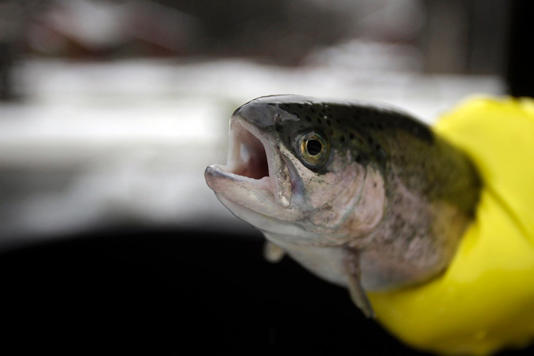
Researchers hope the findings can help improve the welfare of up to 2.2 trillion wild and 171 billion farmed fish killed every year for human consumption.
In the study, scientists focussed on a common method of slaughtering fish called air asphyxiation. Animal welfare groups have flagged this method, which involves depriving fish of oxygen, as inhumane given the significant amount of time they take to lose consciousness in this process.
Researchers found that rainbow trout endured an average of 10 minutes of intense pain during this process, with estimates ranging from 2 to 22 minutes depending on factors like fish size and water temperature.
“Based on a review of research on stress responses during asphyxiation, we estimate 10 min of moderate to intense pain per trout,” they wrote.
The study cautioned that chilling fish in ice slurry after being caught could cause an even greater burden of pain. “By slowing down metabolic processes, lower temperatures may extend the time to unconsciousness,” it noted.
Looking at other interventions, researchers found that if implemented properly, electrical stunning could avert 1 to 20 hours of moderate to extreme pain experienced by fish for every US dollar spent on slaughtering them.
Another method called percussive stunning, which involves dealing a blow to an animal’s head with special devices, could kill fish quickly without much suffering but faced “implementation challenges”, researchers said, adding that other pre-slaughter practices like fish crowding during transport might cause even greater suffering.
The study also highlights the use of the Welfare Footprint Framework, a method to quantify animal welfare by estimating the total time they spend in various states of suffering or well-being.
It uses time-based values to subjective experiences for direct comparisons between different animal welfare interventions.
“The Welfare Footprint Framework provides a rigorous and transparent evidence-based approach to measuring animal welfare and enables informed decisions about where to allocate resources for the greatest impact,” Wladimir Alonso, an author of the study, said.
“These findings provide transparent, evidence-grounded and comparable metrics to guide cost–benefit decisions and inform slaughter regulations and practices in trout.”
The Independent is the world’s most free-thinking news brand, providing global news, commentary and analysis for the independently-minded. We have grown a huge, global readership of independently minded individuals, who value our trusted voice and commitment to positive change. Our mission, making change happen, has never been as important as it is today.




 The Independent

 Exposing the Big Game