BY DAWSON WHITEMARCH 21, 2021 07:46 AM,UPDATED MARCH 21, 2021 08:41 AM
Three hunters must pay major fines after taking mallards and Canada geese over the legal limit, Michigan officials say.BOB BRAWDYTRI-CITY HERALD
Three hunters in Michigan are facing thousands in fines afterusing a bag of cornto bait and poach waterfowl, the state Department of Natural Resources said.
On Dec. 6, the agency received a tip to its poaching hotline that some hunters in Macomb County were shooting waterfowl over the legal limit, the DNR said Thursday in a news release.
Two conservation officers went to the area and heard gunshots before finding three men — identified as Richard Schaller, 52, Robert Kucinski, 49, and Timothy Morris, 58 — and watching them shoot several Canada geese, according to the agency.TOP ARTICLESSKIP ADGirl rescued from Tacoma house fire dies of injuries
I am writing in response to a recent guest columnist piece by Patrick Connelly entitled “Wrong for people, wrong for animals, wrong for science.” Unfortunately it is full of wrong statements.
First off, wildlife management trapping businesses will not be affected by SD1029 /HD 1592: An Act Prohibiting the Sale of Fur Products in Massachusetts. This bill does not interfere at all with trapping or hunting in the commonwealth.
Second, images of fur farms are not inaccurate and disingenuous. I have yet to hear of or see pictures of a “humane” large-scale fur farm.
Fur is a horribly cruel industry and a potential source of future pandemics. SD1029 /HD 1592 would merely prevent the sale of real fur, 90% of which comes from factory fur farms where thousands of animals are kept in cramped, unsanitary conditions for the duration of their lives, unable to ever participate in behaviors natural to their species.
Self-mutilation and cannibalism are common outcomes of the emotional distress caused by this confinement. But their deaths are even crueler since the cheapest methods are used, including anal electrocution, gassing, and clubbing. There are even numerous documented instances of animals being skinned alive while incapacitated on fur farms in China, from where the majority of fur sold in the U.S. is imported.
Further, mink have tested positive for COVID on fur farms across Europe and several states in the U.S. The mink, in turn, have transmitted new COVID variants back to humans, which have now spread across the world, resulting in mass cullings of tens of millions of mink and potentially undermining vaccine effectiveness. Multiple fur farming bans have already been passed in Europe, and now Massachusetts can aid in this fight by banning new fur sales.
It is time to put an end to these reservoirs of disease and cruelty. Please urge your state legislators to support this bill.
Controversial legislation to ban most trapping on public lands in New Mexico passed the state House Thursday evening by a single vote.
House members approved the bill 35-34. Last week the bill passed the Senate 23-16. It now heads to the desk of Gov. Michelle Lujan Grisham for her signature.
The Wildlife Conservation and Public Safety Act, Senate Bill 32 (SB 32), makes it a criminal misdemeanor “to use a trap, snare, or poison wildlife for the purposes of capturing, injuring or killing an animal on public land,” the legislation states.
Hunting and trapping on private or tribal land would be allowed to continue. Exemptions to the prohibition on state and federal public land also would be in place for bonafide scientific research, rodent control, and trapping by an enrolled member of a federally recognized tribe…
Russia has confirmed the first case of human infection with the avian influenza A(H5N8) virus in the world, a Russian sanitary official announced on Saturday
Russia has confirmed the first case of human infection with the avian influenza A(H5N8) virus in the world, a Russian sanitary official announced on Saturday.
Investing in R&D for identifying new diseases and vaccine development remains the top priority. Vaccines have been used in avian influenza (AI) control programs to prevent, manage, or eradicate AI from poultry and other birds. It has been observed that the best protection is produced from the humoral response against the hemagglutinin (HA) protein.
March 22, 2021, 07:37 IShttps://health.economictimes.indiatimes.com/news/policy/vaccination-is-and-will-continue-to-be-the-most-important-intervention-for-prevention-of-infectious-disease-dr-badri-narayan-patnaik-sanofi-pasteur/81560563T
Shahid Akhter, editor, ETHealthworld, spoke toDr. Badri Narayan Patnaik, Head Medical – India and South Asia at Sanofi Pasteur, to know more about the vaccine priorities during the pandemic.
As the world fights pandemic- in order to be prepared for a health crisis, should priority be given to R&D for identifying new diseases and vaccine development?
Over the past 35 years, around 30 new infectious agents affecting humans have emerged. Most of these infective viruses are zoonotic and their…
Interior water ocean worlds like Saturn’s moon, Enceladus, are prevalent throughout the universe. New research from Southwest Research Institute suggests that layers of rock and ice may shield life within such oceans, protecting it from impacts, radiation and other hazards and concealing it from detection. Layers of rock and ice may therefore shield and protect life residing in them, and also sequester them from threats and detection. Credit: NASA/JPL-Caltech/Southwest Research Institute
Layers of ice and rock obviate the need for “habitable zone” and shield life against threats.
SwRI researcher theorizes worlds with underground oceans may be more conducive to life than worlds with surface oceans like Earth.
Delegates vote 54%-46% against policy change request
Leader O’Toole has sought ambitious climate change agenda
Erin O’Toole speaks in Ottawa.Photograph: Dave Chan/AFP/Getty Images
ReutersinTorontoSat 20 Mar 2021 14.19 EDT
2,766
Canada’s main opposition Conservative party members have voted down a proposal to recognize the climate crisis as real, in a blow to their new leader’s efforts to embrace environmentally friendly policies before a likely federal election this year.
The rejected motion included the willingness to act against climate risks and to make highly polluting businesses take more responsibility to reduce greenhouse gas emissions.
On Friday, the Conservative leader, Erin O’Toole, urged party members to rally around an ambitious climate agenda, in order to avoid a defeat at the hands of Liberals.Advertisementhttps://c0c269f1ed7961379105249bcf2bb65a.safeframe.googlesyndication.com/safeframe/1-0-37/html/container.html
He asked members to be open to new ideas if they were serious about toppling the Liberals in the next election, even if that went against the party’s…
Burgers, bacon, steaks, and other meat products have come under scrutiny in recent years due to their impact on health, sustainability, and social justice issues. The number of companies working on meat alternatives in the U.S. is growing. Half of U.S. consumers under the age of 50 have already tried a plant-based meat product. Yet meat consumption in the U.S. is on the rise. As of 2017, America had the second-highest meat consumption in the world, surpassed only by Hong Kong. How much meat do Americans eat, and what are the impacts of their meat consumption?
How Much Meat Is Consumed in the U.S.?
Americans consume around 274 pounds of meat per year on average, not accounting for seafood and fish, or individual food waste. The total amount of meat consumed in the U.S. has increased by 40 percent since 1961. In 2017, the U.S. Department of Agriculture (USDA) reported that Americans are exceeding the amount of meat recommended by national dietary guidelines, although women in the U.S. eat about a third less meat than men, and around 42 percent less beef.
Beef and Veal
The U.S. has the world’s second-highest consumption of beef and buffalo after Argentina. In 2017 Americans consumed 81.74 pounds of beef and buffalo per capita, a 37 percent decrease from 1976, when Americans had reached a record consumption of 129.65 pounds per capita. In the late 1970s beef consumption started falling, due to scientific findings concerning the health impacts of saturated fats. In 2013 beef and buffalo consumption in the U.S. had dropped to under 80 pounds per capita, but then started rising again.
Pork
Pork consumption in the U.S. fluctuated between 72.64 and 53.19 pounds per capita between 1961 and 2017. The latest data shows that Americans eat an annual 66.18 pounds of pork per capita. The U.S. Census data and Simmons National Consumer Survey (NHCS) found that 268 million Americans ate bacon in 2020, with over 16 million eating five pounds of bacon or more during the year.
Poultry
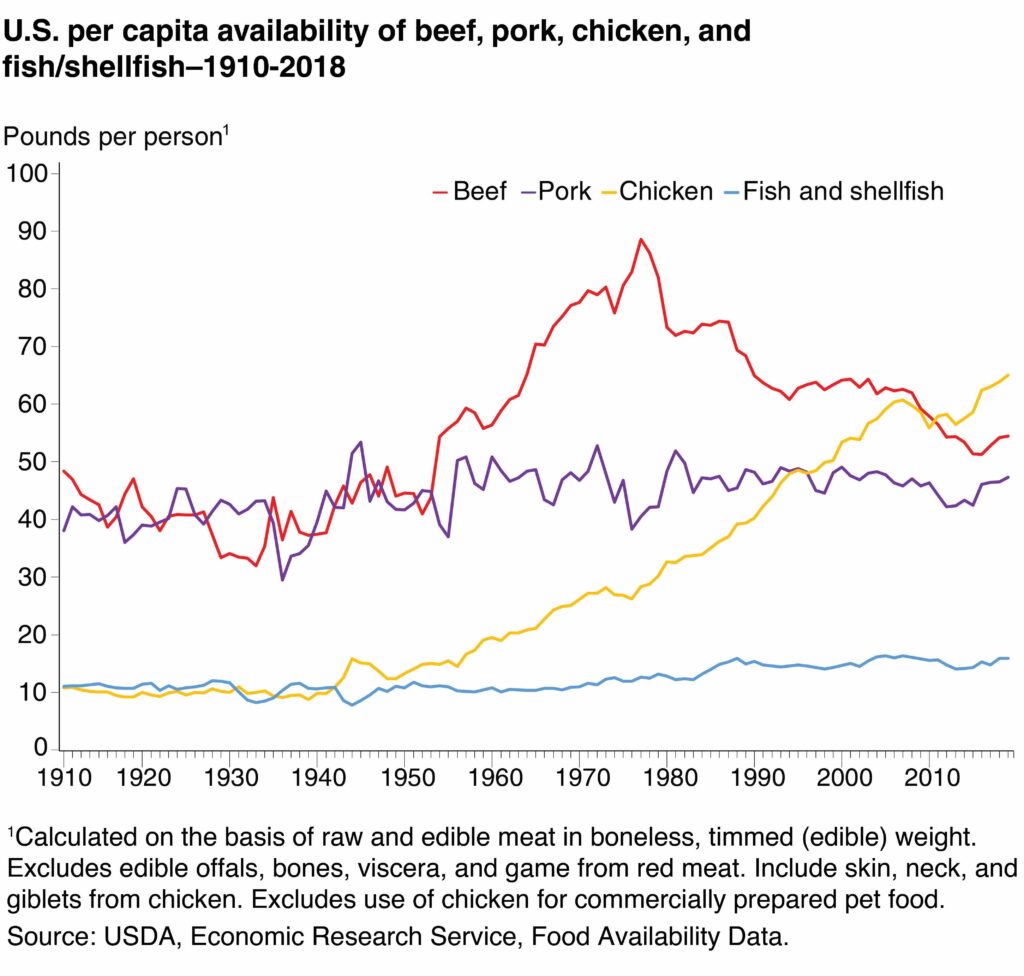
Poultry is defined as domestic fowl, including chickens, turkeys, and geese. In 2017 Americans consumed a record 122.75 pounds of poultry per capita. According to the USDA, chicken consumption has increased by 540 percent since 1910, from around 10.1 pounds per capita to 65.2 pounds in 2018. Since 1961 the consumption of poultry has more than tripled.
The growing popularity of chicken in the U.S. is linked to beef falling out of favor. For decades, consumers have been choosing chicken over beef due to health and environmental concerns; however, eating farmed chickens has also been shown to be problematic for several reasons.
Lamb
Since the 1960s the consumption of lamb and mutton in the U.S. has fallen from nearly five pounds to about one pound per capita. Almost 20 percent of lamb consumption in the U.S. occurs during the spring holidays. Urban consumers are more likely to eat lamb than consumers based in rural areas.
What Is the Most Consumed Meat in the U.S.?
Over the last three decades, chicken overtook beef and pork to become the most commonly consumed meat product in the U.S. In 2020 Americans ate 96.4 pounds of broiler chickens per capita. According to data by the USDA and Economic Research Service, Americans are expected to eat 101.1 pounds of broiler chickens per capita by 2030.
Is Meat Consumption Increasing or Decreasing?
Meat consumption in the U.S. increased by 40 percent between 1961 and 2017. Globally, meat consumption increased by 58 percent between 1998 and 2018.
The number of Americans identifying as vegetarians has remained roughly the same at 6 percent since 1999, according to Gallup surveys. The number of self-identifying vegans increased from just 2 to 3 percent between 2012 and 2018. Nonetheless, and despite projections of growing meat consumption, 23 percent of Americans reported reducing the amount of meat they ate in 2019. The number of U.S. consumers who have tried plant-based alternatives has also risen to 70 percent.
Investment firm UBS predicts that annual sales in the plant-based meat market will grow from $4.6 billion in 2018 to $85 billion in 2030. According to global consultancy AT Kearney, 60 percent of meat eaten globally in 2040 will be from plant-based or lab-grown alternatives. In response to changing consumer preferences, traditional meat producers are increasingly adding plant-based alternatives to their product ranges. A 2021 study found that the average American believes that the U.S. could go completely plant-based by 2039. Yet when faced with falling local demand, some meat companies instead resort to increasing their exports to countries with rising meat consumption levels. In September 2020, for example, the U.S. pork industry exported a record 29 percent of total pork production to buyers outside the U.S.
How Much Meat Is Wasted in the U.S.?
According to a 2020 study, Americans waste around a third of the food they purchase, costing the average household $1,866 per year, or $240 billion for the whole population. Fresh meat requires processing, and is a highly perishable product, which increases the likelihood of waste.
The USDA estimates that only half of the body of a slaughtered cow, pig, lamb, chicken, or turkey ends up being eaten. Beef, for example, can be wasted as it moves from farm to retail due to damage during packaging, inadequate storage, or when inspectors reject it for safety reasons. Within retail, packaging failures, color changes, spoilage, and overstocking can all cause further loss. At the consumer level beef can be wasted due to inadequate storage, spoilage, recalls, and when consumers prepare more beef than they ultimately eat.
Taking the number of farmed animals who die before slaughter into account, the amount of meat wasted in the U.S. is even higher. According to Iowa State University, an estimated 1 out of 3 pigs born into the U.S. pork industry dies before slaughter.
Meat waste entails wasting the land, feed, water, labor, antibiotics, and equipment needed to raise animals from birth to slaughter. Farmed animals only convert 2 to 13 percent of the calories they eat into edible body parts. Poultry wastes 77 percent of feed calories, pork 91 percent, lamb and mutton 94 percent, and beef 98 percent.
When we recognize the resource-intensiveness of animal agriculture, we can see meat consumption itself as a form of food waste.
What Would Happen If Everyone Ate Less Meat?
Animal agriculture, including meat production, is responsible for at least 37 percent of all greenhouse gas emissions. Increasing global meat consumption pushes the planet closer to dangerous limits. Supposing that the whole world adopted the U.S. diet, 138 percent of the world’s habitable land, more land than is available, would be required to meet human dietary needs. If the world instead adopted the more plant-based diet(s) of India, the area of habitable land currently used for agriculture could be more than halved, from 50 to 22 percent.https://ourworldindata.org/grapher/dietary-land-use-vs-beef-consumption
Plant protein can replace animal protein to meet human dietary needs. Instead of monocultures used to grow animal feed, farmers could repurpose land to grow more diverse crops, such as vegetables and pulses. Pulses have nitrogen-fixing properties, are a healthy source of protein with a long shelf life, and can significantly improve soil fertility and reduce food loss in agriculture.
Eating Less Meat
Meat consumption in the U.S. remains high, despite the increasingly urgent need to change global eating habits. Animal products have a significantly larger environmental footprint than plant-based products. According to scientists, a plant-based diet is “probably the single biggest way to reduce your impact on planet Earth.”
Since U.S. citizens have one of the highest rates of meat consumption globally, more people eating a plant-based diet is critical to reducing the country’s emissions, and transitioning towards a more sustainable system of food production.Read More
Tens of thousands of bobcats are hunted and trapped every year in 39 states.Photo by National Geographic Image Collection/Alamy Stock Photo
Each year, trophy hunters and trappers kill around 2,000 of Colorado’s bobcats, either for fun or to sell their furs overseas, usually in Russian and Chinese markets. The animals are hunted down with radio-collared dogs and shot at point-blank range, or they are trapped in cage traps with no protection from the weather nor food or water. Some die or are seriously injured as they try to escape.
Most Coloradans do not approve of such wanton and inhumane killing of their iconic native wildlife. As far back as 1996, Colorado voters spoke out unequivocally against trapping, by passing Amendment 14, an initiative that restricts traps and poisons on public lands. The number of Colorado residents who oppose cruel methods of killing wildlife has…
PLEASE CONTACT THE LEGISLATORS BELOW NOW! OPPOSE PART X OF BUDGET BILL S2508B PART X OF THE GOVERNOR’S BUDGET BILL S2508B STATES: expands provisions of law relating to hunting; authorizes a holder of a license who is twelve, thirteen, fourteen or fifteen to hunt wildlife; removes limiting provisions of law related to hunting with a crossbow (Part X) IF LEFT IN THE BUDGET BILL, THE HUNTING AGE WILL BE LOWERED TO 12 FROM 14 FOR DEER AND BEARS, 12 YEAR OLDS WILL BE ABLE TO USE CROSSBOWS TO KILL DEER AND BEARS, ALL BENEFICIAL TO THE FIREARMS AND BOW AND ARROW INDUSTRIES – BUT DETRIMENTAL TO THE PUBLIC AND ENVIRONMENT. Meet crossbows – with such names as “Killer Instinct”! Please call and/or email the following legislators to voice your opposition to Part X in Gov. Cuomo’s Budget Bill S2508B: Majority Leader Andrea Stewart-Cousins 518-455-2585 scousins@nysenate.gov Senator Liz Krueger, Chair Finance…


 Shahid Akhter, editor, ETHealthworld, spoke toDr. Badri Narayan Patnaik, Head Medical – India and South Asia at Sanofi Pasteur, to know more about the vaccine priorities during the pandemic.