As part of a “Week of Action” targeting Canada Goose over its use of coyote fur and goose feathers, People for the Ethical Treatment of Animals (PETA) staged protests at the company’s flagship store in Soho and at the department store Saks Fifth Avenue, which sells Canada Goose apparel.https://www.youtube.com/embed/ywdwdd6JEso?feature=oembed
In a statement to the media, PETA wrote, “Cruelty can be found in every stitch of Canada Goose’s jackets and other clothing items. Coyotes used for the company’s fur trim can suffer in painful steel traps indefinitely before they’re killed. Mothers desperate to get back to their pups have attempted to chew off their own limbs to escape. Ducks and geese suffer for down as well—no matter their origin. Birds used for their down are inevitably sent to the slaughterhouse, where standard practice is to hang them upside down, stun them, and then slit their throats.”
Canada Goose traps and kills coyotes for their fur and plucks and slaughters geese for their feathers.
On April 22, 2020, the New York Times reported that Canada Goose would stop buying fur from trappers starting in 2022. It would instead use reclaimed fur, which the company describes as fur that “already exists in its supply chain and the marketplace.” As part of its plan, Canada Goose said it would buy back the fur trim from its customers’ coats and recycle it. In a public statement, the company said that its decision was made to reduce the company’s carbon footprint, not in response to the demands of PETA and other animal rights groups.
In April 2020, the New York Times reported that Canada Goose would stop selling “new” fur in 2020.
The announcement, which was met with skepticism and confusion by the animal rights community, did not stop the protests at Canada Goose. After the initial pandemic lockdown in NYC, grass roots animal rights groups resumed protesting at the store. In October 2020, the Coaltion to Abolish the Fur Trade (CAFT) began protesting at Saks Fifth Avenue over its refusal to stop selling Canada Goose and other other fashion labels that use real animal fur.
Animal rights activists with PETA protest at the Canada Goose store in NYC
“Hundreds of major retailers, including Paragon Sports and KITH in NYC, have announced that they would stop selling fur,” said Rachel Levy, an organizer of the Week of Action Protests. “Canada Goose, however, has stated that it will continue to sell it. In 2021, when so many fashionable, functional alternatives exist, no clothing manufacturer should be using real fur.”
Animal rights activists with PETA and the Coalition to Abolish the Fur Trade (CAFT) stage an anti-fur protest at Saks Fifth Avenue
PETA stops traffic in front of Saks Fifth Ave. as part of an anti-fur protest targeting the store.
Updated 8:12 PM ET, Tue March 9, 2021This aerial picture shows people rowing a raft over a flooded road in Jakarta on February 20, 2021, following heavy overnight rains. The combination of so many people and the multitude of rivers has made this city especially prone to relative sea level rise.
(CNN)Coastal communities are experiencing sea level rise four times worse than global water rise, according to a new study released Monday.Groundwater pumping, extraction of materials from the ground and sediment production are all happening near the coasts and that is causing the land to actually sink — compounding the effects of a rising sea level.It is no coincidence that these are the same locations where people live, worsening the impacts and increasing the vulnerability.Many of the largest, most populated cities in the world are built along the deltas of major…
Sophie LewisWed, March 10, 2021, 7:06 AM·2 min read
A fireball traveling at 42,000 miles per hour streaked across the night sky above Vermont on Sunday night, creating a spectacular light show. The meteor “fragmented so violently,” it shook buildings across the state and produced a loud boom,NASA said.
NASA said onFacebookthat over 100 eyewitnesses reported details of the meteor in Vermont around 5:38 p.m. ET. It first appeared about 52 miles above Mount Mansfield State Forest, moving 33 miles through the upper atmosphere, before burning up 33 miles above Beach Hill, in Orleans County.
Gray wolves were removed from the endangered species list less than four months ago. But now, activists say their populations, as well as other endangered wildlife in Montana, may be at risk as the state considers a series of legislative bills that set out to expand trapping and hunting regulations.
Several bills are currently being weighed by legislators that would impact wolves and grizzly bears, both of which have historically struggled to maintain populations in the area.
Mar. 10—SANTA FE — The state Senate late Tuesday passed a bill that would ban traps, snares and wildlife poisons on public land in New Mexico — legislation supporters said would help prevent animal cruelty.
The measure, Senate Bill 32, will head next to the House with just 11 days left in the session.
Democratic Sens. Roberto “Bobby” Gonzales of Ranchos de Taos and Brenda McKenna of Corrales said the ban would protect dogs and other pets from strangulation or catastrophic injuries.
At least nine dogs have been caught in privately set traps or snares on public land in New Mexico this trapping season, according to Animal Protection Voters.
“Imagine trying to free a pet or yourself under these highly stressful and painful circumstances,” McKenna said.
Opponents of the ban offered their own gruesome examples, arguing that…
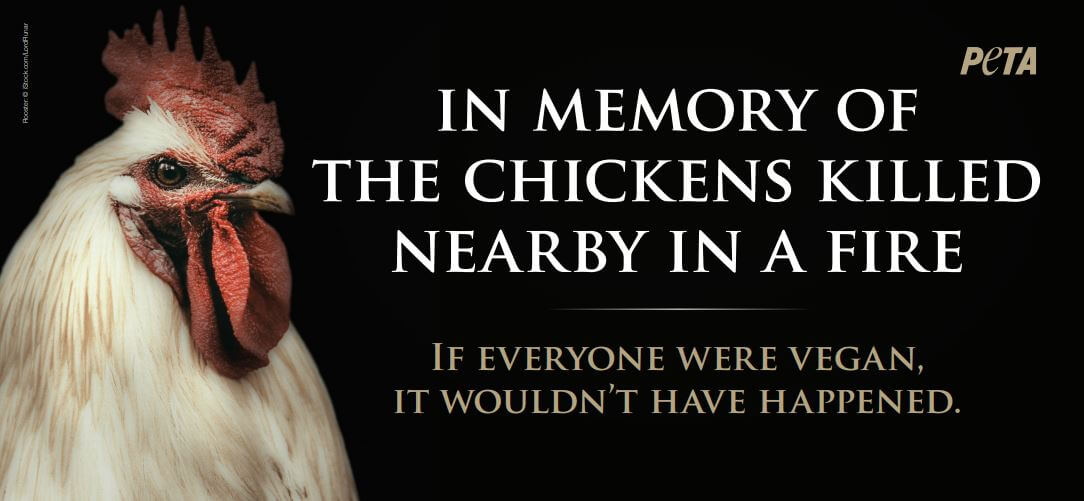
Arlington, Ariz. – In honor of the more than 165,000 birds who burned to death when two massive sheds holding chickens at a facility owned by Hickman’s Family Farms—Arizona’s largest egg producer—were destroyed in a fire on Saturday, PETA plans to place a billboard in the area pointing out who’s responsible for their deaths: everyone who still buys eggs.
“Each one of these hens was an individual who surely felt pain and fear as smoke and flames engulfed her,” says PETA Executive Vice President Tracy Reiman. “PETA urges everyone to prevent birds from being crammed into barns by the tens of thousands in the first place by taking the easy step of going vegan.”
Hens used for egg production are confined to cramped barns, where each bird has no more than a square foot of space. Few farms bother to go to the trouble or expense of installing smoke detectors or fire alarm systems, as they consider the lives of the birds to have such little value. When hens’ bodies wear out and they’re no longer considered profitable, egg producers stuff them into metal boxes and crudely gas them with carbon dioxide, which is distressing and painful—or send them to slaughterhouses, where workers cut their throats, often while they’re still conscious, and scald many to death in defeathering tanks.
PETA notes that going vegan spares animals immense suffering and helps prevent future epidemics and pandemics. SARS, swine flu, bird flu, and COVID-19 all stemmed from confining and killing animals for food.
PETA—whose motto reads, in part, that “animals are not ours to eat”—opposes speciesism, the human-supremacist worldview that other species are nothing more than commodities. For more information, please visit PETA.org.
Concerns over carbon emissions and food crises are fuelling a move away from meat consumption as a symbol of wealth
An advertisement for plant-based products at a KFC store in Hangzhou. International and domestic chains are expanding their range of meat alternatives. Photograph: VCG/Getty Images
Crystal ReidTue 9 Mar 2021 05.07 EST
1,664
The window of a KFC in the eastern Chinese city of Hangzhou hosts the image of a familiar mound of golden nuggets. But this overflowing bucket sporting Colonel Sanders’ smiling face is slightly different. The bucket is green and the nuggets within it are completely meat free.
Over the last couple of years, after many years of rising meat consumption by China’s expanding middle classes for whom eating pork every day was a luxurious sign of new financial comforts, the green shoots of a vegan meat revolution have begun to sprout. Although China still consumes 28% of the world’s meat, including half of all pork, and boasts a meat market valued at $86bn (£62bn), plant-based meat substitutes are slowing carving out a place for themselves among a new generation of consumers increasingly alarmed by food crises such as coronavirus and African swine fever.Advertisement
China’s most cosmopolitan cities are now home to social media groups, websites and communities dedicated to meat-free lifestyles. VegeRadar, for example, has compiled comprehensive maps of vegetarian and vegan restaurants all across China. According to a report by the Good Food Institute, China’s plant-based meat market was estimated at 6.1bn yuan (£675m) in 2018 and projected to grow between 20 and 25% annually.
Yun Fanwei, a 25-year-old student from Shanghai, is one of a new breed of vegetarians hungry for more options. “I buy some of these fake meat products and a lot of them are pretty good. They don’t necessarily taste like meat, but it makes a nice change from tofu,” she said.
Eating meat has been closely connected with the growing affluence of China. In the 1960s, the average Chinese person consumed 5kg of meat a year. This had shot up to 20kg by the time of former leader Deng Xiaoping’s “reform and opening” of the late 1970s, and to 48kg by 2015.
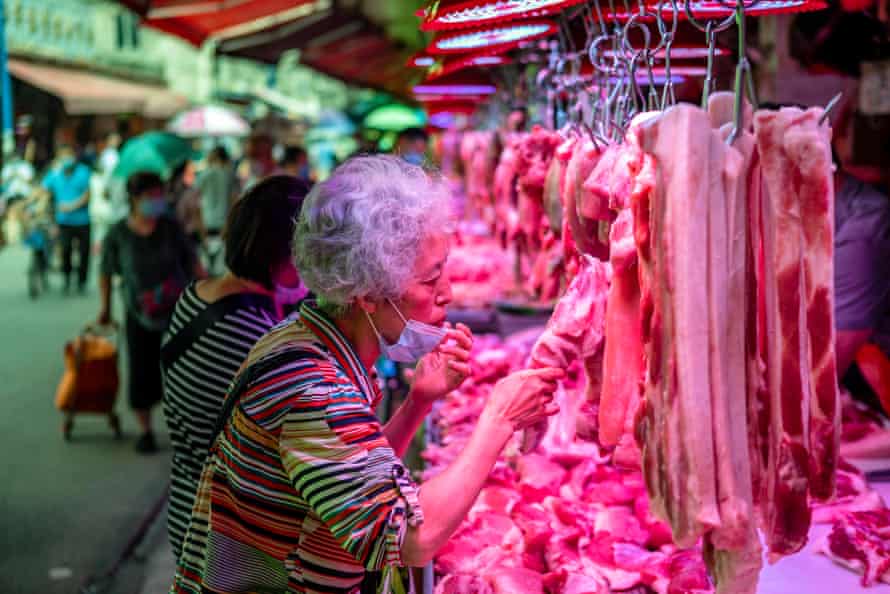
A woman smells meat before buying it at Xihua farmer’s market in Guangzhou, Guangdong province, China. After the coronavirus outbreak China brought in new regulations on the trade and consumption of wild animals. Photograph: Alex Plavevski/EPA
But in 2016, as part of its pledge to bring down carbon emissions, the Chinese government outlined a plan to cut the country’s meat intake by 50%. It was a radical move, and so far very few other governments around the world have included meat consumption in their carbon-reduction plans.
The new guidelines, which called on citizens to consume just 40-75g of meat a day, were promoted with a series of public information adverts featuring the actor Arnold Schwarzenegger and director James Cameron. Since then there have been few other concrete steps taken, other than the president, Xi Jinping, last August launching a “clean plate campaign” aimed at reducing the “shocking and distressing” 40% of food that goes straight from Chinese dinner tables into the bin. Some commentators speculated that asking Chinese citizens to reduce their meat consumption was felt to be particularly unpopular.
But alternative proteins are seen as a possible route forwards. Last year at the annual “two sessions” parliament, Sun Baoguo, a member of the Chinese People’s Political Consultative Conference, called for more investment in and regulation and promotion of artificial meat.
Some of the biggest international chains operating in China have been quick to bet on the growth of alternative meats. KFC is now selling vegan chicken nuggets, Burger King is offering an Impossible Whopper, and Starbucks is serving Beyond Meat pastas, salads and wraps.
But domestic companies are setting up shop too, betting that state backing will come soon, not least because the government may see alternative proteins as a way to let citizens continue to have the “luxury” of meat while also moving towards its carbon-reduction goals. That optimism has led to several Chinese competitors entering the market alongside international powerhouses such as Cargill, Unilever and Nestlé, as well as the vegan meat poster-children Impossible and Beyond.
Packets of plant-based OmniPork on sale at a Green Common plant-based grocery store in Hong Kong. Photograph: Getty Images
OmniFoods, which launched in Hong Kong in 2018, is one of a band of regional startups jostling for market share, having recently opened a multi-brand vegan shop and restaurant in Shanghai and secured its signature product, OmniPork, in McDonald’s in Hong Kong and Aldi, White Castle and Starbucks on the mainland. The company, which plans to operate in 13 countries this year, also just completed its UK soft launch for Veganuary, during which OmniPork was turned into everything from scotch eggs to Korean bibimbap at participating restaurants.Advertisement
The OmniFoods founder, David Yeung, hopes the opening of a China-based factory next year will help bring down the price of his products. Plant-based proteins currently cost much more than their meat counterparts, a major barrier when it comes to getting China’s notoriously thrifty shoppers to make the switch. “Obviously minimising logistics and middle parties and creating economies of scale will have a big impact on the value chain. As we cut these expenses in China, we foresee a significant price drop,” Yeung said.
Shanghai-based Z-Rou produces a plant-based mince substitute which is already in the canteens of some of China’s top international schools, hospitals and businesses. Its CEO, Franklin Yao, is targeting opinion leaders and middle-class consumers who can afford to make conscious choices. “They would even be willing to pay more as they know they’re getting a healthier product that’s helping ensure the future of the planet their children are inheriting. That’s priceless.”
A chef makes spaghetti bolognese with plant-based OmniPork as David Yeung, the co-founder and co-chief executive officer of Green Monday, looks on at the Kind Kitchen restaurant in Hong Kong. Photograph: Paul Yeung/Bloomberg/Getty Images
Other China players include Zhenmeat, which makes plant-based beef, pork and crayfish, and Starfield, whose seaweed-based mince alternative has been turned into dishes at some of China’s leading restaurant chains.
Yao admits the industry is still very small in China but he thinks meat-free substitutes will become mainstream very soon. “Chinese consumers are actively looking for more sustainable products. While the link between meat and the environment is still weak among the majority of the population, the interest is there and China learns fast.”
But weaning people off meat may prove harder than some of these companies would like to think. “I’ve tried a vegetarian braised pork dish before but it’s not the same as real meat,” said 64-year-old retiree Bao Gege.
A pair of new studies show how birds improve our wellbeing, adding to a growing body of evidence that avians are an antidote to our despair.By Julia ZarankinContributor, Audubon magazineJanuary 05, 2021
Research was centered on latitudes found between 20 degrees north, a line that cuts through Mexico, Libya and India, to 20 degrees south.Photograph: Noah Seelam/AFP/Getty Images
Should governments fail to curb global heating to 1.5C above the pre-industrial era, areas in the tropical band that stretches either side of the equator risk changing into a new environment that will hit “the limit of human adaptation”, the…
The Arctic Ocean saw February temperatures that were warmer than the past two decades’ average, according to areport released Mondayby Europe’s Copernicus Climate Change Service.
Worldwide, the month’s temperatures were close to the average for the past 30 years but included the coldest anomaly in nearly six years, according to the organization’s report.
“Conditions were much colder than its 1991-2020 average over much of Russia and North America, but much warmer than average over parts of the Arctic and in a band stretching eastward from north-western Africa and southern Europe to China,” the report states. “Temperature for Europe as a whole, for February 2021, was also close to the 1991-2020 average, though parts of Europe saw considerable variation in temperatures during the month.”
Copernicus further found that the extent of sea ice…


 This aerial picture shows people rowing a raft over a flooded road in Jakarta on February 20, 2021, following heavy overnight rains. The combination of so many people and the multitude of rivers has made this city especially prone to relative sea level rise.