A photo taken on August 25, 2014 shows a crater on the Yamal Peninsula, northern Siberia.
The Siberian tundra is still out here exploding. A newstudyfrom the Woodwell Climate Research Center has identified three new craters in the region’s increasingly volatile permafrost, and the climate crisis is to blame.
Researchers have been seeing giant holes form in western Siberia’s Yamal Peninsula for years. The first, discovered by workers back in2014, measured 262 feet (80 meters) in diameter. Since then, scientists have found another six craters on Yamal and the nearby Gydan peninsula, most recentlydiscovering a crateras deep as half a football field last year. While researchers have suspected explosive methane gas has welled up into the tundra as it thaws and caused the explosions, it’s been an area of active research.
The question is, why aren’t we hearing about it in the media?
I’ve been posting a lot of articles lately on the record-breaking cold we’re getting in the Lower 48 thanks to the Polar Vortex. Fatal 100 car pileups on icy highways in Texas aren’t the norm for states that far South. But while reporting the facts of newsworthy fatalities, our nations news sources have been remiss in making any mention of a climate change connection.
It’s almost like a conspiracy to make our new president look better than the last one, so we won’t risk adding a line about the climate connection while there’s an impeachment to cover. Besides, people would like to think that the climate crisis was solved the minute they voted Biden in and Trump out.
It really wouldn’t have taken much time or ink to inform folks about the climate change link to our current Polar Vortex temperatures. I simply googled Climate Change + Polar Vortex and came up with:
“How climate change is affecting the polar vortex?
How Is the Polar Vortex Affected by Climate Change? … The change is warming higher latitudes and reducing the temperature difference between the warmer mid-latitude and polar regions. This weakens and destabilizes the polar jet stream, causing it to dip into lower latitudes, bringing polar air farther south.”
31.01.2019 | 4:56pmEXTREME WEATHERQ&A: How is Arctic warming linked to the ‘polar vortex’ and other extreme weather?
The past week has seen some brutal weather hitting the US and Canada. With cold Arctic air plunging south down to the US midwest, six states have seen temperatures lower than the south pole and at least eight people have died due to the extreme cold.
The UK, too, is braced for snow this week, but nothing close to the scale seen in the US.
The very cold weather prompted President Trump to tweet: “What the hell is going on with Global Waming? [sic].” This followed an earlier tweet that it “wouldn’t be bad to have a little of that good old fashioned Global Warming right now!”
The cold, snowy weather has also been accompanied by a flurry of stories about the “polar vortex” and how it can bring extreme weather to the northern hemisphere mid-latitude regions of North America, Europe and Asia. But that is not the only way that the Arctic can affect conditions further south.
Over the past decade or so, a growing body of research has proposed ways in which rapid Arctic warming can lead to harsh winters, summer heatwaves and even floods and droughts across the mid-latitudes.
Some scientists say that climate change and Arctic sea ice loss are the root cause of these events, but others are more circumspect.
In this detailed Q&A, Carbon Brief speaks to scientists about the potential connections between Arctic warming and extreme weather across the mid-latitudes, what those theories look like, and how the evidence measures up.
The Arctic is warming more than twice as quickly than the global surface average. This phenomenon is known as “Arctic amplification”. In part, this stems from the rapid loss of sea ice cover in the region. As Arctic sea ice diminishes, energy from the sun that would have been reflected away by the bright white ice is instead absorbed by the ocean, causing further warming. (Declining snow cover over Arctic land areas has the same effect.)
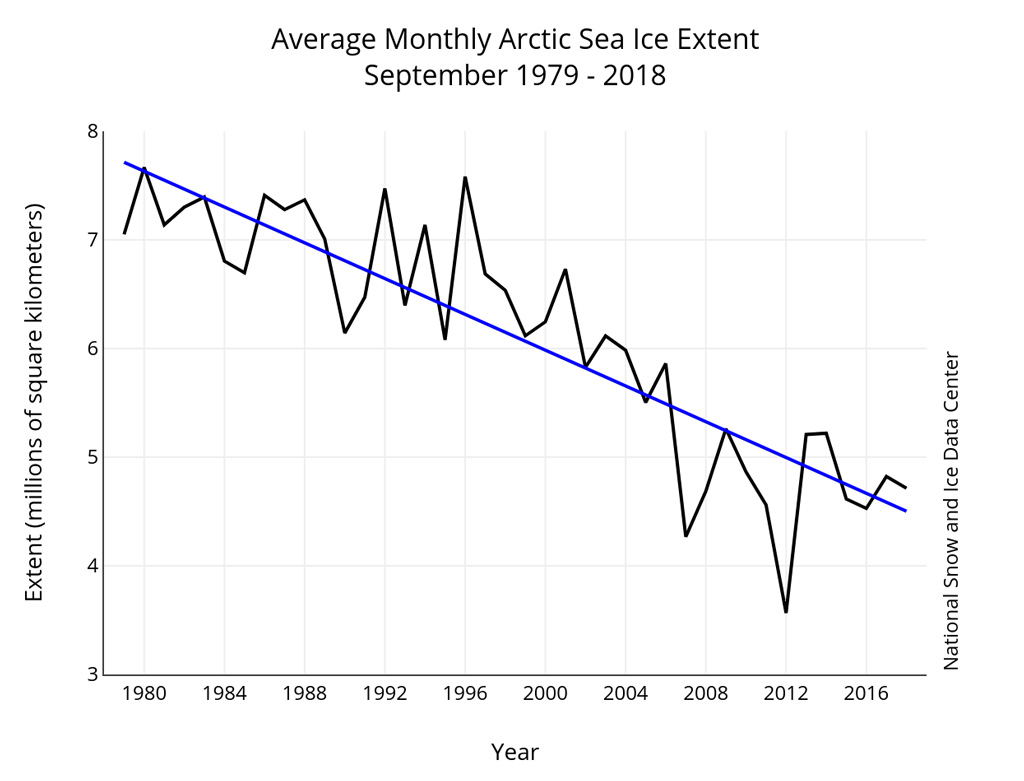
Late summer and early autumn have seen the largest declines in Arctic sea ice cover. Average September sea ice extent, for example, has decreased by around 13% per decade since 1979.
Average September Arctic sea ice extent from 1979 to 2018. Black line shows monthly average for each year; blue line shows the trend. Source: NSIDC
Arctic amplification is also caused by temperature feedbacks. As the Earth’s surface warms, it emits more energy back to space. But less energy is radiated back from the Arctic compared with lower latitudes, meaning the region warms more quickly.
Recent research has suggested that these rapid changes in the Arctic could be having knock-on impacts further south. While a warmer Arctic Ocean further inhibits sea ice growth, it also generates warmer and more moist air masses over the Arctic and nearby continents. A warming Arctic also reduces the temperature difference with the mid-latitudes, which has consequences for circulation patterns in the atmosphere (more on this later).
The theory goes that these changes contribute to an increase in unusual and extreme weather across the North America, Europe and Asia.
This is CNBC’s live blog covering all the latest news on thecoronavirus outbreak. This blog will be updated throughout the day as the news breaks.
The number of new Covid-19 cases in the U.S. is declining to levels last seen before the Thanksgiving and Christmas holidays. In an effort to pick up the pace of vaccinations, President Joe Biden announced Thursday his administrationfinalized deals for another 200 million vaccine doses, bringing the U.S. total to 600 million. The Centers for Disease Control and Prevention has said about 34.7 million people have received at least their first vaccine dose and of that amount, 11.2 million people have received both doses of the two-shot regiment.
LAKE PROVIDENCE, La. (KNOE) – A retired Louisiana State Police trooper has died in a fishing accident in West Carroll Parish.
Robert Patrick was found dead on Feb. 10 near a boat ramp at the Hogue Island Hunting Club near Lake Providence. His phone was nearby and his vehicle was still running. Officials say his boat trailer was in the water.
No foul play is suspected.
According to a post on Oak Grove’s Facebook page, Patrick began his career in law enforcement with the West Carroll Parish Sheriff’s Office before going to the Town of Oak Grove. Later, he became a Louisiana State Trooper and retired in 2019. He leaves behind a wife, a daughter and two grandchildren.ADVERTISEMENThttps://109a8798a84167c9f4d73a4eb4501c69.safeframe.googlesyndication.com/safeframe/1-0-37/html/container.html
Even during a regular trophy hunting season, trophy hunting is devastating for wolf populations. Killing a single wolf can cause entire families to break apart and lead to young pups, still dependent on their mothers, dying of starvation or predation.Photo by Marco Arduino/Alamy Stock Photo1.4KSHARES
A state court has granted a Kansas-based trophy hunting group’s request for a wolf hunt in Wisconsin for the remaining weeks of February. It’s a terrible decision that could result in the slaughter of hundreds of wolves in a matter of weeks, including by such cruel methods as trapping and hounding, during their breeding season. And it proves that now, more than ever, gray wolves need federal protections restored to protect them from short-sighted and lethal state management—an outcome we’refighting for in federal court.
The trophy hunting group filed its lawsuit last week after Wisconsin’s…
Astronomers have discovered the most distant object ever found in our solar system.
The planetoid — the term for a small chunk of rock or dust or ice orbiting the sun — is appropriately nicknamed “Farfarout,” after the previous record-holder, “Farout,” which was discovered by the same astronomers in 2018. After years of observing the object’s trajectory across the sky, that team of researchers announced on Wednesday that they could confidently say Farfarout is, well, much farther out than any solar-system object seen before.
Farfarout is 132 astronomical units (AU) from the sun, meaning it’s 132 times farther from the sun than Earth is, and about four times as far as Pluto. It takes about 1,000 years for the planetoid to complete one orbit around the sun.
“The discovery of Farfarout shows our increasing ability to map the outer solar system and observe farther and farther toward the fringes of our solar system,” Scott Sheppard, one of the astronomers who discovered the object, said in a press release. Sheppard works as a researcher at the Carnegie Institution for Science.
Solar system distances to scale, showing the newly discovered planetoid, “Farfarout,” compared to other known solar system objects.
“Only with the advancements in the last few years of large digital cameras on very large telescopes has it been possible to efficiently discover very distant objects like Farfarout,” he added. “Even though some of these distant objects are quite large — the size of dwarf planets — they are very faint because of their extreme distances from the Sun. Farfarout is just the tip of the iceberg of solar system objects in the very distant solar system.”
Finding and studying other similarly distant objects could help scientists determine whether there’s an unidentified massive planet hiding in the outskirts of our solar system. Scientists have found hints of such a planet, often referred to as Planet Nine or Planet X, in the distant dark. These clues come in the form of smaller objects whose orbital paths appear skewed.
Farfarout most likely cannot contribute to that effort, however, because Neptune appears to have significantly altered its orbit.
Shockingly, theCalifornia Department of Fish and Wildlife (DFW)currently allows hunters to kill up to1,700 black bearsin a single season. This legislation would ban all ‘sport hunting’ of black bears, while this is a historical move in protecting bears throughout California, there are sadly still exemptions including situations in which bears can be killed to protect human safety, public property, livestock, and endangered and threatened species, and for scientific research.
If successful, California would be the first state to offer this level of protection…
The Godfather of Shock Rock got his jab, and he wants you to get one too.
Alice Cooper, the Hall of Fame-inducted rock icon, visited the Abrazo West Campus hospital in Goodyear, Arizona, a suburb of his hometown of Phoenix, where he rolled up his sleeve for the COVID vaccine.
“We’re out here getting vaccinated,” he says. “We’ve already had COVID but we got vaccinated anyways.”
Team Rubicon, who Cooper quipped was one of his favorite bands, administered the shots. “Come on out,” the 73-year-old enthused. “if you haven’t been vaccinated come on out.”https://uw-media.azcentral.com/embed/video/6710648002?placement=snow-embed
During his visit to the hospital, Cooper signed autographs and thanked the volunteers and hospital staff for their good work, AZ Central reports.
Cooper has stayed active during the pandemic. Last May, he cut a single “Don’t Give Up,” which addresses the health crisis and brings it into focus for listeners. “It almost sounds like I’m threatening the virus,” he said at the time.
Cooper is prepping a new album Detroit Stories, due out Feb. 26. The set, his first since 2017’s Paranormal, features a cover of Velvet Underground’s “Rock n’ Roll and the recently-released “Social Debris”.
Fox News medical contributor Dr. Nicole Saphier says the CDC experiment showed ‘that if you put a tight fitting cloth mask on top of a surgical mask, you can reduce viral transmission by 92.5 percent.’
The Centers for Disease Control and Prevention (CDC) on Wednesday said that those who are fully vaccinated against coronavirus and who “meet criteria” will no longer be required to quarantine following exposure to someone with COVID-19. The CDC said the update applies to fully vaccinated people who have received the last dose within the previous three months, and have remained asymptomatic since the COVID-19 exposure.
“Persons who do not meet all three of the above criteria should continue to follow current quarantine guidance after exposure to someone with suspected or confirmed COVID-19,” the agency stated while noting that while the risk of transmission from vaccinated persons remains uncertain, vaccines have been shown to prevent symptomatic COVID-19.
“Additionally, individual and societal benefits of avoiding unnecessary quarantine may outweigh the potential but unknown risk of transmission, and facilitate the direction of public health resources to persons at highest risk for transmitting SARS-CoV-2 to others,” the CDC stated.
The agency advised that fully vaccinated persons who do not quarantine should still monitor for symptoms for 14 days following exposure and that those who do develop symptoms should still be evaluated and tested. It also recommends that fully vaccinated persons continue to adhere to public health measures.
The update applies to fully vaccinated people who have received the last dose within the previous three months, and have remained asymptomatic since the COVID-19 exposure. (iStock)
Further down in the update the agency noted that vaccinated inpatients or those who are residents in health care settings should still quarantine following exposure due to a higher risk of severe disease and death among this population.
“Although not preferred, healthcare facilities could consider waiving quarantine for vaccinated patients and residents as a strategy to mitigate critical issues when other options are unsuccessful or unavailable,” the agency stated.
The update was posted on the same day the CDC issued additional guidance regarding masks, which included data on wearing two masks rather than one. Specifically, the agency found wearing a cloth mask in addition to a surgical or medical mask was up to 95% effective at preventing aerosol transmission in a simulated lab experiment.