Biden takes Day One action to protect Arctic lands and waters

January 22, 2021 By Tim Woody

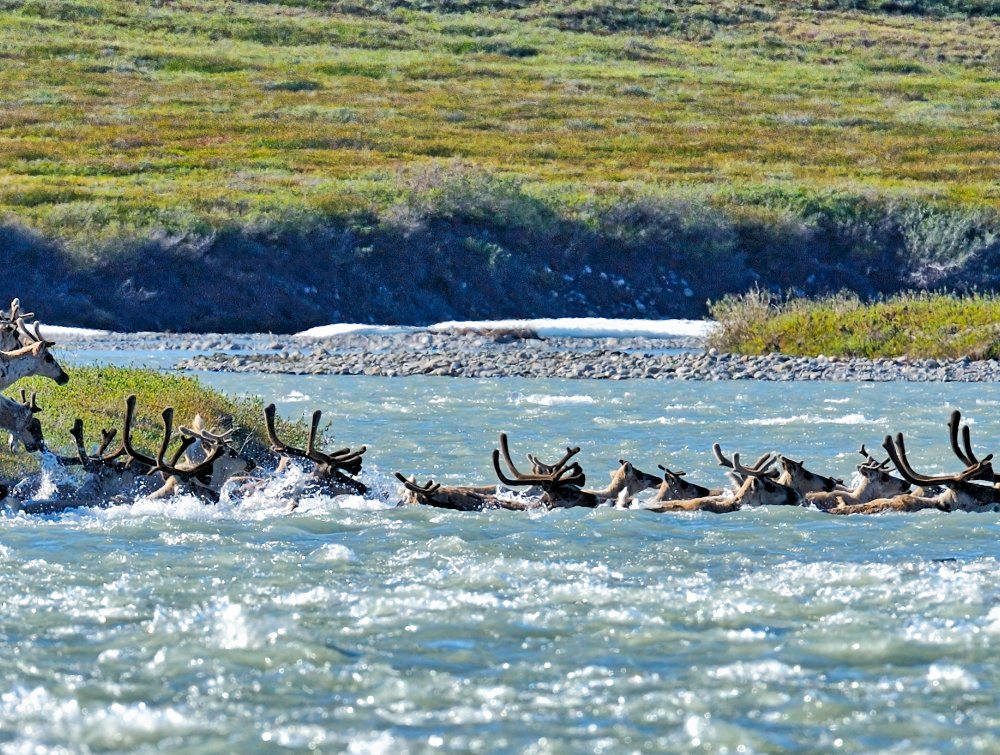
Animals from the Porcupine Caribou Herd in the Arctic Refuge
The Hulahula River runs from Alaska’s Brooks Range to the cArctic Refuge’s coastal plain, which is the calving ground of the Porcupine Caribou Herd.EDWARD BENNETT/BENNETT IMAGES LLC

SHAREShare on TwitterShare on FacebookShare on LinkedInShare via Email

After Trump’s sell off, the Arctic Refuge gets a reprieve

Just hours after being sworn into office, President Biden took a number of monumental actions to protect public lands, address the climate crisis and combat systemic racism, including an executive order that places a moratorium on all oil and gas activity in the Arctic National Wildlife Refuge.

This occurred only one day after the previous administration issued leases for drilling in the refuge’s coastal plain in a rushed, flawed and likely illegal process.

Biden’s action was met with great enthusiasm, particularly by many Gwich’in and Iñupiat peoples who have depended on and protected the refuge for thousands of years and rely on the caribou and other resources in the refuge to sustain their communities and cultures.

“Mashi’ choo, President Biden,” said Bernadette Demientieff, executive director of the Gwich’in Steering Committee. “The Gwich’in Nation is grateful to the president for his commitment to protecting sacred lands and the Gwich’in way of life.”

The executive order also reinstated President Obama’s withdrawal of most of the Arctic Ocean and parts of the Bering Sea from oil and gas drilling—an order that had been reversed by the Trump administration. Protecting offshore areas from the threat of a major oil spill benefits not only marine species such as fish, seals and bowhead whales, but the coastlines of sensitive lands like the Arctic Refuge, too.

We are grateful to President Biden for his commitment to protect the refuge, address the climate crisis and respect the human rights of Indigenous peoples. We are also grateful to the millions of people who made today’s announcement possible by putting the climate and social justice first. This action is a result of years of advocacy from people across the United States, including members and supporters of The Wilderness Society, who refused to stay silent as oil corporations and their friends sought to put drilling rigs in the Arctic Refuge.

This action is a result of years of advocacy from people across the United States, including members and supporters of The Wilderness Society.

This does not mean the fight to protect the Arctic Refuge and the calving grounds of the Porcupine Caribou Herd is over. The moratorium is temporary. But it’s a huge first step in Biden’s plan to review the legality of the Jan. 6 Arctic Refuge lease sale and the issuance of leases to the winning bidders.

We will continue to work with our Gwich’in and Iñupiat partners—as well as the Biden administration and our allies in the Congress and the conservation community—as we explore all options for ensuring that drilling never occurs on the coastal plain of the Arctic Refuge. We’ll also keep putting pressure on corporations like banks and insurers.

But today we rest, raise a glass and celebrate a new day for the Arctic.

Help Stop Wolf Snaring Bill

Image

Exposing the Big Game's avatarCommittee to Abolish Sport Hunting Blog

HB224 Snaring Wolvesin Montana. An indiscriminate cruel death sentence, for wolves and any other innocent unfortunate creature, HB224 will have a public hearing soon in the Montana House Fish Wildlife & Parks committee.

Traps and snares are baited, secreted, and left unattended in the tens of thousands across our public lands. Snares for wolves will add a whole new level to these weapons of mass destruction for these empowered trappers’ lenient and inhumane recreation.

As we continue to hear from owners of trapped dogs in Montana, two bird dogs out hunting were recently snared in our state. Just after one dog was saved from the snare,they found the other dog was killed by anothersnare. They are not the first or the last of our beloved companion animalsto be trapped, injured, or killed. It is amongour worst nightmares, in our dreams and in realty.

Here is the wolf snare bill…

View original post 483 more words

Grizzly, 34, confirmed as Yellowstone region’s known oldest

Exposing the Big Game's avatarCommittee to Abolish Sport Hunting Blog

This 2020 photo provided by the Wyoming Game and Fish Department shows the worn, mostly toothless jaw of Grizzly 168. The grizzly was the oldest documented in the Yellowstone region. Bear biologists euthanized the 34-year-old grizzly due to its poor health. (Zach Turnbull/Wyoming Game and Fish Department)

By ASSOCIATED PRESS |PUBLISHED: January 24, 2021 at 10:51 a.m. | UPDATED: January 25, 2021 at 3:29 a.m.

JACKSON, Wyo. (AP) — A 34-year-old grizzly bear captured in southwestern Wyoming has been confirmed as the oldest on record in the Yellowstone region, Wyoming wildlife officials said.

Grizzly bear 168 was captured last summer after it preyed on calves in the Upper Green River Basin area.

The male had just a few teeth left and weighed 170 pounds (77 kilograms), just a fraction of the 450 pounds (204 kilograms) the bear weighed as a 5-year-old when he was captured in…

View original post 370 more words

Earth has stayed habitable for billions of years – exactly how lucky did we get?

xtock / shutterstock

January 19, 2021 9.25am EST

Author

  1. Toby TyrrellProfessor of Earth System Science, University of Southampton

Disclosure statement

Toby Tyrrell receives funding from UK Natural Environment Research Council

Partners

University of Southampton

University of Southampton provides funding as a member of The Conversation UK.

https://theconversation.com/earth-has-stayed-habitable-for-billions-of-years-exactly-how-lucky-did-we-get-153416

It took evolution 3 or 4 billion years to produce Homo sapiens. If the climate had completely failed just once in that time then evolution would have come to a crashing halt and we would not be here now. So to understand how we came to exist on planet Earth, we’ll need to know how Earth managed to stay fit for life for billions of years.

This is not a trivial problem. Current global warming shows us that the climate can change considerably over the course of even a few centuries. Over geological timescales, it is even easier to change climate. Calculations show that there is the potential for Earth’s climate to deteriorate to temperatures below freezing or above boiling in just a few million years.

We also know that the Sun has become 30% more luminous since life first evolved. In theory, this should have caused the oceans to boil away by now, given that they were not generally frozen on the early Earth – this is known as the “faint young Sun paradox”. Yet, somehow, this habitability puzzle was solved.

Scientists have come up with two main theories. The first is that the Earth could possess something like a thermostat – a feedback mechanism (or mechanisms) that prevents the climate ever wandering to fatal temperatures.

Read news coverage based on evidence, not tweets

Get newsletter

The second is that, out of a large number of planets, perhaps some just make it through by luck, and Earth is one of those. This second scenario is made more plausible by the discoveries in recent decades of many planets outside our solar system – so-called exoplanets. Astronomical observations of distant stars tell us that many have planets orbiting them, and that some are of a size and density and orbital distance such that temperatures suitable for life are theoretically possible. It has been estimated that there are at least 2 billion such candidate planets in our galaxy alone.

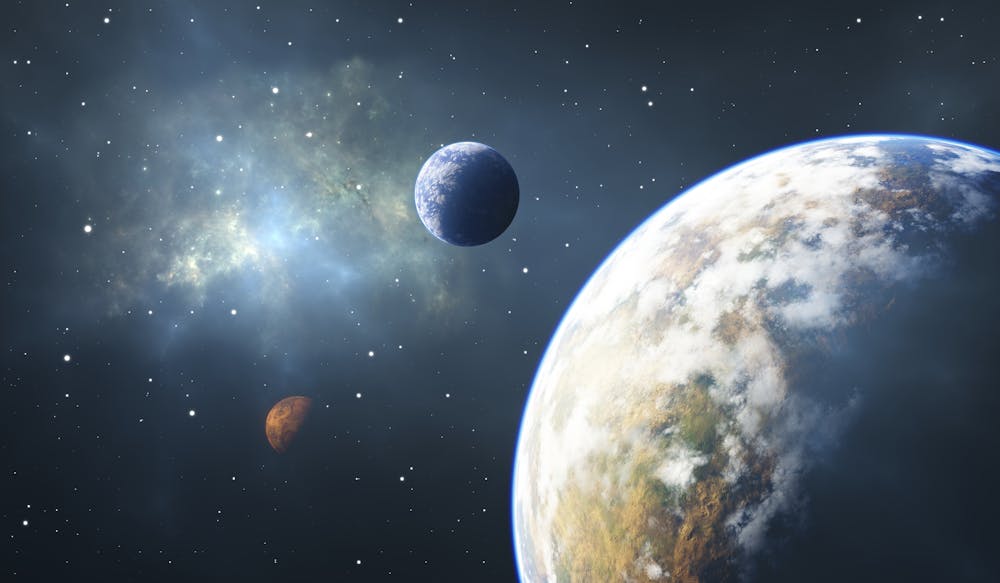
Planets in space.
There are many exoplanets…but how many have a stable climate? Jurik Peter / shutterstock

Scientists would love to travel to these exoplanets to investigate whether any of them have matched Earth’s billion years of climate stability. But even the nearest exoplanets, those orbiting the star Proxima Centauri, are more than four light-years away. Observational or experimental evidence is hard to come by.

Instead, I explored the same question through modelling. Using a computer program designed to simulate climate evolution on planets in general (not just Earth), I first generated 100,000 planets, each with a randomly different set of climate feedbacks. Climate feedbacks are processes that can amplify or diminish climate change – think for instance of sea-ice melting in the Arctic, which replaces sunlight-reflecting ice with sunlight-absorbing open sea, which in turn causes more warming and more melting.

In order to investigate how likely each of these diverse planets was to stay habitable over enormous (geological) timescales, I simulated each 100 times. Each time the planet started from a different initial temperature and was exposed to a randomly different set of climate events. These events represent climate-altering factors such as supervolcano eruptions (like Mount Pinatubo but much much larger) and asteroid impacts (like the one that killed the dinosaurs). On each of the 100 runs, the planet’s temperature was tracked until it became too hot or too cold or else had survived for 3 billion years, at which point it was deemed to have been a possible crucible for intelligent life.

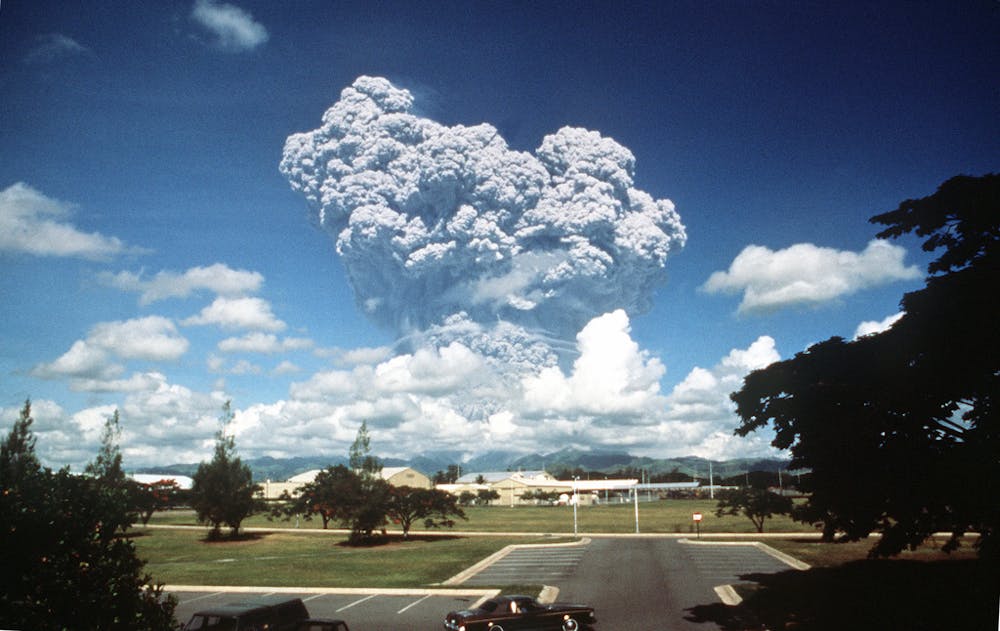
A large volcanic eruption cloud seen from distance.
Climate-altering: the 1991 eruption of Mount Pinatubo in the Philippines blasted so much ash into the atmosphere that global temperatures temporarily dropped by 0.6˚C. SRA Blaze Lipowski / picryl

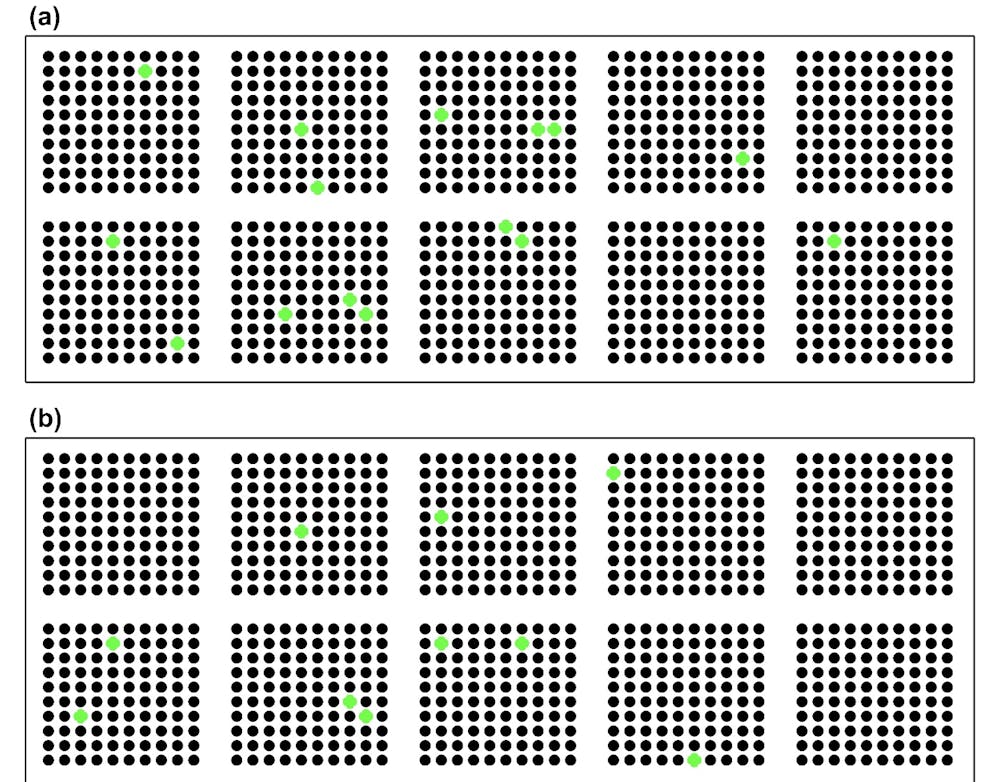
The simulation results give a definite answer to this habitability problem, at least in terms of the importance of feedbacks and luck. It was very rare (in fact, just one time out of 100,000) for a planet to have such strong stabilising feedbacks that it stayed habitable all 100 times, irrespective of the random climate events. In fact, most planets that stayed habitable at least once, did so fewer than ten times out of 100. On nearly every occasion in the simulation when a planet remained habitable for 3 billion years, it was partly down to luck. At the same time, luck by itself was shown to be insufficient. Planets that were specially designed to have no feedbacks at all, never stayed habitable; random walks, buffeted around by climate events, never lasted the course.

Lots of black dots with occasional green dots.
Repeat runs in the simulation were not identical: 1,000 different planets were generated randomly and each run twice. (a) results on first run, (b) results on second run. Green circles show success (stayed habitable for 3 billion years) and black failure. Toby Tyrrell, Author provided

This overall result, that outcomes depend partly on feedbacks and partly on luck, is robust. All sorts of changes to the modelling did not affect it. By implication, Earth must therefore possess some climate-stabilising feedbacks but at the same time good fortune must also have been involved in it staying habitable. If, for instance, an asteroid or solar flare had been slightly larger than it was, or had occurred at a slightly different (more critical) time, we would probably not be here on Earth today. It gives a different perspective on why we are able to look back on Earth’s remarkable, enormously extended, history of life evolving and diversifying and becoming ever more complex to the point that it gave rise to us.https://www.youtube.com/embed/K7hCh6v7HNs?wmode=transparent&start=0Professor Toby Tyrrell discusses his research.

Moderna says its Covid-19 vaccine is expected to protect against new variants

Exposing the Big Game's avatarThe Extinction Chronicles

https://www.cnn.com/world/live-news/coronavirus-pandemic-vaccine-updates-01-25-21/h_a1adaf5face422a677fc86f72a98e435

3 hr 40 min ago

From CNN’s Elizabeth Cohen

Stephanie Lecocq/Pool/AFP/Getty Images

TheModernaCovid-19vaccine created antibodies that neutralizedcoronavirusvariants first found in the United Kingdom and South Africa, the company said in a news release on Monday.

Two doses of the vaccine “is expected to be protective against emerging strains detected to date,” according to the release.

The company’s study showed that the variantfirstfound in the UK had “no significant impact” onthe vaccine’s effectiveness.

The results for the variant first spotted in South Africa, however, werenot asoptimistic —and some early studies havesuggestedvaccines may be somewhat less effective against this strain.

In the press release,Modernanotedthat“a six-fold reduction in neutralizing titers was observed with(the variantdiscovered in South Africa)relative to prior variants.”

The companysaid the vaccine was still expected to be effective.

“Despite this reduction, neutralizing titer levels with(the variant discovered in South Africa)remain above levels that are expected to be protective,” according to…

View original post 1,381 more words

Dr. Fauci Just Warned 20 States Have “Deadlier” COVID

Dr. Fauci Just Warned 20 States Have “Deadlier” COVID (msn.com)

Alek Korab  1 day ago


Teen turns dad who participated in the Capitol riot over to the F.B.I.Dr. Fauci Says Don’t Go Here Even if It’s OpenDr. Fauci Just Warned 20 States Have “Deadlier” COVID

There’s a new coronavirus strain in America from the U.K., and it’s in 20 states and it’s more transmissible—this we knew. Now, Dr. Anthony Fauci, the chief medical advisor to the President and the director of the National Institute of Allergy and Infectious Diseases, is saying we have to also presume this U.K. mutation is deadlier, too. Read on for his warning, and how he says you should protect yourself—and to ensure your health and the health of others, don’t miss these Sure Signs You’ve Already Had Coronavirus. Anthony S. Fauci wearing a neck tie: Doctor Anthony Fauci© Provided by Eat This, Not That! Doctor Anthony Fauci

Dr. Fauci Said We Have to Assume the COVID-19 Mutation Can Cause More Death

U.K. Prime Minister Boris Johnson said yesterday at a news briefing: “We’ve been informed today that in addition to spreading more quickly, it also now appears that there is some evidence that the new variant—the variant that was first discovered in London and the southeast [of England]—may be associated with a higher degree of mortality.”

Dr. Fauci, who had previously said there was no evidence of it being more deadly, now says it may be. “The data that came out was after they had been saying all along that it did not appear to be more deadly,” he told Margaret Brennan on Face the Nation. “So that’s where we got that information. But when the British investigators look more closely at the death rate of a certain age group, they found that it was one, two per thousand, we’ll say, and then it went up to 1.3 per thousand in a certain group. So that’s a significant increase. So their most recent data is in accord with the Brits are saying, we want to look at the data ourselves, but we have every reason to believe them. They’re a very competent group. So we need to assume now that what has been circulating dominantly in the U.K. does have a certain degree of increase in what we call virulence, namely the power of the virus to cause more damage, including death.“

The U.K. mutation has been discovered in the following U.S. states: 

  • Massachusetts
  • Wyoming
  • Louisiana
  • Michigan
  • Oregon
  • Illinois
  • Utah
  • New Mexico
  • Wisconsin
  • Maryland
  • Indiana
  • Minnesota
  • Connecticut
  • Texas
  • Pennsylvania
  • Georgia
  • New York
  • Florida
  • California
  • Colorado

Hunting idiots provide plenty of comic relief

Exposing the Big Game's avatarCommittee to Abolish Sport Hunting Blog

https://www.mpnnow.com/story/sports/outdoors/2021/01/24/lisenbee-hunting-idiots-provide-plenty-comic-relief/6657341002/

Len Lisenbee

I really enjoy getting feedback from any of my 93 regular readers. And the feedback I have been getting recently is, with the exception of the flying squirrels column, overwhelmingly in favor of more dumb outdoor crook stories.

So, since I try to remain on the cutting edge of journalistic excellence, here are some more dummies to chuckle over.

Robert Miller lives in the town of Mexico not too far from Oswego. And he sure must enjoy the taste of venison. It seems he spotted a deer grazing in a field, so he shot it.

However, there were just a few problems involved with his activities. He was sitting in his car at the time. It (and he) was stopped on a public highway. The deer was a doe, and he did not have a doe permit.https://093e951f9d55267de8cacea727cc66f6.safeframe.googlesyndication.com/safeframe/1-0-37/html/container.html

The car (and he) were within 500 feet of several…

View original post 894 more words

The Devonian Extinction: A Slow Doom That Swept Our Planet

Exposing the Big Game's avatarThe Extinction Chronicles

Over millions of years, most living organisms suffocated in oxygen-deprived oceans. In the aftermath, modern vertebrates conquered the world.

ByCody CottierJanuary 23, 2021 9:00 AM

ocean underwater

(Credit: Rich Carey/Shutterstock)

Newsletter

Sign up for our email newsletter for the latest science newsSign up for the NewsletterSIGN UP

We think of mass extinctions as brief moments of havoc — profoundly devastating but over within a geologic instant. The Devonian, the second of the so-called “Big Five,” defies this notion. If the other great die-offs are short stories of death and destruction, this one is an epic akin toWar and Peace. Even that paradoxical title seems fitting: The Devonian extinction ravaged Earth on and off for 25 million years, and although it ultimately killed three-quarters of all species, it also cleared the way for a new balance of animal life that endures to this day.

The extinction began roughly 380…

View original post 1,201 more words

How many early human species existed on Earth?

Exposing the Big Game's avatarThe Extinction Chronicles

ByBenjamin Plackett-Live Science Contributor9 hours ago

It depends on your definition of human.

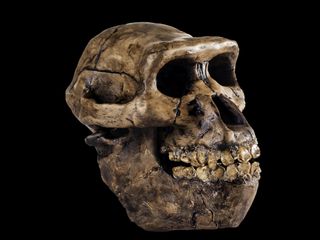
Australopithecus skullAn Australopithecus skull(Image: © Jose A. Bernat Bacete via Getty Images)

WeHomo sapiensdidn’t used to be alone. Long ago, there was a lot more human diversity;Homo sapienslived alongside an estimatedeight now-extinct speciesof human about 300,000 years ago. As recently as 15,000 years ago, we were sharing caves with another human speciesknown as the Denisovans. And fossilized remains indicate an even higher number of early human species once populated Earth before our species came along.

“We have one human species right now, and historically, that’s really weird,” said Nick Longrich, an evolutionary biologist at the University of Bath in the United Kingdom. “Not that far back, we weren’t that special, but now we’re the only ones left.”

So, how many early human species were there?

Related:What’s the…

View original post 866 more words

Atmospheric river means massive snow coming to the West

Exposing the Big Game's avatarThe Extinction Chronicles

https://www.cbsnews.com/news/atmospheric-river-snow-west/

BY JEFF BERARDELLI

JANUARY 24, 2021 / 6:56 AM / CBS NEWShttps://www.cbsnews.com/embed/video/?

In what has been the worst fire season in recorded history in California, withtwice the burned acreageof any season prior and fires burning months past the end of traditional wildfire season -some just days ago- fortune is about to shift, but to another extreme. A rip-roaring jet stream with embedded atmospheric rivers is primed to pummel California with heavy rain and massive snow over the coming week.

With the flip of a switch, California and the Southwest U.S., will go from the driest 6-month stretch in state history to the potential for flash flooding, landslides and snow so deep in the elevations, avalanches will become a danger.https://platform.twitter.com/embed/index.html?dnt=true&embedId=twitter-widget-0&frame=false&hideCard=false&hideThread=false&id=1353012419203887105&lang=en&origin=https%3A%2F%2Fwww.cbsnews.com%2Fnews%2Fatmospheric-river-snow-west%2F&siteScreenName=CBSNews&theme=light&widgetsVersion=ed20a2b%3A1601588405575&width=550px

Scientists say that patterns like this, which vacillate between extreme dry and extreme wet, are becoming the new normal, and will likely get worse, due in part…

View original post 1,004 more words