A clamor of sorrow and outrage from the residents of Island Walk, Florida and UPC supporters changed the trajectory of a plan by the community’s board of directors from violence to peaceful resolution. On Dec. 23, the board voted to:
“Rescind the vote to have Ray the Trapper capture Muscovy Ducks and to suspend any action until additional input can be gathered from state, local and federal wildlife experts, academics and environmentalists, as well as residents, on the best methods for managing population growth. The Lake Committee, along with management and the Board will develop a plan, which will be discussed with the community and amended as needed.”
The Island Walk resident most responsible for saving the ducks is animal rights vegan…
The Cottesmore Hunt in Oakham on December 26, 2018.
The legal method of ‘hunting’ with hounds, involves a fox-scented trail being laid by a horserider and the hounds then following the trail through the countryside.
“Because of Covid we can’t have 500 people gathering in Oakham,” said Clare Bell, Cottesmore Hunt secretary.
“It’s really sad as it is an important part of a lot of people’s Christmas but traditions for everybody this year are going to be different.”
A Carmel man and a dog died last week after a fire at a private hunting club in Kentucky.
According to Kentucky news reports, Robert L. Delaby, 50, and his dog were found dead Dec. 17 after firefighters responded at 5:30 a.m. to a report of a fire involving a small structure at Gumz Hunting Club near Henderson, Ky.
The cause of the fire is still under investigation by Kentucky’s State Fire Marshall’s Office.
Since early this summer, Keith Poulsen, the director of the Wisconsin Veterinary Diagnostic Laboratory, was worried about mink. Poulsen’s lab is part of a national network of veterinary labs that work on animal diseases, and they had “been watching COVID-19 very carefully,” Poulsen told me. In Europe, mink on fur farms were catching COVID-19. And they seemed to be able to pass it back to people. The Netherlands had an outbreak in April; Danish mink farms quickly followed in June. By October, the situation was gruesome: Hundreds of mink farms in Denmark and the Netherlands had COVID-19 cases, and two farms in Utah had reported the first U.S. cases in mink.
Sign up for The Atlantic’s daily newsletter.
Each weekday evening, get an overview of the day’s biggest news, along with fascinating ideas, images, and voices.Email Address (required)Sign Up
Thanks for signing up!
Since then, the global mink situation has significantly worsened. To date, COVID-19 has been found on mink farms in a total of nine countries, including Spain, Italy, Lithuania, Sweden, Greece, and—just two weeks ago—Canada.
For nearly a year, the coronavirus has spread with little check through the places where humans live and work, but the growth of the pandemic among mink poses additional threats. It gives the virus a chance to pass from an environment humans ostensibly control to one that they don’t. And as it spreads among mink, and between minks and humans, and between humans and humans, it can mutate; it already has. One mink-associated variant bears the same mutation as the coronavirus variant now spreading rapidly in the United Kingdom; each time such changes happen, there is a risk the virus changes in a way that could make it more dangerous and prolong the pandemic.https://db071f7191afacff422e7694d2e06c53.safeframe.googlesyndication.com/safeframe/1-0-37/html/container.html
Around 11 a.m. on a Friday in October, Poulsen got the call he’d been expecting for months. Mink in Medford were sick, and it looked a lot like COVID-19.
Medford, a city of just more than 4,000 people in north-central Wisconsin, used to call itself the mink capital of the world. There, a person can live in the neighborhood of “Mink Capital Terrace” or on a road called “Mink Drive.” A generation ago, a Medford girl could have aspired to becrowned Mink Princess U.S.A. at the annual Medford Mink Festival.
Though the United States mink industry has shrunk along with Americans’ waning appetites for fur coats and the festival is no more, Wisconsin is still the country’s biggest producer of mink pelts. And Medford is still a mink town; there are 12 mink ranches in the area, within five miles of one another—and the coronavirus has now reached two of them.
Once the coronavirus finds mink, it works fast. When Poulsen picked up the phone, the veterinarian for the Medford-area mink ranches told him that several hundred mink had already died. Plus, some people on the ranch had COVID-like symptoms. “I think we need them tested,” the vet said. By 11:30 a.m., Poulsen was driving a van 250 miles upstate; by the time he arrived at the ranch, at 3:30 p.m., several hundred more mink had died.
Mink are extremely vulnerable to respiratory disease. Like people, they get seasonal respiratory issues. They’re also prone to pneumonia. Respiratory viruses replicate so readily in minks and their mustelid relatives (ferrets, most notably) that the animals are often used to study human illnesses.
So mink can get the coronavirus, and they can get it from people; as cases in humans rose precipitously in Wisconsin this fall, Poulsen and his staff figured it was just a matter of time before someone on a mink farm sneezed it into the mink population. So did the local veterinarians. “We were just waiting,” says Dr. John Easley, a mink specialist who serves as a veterinarian for mink ranches in southern Wisconsin. Both mink and human cells have specific receptors that allow the virus to attach to them, which made mink a greater concern than other farmed animals, including Wisconsin’s immense dairy-cow population, he says. “Cows don’t allow the virus to enter their cells quite as easy. They do get infected, but the virus just doesn’t replicate very well in their system.”
Farmed mink have proved to provide absolutely excellent conditions for the virus to be fruitful and multiply. In addition to all of the ways mustelid physiology makes them similarly predisposed to the malady as humans, mink on farms are housed closely together. Social distancing is out of the question, and transmission is all but guaranteed. As of December 3, a total of 644 people associated with mink farms had contracted COVID-19 since June, along with another 338 people who work in mink pelting, according to a World Health Organization report that came out before the news of Canada’s outbreak, where an additional eight people on a mink farm have been sickened. In mid-November, a virologist at the Danish health authority told Nature that COVID-19 mutations believed to have originated in mink had shown up about 300 times in people in Denmark.https://db071f7191afacff422e7694d2e06c53.safeframe.googlesyndication.com/safeframe/1-0-37/html/container.html
Denmark, the world’s largest mink exporter, has seen arguably the worst of this species-leaping horror show. In early November, the country ordered a complete cull of the farmed mink population; even so, by the beginning of December, 289 mink farms in northern Denmark had reported outbreaks.. The bodies of thousands of culled mink, buried in shallow graves, then proceeded to ferment. Gases built up in their bodies, propelling them to rise, luridly, from the ground.
The Danish mink outbreak also birthed a new strain of SARS-CoV-2, the coronavirus responsible for COVID-19. The variant has mutations in the spike protein, which the virus uses to invade host cells, and has been named “Cluster 5.” It infected at least a dozen people associated with mink farms in northern Denmark from August to September. Such mutations can affect the spread of the virus among humans; one, known as D614G, emerged in February and became the dominant strain of COVID-19 globally, perhaps because it traveled more easily among humans. The U.K. variant emerged more recently and has spread quickly as well. (It’s not yet clear whether the mutation is responsible for the speed, or coincident with it.) This variant shares a mutation with one found in minks; a missing bit of genetic code helps these viruses guard against antibodies that otherwise can fight back. Researchers initially speculated that the mutations in the mink variant could make a vaccine less effective, but the little information available so far on human-to-human transmission suggests that these particular variants aren’t more infectious or more deadly, and won’t interfere with the vaccine..
But the mink outbreak raises another fear—if the coronavirus escapes into the wild mink population, COVID-19 could become an entrenched and uncontrolled animal disease, wreaking havoc on animal communities and probably also occasionally infecting people.
“On a ranch, you can quarantine them. When you have a wild population, that’s impossible; you can’t stop them all,” Poulsen said.
After the mink in Wisconsin tested positive for SARS-CoV-2, what followed “happened really, really fast,” Poulsen said. The lab alerted the USDA, the state department of agriculture, the state department of public health, and a local public health official. By Sunday afternoon, the CDC had teams on the ground to interview ranch owners and take stock of the environment.
It’s another blow to the contracting mink business. “This is just one more industry that can’t really afford it,” Poulsen said. “I feel terrible for everyone involved, whether it’s the feed mill, the veterinarian, the family. Everyone’s tired of it.” When a farm is struck by foot and mouth and other animal diseases, “the government would pay for those animals so you don’t completely wipe out a farm.” But there are no indemnity programs for mink. “If you have a major mortality problem, you’re losing a significant amount of profitability. Then there’s the cost of testing. 62 animal tests cost $3,000, which is a big deal to a farm that just suffered losses of tens of thousands of dollars,” Poulsen said. To avoid further contamination, mink farmers must compost the dead bodies, as well as any used feed and fecal matter. “There’s no money to do that on the federal or state level, so that’s all on the farm.”
In Europe, the already-shrinking mink industry is now quickly crumbling. Efforts to ban fur farming, often in response to campaigns led by animal rights activists, are now accelerating. The Netherlands announced it would end mink farming for good in 2021, three years earlier than planned. France announced it would ban farming mink by 2025. Poland, where undercover footage from the country’s largest mink farm appeared to show animals cannibalizing each other, is expected to soon follow suit. Ireland, which is home to only three mink farms, previously had voted down a bill to end mink farming, but has now decided to cull its farmed mink population preemptively, likely ending the industry in the country.
In China, meanwhile, where about 8,000 mink farms hold roughly 5 million animals, the state has reported no COVID-19 cases among mink, either on farms or in the wild. China’s mink farmers say they are benefiting from the Danish mink cull; Wang He, a Shangcun trader and breeder, told Reuters his earnings increased 30 to 50 percent when the price of mink fur jumped after Denmark ordered the cull. (In the past decade or two, China became the main export market for U.S. and European mink; demand for fur coats there now dwarfs that of every other country.)
But Ilaria Capua, a veterinarian and virologist who recently authored a paper on the possibility of a COVID-19 panzootic—the spread of a disease among animals across a large region or globally—is worried that the levels of infection in Asia were high enough that some mink were likely infected. “I am just concerned that we are not looking well enough,” she told me. “If the virus spills over into wild mustelids, then you lose track of it.”
On December 13, the world took another step toward this scenario: The USDA announced the first known case of a non-captive wild animal with the coronavirus. A wild mink, trapped just outside a mink farm in Utah where there was a COVID-19 outbreak, tested positive. The strain was “indistinguishable” from that of the farm outbreak. The spillover had happened. The question now is whether the virus will become established in the wild population. The USDA says there is “currently no evidence that SARS-CoV-2 is circulating or has been established in wild populations surrounding the infected mink farms.” Several other wild animals in the vicinity were sampled, but they tested negative.
“Let’s put it this way,” Capua said. “We realized the spillover of SARS-CoV-2 in a new animal population—Homo sapiens—when it was too late. Let’s not make the same mistake with other animals.”
Okanogan County farm company fined more than $2M after two workers die from COVID-19https://imasdk.googleapis.com/js/core/bridge3.432.0_en.html#goog_882034381Volume 90% Author: Megan CarrollPublished: 7:45 AM PST December 22, 2020Updated: 7:25 PM PST December 22, 2020
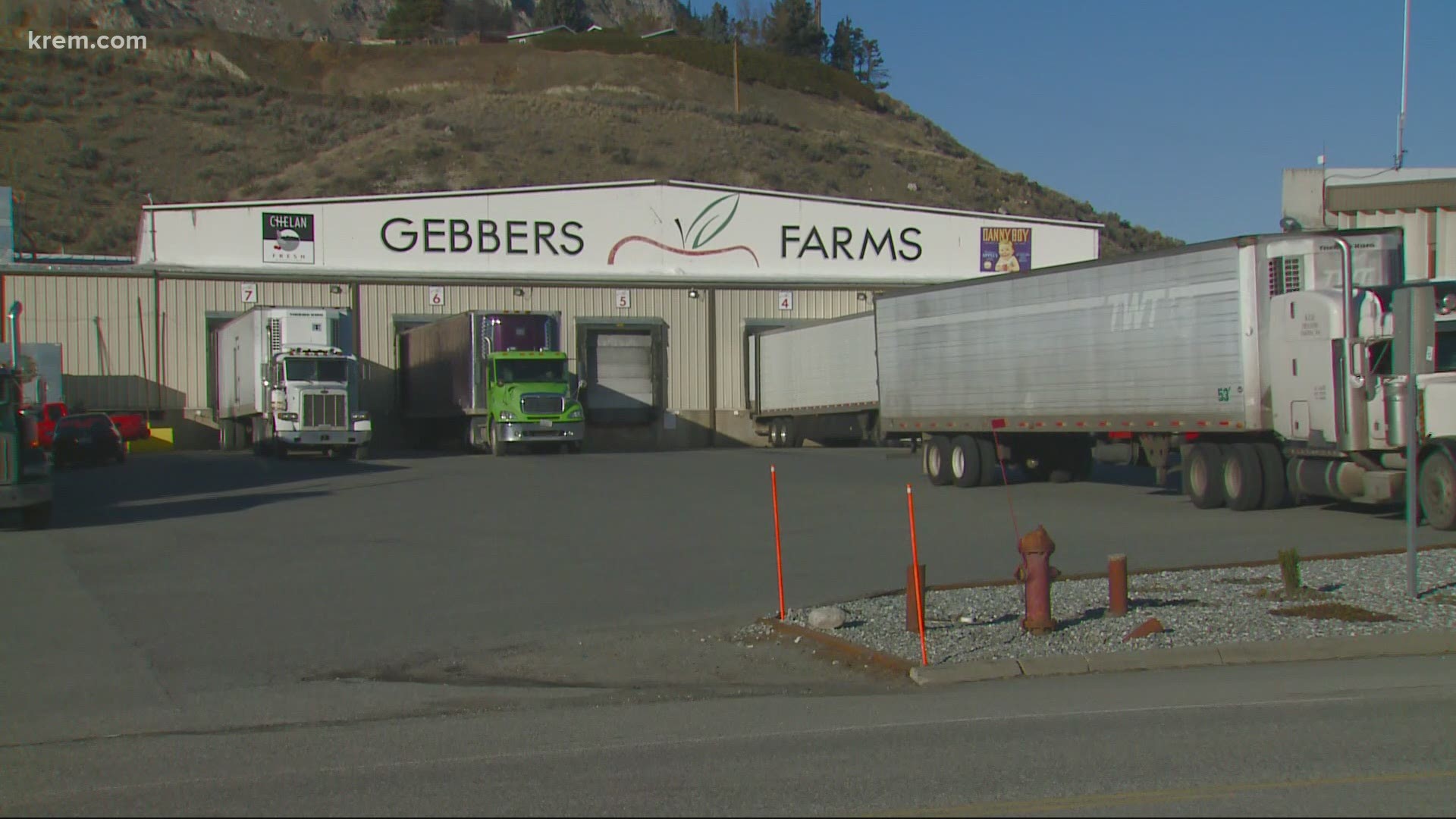
BREWSTER, Wash. — A farming company in Brewster, which is located in Okanogan County, is facing fines totaling more than $2 million from Washington state regulators after an investigation into the COVID-19 deaths of two workers.
“Gebbers made it very apparent to investigators they had no intention of following the rules as written regarding temporary agricultural worker housing and transportation,” said L&I Director Joel Sacks.
The agency’s Division of Occupational Safety and Health (DOSH) opened an investigation on July 16 after receiving anonymous calls from Gebbers employees.
The first caller said someone at the camp had died from COVID-19, adding that workers who shared the same cabin with the person were not tested for the virus and were then split up into different cabins with other migrant workers, according to L&I.
The second caller said he feared that hundreds of workers at his camp had COVID-19, including himself, and he worried that he would die. He added that the farm owners did nothing to help the sick.
Investigators confirmed that the death of a 37-year-old temporary worker from Mexico on July 8 was not reported to DOSH as required, L&I said. Businesses must report any workplace-related deaths within eight hours.
A second worker, a 63-year-old man from Jamaica, collapsed and died on July 31.
The cause of death for workers was COVID-19, according to L&I.
Two investigations of farm found COVID-19 violations
Gebbers Farm Operations was the subject of two L&I investigations in less than two months.
L&I first opened an investigation into Gebbers on May 28 after receiving a worker complaint, which resulted in a $13,200 fine issued to the company for not ensuring adequate social distancing. Employees were using the top and bottom bunks while not using a cohort and no barriers were present in the kitchen and cooking areas, according to L&I.
this day in history
this day in history
Ads By Connatix
L&I explained the details of emergency temporary agricultural worker housing rules and the changes needed for the farm to in compliance.
During the second investigation, L&I issued an order Order and Notice of Immediate Restraint to the farm on July 22, requiring immediate COVID-19 safety and health rule compliance.
Under state emergency rules for temporary agricultural worker housing, top and bottom bunks can only be used if a farm separates workers into group shelters known as cohorts. Those groups of no more than 15 workers must live, work, eat, use shower and cooking facilities and travel separately from other workers.
Investigators confirmed hundreds of workers were sleeping in bunk beds and not instructed to remain in cohort groups, according to L&I. Gebbers also bused workers to the fields in groups significantly larger than allowed.
Investigators returned unannounced daily to ensure compliance with safety and health rules.
“Gebbers continually failed to comply, even after the first worker died and our repeated presence at the farm, clearly demonstrating a lack of regard for worker safety and health,” said Anne Soiza, L&I assistant director for DOSH.
The investigation found a total of 24 egregious willful violations, L&I said, including 12 for unsafe sleeping arrangements and 12 for unsafe transportation. Each of the violations was assessed a fine of $84,000.
According to L&I, the farm was also cited for four other serious violations, including failure to report the worker’s death.
“There is nothing more important to Gebbers Farms than our workers’ health and safety, as evidenced by the fact that 99.3% of our entire workforce tested negative for the virus, which is better than county, state and national rates to date. While we cannot comment on the specific violations because we are evaluating our options to appeal, we strongly disagree with the agency’s assessment,” the statement reads in part. https://eb647078b1059a4c6f62b25f5289ee03.safeframe.googlesyndication.com/safeframe/1-0-37/html/container.html
Management said in the statement that it had already established cohorts of 42 people before the state set a 15-person cohort rule.
“We consulted experts to develop our program, and there is nothing magical about the number 15. Considering that the state recommended size for community group gatherings is far fewer today than at any other time in the year, and community cases are rising,” the statement reads in part.
“We said that we would (and we did) change our program as quickly as possible to follow the state rules. We explicitly said that we would change our program to follow the rules as quickly as possible, but that for an operation this size, we needed time,” the statement continues.
Management said later in the statement that the company is “deeply saddened by the loss of our team members and long-time workers who we considered family.”
The whales in the group seem to sing a unique song.
Researchers said that the blue whale song that crackled through the team’s underwater recordings was unlike any they had heard.Credit…Robert Baldwin/Environment Society of Oman
Weighing up to 380,000 pounds and stretching some 100 feet long, the blue whale — the largest creature to have ever lived on Earth — might at first seem difficult for human eyes and ears to miss.
But a previously unknown population of the leviathans has long been lurking in the Indian Ocean, leaving scientists none the wiser, new research suggests.
The covert cadre of whales, described in apaperpublished last week in the journal Endangered Species Research, has its own signature anthem: a slow, bellowing ballad that’s distinct from any other whale song ever described. It joins only a dozen or so other blue whale songs…
The whales in the group seem to sing a unique song.
Researchers said that the blue whale song that crackled through the team’s underwater recordings was unlike any they had heard.Credit…Robert Baldwin/Environment Society of Oman
Weighing up to 380,000 pounds and stretching some 100 feet long, the blue whale — the largest creature to have ever lived on Earth — might at first seem difficult for human eyes and ears to miss.
But a previously unknown population of the leviathans has long been lurking in the Indian Ocean, leaving scientists none the wiser, new research suggests.
The covert cadre of whales, described in a paper published last week in the journal Endangered Species Research, has its own signature anthem: a slow, bellowing ballad that’s distinct from any other whale song ever described. It joins only a dozen or so other blue whale songs that have been documented, each the calling card of a unique population.
“It’s like hearing different songs within a genre — Stevie Ray Vaughan versus B. B. King,” said Salvatore Cerchio, a marine mammal biologist at the African Aquatic Conservation Fund in Massachusetts and the study’s lead author. “It’s all blues, but you know the different styles.”
The find is “a great reminder that our oceans are still this very unexplored place,” said Asha de Vos, a marine biologist who has studied blue whales in the Indian Ocean but was not involved in the new study.
Dr. Cerchio and his colleagues first tuned into the whales’ newfound song while in scientific pursuit of a pod of Omura’s whales off the coast of Madagascar several years ago. After hearing the rumblings of blue whales via a recorder planted on the coastal shelf, the researchers decided to drop their instruments into deeper water in the hopes of eavesdropping further.CLIMATE FWD:: Our latest insights about climate change, with answers to your questions and tips on how to help.Sign Up
“If you put a hydrophone somewhere no one has put a hydrophone before, you’re going to discover something,” Dr. Cerchio said.
A unique blue whale song
The song of the northwest Indian Ocean blue whale population, sped up 20 times to be more audible to human ears.Listen
A number of blue whale populations, each with its own characteristic croon, have long been known to visit this pocket of the Indian Ocean, Dr. Cerchio said. But one of the songs that crackled through the team’s Madagascar recordings was unlike any the researchers had heard.
By 2018, the team had picked up on several more instances of the new whales’ now-recognizable refrain. Partnerships with other researchers soon revealed that the distinctive calls had been detected at another recording outpost off the coast of Oman, in the Arabian Sea, where the sounds seem particularly prevalent. Another windfall came later that year when Dr. Cerchio learned that colleagues in Australia had heard the whales crooning the same song in the central Indian Ocean, near the Chagos Archipelago.
Data amassed from the three sites, each separated from the others by hundreds or thousands of miles, painted a rough portrait of a pod of whales moseying about in the Indian Ocean’s northwest and perhaps beyond.
Using acoustic data to pin down a new population is, by nature, indirect, like dusting for fingerprints at the scene of a crime. But Alex Carbaugh-Rutland, who studies blue whales at Texas A&M University and was not involved in the study, said the results “were very sound, no pun intended.”
Not much is known about blue whale songs, although most researchers think that they help males woo their mates, as is the case with closely related species.Credit…Robert Baldwin/Environment Society of Oman
The researchers ruled out the possibility that the songs could be attributed to other species of whales. And side-by-side comparisons of the new blue whale tune with others showed convincingly that the northwestern Indian Ocean variety was distinct, Mr. Carbaugh-Rutland said. “I think it’s really compelling evidence,” he said, drawing a comparison to linguistic dialects.
Genetic samples would help clinch the case, he added. But blue whales, which spend most of their time far from shore, are difficult to study. Whaling in the 19th and 20th centuries also culled hundreds of thousands from their ranks; an estimated 10,000 to 25,000 blue whales are thought to remain.
Not much is known about blue whale songs, although most researchers think that they help males woo their mates, as is the case with closely-related species. That can make any modifications to a cetacean melody fairly high stakes, Dr. de Vos said: “If two populations can’t talk to each other, over time, they’re going to grow apart.”
Eventually, populations with different takes on a tune might splinter into subspecies, with their own behaviors and quirks. There’s not yet evidence to show that has happened with these blue whales, nor much information on what might have driven them apart from their southerly kin. But even if the whales in this new group don’t yet formally occupy a new branch on the tree of life, they are worth getting to know.
“What things like this show us is that there are different populations, with different adaptations, with potentially different needs,” Dr. de Vos said. To conserve the world’s blue whales, she said, “there’s not one single protection measure that’s going to work.”
The promise of negative emissions is baked into most “net zero” pledges. But putting that into practice is easier said than done.
SARAH RICE/GETTY IMAGESAlgae at the wastewater biofuel system at the San Francisco Public Utilities Commission’s Southeast Water Pollution Control Plant (shown here in 2012) capture carbon dioxide and produce biofuel.
In December, the Vatican became one of the latest entities to unveil a plan to reach net-zero emissions by 2050, joining far less pious actors like BP, Shell, and President-elect Joe Biden. Net-zero plans have become all the rage as public concern about the climate crisis has grown. But approving coverage of these wide-ranging announcements rarely question what the “net” of net-zero actually means.
Meeting climate targets means releasing fewer fumes into the sky, for starters. And those plans include that. But they also include something else. The way they get to “zero” isn’t by…
Missouri held its firstelk-hunting seasonin modern history this year, which consisted of two portions: the archery portion, which ran in late October, and a firearms portion that just concluded.And while the archery portion did not produce any harvests, all of the hunters who participated in the firearms session were successful,Fox 2reports.
On Dec. 19, Bill Clark harvested a bull elk on his own property in Van Buren(Missouri Department of Conservation)
Five hunters were selected to participate in the session that ran from Dec. 12 to Dec. 20, and all five reportedly harvested an…
NORTH LIMA — An investigation is underway after a man was shot in the foot in Beaver Township over the weekend, possibly the result of a hunting mishap.
Investigators with Beaver Township police said the victim is a man in his late 20s to early 30s and was the only one injured.
The shooting occurred before noon Sunday on East Calla Road, between Market Street (state Route 7) and Sharrott Road.
Charges likely will be filed in the accidental shooting, local investigators said.
The Ohio Department of Natural Resources said another agency is handling the investigation, but no further information was available.







 SARAH RICE/GETTY IMAGESAlgae at the wastewater biofuel system at the San Francisco Public Utilities Commission’s Southeast Water Pollution Control Plant (shown here in 2012) capture carbon dioxide and produce biofuel.


