Woman, 26, shot by hunter in Waushara County(WCAX)
Published:Nov. 30, 2020 at 12:50 PM PST
TOWN OF COLOMA, Wis. (WSAW) – The Waushara County Sheriff said one person was injured in a hunting accident Nov. 26 in Coloma.
According to a news release, around 4:45 p.m. dispatch received a call reporting someone had been shot in a near the intersection of Czech Ave and 7th Court in the Town of Coloma
A 26-year-old woman suffered a gunshot wound to the leg. The DNR’s incident log states, the shooter shot at what he thought was a deer and struck the victim in the leg. Investigators said the victim, and the 51-year-old man that shot the woman are not from the area.
The circumstances surrounding the shooting are still under investigation by the Waushara County Sheriff’s Office and the Wisconsin DNR.
A 28-year-old Bemidji man was killed in a hunting accident last Wednesday, the Beltrami County Sheriff’s Office said in a Monday afternoon Facebook post.|Photo: WDIO-TV/File
WDIO Updated: December 01, 2020 12:22 AM Created: November 30, 2020 10:16 PM
A 28-year-old Bemidji man was killed in a hunting accident last Wednesday, the Beltrami County Sheriff’s Office said in a Monday afternoon Facebook post.
SheriffErnie Beitel says just after 7:15 Wednesday nightthey received a report from the FBI and Red Lake Tribal Police that they were investigating a hunting related fatality that occurred on or near the Red Lake Reservation boundary in the 29000 block of Irvine Avenue, near Puposky, in Nebish Township.
Beitel says LukasDudley was reportedly deer hunting east of Irvine Ave near the south boundary roadwhen he was shot by another hunter.
The other hunter allegedlytold authorities near duskhe “observed movement of what he thought was a deer…
An 8-mile-long “canvas” filled with ice age drawings of mastodons, giant sloths and other extinct beasts has been discovered in the Amazon rainforest.
The gorgeous art, drawn withochre— a red pigment frequently used as paint in the ancient world — spans nearly 8 miles (13 kilometers) of rock on the hills above three rock shelters in the Colombian Amazon, a new study finds.
“These really are incredible images, produced by the earliest people to live in western Amazonia,” study co-researcher Mark Robinson, an archaeologist at the University of Exeter, who analyzed the rock art alongside Colombian scientists,said in a statement.
A new species of bird from around 68 million years ago has been discovered on the island of Madagascar, and its unusual beak could give new insights into how modern birds evolved.
Discovered from a single, nearly complete skull that was fossilised after it was buried in muddy debris, Falcatakely is a crow-sized bird with a scythe-shaped beak. This is not at all unusual in modern birds, and is similar to hornbills and toucans. However, there’s a gap of tens of millions of years between these species evolving.
“What is so amazing is that these lineages converged on this same basic anatomy despite being very distantly related,” said Dr Ryan Felice, lecturer in human anatomy at University College London and one of the study’s authors. In fact, this is the first time such a beak shape has ever been found on a bird from the Mesozoic era – the era that contains the Cretaceous, Jurassic and Triassic periods.
Looking underneath Falcatakely’s skin reveals another unusual feature. Though its face may have the appearance of a modern bird, its underlying bone structure is much more like a dinosaur’s. Modern birds have a beak made mostly of one large bone, called the premaxilla. Ancient birds, like the dinosaur Archaeopteryx, instead had two, with a small premaxilla and a large maxilla.
So, Falcatakely developed a modern face shape without a modern facial structure. “Falcatakely might generally resemble any number of modern birds with the skin and beak in place, however, it is the underlying skeletal structure of the face that turns what we know about bird evolutionary anatomy on its head,” said Prof Patrick O’Connor, an anatomist at Ohio University.
The team haven’t been able to study the skull directly. Bird fossils are rare, because their skeletons are so fragile that they are usually destroyed rather than fossilised. The specimen is so fragile that they couldn’t even remove it from the rock. Instead, the team used high-resolution micro-computed tomography to scan the fossil, which they then used to digitally reconstruct it.
“The discovery of Falcatekely underscores that much of the deep history of the Earth is still shrouded in mystery,” added O’Connor, “particularly from those parts of the planet that have been relatively less explored.
“The more we learn about Cretaceous-age animals, plants, and ecosystems in what is now Madagascar, the more we see its unique biotic signature extends far back into the past and is not merely reflective of the island ecosystem in recent times.”
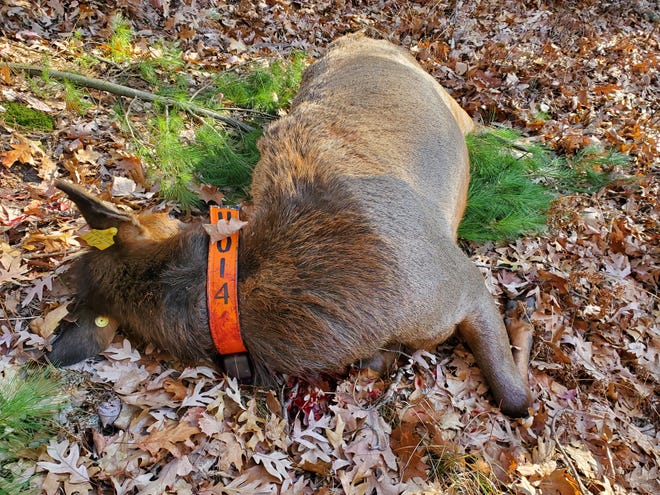
Two adult cow elk in Jackson County were illegally killed by hunters during the 2020 Wisconsin nine-day gun deer hunting season, according to the Department of Natural Resources.
The incidents occurred Nov. 21 on public land at Lake Wazee County Park and Nov. 23 on private land east of Milston.
The animal shot near Milston was at least6½ years old and was among the elk transferred to Wisconsin from Kentucky in2015 and2016to re-establish an elk herd in central Wisconsin, said Scott Roepke, DNR elk biologist. It was wearing a bright orange GPS collar.
The other elk was a 2½-year-old born in Wisconsin; it was wearing an orange-and-red collar.
The Washington Post Magazine recently ran a misleading story on wild horses, focusing attention on anti-federalist ranchers in Nevada and the big money behind them. By failing to look beyond the superficial personality conflicts, and missing the real and important public lands issues, this article does its readers a disservice.
In the article, the writer characterizes the wild horse issue as an “emotional battle,” and correctly observes, “Many ranchers see the mustangs as an overpopulated invasive species that competes for the public land their livestock grazes.”
However, the reality is that wild horses are only bit players in a very real, West-wide ecological battle in which the livestock industry is the principle antagonist. Domestic cattle and sheep (not horses) are the most significant overpopulated invasive species, competing for the public land that our wildlife – elk, mule deer, pronghorn, and bighorn sheep – need to survive.
Pancake Herd, BLM lands, Nevada. Photo: Erik Molvar.
The scope of livestock destruction on western public land dwarfs the impact of wild horses. Wild horses are completely absent on almost 90% of western public lands, and on that small subset where they roam, free-ranging equids pose a measurable impact only in places where aggressive federal roundups aren’t already holding their populations at low levels. In the 1700s, there were an estimated two to seven million wild horses in North America, and native wildlife were abundant. Since the Wild Horse and Burro Protection Act of 1971, many herds have been entirely eliminated. Meanwhile, domestic livestock are found almost everywhere on federal public lands and are authorized to graze at densities that create long-term ecological destruction, with minimal oversight and management.
In fact, the livestock industry in the West plays a pivotal role in the two great environmental issues of our time: climate change and the biodiversity crisis. With their wholesale destruction of native grasses, cattle and domestic sheep today are converting native ecosystems to cheatgrass wastelands at a rate that hasn’t been seen since the Dust Bowl. Cheatgrass burns with unnatural frequency, eliminating sagebrush and other deep-rooted plants. An annual weed, it dies each year, surrendering its carbon and bankrupting the soil of its carbon stores. If left undisturbed, high deserts provide carbon sequestration that scientific studies have found to immobilize more carbon even than forests. Thus, the cattle grazing on western public lands are exacerbating the climate crisis. Public lands ranching also decimates native wildlife, degrading wildlife habitats and targeting native species from wolves to prairie dogs to beavers for elimination. The role of wild horses in all this has never been found to be anything other than negligible on either of these fronts.
The article also neglects to mention that Kevin Borba – one of the two livestock industry spokespeople featured in its story – is damaging the public lands where he runs his livestock. His Fish Creek Ranch grazing allotment covers almost 300,000 acres of leased public lands, lands that are failing the Bureau of Land Management’s (BLM’s) basic rangeland health standards. According to the BLM, the cause of the land health problem is cattle, not horses. Borba has a history of involvement with anti-public-land insurrections, including the 2014 “Grass March,” where anti-government ranchers drove across the country with horse trailers, ceremonially riding their horses through the towns along the way to protest federal management of livestock grazing on public lands.
Pancake Herd, BLM lands, Nevada. Photo: Erik Molvar.
Similarly, the article fails to identify the other livestock industry spokesman, David Duquette, as a supporter of the Hammonds, notorious ranchers and convicted arsonists who had set fire to Oregon’s public lands in order to create more grass for their cows. It was the Hammonds’ imprisonment that touched off the armed occupation of Malheur National Wildlife Refuge in 2015 by Cliven Bundy’s sons and their ragtag gang of domestic terrorists. These spokespeople aren’t outliers, they are just some of the more prominent voices in a movement that seeks to give control of public lands and resources to profit-driven interest groups.
Wild horses can absolutely damage the vegetation, as can any large herbivore, but this is rarely the case. In Wyoming, for example, the BLM is currently in a planning process to zero out three major wild horse Herd Management Areas in the fabled Red Desert, an area currently home to 2,065 wild horses, according to BLM estimates. The agency’s own analysis shows that all of these Herd Management Areas are able to maintain a “thriving natural ecological balance” under current management, without the massive reductions or elimination of wild horses proposed in the proposed plan.
The Washington Post article glosses over a deep and complicated controversy over land management in northeastern Nevada, in which a Bureau of Land Management field manager was targeted for bullying, not just by the livestock industry but by his own State Director, for trying to address chronic violations of domestic livestock leases on federal lands. These types of violations have been repeated over and over again throughout the West, and are symptomatic of systematic (and too often officially authorized) overgrazing of public lands by cattle and sheep that are the real problem here. A more penetrating article on the subject – featuring the same cast of characters – was written several years ago by a more thorough and insightful journalist. It’s too bad that the Washington Post couldn’t offer its readers an article living up to this higher standard of journalism.
By parroting the fake-news hysteria of the livestock industry, the Washington Post has given a nationwide megaphone to half-baked myths about wild horses first voiced by William Perry Pendley, the illegitimate and now-discredited interim director of the Bureau. This narrative distracts public attention from the very real and major ecological problems posed by domestic livestock. In doing so, it helps the livestock industry escape accountability for business practices that have long been abusive and destructive to America’s public lands.
Submitted to OnFocus – On Thursday, November 26, 2020 at 1641 hours, the Waushara County Sheriff’s Office 911 Dispatch Center received a 911 call reporting someone had been shot in a hunting incident near the intersection of Czech Ave and 7th Court in the Town of Coloma, Waushara County, Wisconsin.
The Waushara County Sheriff’s Office, Department of Natural Resources, Waushara County EMS and Coloma Rescue responded to the scene.
The victim in this case had non-life threatening injuries. Both suspect and victim are not from the area.
The circumstances surrounding the shooting is still under investigation by the Waushara County Sheriff’s Office and the Wisconsin DNR.
Jake PrinsenFond du Lac Reporter0:430:43https://imasdk.googleapis.com/js/core/bridge3.426.0_en.html#goog_763851026
CAMPBELLSPORT – A 40-year-old Oakfield man was airlifted to the hospital Monday after he fell about 35 feet from his tree stand in the Kettle Moraine State Forest.
Deputies responded around 12:40 p.m. after the hunter called for help in the Northern Unit of the Kettle Moraine State Forest near the Zillmer Trail, according to the Fond du Lac County Sheriff’s Office.
Officials said the man used his phone to direct DNR wardens and first responders to him. A Flight for Life helicopter took the man to a hospital with injuries that weren’t life-threatening.
By: Mark ThorsellPosted at 2:40 PM, Nov 30, 2020 and last updated 2:02 PM, Nov 30, 2020
HAMILTON — Authorities have released the name of a man who died in a weekend hunting accident in the Bitterroot.
Ravalli County Sheriff Steve Holton says 51-year-old Joseph Burgess of Corvallis died on Saturday morning in an area near Hamilton Heights Road east of Hamilton.
Sheriff Holton says that Burgess died as a result of an accidental gunshot injury sustained when a rifle was discharged inside a vehicle.
Scott Elliott the mayor-elect of Dunbar, West Virginia lost his arm in a hunting accident.November 30, 2020 at 10:51 amFiled Under:Dunbar, Hunting Accident, Scott Elliott, West Virginiajavascript:false
DUNBAR, W.Va. (AP) — The mayor-elect of a West Virginia city has lost an arm in a hunting accident.
Dunbar Mayor-elect Scott Elliott was injured in a hunting accident Friday, City Council member Greg Hudson said in a Facebook post.
The accident happened in the Davis Creek area of Charleston, WCHS-TV reported.
Elliott was elected mayor in November. He is the city’s current public works director and retired in 2017 after more than 20 years with the Dunbar police department.


 A 28-year-old Bemidji man was killed in a hunting accident last Wednesday, the Beltrami County Sheriff’s Office said in a Monday afternoon Facebook post.|Photo: WDIO-TV/File
 Thousands of images drawn during the last ice age were found in the Amazon Rainforest.(Image: © Marie-Claire Thomas/Wild Blue Media)