California and southwest US under heightened fire risk02:25
(CNN)A wildfire that nearly quadrupled in size Monday, prompted tens of thousands of people to evacuate and caused two firefighters to suffer critical injuries may have been started by a power company’s equipment.Southern California Edison said a power line may have played a role in the ignition of the Silverado Fire — which has burned 7,200 acres near Irvine — a report filed with California Public Utilities Commission shows.The initial safety incident report describes overhead electrical facilities in the area where authorities think the fire started, but notes there was no activity on the circuit.”We reported the incident despite seeing no activity on the nearby 12-kV circuit nor any downed power lines because it appears that a lashing wire attached…
Researchers worry that the Laptev Sea findings may signal a new climate feedback loop has been triggered. Photograph: Markus Rex/Alfred-Wegener-Institut
Scientists have found evidence that frozen methane deposits in theArcticOcean – known as the “sleeping giants of the carbon cycle” – have started to be released over a large area of the continental slope off the East Siberian coast, the Guardian can reveal.
High levels of the potent greenhouse gas have been detected down to a depth of 350 metres in the Laptev Sea nearRussia, prompting concern among researchers that a new climate feedback loop may have been triggered that could accelerate the pace of global heating.
BY JONATHAN JAKUBOWSKI AND CHRISTOS A. MAKRIDIS, OPINION CONTRIBUTORS — 10/27/20 01:30 PM EDT 2,311THE VIEWS EXPRESSED BY CONTRIBUTORS ARE THEIR OWN AND NOT THE VIEW OF THE HILL151
We predict that PresidentTrumpis going to win the 2020 presidential election — and win big.
Whilethe majority of the pollssuggest that Democratic presidential nomineeJoe Bidenis leading, or at best that it’s close, those polls suffer from at least three problems.
First, the tone of the questions. There is significant evidence frombehavioral psychologythat suggests that the way a question is framed predetermines the range of potential answers. In fact, Gallup hasfoundthat respondents can answer very differently to questions with the same topic even in the same survey based on the language that’s used. And the use of metaphors can evendwarfthe importance…
In his new book Why Vegan?, the pioneering philosopher of animal rights takes stock of the movement’s progress — and why there’s so much work left to doBy Kelsey Piper Oct 27, 2020, 8:30am EDT
Philosopher Peter Singer’s newest book, Why Vegan? returns to questions he’s spent 45 years writing about.
This story is part of a group of stories called
Finding the best ways to do good.
Forty-five years ago, Australian philosopher Peter Singer published the book Animal Liberation. The arguments it made— that animals can suffer; that it is morally wrong to inflict extraordinary suffering upon them; and that we consequently haveto rethink our farming and food systems — are ones that many consumers today will have heard.
At the time, however,Singer’s perspective was a deeply unusual one. There were animal advocacy groups,certainly, but they tended to focus on the plight of abandoned pet animals, like cats and dogs, with no major organization working on the plight of farmed animals (more on this below).
In a 1999 New Yorker profile, journalist Michael Specter wrote thatSinger “gave birth to the animal-rights movement.” Singer’s book, activist Ingrid Newkirk wrote, “was a philosophical bombshell. It forever changed the conversation about our treatment of animals. It made people — myself included — change what we ate, what we wore, and how we perceived animals.” Simply put, the animal welfare movement would not be where it is today without Singer and his book.
Now, 45 years later, he’s revisiting the topic in a new book — a collection of his essays called Why Vegan?, released for sale in the US last week. I spoke with Singer about the history of the animal welfare movement, what progress we’ve made since Animal Liberation came out, and what it will take to change the world he’s been criticizing for nearly half a century now.
This transcript has been edited for clarity and brevity.
Kelsey Piper
You first wrote about the case for caring about animals 45 years ago. What has changed?
Peter Singer
A lot has changed, really. There has been a huge amount of change in awareness. Quite frankly, there is an animal movement now, which is concerned about all animals, not just about dogs and cats and horses.
And there really wasn’t in 1975. It’s not that thereweren’t sort of tiny organizations. There were so many vivisection organizations [which work to combat the practice of animal vivisection for research], actually. But in terms of farm animals, there was really nothing going on. There was a small organization called Compassion in World Farming in the UK when I got into it, which is now a sort of quite large global organization. But it was run by one guy out of his home, I think, at the time, and there was no legislation to protect the welfare of farm animals.
Then there’s a huge change in the availability of vegetarian and vegan food. Nobody would have known what vegan meant in 1975. There was this very small British organization that was founded in the late ’40s, called the Vegan Society. That was probably pretty much all of the vegans in the UK. And virtually none in the US either. There’s been a huge growth of awareness — organizations like People for the Ethical Treatment of Animals, to courses in animal law being taught at Harvard. There was none of that happening at all [in 1975].
So that’s an immense amount of change. But there hasn’t been nearly enough change in the way we treat animals.
Kelsey Piper
There’s change, maybe, in people’s interest in the issue and how we think about it, but still a pretty bad situation on the ground, and in some ways getting worse, right? Because we have more automation, we have more technology. We’ve bred birds differently.
Peter Singer
Yeah, the breeding of chickens in particular is a really bad aspect of it. They grow faster, they put on weight faster, and they seem to be in more pain just standing up now. That’s one difference, which you’ve written about.
The other thing that I would say is — it isn’t bad that China and a lot of other countries are more prosperous. That’s great because there are fewer people in extreme poverty. But there are also hundreds of millions more people wanting to eat meat, [previously] unable to afford to eat meat. And China, in particular, has no national laws about animal welfare at all. The multiplying factory farms, what conditions the animals undergo — they’re pretty terrible. When you go to China, you see [animal abuses] that are pretty horrible you wouldn’t see here in the US.
Kelsey Piper
I’m also curious about the philosophy side of this. Are the arguments that you put forward 45 years ago still what you see as some of the strongest arguments for animals?
Peter Singer
I think the arguments that I put forward in 1975 are still the basic arguments, which seemed to me the most cogent. So what happened after I wrote Animal Liberation is that a number of different philosophers use different approaches.[American philosopher]Tom Regan’s animal rights argument, for example, wasn’t really in the literature beforehand, not in the form that Tom put it in, and a variety of other different views. [Regan argues that from a Kantian perspective, at least some animals have intrinsic rights as humans do, because they are what he called “subjects-of-a-life.”]
So there is more pluralism about different approaches, philosophically, that lead to somewhat similar conclusions. But I remain a consequentialist. [There are] rights-based approaches — for those who like that approach … [they] are out there, and that’s a good thing. Martha Nussbaum’s capabilities approach comes to a similar conclusion as well. [Nussbaum’s approach argues that ethics should be focused on the freedom to achieve well-being, and understood in terms of how many real opportunities to do that someone has.]
Kelsey Piper
I have seen it said that animals mattering, and being of moral significance — and accordingly, factory farming being very bad — is something of a rare area of agreement in moral philosophy.
Peter Singer
Yeah, absolutely. And even people who disagree on some of the points, like Roger Scruton, who died recently, was a conservative, British philosopher. Some sort of religious bent, I think, because hetalked about [how] we should have piety towards animals. He certainly continued to eat them, and even champion eating them, but he certainly opposed factory farming.
Kelsey Piper
I’m curious what you see as the strongest, simply put argument for being vegan.
Peter Singer
I think that it removes you completely from complicity in practices that are not morally defensible about the raising and killing of animals for food.
There are more complicated arguments about whether you’re justified in bringing animals into existence who would not otherwise have existed and have a good life, about animals raised in suitable conditions and humanely killed. So you know, there are arguments for defending some forms of animal consumption. I don’t know what the impact of that is on attitudes to animals and whether it reinforces the idea that animals are still things for us to use.
Kelsey Piper
Are you personally vegan?
Peter Singer
Strictly speaking, no. For example, I don’t think that bivalves — mussels and clams — I don’t think they can suffer, so I eat them. I would certainly eat cellular-based meat, once it was available. And I’m not really strict about avoiding free-range eggs.
Kelsey Piper
That’s been one of the struggles in our family, finding eggs that we are confident come from chickens who were well-treated.
Peter Singer
Yes, that’s right. I think it’s somewhat easier to get genuinely free-range eggs in Australia [where Singer lives] than in big American cities anyway. It’s not always that easy to sort out which are labeled free range, but actually kept in big warehouses with small patches where they can go outside. In Australia they report the stocking density.
Kelsey Piper
In 2020, of course, there’s lots of old arguments about animal farming that are still relevant. But there’s also some new sorts of concerns on everybody’s horizon — like the potential for pandemics and the potential for contributing to climate change.
Peter Singer
The last essay in the collection is a 2020 essay about the origins of the coronavirus pandemic, flu, and whatnot. It talks about wet markets, and the combination of cruelty and health risk that involves.
When I published Animal Liberation, I was focused entirely on the animal aspect of it. Then, during the ’80s, I became aware of the climate change issue, and of the role of animal production in that. So there was a second major argument for avoiding animal products. When I talk to people who’ve become vegan in the last few years, I find climate has played quite a significant role.
And then in recent years, I’ve become aware of the risk of pandemics coming out of factory farming. So what I say in the book is — there’s now this third reason: animals, climate, pandemics.
By10/11 NOWPublished:Oct. 26, 2020 at 7:18 AM PDT|Updated:6 hours ago
LINCOLN, Neb. (KOLN) – The Lancaster County Sheriff’s Office said a 9-year-old Seward boy was killed in a hunting accident near Branched Oak Lake on Sunday morning.
The accident happened near NW 98th Street and West Davey road about 7:40 a.m.
LSO said the young boy accidentally shot himself while pheasant hunting with his father.
Authorities said Gunnar Holte, 9, was shooting at a bird, went to reload a shotgun, and the gun fired.ADVERTISEMENThttps://bc7e4732dc648cfe303b03e1c0e3ea36.safeframe.googlesyndication.com/safeframe/1-0-37/html/container.html
The father said he turned around and saw his son had fallen.
An off-duty Lincoln Police officer was also in the area hunting and tried to help the boy.
The child was taken to the hospital where life-saving measures were not successful, LSO said.
A GoFundMe account has been created to help cover funeral expenses:https://www.gofundme.com/f/qvesmv-gunnar-holte-funeral-expensesADVERTISEMENThttps://bc7e4732dc648cfe303b03e1c0e3ea36.safeframe.googlesyndication.com/safeframe/1-0-37/html/container.htmlhttps://www.facebook.com/plugins/post.php?href=https%3A%2F%2Fwww.facebook.com%2Fpermalink.php%3Fstory_fbid%3D3454499491283747%26id%3D148154821918247&show_text=true&width=552&height=551&appId
Boston police said officers responded at 4:11 a.m. to the area of 700 Boylston St., which is the location of the library’s main branch. When they arrived at the scene, the officers saw Boston firefighters tending to smoke coming from the ballot box.
The ballot box appeared to be on fire, but firefighters were unable to determine if the fire was burning on the inside, according to police. Crews were eventually able to extinguish the fire by filling the box with water.
Police released photos of a suspect Sunday evening, and officers on patrol in the area of Copley Square saw a man matching the description at about 10:50 p.m. While speaking with the man, 39-year-old Worldy Armand, police discovered that he had an active warrant out of Ipswich District Court for receiving stolen property and took him into custody.
While he was in police custody, members of the fire investigation unit were able to identify Armand as the suspect in the ballot box fire and charged him with willful and malicious burning.
“I want to thank the Boston Police Department for their swift action, our law enforcement partners and members of the community who all played a role that led to the arrest of the suspect in the Copley Square ballot drop box incident,” reads a statement from Boston Mayor Marty Walsh. “From our election workers who are working hard to trace every legible ballot in that drop box, to our firefighters who quickly responded to the fire, and our police officers who launched an immediate investigation, voters can be assured that our first and foremost priority is maintaining the integrity of our elections process. We remain committed to making their voices heard in this and every election, and maintaining transparency and trust with voters.”
Boston Police Dept.Worldy Armand, 39, of Boston
Armand was arraigned Monday in Boston Municipal Court, where he underwent a mental health evaluation.
“I do not believe that this individual is plotting against our democracy. I think that he is emotionally disturbed,” said Suffolk County District Attorney Rachael Rollins.
The U.S. Attorney’s Office was going to prosecute the case, but since Armand’s case is going to be handled by Rollins’ office unless federal charges are filed in the future.
“You will be held accountable if you do this,” the district attorney said. “Certainly, if you have cognitive impartments, we will get you the help that you need. But you will not be out here engaging in this behavior. Whether it is intentional or not, we are going to make sure we remove individuals that are doing that.”
Secretary of the Commonwealth William Galvin contacted U.S. Attorney’s Office after he was notified of the incident Sunday morning, and also called on the FBI to investigate the “deliberate attack.”
When the drop box was emptied Sunday morning, 87 of the 122 ballots inside were legible and able to be processed, and at least 30 were destroyed by either the fire or the water that extinguished it. The last time the box had been emptied prior to the fire was just before 2:30 p.m. Saturday.
Galvin told NewsCenter 5’s Julie Loncich that it appears a sophisticated incendiary device was used to start the fire, as the damage to the interior plastic lining of the ballot drop box was severe.
In announcing their investigation, the U.S. Attorney’s Office and the FBI issued a statement saying in part, “For the next several weeks, it is a top priority of our offices to help maintain the integrity of the election process in Massachusetts by aggressively enforcing federal election laws.”Play Video
Boston voters who used the Copley Square drop box between 2:30 p.m. Saturday and 4 a.m. Sunday, and who haven’t been able to confirm receipt of their ballot through the state’s tracking website, are urged to immediately contact the Boston Election Department.
Affected voters will be mailed a replacement ballot and can either cast it or vote in-person until 8 p.m. on Election Day, which is Nov. 3. Any affected voters who do not submit a new ballot will have their original ballot hand-counted to the best extent possible, according to Galvin’s office.
“I sent out an urgent directive (Sunday) afternoon to secure ballot drop boxes,” Galvin said. “If at all possible, have them inside of municipal facilities. If necessary, as we go down the stretch in this election and they need police officers there, that’s what they need to do. We’ll deal with the compensation issues later.”
According to the Malden District Court criminal clerk, Armand was arrested on Oct. 11 and charged in connection with a fire that was set outside of the Town Line Inn Motel. That case remains open and he is due back in court on Dec. 3.
The last time CO2 concentrations reached today’s level was 3 million years ago, during the Pliocene Epoch. Hear from geoscientists who see evolving conditions in the Arctic as an indicator of how climate change could transform the planet.Sharing is caring!
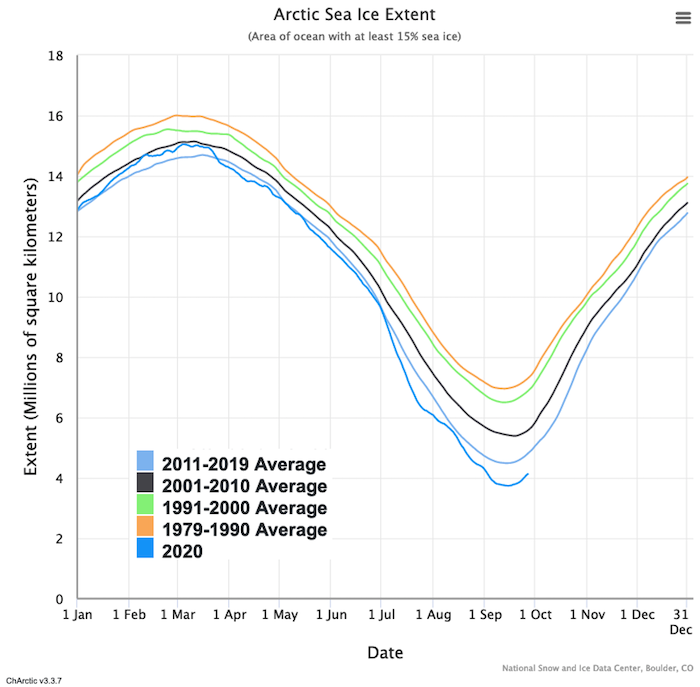
Every year, sea ice cover in the Arctic Ocean shrinks to a low point in mid-September. This year it measures just 1.44 million square miles (3.74 million square km), thesecond-lowest valuein the 42 years since satellites began taking measurements. The ice today covers only50% of the area it covered 40 years agoin late summer.
A man is facing charges of grand theft and trespassing after police say he stole a bulldozer from a construction site and drove around Haines City, Fla., destroying signs supporting former Vice President Joe Biden‘s (D) campaign.
Bay News 9 reported that 26-year-old James Blight told police he was drunk at the time and did not remember the incident. Residents told the news outlet that Blight stole signs from some houses and destroyed at least one resident’s chain-link fence, while destroying others on his rampage around town.
“This man came onto my property, took the two Joe Biden signs I had in my yard and them came back with a bulldozer to run down my fence,” said Adam Burgess, the town’s former vice mayor, in an interview with Bay News 9.
“He stopped traffic and cussed everybody out,” another resident told the news channel. “There were four signs on H Street, he took the front loader and dug them up.”
Representatives from the Trump and Biden campaigns did not immediately return a request for comment.
Florida is seen as a key target of President Trump‘s reelection efforts; he won the state over Hillary Clinton (D) in 2016 by just over 1 percent of the vote. A FiveThirtyEight average of polls in the state shows Biden with a lead of just over two percentage points.





 Updated: 3:46 PM EDT Oct 26, 2020Infinite Scroll EnabledPlay Video SHOW TRANSCRIPT