A woman walks by a projection of flames and commentary on the side of the Trump International Hotel organized by activists in protest of President Donald Trump’s response to science and climate change in the face of devastating wild fires burning throughout the United States on October 21, 2020, in Washington, D.C.
The position of the Academies of Science from more than 80 countries and scores of scientific organizations is that global warming is human-caused through the release of carbon dioxide and other greenhouse gases into the atmosphere from the burning of fossil fuels (coal, natural gas, oil) to generate power. In fact, scientists have known for decades how carbon dioxide traps heat in the atmosphere and contributes to global warming, with nuclear weapons physicistEdward…
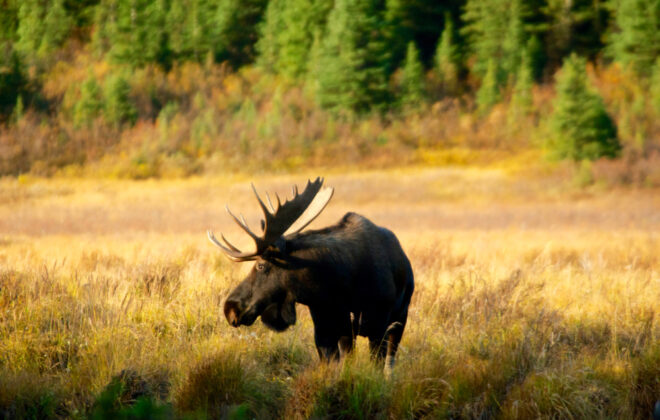
The Manitoba Metis Federation has indicated it’s prepared for a legal battle over members’ constitutional rights to hunt moose.
“We are standing firm on our commitment to a balanced approach for Métis harvesters seeking moose meat to feed their families and elders, while limiting the number of animals taken,” said MMF president David Chartrand in an Oct. 9 news release.
“Any Métis harvester card holder with a drawn tag who is charged by this premier will be protected by your Métis Government,” the release says.
For the first time since 1980, important field research on polar bears near Churchill, Manitoba will not take place and this, because of the COVID-19 pandemic and travel restrictions. Usually, in September, scientists get transportation by government helicopter so they can sedate more than 100 bears. The bears are measured and fitted with ear tags or special collars that transmit data on their movement to a satellite and back to scientists’ desktops. Batteries run out eventually and the collars are programmed to fall off. They are later retrieved, new batteries put in and the collars are placed back on the bears.
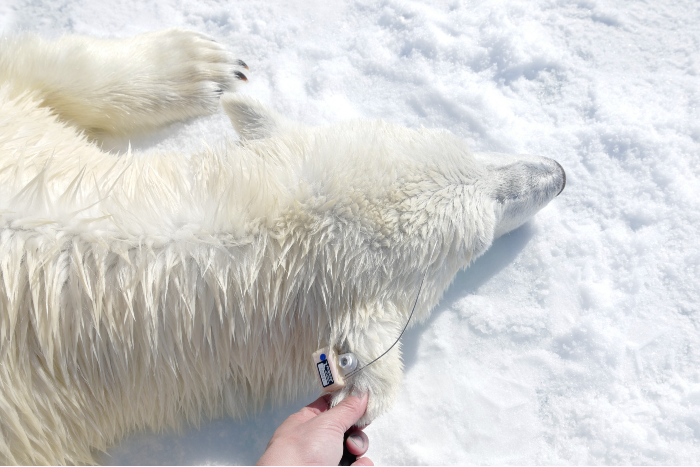
“Satellite ear tag radio that provides one location per day. These are the tags that we have been deploying in the last years out on the sea ice in the spring but were unable to do so in 2020. These provide information on habitat use, movement, site fidelity, and timing of return to land – these are all relevant to understanding and monitoring the effects of climate change,” explains Andrew Derocher. (Andrew Derocher)
‘A mystery year’
“This will be a mystery year,” says Andrew Desrocher, a biology professor at the University of Alberta and long-time polar bear specialist. He notes that earlier this year there was more ice for bears to hunt from and the bears appeared fatter. But it is important to follow up and see how they have progressed. In recent years, the population has dropped from 1,200 to 800 and it would be good to know if the number has stabilized, he says. Polar bears in Hudson Bay have been studied for a long time. In particular, Desrocher has been monitoring how climate change is affecting them.
There are two issues of particular focus: have the numbers declined because ice cover is changing due to climate change or is the number of seals, which polar bears eat, declining. To some extent, it could be both. But this year there will be a hole in the data used to try to puzzle this out.
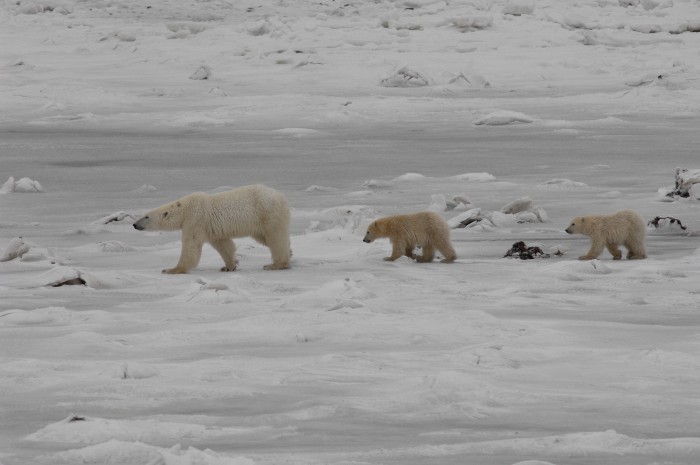
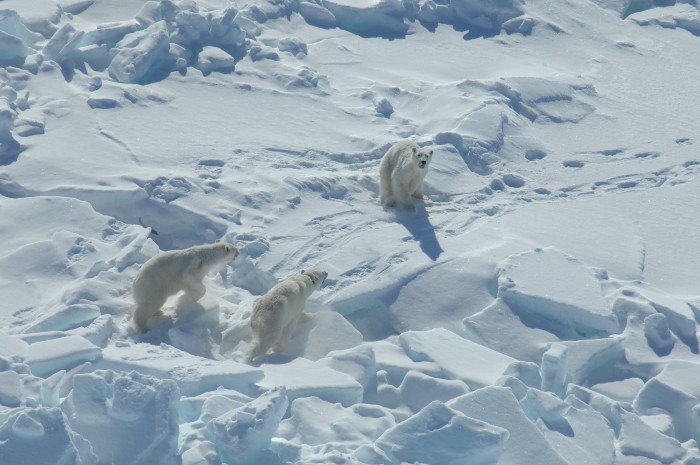
“Mother with 2 cubs-of-the-year (about 10 months old) waiting for the sea ice to reform. Cubs nurse for 2.5 years and rely on fat stores of their mother to produce milk when seals are unavailable. If a mother drops too low in body condition, she stops lactating and the cubs, which have low fat stores themselves, often succumb to starvation. The date of sea ice break up and freeze up are critical as the bears use almost 1 kg of body weight per day when not feeding. The ice-free period in Hudson Bay has increased over the past decades,” says Andrew Derocher. (Andrew Derocher)
“Adult female polar bear with her 2 year cubs. The mother is wearing a tracking collar that provides 6 locations per day that are sent by satellite,” explains Andrew Derocher.
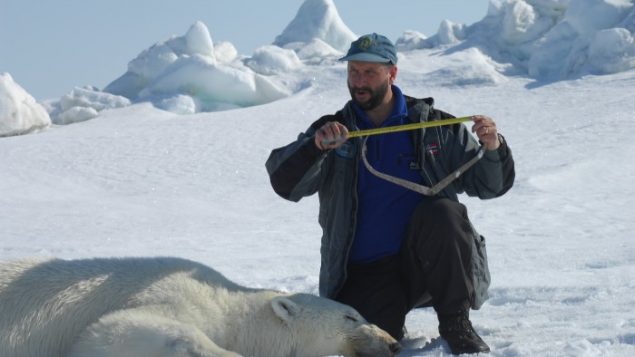
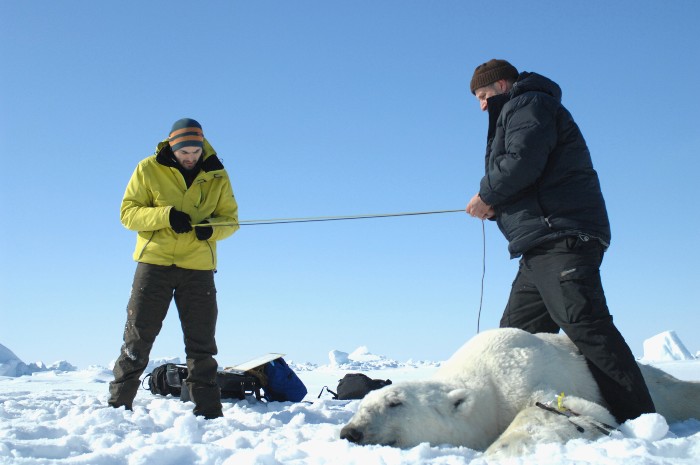
“University of Alberta researchers (Ron Togunov (L), Andrew Derocher (R)) measuring the rope used to determine the chest girth of a polar bear. Along with body length, the chest measurement allows researchers to estimate body weight and body condition,” explains Andrew Derocher. (Andrew Derocher)
For Atlanta-based food writer Angela Hansberger, the coronavirus pandemic has been hard to swallow. She can’t write about restaurants when they’re closed.
“I was facing a lot of anxiety. I kind of hid it,” said Hansberger. “Gosh, I’m crying. I was really sad for all the people in the industry that I worked with.”
Hansberger said she had to get her mind off it. So, using ingredients from her garden, and her encyclopedic knowledge of fine dining, she opened her own restaurant on her front porch, where she now serves chipmunk.
The little guy has had a standing lunch reservation for months now.
A chipmunk sits in its own porch restaurant. CBS NEWS
Whether it’s veggie pizza and a side salad, or imitation sushi with walnut wontons, every day, Hansberger goes to remarkable lengths for her exclusive clientele.
“Took a while to try and make little tortillas that I could fold to put the…,” said Hansberger, as she started laughing. “I love the way that you’re shaking.”
“Well, I love how you’re realizing how crazy it sounds as you’re saying it,” I responded.
Today, it’s mini spaghetti with tiny date meatballs and a thimble full of almond flour breadsticks. The chipmunk, who she named Thelonious Munk, typically arrives within seconds of serving, eats his fill and packs the rest to go in his cheeky doggy bag.
“And the reviews have been good?” I asked Hansberger.
“The reviews have been great,” she replied. “One day he came up with this little tiny bundle – waded up leaves – and put it on the table. So, I take it to mean he brought a tip.”
That said, you get the sense that Thelonious is still a little skeptical – like there’s gotta be a catch. Her cat wishes there was a catch. But there will be none of that because, for Hansberger, this bit of silliness has become her daily sustenance.
When asked what this has done for her, she responded, “It’s brought joy. I have more videos of this chipmunk than I have of my children. It’s bad.”
We all need to find a way to cope during this pandemic, which is why I’m giving Chez Angela my highest rodent restaurant rating: 3 stripes.
Park County Search and Rescue volunteers prepare to get a lift home after hiking 2 miles from the scene of a rescue in the South Fork area earlier this month. A team of six rescued an Iowa man after he broke his leg in a fall during an elk hunt.COURTESY PHOTO
PostedThursday,October 22, 20208:15 amByMark Davis
A recent rescue mission in the backcountry of the South Fork highlighted the importance of being prepared — and the commitment of Park County volunteers.
After a hunter shot an elk on Friday, Oct. 9, his guide returned to camp to get horses to pack out the trophy. In the meantime, while trying to reach his harvested elk, the hunter slid down a steep ravine and snapped his lower right leg.
When the guide returned, he found the elk, but couldn’t find his client. He went back to camp, thinking the hunter had…
A man being stalked by a mountain lion in southern Colorado on Sunday lived to tell about it — and post a two-minute Facebook video capturing the encounter.
“After changing the memory cards and rustling around in the leaves, I stood up and turned around slowly, scanning the woods behind me,” Shivelywrote in his Facebook post. “Suddenly, I spotted this motionless mountain lion crouched down behind a rock, ready to pounce on me. He had silently stalked to within 20…
The U.S. reported more than 83,700 new Covid-19 cases on Friday, passing the last record of roughly 77,300 cases seen in mid-July, according to data compiled by Johns Hopkins University.
Amid the growing trend in cases, health experts are warning that the U.S. could be in for a difficult winter.
The increase in cases in several states are leading to more hospitalizations and will ultimately lead to more deaths, White House coronavirus advisor Dr. Anthony Fauci said Friday.
U.S. National Guard Cpl. Kyle Zahn of the 157th Maneuver Enhancement Brigade, physician assistant (PA) Harrison Pham, and certified nursing assistants (CNAs) Jermaine LeFlare and Shameka Johnson process nasal swab samples at a drive-thru testing site outside the Southside Health Center as the coronavirus disease (COVID-19) outbreak continues in Milwaukee, Wisconsin, October 21, 2020.Bing Guan | Reuters
The U.S. reported a record-breaking number of new coronavirus cases on Friday, continuing an alarming surge and stoking concerns from health experts that the nation could be in for a difficult winter.
The country reported more than 83,700 new Covid-19 cases on Friday, passing the last record of roughly 77,300 cases seen on July 16 as the U.S. grappled with outbreaks in Sun Belt states, according to data compiled by Johns Hopkins University.
“I think we’re in for a very hard stretch here,” Dr. Scott Gottlieb, the former U.S. Food and Drug Administration commissioner, told CNBC on Friday evening. “I think the winter is going to be very difficult.”
Coronavirus cases grew by 5% or more over the past week in 37 states as of Friday, according to a CNBC analysis of Johns Hopkins data that uses a weekly average to smooth out fluctuations in daily reporting.
Some states, like California and Alabama, have been working through a backlog of tests that were added to Friday’s count, pushing the nation’s total higher, according to their data dashboards. However, the nation is now reporting roughly 63,200 daily new cases based on a weekly average, a more than 14% increase compared with a week ago.
While Covid-19 testing is up nearly 13% from Oct. 1, new cases have risen at a much faster rate. The seven-day average of new infections is up 51% over that same period, according to Johns Hopkins data.
“I think we’re going to bear a lot more infection … and the health-care system is going to have to bear the brunt of this burden, because I don’t think you have the popular will for stay-at-home orders or broad mitigation,” Gottlieb said, adding that the virus’ spread would slow “if everyone would just wear masks.”WATCH NOWVIDEO00:58Daily death statistics from Covid this winter could be staggering: Dr. Scott Gottlieb
The recent surge is a “distressing trend” that is likely due to “smaller, more intimate gatherings of family, friends and neighbors” that are moving indoors as the weather cools, Jay Butler, the U.S. Centers for Disease Control and Prevention’s deputy director for infectious diseases, told reporters on a conference call Wednesday.
The outbreaks are building throughout the country with particular areas of concern in the Midwest, Butler said. As of Friday, North Dakota, South Dakota, Montana and Wisconsin continue to report the highest number of new cases per capita.
The increase in cases in several states are leading to more hospitalizations and will ultimately lead to more deaths, White House coronavirus advisor Dr. Anthony Fauci told MSNBC’s Chuck Todd on Friday.
Thirteen states reached record high hospitalizations on Friday, based on a weekly average. Many of them are in the West and Midwest, including Iowa, Montana, North Dakota, Nebraska, Ohio, Oklahoma, South Dakota, Utah, Wisconsin and Wyoming, according to a CNBC analysis of Covid Tracking Project data.WATCH NOWVIDEO03:22Here are the chances you’ll get another $1,200 stimulus check
Coronavirus deaths have remained relatively flat in the U.S., though health experts warn fatalities typically lag infections by a few weeks.
“When you enter the season of the cooler months of the fall and the colder months of the winter, where a lot of activity, out of necessity, is going to be inside as opposed to outside, that’s a difficult and challenging situation to be in because you have a couple of factors against you,” Fauci said.
If SCI wants to serve the greater good of wildlife conservation, it should join with us and other organizations in support of the numerous federal and state bills aimed at saving and protecting endangered wildlife worldwide.Photo by iStock.com79SHARES
Our agenda for the protection of wildlife is an ambitious one, focusing on the most serious threats to threatened and endangered animals in the United States and around the world. We’ve invested a lot of energy and resources in the fights to stop the trophy hunting industry in its tracks, to minimize human-wildlife conflict, halt wildlife trafficking, reduce consumer demand for products derived from endangered and threatened species, cripple the shark fin trade, end commercial whaling and other threats to marine life and eliminate…
Contaminated water from Japan’s Fukushima nuclear plant contains a radioactive substance that has the potential to damage human DNA, a report by Greenpeace says.
The claim from the environmental campaign group follows media reports suggesting the government plans to release the water into the ocean.
Many scientists say the risk is low but some environmentalists oppose the idea.
The government has not yet responded to the Greenpeace report.- ADVERTISEMENT -https://s.yimg.com/rq/darla/4-5-0/html/r-sf-flx.html
For years Japan has debated over what to do with the more than a million tonnes of water used to cool the power station, which went into meltdown in 2011 after being hit by a massive tsunami.
Space to store the liquid – which includes groundwater and rain that seeps daily into the plant – will fill up by…