Exposing the Big Game

Forget Hunters' Feeble Rationalizations and Trust Your Gut Feelings: Making Sport of Killing Is Not Healthy Human Behavior

Exposing the Big Game

Trump wants to put a rightwing zealot in charge of public land. Here’s why it matters

Cas Mudde

William Perry Pendley, Trump’s nominee to lead the Bureau of Land Management, has ties to anti-environment and anti-government forces
‘Although Pendley has been acting director of the Bureau of Land Management since last July, his official nomination will give him troubling new authority and political clout.’

‘Although Pendley has been acting director of the Bureau of Land Management since last July, his official nomination will give him troubling new authority and political clout.’ Photograph: georgesanker.com/Alamy Stock PhotoPublished onMon 6 Jul 2020 04.30 EDT

890

On 26 June, Donald Trump announced that he plans to nominate William Perry Pendley to lead the Bureau of Land Management. That may not sound like big news, but it is. First of all, the office manages one-tenth of the United States’ land mass and, therefore, massive amounts of fossil fuels. Second, Pendley is linked to two little-known but very dangerous political movements: the so-called Wise Use movement and the anti-government extremists sometimes called constitutionalists or sovereign citizens.

The appointment should not come as a total surprise. Wise Use advocates, who are fiercely opposed to almost any environmental protection laws, have long had exceptional access to the Trump administration. In 2017, Lars Larson, a “journalist” from the alternative rightwing media sphere, crystallized the attitude of the Wise Use movement with a comment he made to then press secretary Sean Spicer:

The federal government is the biggest landlord in America. It owns two-thirds of a billion acres of America. I don’t think the Founders ever envisioned it that way. Does President Trump want to start returning the people’s land to the people? And in the meantime … can he tell the forest service to start logging our forests aggressively again to provide jobs for Americans, wealth for the treasury, and not spend $3.5bn a year fighting forest fires?

Larson was expressing a key demand of the Wise Use movement. The movement wants to privatize basically all public land, so that it can be used “wisely” by big business – especially the agricultural, fossil fuel and logging industries, which are also the movement’s biggest donors. The movement has been responsible for significant harassment and threats of political violence, particularly against environmentalists and employees of government agencies in the Pacific north-west. Between 2013 and 2018 alone, federal employees overseeing public lands were assaulted or threatened at least 360 times. In roughly the same period, the FBI initiated under 100 related domestic terrorism investigations, most concerning individuals motivated by anti-government ideologies.

The anti-environmentalists overlap with sections of the broader US far right, notably so-called constitutionalists and sovereign citizens, who hold a variety of different beliefs, all essentially denying the legitimacy of the federal government. This very loosely organized subculture has been responsible for some of the most notorious anti-government actions, including the 2014 Bundy Standoff in Nevada and the 2016 Oregon Standoff. The Oregon standoff, in which members of rightwing militia groups occupied the Malheur national wildlife refuge for 41 days to protest the sentencing of two ranchers for burning federal lands, became a cause celebre for many far-right activists.

Trump has long been sympathetic to these movements. In 2018 he pardoned Dwight Hammond Jr and his son, Steven Hammond, the two farmers whose case sparked the Oregon Standoff. But so far Trump’s support has been mainly symbolic and verbal. Like Jair Bolsonaro in Brazil, Trump has questioned federal ownership of public land on many occasions. In November 2018, as California was battling massive forest fires, he tweeted:

There is no reason for these massive, deadly and costly forest fires in California except that forest management is so poor. Billions of dollars are given each year, with so many lives lost, all because of gross mismanagement of the forests. Remedy now, or no more Fed payments!

Note the similarity to Larson’s demand a year earlier.

Although Pendley has been acting director of the Bureau of Land Management since last July, his official nomination will give him troubling new authority and political clout. In addition to undermining his own agency, he will also probably push to privatize more public land and provide even more access to exploitation by agricultural, fossil fuel and logging companies. Just last week, the Bureau of Land Management proposed opening millions of acres in rural Alaska for oil and gas leasing.

Just as troubling: Pendley’s new role will probably further embolden far-right anti-environment and anti-government forces, some of which already consider themselves above the law. In an op-ed last year in the Las Vegas Review-Journal, Pendley defended the role of Bureau of Land Management law enforcement officers, but did so in rhetoric carefully calculated to appease the anti-government far right, which believes local authorities are more legitimate than the federal government: “[Bureau of Land Management] rangers,” he wrote, “partner with local law enforcement, while recognizing that counties are a governmental-arm of sovereign states. Maintaining that deference is essential to making BLM a truly productive and valued partner to western communities.”

In articles for the conservative magazine National Review, Pendley has argued that the federal government should “sell its western lands” because “westerners are tired of having Uncle Sam for a landlord”, and expressed thinly-veiled support for anti-government extremists involved in armed stand-offs with federal agents.

The Pendley case is an important reminder that the ultimate far-right threat to American democracy does not come from the Klansmen or neo-Nazis shouting “Jews won’t replace us” in the streets of Charlottesville. It comes from broad but loosely organized anti-federal government subcultures, aided by men in suits fronting for multi-billion industries.

It is this coalition of disaffected, illiberal and self-interested forces that holds Trump and the Republican leadership together and which is slowly but steadily dismantling the federal government from within. It will not stop until every acre of public land is exploited by big business and federal oversight only exists on paper. It operates in broad daylight, aided by federal, state and local Republicans and ignored or underestimated by most Democrats.

  • Cas Mudde is the Stanley Wade Shelton UGAF professor of international affairs at the University of Georgia, the author of The Far Right Today (2019), and host of the new podcast Radikaal
Dog meat: First Cambodian province bans sale and consumption

  • 8 July 2020
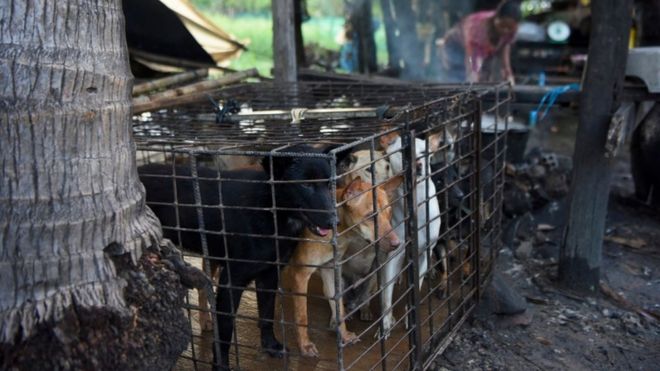
Dogs are kept in a cage as a woman boils water at a slaughterhouse in Siem Reap province (file photo)
Image captionCampaigners say 30 million dogs are killed for meat across Asia every year

A province in Cambodia has become the first in the country to ban the sale and consumption of dog meat.

Siem Reap is best known as the home of the Angkor Wat temple complex, but an animal rights group says the region had become a “hub” for the trade.

The new ban will include punishments of up to five years in prison or fines of between 7 and 50 million riel ($12,200; £7,940), AFP reports.

The decision follows similar moves in other parts of Asia in recent months.

The consumption of dog meat is not widespread in Cambodia, with fewer than 12% of people eating it on a regular basis, according to animal rights charity Four Paws. But the organisation identified Siem Reap province as a “key hot spot” in the trade.

The director of Siem Reap’s department of agriculture, forestry and fisheries, Tea Kimsoth, told Reuters news agency that tourism had led to a growth in demand for dog meat in the region.

“Dog meat has been a lot more popular following the arrivals of foreigners, especially among the (South) Koreans,” he said.

Media captionSouth Korea dog meat: The dogs saved from being eaten

The charity Four Paws welcomed the ban.

“We hope that Siem Reap will serve as a model for the rest of the country to follow suit to protect the lives of millions of dogs,” Dr Katherine Polak, the charity’s head in south-east Asia, said.

According to the Humane Society International (HSI), 30 million dogs are killed for meat across Asia every year.

In April, Shenzhen became the first city in China to ban eating cats and dogs, while India’s north-eastern state of Nagaland outlawed the import, trade and sale of dog meat earlier this month.

More on this story

C.A.S.H. article of the month: TAKE A HIKE, NOT A LIFE

Exposing the Big Game's avatarCommittee to Abolish Sport Hunting Blog

Living near prime wildlife habitat means that at any given moment you might witness the astounding sight of great Vs of migratory ducks or cackling Canada geese flying right overhead. If you’re lucky, trumpeter swans might be among the waterfowl feeding and calling in the nearby estuary. And wood ducks or hooded mergansers might pay your inland pond a visit while searching for a quiet place to nest.

The downside of living near a natural wonderland? Being awakened Sunday morning at first light by the repeated volley of shotgun blasts, as though all-out war has been declared on all things avian (as is currently happening here this morning). The Elmers (hunters) out there (no doubt dressed in the latest expensive camo-pattern—a fashion statement apparently meant to impress the other Elmers out there) must be reveling in the fact that the dense morning fog…

View original post 2,171 more words

“PSYCHOLOGICALLY DISTRESSED” TIGER IN BEIJING ZOO WALKS IN ENDLESS CIRCLES IN SMALL ENCLOSURE

Posted on 2020/05/7
TAGS: ANIMALS, NEWS

By John Vibes / Truth Theory

Footage captured at a zoo in Beijing, China shows a captive tiger walking in endless circles in his enclosure. A staff member told reporters that this type of behavior is actually common for animals who have been staying at the zoo for a long time.

Representatives with the zoo say that the Bengal tiger was later given “psychological counseling” after zookeepers noticed the strange behavior. However, the so-called “psychological counseling” that the animal was given did not seem very professional.

“We have taken the animal to receive behavior training. We also brought more food and toys for the tiger. It’s like “psychological counseling”,’ a zookeeper told reporters.

When tigers are in the wild, they usually cover a lot of ground and do a lot of exploring in their day to day activities, and that is what their instincts tell them to do.

The enclosure that the animal was kept in was just a giant cage or fence, with no semblance of a tiger’s natural habitat. This is why many zoos at least make an attempt to recreate an animal’s natural habitat in their enclosures. Unfortunately, the zoo where this tiger was held did not implement these types of natural landscapes in the animal’s enclosure, leading to severe psychological stress.https://googleads.g.doubleclick.net/pagead/ads?client=ca-pub-3352039084549762&output=html&h=280&slotname=3150226346&adk=2975939105&adf=4151858944&w=560&fwrn=4&fwrnh=100&lmt=1594312452&rafmt=1&psa=1&guci=2.2.0.0.2.2.0.0&us_privacy=1—&format=560×280&url=https%3A%2F%2Ftruththeory.com%2F2020%2F05%2F07%2Fpsychologically-distressed-tiger-in-beijing-zoo-walks-in-endless-circles-in-small-enclosure%2F%3Ffbclid%3DIwAR2wbrakKEwYO4494G1kQWeANRdixFa310X7fn8iY3KjYz7ApT7BkJsuENY&flash=0&fwr=0&fwrattr=true&rpe=1&resp_fmts=3&wgl=1&adsid=ChEI8ICb-AUQ3euZmYfC3ObdARJMALqdR0Ithprx9XP4a0v6wwQ9bdIVQMLERQERFS6Yd0lqLOg9AaPHyFPZ2pXOgJJbnKpMVYYt-Mrco_V6_8zYJsdudNNBgrtilcGqRA&dt=1594312450112&bpp=55&bdt=3819&idt=2029&shv=r20200706&cbv=r20190131&ptt=9&saldr=aa&abxe=1&cookie=ID%3D979f73b8979b71d2%3AT%3D1594309830%3AS%3DALNI_MbHGUIj4OFoXku-exRl_Rokjhdr6A&prev_fmts=0x0&nras=1&correlator=7951419361940&frm=20&pv=1&ga_vid=358418846.1594309840&ga_sid=1594312451&ga_hid=1852987212&ga_fc=1&iag=0&icsg=3000292152959520&dssz=89&mdo=0&mso=0&u_tz=-420&u_his=1&u_java=0&u_h=768&u_w=1366&u_ah=728&u_aw=1366&u_cd=24&u_nplug=3&u_nmime=4&adx=213&ady=1733&biw=1349&bih=657&scr_x=0&scr_y=0&eid=21060548&oid=3&pvsid=3207325954121030&pem=600&rx=0&eae=0&fc=1920&brdim=0%2C0%2C0%2C0%2C1366%2C0%2C1366%2C728%2C1366%2C657&vis=1&rsz=%7C%7CeEbr%7C&abl=CS&pfx=0&fu=8336&bc=31&jar=2020-7-8-19&ifi=1&uci=a!1&btvi=1&fsb=1&xpc=pEd1boSLxz&p=https%3A//truththeory.com&dtd=2284

Sun Quanhui, a senior scientific adviser at a non-profit organization called World Animal Protection China told the South China Morning Post that this is a common problem in Chinese zoos.

“Let’s just give the example of how beasts of prey are kept. In almost every Chinese zoo, we see them in cement cages or behind steel bars, which to some extent is considered maltreatment. Some are species that naturally live in groups, but they’re often isolated, which also causes them huge psychological distress.” Quanhui said.

Tigers are listed as Endangered on the IUCN Red List since 1986. As of 2015, the global wild tiger population was estimated to number between 3,062 and 3,948, but the number in captivity is far higher.

Image Credit: Asia Newswire

Coyote Pup Illegally Trapped & Fatally Maimed in Cruel Leghold Trap

Exposing the Big Game's avatarCommittee to Abolish Sport Hunting Blog

For Immediate Release: July 9, 2020

Contact:

Randi Feilich, Project Coyote Southern Cal. Rep. (310) 498-2975, rfeilich@projectcoyote.org
Camilla Fox, Project Coyote Executive Director (415) 690-0338, cfox@projectcoyote.org

Incident Under Criminal Investigation ~ Wildlife Protection Organizations Call for Justice

VALLEY VILLAGE, CA—California-based Project Coyote has released a video depicting a coyote pup captured in an illegally set leghold trap in the upscale neighborhood of Valley Village (adjacent to North Hollywood), and law enforcement agencies are currently investigating the incident for possible criminal violations.

The video shows—in graphic detail—the coyote pup struggling in the trap, desperate to free itself, with no cover in the searing summer heat. It is believed that the pup suffered in the trap for days before local residents heard it crying in pain and came to its rescue. The animal’s distress was so great, as is evident in the video, that at one point a caring girl felt compelled to offer water…

View original post 455 more words

Opinion: La. Department of Wildlife, Fisheries, ‘nuisance hunter’ shouldn’t have euthanized Lakeview alligator

Exposing the Big Game's avatarCommittee to Abolish Sport Hunting Blog

An Alligator opens its mouth Aug. 22, 2013 at LSU’s Alligator Research Station.

Authorities at the Louisiana Department of Wildlife and Fisheries (LDWF) captured and tranquilized a 10-foot, roughly 300-pound American alligator without incident after members of the New Orleans’s Lakeview community reported spotting the reptile ambling along a residential street on the morning of July 3.

In less than two hours, LDWF agents made it to the scene and were able to capture and tranquilize the alligator without incident, only to euthanize it later after contacting a licensed “nuisance alligator hunter.” The hunter in question has chosen to remain anonymous in the media, fearing targeted backlash from the public.

Many locals have expressed anger and even grief concerning the unjust fate of the Lakeview alligator. “What, too hard to drive him out to Barataria or a suitable habitat? Sounds like bad…

View original post 414 more words

Two cases of bubonic plague prompt crack down on marmot hunting

Exposing the Big Game's avatarCommittee to Abolish Sport Hunting Blog

(CNN) — Russian authorities have warned people near the country’s border with Mongolia not to hunt or eat marmots after an outbreak of bubonic plague.

Two cases of the plague were recorded in the Khovd province in western Mongolia, reported Russian state media agency TASS on Tuesday.

Marmots are large ground squirrels, a type of rodent, that have historically been linked to plague outbreaks in the region.

Officials from the Republican Ministry of Agriculture and Food told citizens in the border area not to hunt marmots or eat marmot meat, and take preventive measures against insect bites.

Rodents are the main vector of plague transmission from animals to humans, but the disease can also be passed on through flea bites.

Plague killed an estimated 50 million people in Europe during the Black Death pandemic in the…

View original post 303 more words

There’s no quick fix for climate change

Scientists looked for a ‘shortcut’ and didn’t find oneBy Justine Calma@justcalma  Jul 7, 2020, 11:00am EDT

Share this story

It could take decades before cuts to greenhouse gases actually affect global temperatures, according to a new study. 2035 is probably the earliest that scientists could see a statistically significant change in temperature — and that’s only if humans take dramatic action to combat climate change.BE READY FOR THE LONG HAUL

Specifically, 2035 is the year we might expect to see results if we switch from business-as-usual pollution to an ambitious path that limits global warming to under 2 degrees Celsius — the target laid out in the Paris climate agreement. The world isn’t on track to meet that goal, so we might not see the fruits of our labor until even later. That means policymakers need to be ready for the long haul, and we’re all going to need to be patient while we wait for the changes we make now to take effect.

“I foresee this kind of train wreck coming where we make all this effort, and we have nothing to show for it,” says lead author of the study, Bjørn Samset. “This will take time.”

It will be time well spent if we manage to cut emissions — even if we have to wait to see results. Humans have so far warmed up the planet by about 1 degree Celsius. That’s already come with more devastating superstorms and wildfires and has forced people from Louisiana to Papua New Guinea to abandon their homes as rising sea levels flood their lands. Even keeping the planet to the 2 degree goal would result in the near annihilation of the world’s coral reefs. Taking into consideration all of the commitments from world leaders to work together on climate change, we’re currently careening toward global warming of about 3 degrees Celsius above preindustrial levels.

To avoid burnout and keep aspirations high when it comes to tackling climate change, scientists and policymakers will need to be realistic about what’s ahead. The first line of the new study, published today in the journal Nature Communications, reads: “This paper is about managing our expectations.”

The study looks at the effects of cutting down on carbon dioxide, black carbon, and methane emissions. Carbon dioxide is the toughest greenhouse gas to tackle because so much of the world economy still relies on burning fossil fuels.

Methane (a more potent greenhouse that comes from agriculture and natural gas production) and black carbon (a big component of soot) are, in theory, easier to cut back. Using climate models and statistical analysis,Samset and his colleagues wanted to know whether addressing these other pollutants might lead to faster results. Their analysis isolated the effects that reducing methane and black carbon might have. They found that temperatures might respond quicker to axing these pollutants, but it wouldn’t have as big of an effect in the long term as pushing down our carbon emissions. The best bet is to tackle all three at once.“IS THERE A SHORTCUT?”

“We kind of break this apart and try to see, is there a shortcut? Is there anything we can do to give people the impression that things are having an effect? And unfortunately, the answer is no,” says Samset. “There’s no quick fix to this.”

Part of the problem is that carbon dioxide can persist in the atmosphere for hundreds of years after being released by burning coal, oil, and gas. Natural variations in climate can also delay the impact that cutting down greenhouse gases has on global temperatures.

“There is this fundamental misunderstanding of the climate system by non climate scientists trying to use trends on a 10 year time scale for climate change, when [with] climate change a 100 or 200-year timescale is relevant,” explains Natalie Mahowald, a climate scientist at Cornell University who was not involved in the study.

“All our hard work today, we will not be able to see for 20 or 30 years — this is the crux of the problem,” Mahowald says. “Humans have a really hard time doing something for future generations.”