Florida launches its tax break on guns and ammo Monday
Reply

stock up on Tofurky.
Published 2025-09-08 by Cory Allen Heidelberger
South Dakota stands out this week as the nation’s leader in newly reported outbreaks of bird flu:
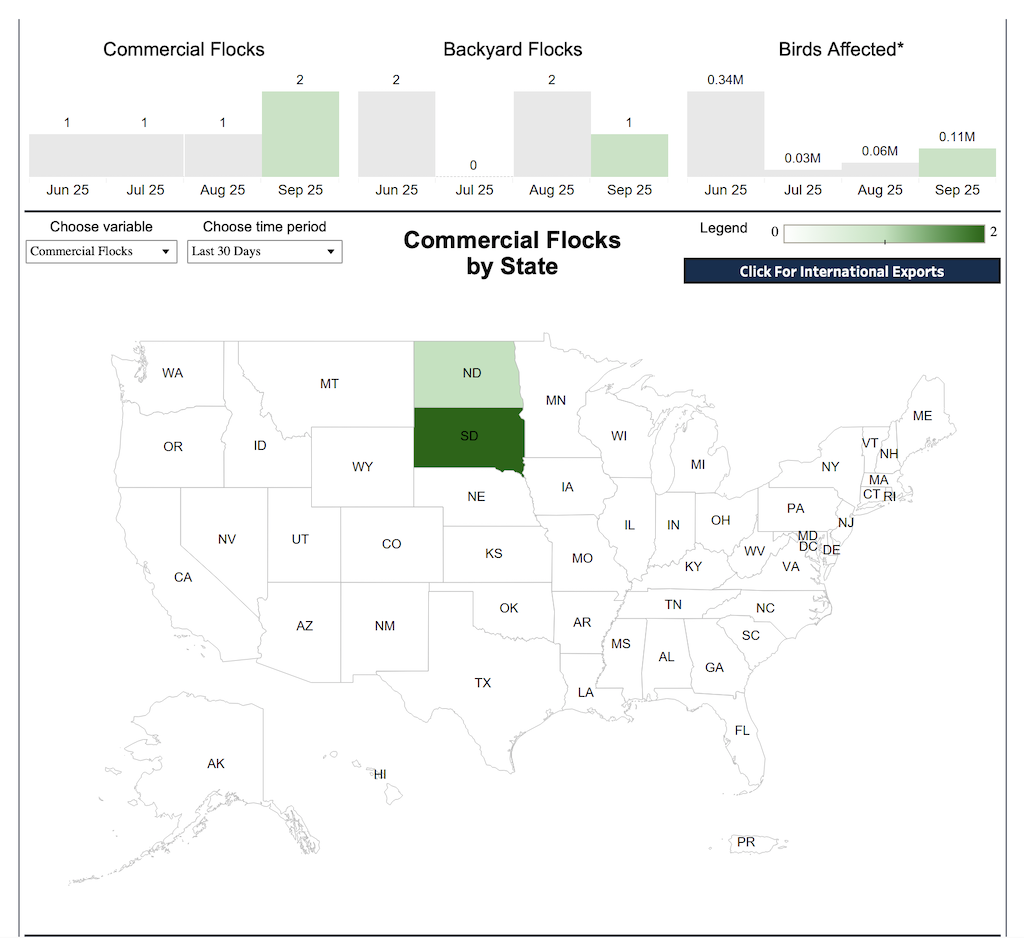
The two outbreaks in South Dakota affect 55,400 turkeys at a facility in Faulk County and 52,600 turkeys at a facility in Beadle County. North Dakota has one outbreak affecting 60,300 turkeys in Dickey County. The other outbreaks in the last couple weeks affected a few dozen birds in a couple of backyard flocks in Georgia and New York.
APHIS continues to crank out this bird flu data despite losing 1,300 workers in the Trump-Musk government hacking last spring. The agency’s ability to collect and share data like these bird flu figures is vital to American agriculture:
[45-year APHIS veteran Kevin] Shea notes that over the years, APHIS employees have worked to successfully eradicate or keep at bay pests such as the boll weevil, a beetle that feeds on cotton buds, and New World screwworm, a parasite that burrows into the open wounds of animals. It’s recently resurfaced in Mexico.
He fears that progress could now be lost, with animal health technicians, epidemiologists, entomologists, wildlife biologists and many who supported them gone.
“It’ll be very hard to ever rebuild the animal health workforce and the plant health workforce because they’ve taken away so much of what made government service attractive to those people — stability, security and a sense of public mission,” Shea says.
…Given the depletion of key staff at APHIS, Shea presumes there was a lack of understanding among the new political leadership of what the agency does. He also presumes the Trump administration outsourced the reduction of the workforce to Elon Musk’s Department of Government Efficiency, “who I’m sure have no idea,” he says.
What he would want them to know is that American agriculture has been relatively free of pests and disease in recent decades thanks in large part to the work of APHIS. And that, in turn, has given the U.S. two important things: a trade advantage in relation to the rest of the world and an abundant, cheap supply of food.
It’s easy to imagine what it would look like if the U.S. were to lose significant ground on this front. Outbreaks of avian influenza in 2025 alone have resulted in the culling of more than 30 million hens, according to USDA, sending egg prices soaring. Citrus greening disease, caused by a tiny sap-sucking insect from Asia, has already wiped out much of Florida’s orange crop.
“We’re trying to save California,” Shea says. “If we don’t have a fully functioning APHIS, that’s at risk” [Andrea Hsu, “Exodus of USDA Veterinarians and Others Drives Fears That U.S. Farms Are at Risk,” NPR, 2025.05.30].
But who needs the USDA and all those so-called experts, anyway? Just don’t let any turkeys sneeze on you… and stock up on Tofurky.

By
SEVEN HILLS, Ohio — Bow hunting season returns to Seven Hills.
“We offer a deer hunting program, whether you’re a resident or nonresident,” Seven Hills Police Chief Michael Salloum said.
Families ‘hope no stone is unturned’ as Southport killings inquiry resumesFamilies ‘hope no stone is unturned’ as Southport killings inquiry resumes
“As long as you complete the application, your land qualifies for the minimum acreage, you pass the archery test and have hunting permits from ODNR (Ohio Department of Natural Resources), we’ll allow deer bow hunting in the city.”
Applications are now being accepted for the white-tailed deer herd archery season, which runs from Sept. 27 through Feb. 1.
The requirement includes having access to 2.5 contiguous acres, which can include multiple properties.
“Most of them find adjacent properties that add up to the minimum of acreage required,” he said.
“There may be one or two that have just enough for one property.”
With a cutoff date of Dec. 31, deer applications are $28 for residents and $55 for non-residents.
“Last year, we had 20 permits issued,” he said.
“The year before, it was roughly about 34, so it all depends on the season. We get anywhere from 20 to 30 permits each deer hunting season.”
In terms of deer kills last season, the chief said 26 were reported.
The chief said last year there were 12 vehicle vs. deer accidents in Seven Hills.
While currently Parma and Parma Heights are actively culling deer, that’s not the case in Seven Hills.
RECOMMENDED
You can now charge your electric vehicle in Seven HillsSep. 4, 2025, 2:02 p.m.
Seven Hills couple mark 70 years since ‘Rock Around the Clock’ wedding Sep. 3, 2025, 11:11 a.m.
“In 2016, Seven Hills — along with five neighboring communities — asked voters if we should participate in a deer management program,” Seven Hills Mayor Anthony D. Biasiotta said.
“The voters approved this measure. Seven Hills now enters year 10 of seasonal deer bow hunting. There is no plan to change the program at this time.”
 Exposing the Big Game