Foxes ‘torn apart’ in shocking footage of illegal hunts in UK
Reply

GON Staff | February 1, 2026

Wild hogs remain one of Georgia’s most destructive invasive species, rooting up crops, damaging wildlife habitat and costing landowners millions of dollars each year. The good news? Georgia hunters are uniquely positioned to be part of the solution.
The Hog Down Awards Program from the Georgia DNR Wildlife Resources Division turns responsible wild hog harvest into a chance to win a whole-sounder feral hog trap valued at approximately $3,500. To qualify for the drawing, a hunter must lawfully harvest 10 wild hogs during a program period. At the end of each quarter, five winners are randomly selected, with each receiving a whole-sounder trap.
Whole-sounder trapping is an especially effective method because it removes entire groups of wild hogs rather than leaving survivors that can become more difficult to manage. With a new quarter now underway, there’s no better time to get involved. Consider joining the fight to control Georgia’s wild hog population—while earning recognition for the work you’re already doing in the woods.
To enter the program, hunters must lawfully harvest 10 feral hogs in Georgia during a quarterly period and submit photo documentation as proof. Road-kill hogs, spoiled carcasses and live hogs do not count. Photos must clearly show at least 10 dead hogs and include the date, time and location data. Submissions may be made only after the full harvest is completed. For every additional 10 hogs harvested, a hunter may submit another entry.
Entries are submitted online and must include the hunter’s contact information, the county or counties where the hogs were harvested, the method and date of take and a DNR customer number or hog control permit number. Hunters must certify that all information is accurate and that all hogs were taken legally.
Entries must be submitted by noon on the day after each quarter’s final date. Duplicate or shared photos are prohibited, incomplete entries will be disqualified and individuals may win only one trap per quarter. Winners are also required to complete two follow-up monitoring surveys—one after receiving the trap and another one year later.
The program is open only to eligible Georgia residents. DNR employees, government personnel controlling hogs in an official capacity, their immediate family members and nonresidents are not eligible to participate.
For complete rules and entry instructions, visit the Wildlife Resources Division’s Hog Down Awards Program page https://georgiawildlife.com/HogDownAwardsProgram.

1.8M Followers
Story by Pei-Sze Cheng
• 11mo •
2 min read
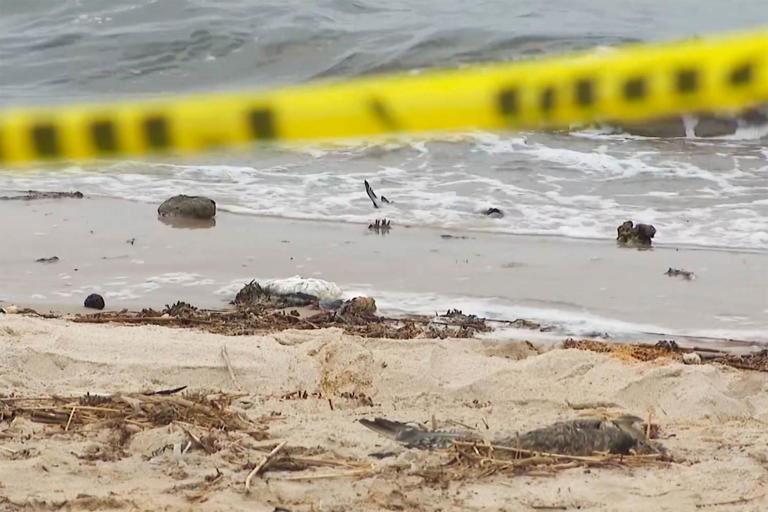
Birds washed up on Patchogue Shores in East Patchogue, N.Y.
A Long Island beachside community in Suffolk County is worried about dozens of dead birds that have washed up on the shore and been found in backyards, especially because officials believe the birds died from avian flu.
Patchogue Shores in East Patchogue has a private community beach. Earlier this week, Tim Jones, the vice president of their association, was walking along the beach with his family when he noticed many dead birds.
We tested the most popular space heater of 2025. Here’s the #1
·


“I saw three seagulls, a cormorant, and I got a count of 11 ducks,” explained Jones.
NBC New York walked with him and saw a dead gull, a dead goose bobbing in the water and various other smaller birds strewn along the small stretch of sand.
Jones contacted the Department of Environmental Conservation. The DEC said it appeared to be avian flu because there have been cases in Suffolk County and Nassau County before. Officials from the department urged the community to close the beach to avoid any contact with the dead birds.
While bird-to-human transmission has been extremely low, the avian flu can be spread by direct contact through saliva, secretions and feces. It can also be spread through viral particles in the air and consumption of raw food and milk.
Earlier this month, bird flu was detected at Crescent Duck Farm in Aquebogue. The farms owner forced to euthanize nearly a 100,000 ducks.
Type 2 Isn’t From Sweets — Experts Point to This Common Spice
·

Residents of Patchogue Shores are staying away from the beach for now, hoping the issue will be resolved as the weather gets warmer.
“It’s very frightening, obviously, and I’m not quite sure what we can do about it at this point, other than to stay away,” said resident Janet Bondy, “But that becomes very difficult if you live down here.”
“It’s upsetting because people enjoy this. This is the one place where everybody who lives here enjoys, it’s something to have special, private, and it’s sad,” added Jones.
The DEC says the wind may have brought the influx of dead birds to shore. While they are assessing the reports, they may decide to collect some bird specimens for testing.
This article was originally published on NBCNews.com
A suspected case of highly pathogenic avian influenza was found at a poultry farm.
Author: Amanda Kesting
Published: 10:52 PM MST January 30, 2026
Updated: 11:12 PM MST January 30, 2026
WELD COUNTY, Colo. — State officials issued a disaster declaration after a suspected case of bird flu was discovered at a commercial egg farm in Weld County.
Lt. Governor Dianne Primavera (D) verbally issued the declaration on Thursday evening. Governor Polis (D) is in Washington D.C. to attend the Colorado River negotiation meeting.
The Colorado Department of Public Health and Environment (CDPHE) said they were informed of a presumptive positive case of highly pathogenic avian influenza at a poultry farm in Weld County. The state is now waiting for confirmation of that positive test from the U.S. Department of Agriculture in Iowa.
The disaster declaration “enables state agencies to continue to properly coordinate for mitigation of disease spread, response, consequence management, and recovery efforts.”
Currently, CDPHE said there are no suspected or confirmed cases of avian influenza in humans, and that they will be working to help protect farm workers during the suspected outbreak. The department said they are working with the Colorado Department of Agriculture and the Weld County Health Department to ensure workers at the farm are using personal protective equipment and being screened daily for any symptoms.
The last human cases of bird flu in Colorado were in 2024, when at least ten people in the state ended up contracting the virus. This included a dairy farm worker who contracted the H5N1 avian flu strain after having direct contact with dairy cows that were infected, and nine people who worked at two different poultry farms in Weld County, including workers who were culling birds that had tested positive for avian flu.