Five deer poachers ordered to pay $120,000 in fines and restitution
Reply

Share: https://wabcradio.com/2025/07/20/will-canada-really-kill-these-defenseless-animals/
© Becca Mahon/Battle Creek Enquirer / USA TODAY NETWORK
(New York, NY) – There’s a long-established legacy with 77 WABC under John Catsimatidis — animals rights will not be ignored. Recently, we’ve been at the front end and ringing alarm bells as tied to concerns with off-shore wind energy projects, and the potentially negative impact on whales. For years the station has hosted radio shows dedicated to animal rights. And there’s even been efforts to foster unity via Giant Pandas.
Now, that same spirit and fight extends to a flock of birds, living on a farm — in our neighboring nation to the north. While so much has been made of the back-and-forth over trade, and tariffs, and how the US-Canada economic partnership should exist, an injustice has gone unnoticed by too many. With the worst of the bird flu outbreak seemingly behind us, a residual reminder is that a flock of ostriches in British Columbia face killing, or “culling”, if a court decision doesn’t break their way.
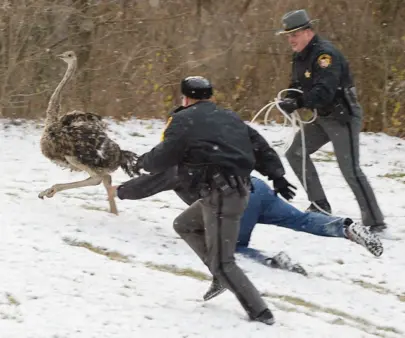
Ostriches are ancient creatures, and likely haven’t changed all that much from the large, flightless birds that roamed the earth millions of years ago. There’s even speculation that their DNA could contain genetic code or otherwise provide the scientific community with valuable aspects of research — especially in the bio-medical field. So why would anyone want to kill an entire flock?
The flock in question, at The Universal Ostrich Farm, has been operated by Karen Espersen and Dave Bilinski since 1995. It houses around 400 ostriches in a remote area of B.C.’s West Kootenay region. It’s not some typical farm either. These aren’t birds being raised for food such as chickens, or turkeys. Rather, the group focuses on producing bird oil, feathers, skins, and antibodies for research, not meat. It collaborates with institutions such as Japan’s Kyoto Prefectural University for antibody studies, aiming to develop treatments for H5N1 — itself a strain of the bird flu.
The request cannot be completed because you have exceeded your quota.
H5N1 is admittedly a highly pathogenic avian influenza. It primarily affects birds and poultry. It can also infect mammals, including humans, though human infections are relatively rare. The virus is highly contagious among birds and can cause severe illness and death in domestic poultry.
It was back in November of 2024 when it appears wild ducks may have infected the ostrich flock in British Columbia. In early November, 2024 is when it appears to have gotten going. By Christmas, Espersen says he noticed illness in some ostriches, with symptoms including red eyes and green feces. Testing confirmed H5N1 in two deceased birds on December 31, 2024. Over December and January, approximately 69 ostriches (about 10% of the flock) died from the virus.
It didn’t take long for the Canadian government to respond with a blunt, broad brush. The Canadian Food Inspection Agency (CFIA) ordered the entire flock be killed by February 2025. In essence, the agency was saying to treat the ostriches like any other chicken or turkey raised for food.
It also didn’t take long for prominent animal rights activists such as Catsimatidis to act. He made the ostriches death order and the farm’s fight for individual liberties a focus of his radio show. And, he sent a pointed letter to Canada’s Prime Minister Mark Carney, urging action on behalf of the defenseless animals.
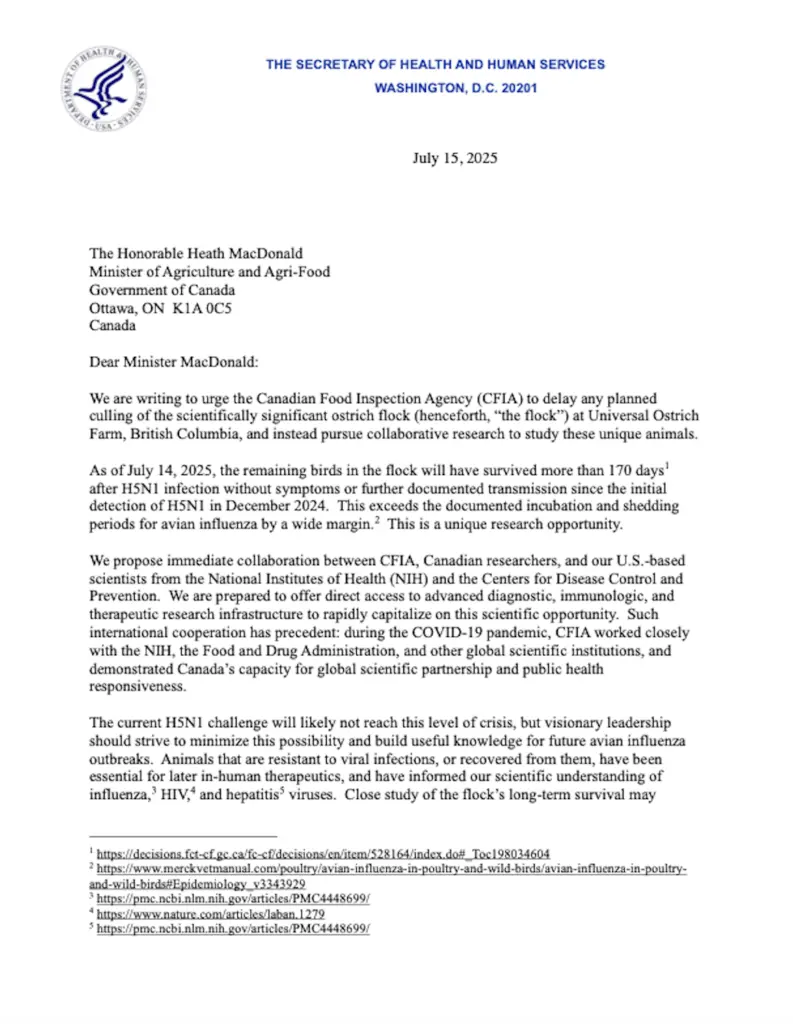
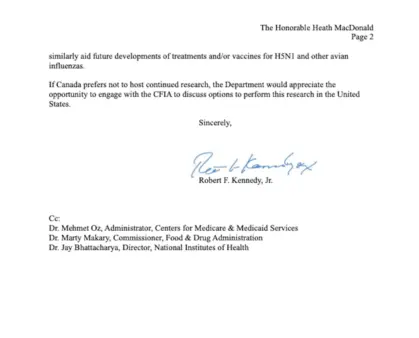
Herein we’ve included the letter’s contents, which Catsimatidis headed as an “urgent humanitarian appeal.” In the letter, he notes that several members of the Trump Administration have gotten involved — including Health Secretary Bobby Kennedy Jr. and Dr. Mehmet Oz — Administrator for the Centers for Medicare & Medicaid Services.
Similarly, Secretary Kennedy penned a letter that we’ve posted here:
Meanwhile, the Canadian government argues their “stamping out” policy gives them no wiggle room and that the birds must be destroyed in order to avoid the spread of the bird flu. But the policy classifies the ostriches as similar to chicken and turkey — despite the fact they’re used for research.
It is worth noting the CFIA argues a novel reassortment of the virus was linked to a human case in Ohio. And the ostrich farm’s open-air setup means potential contact with wildlife. Canada’s poultry export business is worth protecting as well, given nations such as Japan and Mexico restrict imports in connection to bird flu outbreaks.
But the farm’s owners aren’t just willing to accept their flock’s destruciton. They argue that the surviving ostriches (around 330) have shown no symptoms since January 19, 2025, suggesting possible herd immunity. They proposed studying the birds for antibodies rather than culling them, citing their unique resilience and research value. They also noted the farm’s remote location and lack of meat production minimize public health risks.
After a judge granted a stay of execution in January, the legal battle continues. Most recently, in June, a federal appeals court in Canada granted a temporary stay. Now, following hours of arguments this week — the situation lays in the hands of a new appeals court decision.
The farm has received significant backing from within the local community. Supporters have camped at the site to protest the cull, viewing it as government overreach. A GoFundMe and petitions were launched. Local officials, including MLA (Member of the Legislative Assembly) Steve Morissette, supported the farm. Dr. Oz even offered to relocate the ostriches to his farm in Florida — but the owners of The Universal Ostrich Farms declined.

The cull remains on hold pending the Federal Court of Appeal’s review, expected by late July 2025. The farm continues to advocate for testing and research, while the CFIA plans to proceed with “humane depopulation” if the appeal fails, citing ongoing risks. The CFIA has offered up to $3,000 per ostrich killed as compensation, but the farm emphasizes the emotional and scientific loss over anything related to finances.
Another, fascinating aspect of the entire debate centers on the ostriches themselves, and what they may or may not represent to the scientific community. As stated, their status as ancient creatures lends itself to cutting-edge research and the ongoing ability to discover something from our past world. It’s been suggested that pharmaceutical companies see this as a potential threat, given ongoing or existing medical technologies — including vaccines. Catsimatidis has noted that Big Pharma would therefore have a reason to worry potential findings that could disrupt their profits — as related to ostrich antibodies.
In essence, ostriches at Universal Ostrich Farm may indeed have antibodies or immune responses valuable for H5N1 research, supported by their survival rate and ongoing studies. However, claims that their ancient lineage grants unique resistance are speculative, pending further research. Hence why the work at the farm is so vital — and why so many are fighting for their survival.
77 WABC will keep up the watch, as many “push for a pardon” — at Universal Ostrich Farm.
By Stephanie Finucane
Monday, July 21, 2025 | 2 a.m.
Talk about hen-pecking.
President Donald Trump has taken his feud with blue states like California to a ridiculous new level by suing us for being too nice to chickens.
Apparently, his administration believes that California coddles egg-laying hens by allowing them to occasionally take a break from their duties — maybe stand up and spread their wings — rather than confining them in cages where they can barely budge.
While the administration believes it’s fine for California to set standards for its own chickens, the lawsuit alleges that imposing the same requirements on other states that want to sell eggs in California is a step too far. It demands that all states be allowed to sell eggs in California, as long as they comply with national standards for egg farms.
This may seem like some heartless campaign to make chickens miserable again, but the Trump administration claims it’s looking out for American consumers.
The lawsuit says animal welfare standards have driven up the cost of eggs. That’s anathema for an administration that promised to bring down the cost living but has done precious little to make that come true.
Quite the opposite. Trump’s tariffs are expected to raise prices on a host of items — cars, appliances, clothing and toys, to name a few. But as long as we can buy eggs for less than $5 a dozen, maybe we’ll be so busy making omelets that we won’t notice.
Except there’s a problem with that. Economists say it was bird flu — not animal welfare regulations — that was primarily responsible for the steep cost increases we saw several months ago.
Since then, there has been a drop in the number of avian flu cases, and egg prices have fallen along with them.
This lawsuit is nothing but posturing by an administration that couldn’t care less about American consumers — not to mention animal welfare. As much as Trump likes to discredit the “woke” Democratic leadership of states like California, a growing number of Americans want farm animals to be treated humanely.
What’s more, the Supreme Court already affirmed that states have the authority to regulate what can be sold within their borders.
The majority decision, written by Justice Neil Gorsuch, even provided an example: If one state allows horse meat to be sold for human consumption, should that mean every state is required to do so?
Of course not.
Instead of filing this ridiculous, anti-chicken lawsuit, the Trump administration would be better off focusing on ways to actually support agriculture.
Start by allowing migrant farm workers to continue their important work without fear of being hauled off to Alligator Alcatraz.
Otherwise, $10 zucchinis may be coming soon to a grocery near you.
Stephanie Finucane is an opinion editor and writer for McClatchy and the San Luis Obispo (Calif.) Tribune.
In one of the top Arctic birding destinations in the world, environmental and health challenges are threatening some of the seabirds that are part of Norway’s unique coastal ecosystem
ByHELI SIVUNEN Associated Press and STEFANIE DAZIO Associated Press
July 19, 2025, 11:11 PM

1:04
about:blank
International headlines from ABC NewsCatch up on the developing stories from around the globe making headlines.
VARDØ, Norway — In one of the top Arctic birding destinations in the world, environmental and health challenges are threatening some of the seabirds that are part of Norway’s unique coastal ecosystem.
The population of kittiwakes has decreased by 80% since the 1990s along the Scandinavian country’s coast. The small seagull species, among others, is under siege from climate change, predation, local fisheries and the bird flu.
So the town of Vardø, on the remote Vardøya Island in the Barents Sea, has stepped up to help the migrating visitors.
Three years ago, local fisherman Jan Vidar Hansen built a “seagull hotel” out of crates for kittiwakes and other seabirds to nest in safely. The hotel has the added bonus of limiting the spread of unwelcome smells, dirty nests and droppings that have become a nuisance for the island’s human population.
“The first year there was 55 nests. Last year it was 74, and this year we have 76,” Vidar Hansen said. He hopes the local council will agree to build a bigger seagull hotel in the future.
Advertisement
https://cds.connatix.com/p/plugins/cnx.bridge-1.0.9-compressed.htmlThe video player is currently playing an ad.
Seabirds have long been an important part of the identity of Vardø — so much so that the local museum has an exhibition dedicated to them. The town is known for its birding tourism as much as its radar station, which provides critical data to the U.S. Strategic Command thanks to its location nearly 60 kilometers (37 miles) from Russia’s military hub on the Kola Peninsula.
Norway’s northern coast is an ecologically diverse area due to its topography as well as the Gulf Stream, which brings warmer water up from the Gulf of Mexico and then mixes with the cold Arctic air and water. This warmer water keeps the Barents Sea free from ice even though it’s north of the Arctic Circle, and brings tons of fish larvae and other biomass up the Norwegian coast.
But the Gulf Stream is affected by climate change and is now bringing water that is too warm into the Barents Sea, changing the rich composition of the species there. It affects congregations of seabirds, marine mammals and, of course, many fish species.
Fish that need colder water are being pushed further north, while others that require the mix of warmer and Arctic water — like the small schooling fish called capelin — are seeing their migration patterns disturbed.
Capelin, for instance, are a major part of the diet for surface-feeding seabirds like kittiwakes, according to Tone Kristin Reiertsen, a researcher with the Norwegian Institute for Nature Research.
When capelin either swim deeper into the sea to get to colder water, or migrate further north, seabirds cannot get to them, she said. That in turn impacts the success of seabirds’ breeding because they depend on capelin to bring to their chicks.
Boris Belchev, a bird guide and ranger on the nearby Hornøya Island, says it’s a frightening domino effect.
“I was seeing birds that usually eat fish on the tundra start eating berries because they don’t have their normal food,” he said.
With fewer seabirds surviving, those who remain are easy targets for predators like white-tailed eagles, Reiertsen said. Plus, fisheries situated close to the coastal cliff nesting sites can disturb the dynamics of the colonies.
And then there’s the threat of bird flu. In 2023, a large outbreak killed some 25,000 kittiwakes alone along the northern Norwegian coast, Reiertsen said.
Recent Stories from ABC News

00:00
02:00
Read More
“It felt like an apocalypse,” she said.
Vidar Hansen’s seagull hotel in Vardø is one of seven such kittiwake hotels along the Norwegian coast, Reiertsen said.
“It’s not an easy task to get the kittiwakes to move in to these hotels,” she said with a laugh.
But it’s working. The small seagulls in recent years have migrated deeper into Vardø’s center in search of protection from predators. There were roughly 300 kittiwakes nesting in various buildings in the town and now the population there is roughly 1,300, she added.
Before the Vardø hotel, there were “many empty nests around the whole city,” Vidar Hansen said.
Recent Stories from ABC News
Reiertsen said kittiwakes and other seabirds are crucial to the region’s ecology. Their droppings bring important nutrients into the sea, and further decreases in their population could be dangerous to the entire ecosystem.
She said officials need to change their mindset from monitoring the problem to figuring out how to fix it. A potential idea, she added, could be limiting or prohibiting fisheries and boat traffic near nesting colonies.
“We don’t have much time,” she said. “We have to act quickly.”
The seabirds are also key to Vardø’s economy.
Just a short boat ride away from Vardø lies Hornøya Island, a birdwatchers’ paradise. Thousands of visitors flock to the uninhabited Hornøya, which is home to some 100,000 seabirds nesting there during breeding season, including much-loved Atlantic puffins, common guillemots and razorbills.
But the island’s seabird population has also declined dramatically in recent years. There haven’t been any recorded common guillemot chicks there since 2018, Belchev said.
“Last summer, I was shocked. ‘What’s going on here? Where are all the birds?’” he said.
If Norway’s government closes the island to the public, or birds stop nesting there and the birdwatchers stop coming, it could have a huge impact on Vardøya Island.
“Every small business in the town, it’s depending on the tourists to come and visit the island and stay in the town and shop and use the gas station and use the small restaurants,” Belchev said. __
Dazio reported from Berlin. Tommi Ojala in Vardø, Norway, contributed to this report.
__
The Associated Press’ climate and environmental coverage receives financial support from multiple private foundations. AP is solely responsible for all content. Find AP’s standards for working with philanthropies, a list of supporters and funded coverage areas at AP.org.

9.2K Followers
Story by Stephen Underwood, Hartford Courant
• 3w •
3 min read
Connecticut hunters are hailing the passage of legislation allowing for Sunday hunting on private lands after decades of restriction, according to officials.
Connecticut hunters and conservation advocates are applauding the passage of Senate Bill 7231, which expands Sunday hunting for the first time in the state’s history. The law will take effect on Oct 1, officials said.
1-2 days- All it takes to replace your old windows with these durable, slim-frame ones

This act repeals the longstanding ban on Sunday hunting and will now allow hunting on private properties of 10 acres or more. Hunters must possess written permission from the landowner and display it while hunting. The act prohibits hunting within 40 yards of public trails, including blue-blazed and federally designated trails, and maintains Sunday closures for migratory bird hunting.
Hunting advocacy groups including the National Wild Turkey Federation and Congressional Sportsmen’s Foundation have said the legislation is a major success because lifting the ban creates more equitable opportunities for those who participate in outdoor sports.
“Sunday hunting restrictions are one of the last remaining examples of the puritanical blue laws that were initially designed to encourage church attendance. At the time when these restrictions were first put in place, other activities were illegal on Sundays such as opening a store for business, drinking alcoholic beverages and tilling your fields,” said Northeastern assistant manager for the Congressional Sportsmen’s Foundation Christian Ragosta.
10 Best Home Warranties 2025 – Top 10 Best Home Warranties
“The current restrictions are a major limiting factor hindering participation in hunting, and restrictions on Sunday hunting create a temporal-access barrier to youth and others that work or attend school throughout the week and are often involved in extracurricular activities on Saturdays,” he said.
Connecticut has historically followed what are known as blue laws, which restrict or prohibit certain activities on Sundays. The first major shift came in 2015, when former Gov. Dannel Malloy, legalized Sunday archery deer hunting on private lands. Hunters have argued unsuccessfully for decades to overturn the state’s ban on Sunday hunting, which they have described as the last of Connecticut’s historic “blue laws.”
“The passage significantly improves access and opportunity for Connecticut’s sportsmen and women and will likely result in increased hunting participation,” Ragosta said. “A lack of access is regularly cited as the No. 1 reason that lapsed hunters give when asked why they decided to stop hunting, and the passage of such legislation would contribute to the retention of sportsmen and women in the state. Repealing laws restricting hunting on Sundays will likely increase participation, have a positive impact on the state’s wildlife management and will strengthen the Constitution State’s outdoor heritage and private property rights.”
Some critics of Sunday hunting argue that Sundays are a day of recreation by many non-hunters who would be disturbed — or potentially put in harm’s way — if hunters were allowed to shoot on Sundays. But hunting groups say that the compromise to not hunt within 40 yards of public trails ensures safety for hikers.
“The passage of Sunday hunting legislation in Connecticut is a big win for hunters, conservation and the future of our outdoor traditions,” said Kaylee Szymanski, NWTF district biologist. “By expanding access and opportunity, this law helps ensure that more people, especially youth and working families, can participate in wildlife conservation through regulated hunting. We applaud the state for taking this meaningful step to increase recreational access and support the hunting community.”
Stephen Underwood can be reached at sunderwood@courant.com.
©2025 Hartford Courant. Visit courant.com. Distributed by Tribune Content Agency, LLC.

