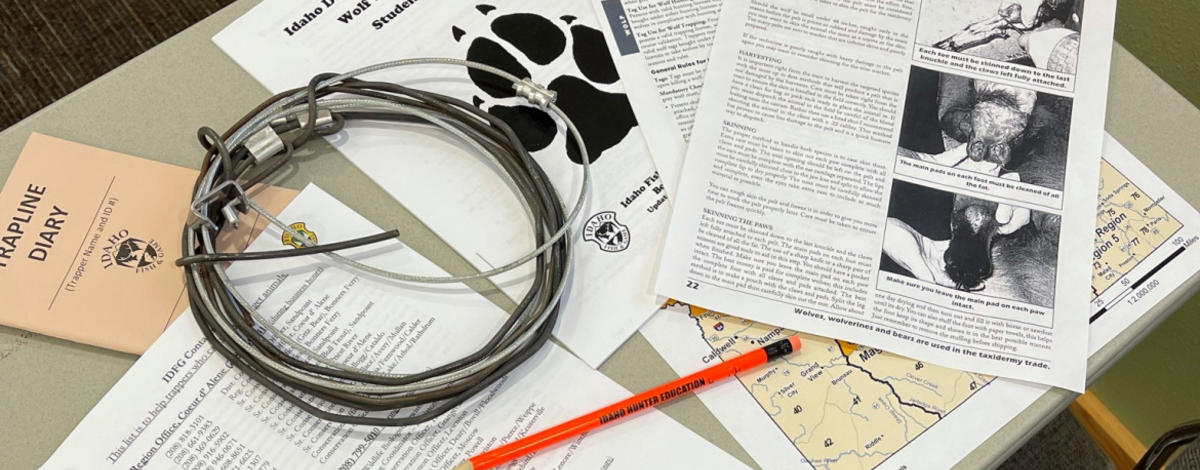
Idaho Fish and Game is holding a wolf trapper certification class during the 2025 Idaho Sportsman Show at Expo Idaho in Garden City, on Saturday, March 1, and there is still space available.
The class will be held from 1:45 p.m. to 6:45 p.m. at the Expo Idaho Western Town Conference Room, located at 5610 N. Glenwood St.
Everyone who pre-registers for this wolf trapper certification course will have their entry fee for the Idaho Sportsman Show waived for Saturday – all they will need to do is present their confirmation email at the entry gate for the Sportsman Show. Be sure to show up early and stop by Idaho Fish and Game’s booth (and everything else the show has to offer)!
Anyone intending to trap wolves in Idaho must attend wolf trapper education prior to buying wolf trapping tags. Anyone intending to trap wolves that did NOT hold an Idaho trapping license prior to 2011 is required to take BOTH trapper and wolf-trapper education.
Class registration can be completed online, or by stopping by any regional Fish and Game office for assistance. The cost of the course is $9.75.
Wolf trapper education is taught by a certified wolf-trapping instructor who will cover wolf trapping regulations and ethics, wolf habits and behavior, trapping methods, and reporting requirements.
For more information about any of the trapper and hunter education programs in Idaho or specific classes in the Southwest Region, please contact the regional Fish and Game office in Nampa at 208-465-8465.
A new variant of the bird flu has infected a dairy worker in Nevada, marking the state’s first human case of the H5N1 avian influenza.
The worker was exposed to the D1.1 strain after working with infected dairy cattle in Churchill County, the Central Nevada Health District confirmed Monday.
The new genotype was first confirmed on Jan. 31 in dairy cattle and is not the same strain that has been triggered a nationwide egg shortage and price hikes in recent months.
There are no additional confirmed human cases in Nevada and no evidence that humans can transmit the virus to other humans, the state’s health district said. Officials are monitoring the symptoms of the infected worker and the other farm staff who have been offered testing, antiviral medication and personal protective equipment.
The U.S. Department of Agriculture confirmed last week that the new variant had infected dairy herds in the state after previously only appearing in wild birds since late 2023 or early 2024. Up until last month, the B3.13 strain made up all bird flu cases in dairy herds.
The D1.1 variant is a strain of the H5N1 avian influenza that has previously only been reported in wild birds. The variant has recently infected dairy cattle and humans, including the Nevada adult and a 13-year-old girl in Canada.
The D1.1 strain poses a low health risk to the general public though people regularly exposed to birds, poultry or cows are at a higher risk, according to the U.S. Centers for Disease Control and Prevention.
The strain is common among the starlings that migrate through Nevada in the winter and might have carried the virus into the state, the Nevada Department of Agriculture shared on Facebook last March.
The day’s top stories, from sports to movies to politics to world events.
Delivery: DailyYour Email
The adult, who health officials did not identify, was exposed to the virus from a backyard flock, according to the department. They were over 65 and had underlying health issues, officials said.
The version of the virus also hospitalized a 13-year-old girl with a history of mild asthma, according to the New England Journal of Medicine.
Since 2003, there have been 950 human cases of bird flu outside the U.S. with 464 of them resulting in death, according to data from the World Health Organization.
Most human cases of bird flu involve mild symptoms like eye infections.
When did bird flu start?
The H5N1 avian influenza has been reported globally since 1997 though it previously solely presented in wild birds until recent years.
How to avoid bird flu?
The most effective way to avoid contracting bird flu is to prevent sources of exposure, health experts say.
This includes avoiding direct contact with wild birds and all animals that are either infected or presumably infected with the virus.
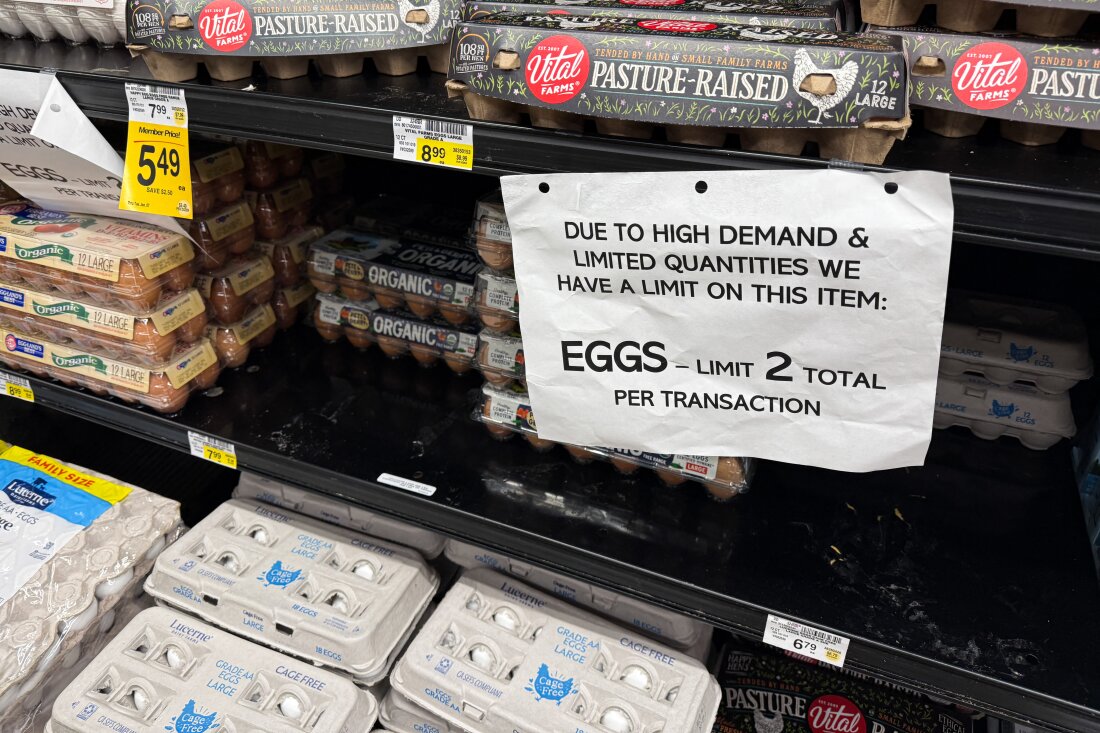
Depending on where you live, a dozen eggs could cost anywhere from $4 to more than $8. (Looking at you, California!)
So, what do you do if you cannot find – or afford – a carton of eggs?
Sponsor Message
Leah Curran Moon co-founded DC Vegan, a plant-based deli and catering company, with her husband, Michael Jantz Moon.
Curran Moon, who has been vegan for more than 20 years, told Morning Edition that there is no shortage of great plant-based egg alternatives.
Here are a few of the options she recommends.
“Just Egg”
Weekend brunch at DC Vegan is totally egg-free, and that’s largely thanks to a product called “Just Egg,” which is made with mung beans and found at most grocery stores.
A 16-ounce carton costs about $7.
Firm Tofu
Tofu can mimic a scrambled egg really well, Curran Moon says. But you should be sure to add plenty of spices: salt, pepper and turmeric, to give your tofu that yellow color.
Firm tofu, which is ideal for a scramble, is typically just over $2.
Egg Replacer
For baking without eggs, Curran Moon suggests an egg replacer, like Bob’s Red Mill. “That’s just potato starch and tapioca, and you cannot tell the difference in your baking when you’re using that product.”
This egg replacer works for baking, binding, breading or frying.
Bob’s Red Mill Egg Replacer costs about $5.
Flax Meal
Another go-to for DC Vegan is flax meal, which can be made by grinding up flax seeds. “One teaspoon of flax meal plus a tablespoon of water equals one egg,” Curran Moon said.
For sweeter recipes, Curran Moon says applesauce or pureed bananas make a great egg alternative. They’re also usually the cheapest option.
Aquafaba
Another low-cost way to replace eggs: Aquafaba. “Aquafaba is just the water from a can of chickpeas,” Curran Moon said. “And you can use that to whip up and turn into a meringue or you can use it for egg-based cocktails.”
A can of chickpeas is often a little over $1.
This story was edited for radio by Olivia Hampton.
“Plant-based foods are the future.” That is not a statement you would expect from a right-wing farming minister in a major meat-producing nation. Denmark produces more meat per capita than any other country in the world, with its 6 million people far outnumbered by its 30 million pigs, and it has a big dairy industry too. Yet this is how Jacob Jensen, from the Liberal party, introduced the nation’s world-first action plan for plant-based foods.
“If we want to reduce the climate footprint within the agricultural sector, then we all have to eat more plant-based foods,” he said at the plan’s launch in October 2023, and since then the scheme has gone from strength to strength. Backed by a €170m government fund, it is now supporting plant-based food from farm to fork, from making tempeh from broad beans and a chicken substitute from fungi to on-site tastings at kebab and burger shops and the first vegan chef degree.
Globally, animal farming produces 12%-20% of total global greenhouse gas emissions and significant cuts in meat and dairy consumption in rich countries is essential to tackling the climate crisis, scientists say. However, attempts to curb the huge impact of livestock on the environment in other countries have usually descended rapidly into bitter culture wars and tractors on the streets in protest.
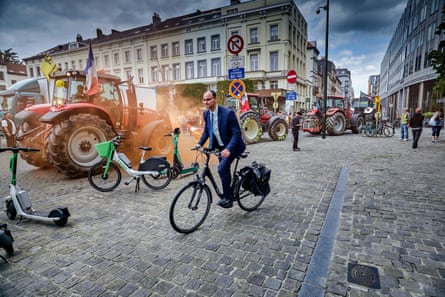
The last few years have seen multiple protests across the continent by farmers who are up in arms over national policies – such as plans in the Netherlands to reduce livestock numbers – and over European wide green policies. Photograph: Norbert Voskens/SOPA Images/REX/Shutterstock
So how did Denmark’s plan to promote beans and vegetables come to get widespread support and funding?
Food is deeply personal and has enormous cultural significance, making it a minefield for climate action. So the transition away from meat and towards plant-based eating had to be approached delicately, says Rune-Christoffer Dragsdahl, head of the Vegetarian Society of Denmark and one of the key actors in delivering the Danish plan. Dragsdahl says, appropriately enough, that carrots not sticks were crucial to getting agreement on the policy.
“One of the key reasons was talking about what we want more of, instead of talking about what we want less of, that is how we got broader support,” he says. “There was a delicate balance. People had to feel welcome, even when they had not just differing opinions, but maybe even different versions of the truth. This was a tricky but important balance, because that’s how you secure the continued participation of people.”
Getting farmers on board was vital and the Vegetarian Society had been putting on friendly events for food producers. Then, in 2021, it was invited to help the Danish Agriculture and Food Council (DAFC) produce the plant-based food strategy.
Anders Martin Klöcker, the DAFC innovation director, says: “I am proud of that, because it was an unusual alliance.” Nonetheless, landing the action plan was tricky.
“It was controversial,” says Klöcker. “You have a farming sector which has been predominantly based on animal products for centuries. They have difficulty understanding that now we should shift the diet.”
The plant-based food plan was part of a bigger farming deal that also supported animal agriculture. “We consider it a ‘both-and’ not an ‘either-or’,” says Klöcker. “We don’t want it to be polarised. We consider [plant-based food] a market that’s interesting, which is also growing.”
The support from farmers shifted the politics, says Dragsdahl: “It clearly helped make the right-wing parties more neutral, and thereby also made the central parties more daring – it was really important.”
A politician who had a key role in finalising the action plan was Zenia Stampe, agriculture spokesperson for the centrist Social Liberal party. The task was initially daunting, she says: “Farming is still a big part of our identity and while climate was such a hot topic then, agriculture was not a part of that debate at all.”
Stampe remembers an “eye-opening” early meeting with Dragsdahl, where she learned that a quarter of Denmark’s greenhouse gas emissions come from agriculture, with livestock and feed crops occupying 80% of farmland.
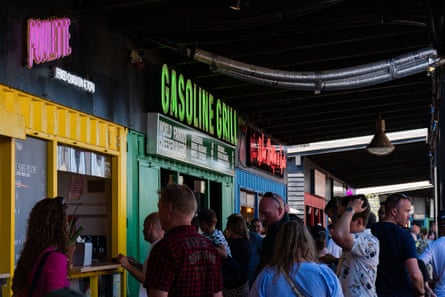
People lined up in front of the Gasoline Grill in Broens Gadekokken, the street food area in Copenhagen harbour. Photograph: O Kemppainen/Alamy
“But the [Vegetarian Society and other allied groups] knew it was such a big taboo in Denmark, so they turned it around and presented plant-based food as a business opportunity,” she says. “I think that is the key to understanding why this succeeded.”
The plant-based action plan also avoided using the terms vegan and vegetarian, which can be polarising, and did not set targets for cutting meat consumption or livestock numbers. It dished out its first grants last year.
The new fully-government-funded degree at Copenhagen Hospitality College now has its first 26 students, who can choose either vegetarian or vegan paths. Thais Brask-Simonsen from catering company Compass Group says: “Vegetarian cuisine is booming, and both restaurants and canteens are screaming for this expertise.” Student Magda says connecting food and sustainability is vital: “I want to contribute by making some insanely tasty green food that makes people not miss meat.”
The Vegetarian Society also has funding to work on better menu design. “You still find many places where there’s one vegan item at the bottom of the menu, which is just called vegan dish of the day, so it’s only chosen by very few people,” says Dragsdahl. “But if you call it something delicious, put it first on the menu, and maybe even have three vegan options, and then three meat options, many more people choose the veggie options.”
One grant, won by the Association of Agricultural Colleges, is an appeal to the belly of farmers themselves. It is training the chefs that feed the student farmers in plant-based cooking, as well as include more pulses in the curriculum. “It should help normalise plant-based meals,” says Dragsdahl.
Other grants focus on developing new plant-based products, and improving the taste and texture of meat and dairy alternatives. Klöcker would like to see more focus on product development, which he says has to go hand-in-hand with building demand to create successful businesses, and more focus on export opportunities – 85% of Danish food is sold overseas.
A new €7bn green farming deal in 2024 saw a commitment from the Danish government to work towards an EU-wide action plan for plant-based foods. It has already been credited with influencing Portugal’s recent decision to produce an action plan for a low-carbon diet, and Denmark takes over the rotating presidency of the European Commission in July.
Denmark was a leader in wind energy and in banning trans fats in food. But whether its plant-based food plan, still in its nascent stage, is similarly successful remains to be seen. So far it has certainly made farming the hottest climate issue in Denmark, but will it ultimately shift diets?
“The theory of change is hopefully that the plan and fund will lead to an actual transformation, with less intensive livestock,” says Dragsdahl.
Stampe is unsure: “I hope so. But to be honest, I don’t know yet. There will always be some people, saying: ‘Yeah, if you eat less meat, then I will eat more!’”
The deal in 2024 saw sticks added to the carrots, with a world-first tax on emissions from livestock, a plan to convert 140,000 hectares (346,000 acres) of low-lying farmland into natural areas and to establish 250,000 hectares of new forest.
But Stampe says animal farming still gets far more government support than plant-based production. “The solutions to the climate crisis are not in the margins,” she says. “It is in the big shifts. So not from one type of animal production to another type of animal, but from animal-based to plant based food.”
Klöcker accepts that even the best-produced animal products have bigger climate footprints than plant-based ones, and like Stampe sees a generational shift with younger people eating less meat.
“But we have to have a market to do anything at all,” he says, and he does not think a transition to more plant-based eating will be fast.
Klöcker points out that it took 30 years of nurturing supply and demand for organic food to reach today’s 12% market share in Denmark: “The worst thing would be a farmer or food company realising that [plant-based products] they developed don’t have a market – then you might really lose them for good.”
Dragsdahl is more optimistic, but says continuing a measured approach will be essential: “There is a strong majority of Danes who are open to eating less meat. They understand it might be good for their health and the environment, but we should really not push it too hard or too far. Because then these people will just say: ‘Fuck off, it’s my plate.’”
This article was amended on 31 January 2025. The Social Liberal party has not been part of either the current or the previous Danish government as earlier versions of the article indicated.



 Exposing the Big Game