Bird Flu Hospitalizes 2 More Patients as Outbreaks Increase
Reply

Cat was lost after a move from Black Creek to Cumberland, recovered by Cat Advocates Teaching & Saving Society
Comox Valley Record Staffa day ago
.png;w=960)
After spending an astonishing ten months trying to survive in the wilderness, Zaphira the cat has finally returned home, thanks to the relentless efforts of the Cat Advocates Teaching & Saving Society (CATS Rescue) in the Comox Valley.
Zaphira went missing shortly after her family moved from Black Creek to Cumberland, leaving her lost in unfamiliar and dangerous terrain. Her owner, Lisa Larkin, never gave up hope, and neither did CATS Rescue.
Recovering Zaphira was no small feat. It took three highly experienced trappers five months of dedicated effort to locate and capture her. The team hiked a grueling half-hour up rugged, cougar-inhabited terrain each week to monitor a feeding and trapping station. Once Zaphira began regularly visiting for food, they started a two-week intensive trapping effort, braving rain, wind and pitch darkness every day until she finally stepped into the trap.
Soaking wet and shivering, the team hiked Zaphira back down the trail and brought her to safety at the CATS shelter. Thanks to a tattoo in her ear, her ownership was easily confirmed, proving the importance of microchipping and tattooing pets.
In a heartwarming twist, Zaphira’s long-awaited reunion with her owner, Larkin, happened on her birthday, truly the best gift imaginable. Now, at 12-years-old, Zaphira is finally back where she belongs, safe at home. Larkin shared that Zaphira is doing fantastic, is super affectionate and just so happy to be back home.
CATS Rescue remains committed to helping lost and abandoned cats, setting up feed stations in remote areas and working tirelessly to reunite pets with their families. Zaphira’s story is a testament to their dedication and the life-saving importance of identification for pets.
For more information about CATS Rescue or to support their mission, visit TheCatAdvocates.com.
CBC News · Posted: Mar 31, 2025 7:00 AM PDT | Last Updated: March 31

#TheMoment a Canada goose hit by an arrow was released back into the wild
4 days ago
Duration1:14Tim Cyr recounts the moment he released Wilson the Canada goose into the wild after a journey that included having an arrow in its backside for seven months, having the arrow removed and undergoing three months of rehab.”
A Canada goose named Wilson — who spent months with an arrow lodged in his rump — is finally flying free.
The bird was released Sunday at Squamish’s Brennan Park field, where dozens had gathered to cheer him on to freedom.
As the cage door opened and Wilson took a few tentative steps, he turned toward a nearby flock of geese and took flight, marking the end of a months-long rescue effort that brought together a local photographer, veterinarians, wildlife rescuers, and an entire community.
“I’m glad to see him finally get a second chance at life,” said Tim Cyr, the Squamish photographer who has been a key figure in leading the rescue effort.
WATCH | The moment Wilson was released:

Rescued Canada goose Wilson gets a second chance
4 days ago
Duration2:03Wilson the goose drew public attention after being found last year with an arrow lodged in his back. After months of treatment, he was released back into the wild today. CBC’s Sohrab Sandhu was there to capture the dramatic moment.
The goose, which was named after the volleyball in the movie Cast Away, was shot with a training arrow with a blunt point near Sechelt last year.
He eventually made his way to Squamish, where he was tracked by Cyr for about seven months.
Despite multiple attempts to catch him with nets, Wilson kept slipping away, Cyr says.
“We tried lots of different ways to catch him with nets and blankets and whatnot,” he told CBC News.

In October last year, Cyr launched a GoFundMe campaign to purchase a net gun, a humane capture tool that shoots a net over the animal, that brought in $3,300.
The bird was ultimately captured by Myles Lamont, a registered professional biologist and owner of TerraFauna Wildlife Consulting, who used his personal net gun.
Wilson was taken to Dewdney Animal Hospital in Maple Ridge, where veterinarian Dr. Adrian Walton removed the arrow and treated the wound it left behind.
“There was a large hole that had been left behind,” he said. “And that was the big fear that this hole would continue to putrify and become an abscess and that the recovery would be delayed.”

But after weeks of treatment, Wilson was transferred to MARS Wildlife Rescue near Courtenay on Vancouver Island, where he spent more than two months recovering.
“He was very feisty didn’t like any of us very much, just like any other goose,” said Dylan Doucet, a volunteer at MARS. “But he had more energy than average considering what he’d been through.”
Doucet got to know Wilson’s temper firsthand.

“At least 10 bites. I would say during the time that I dealt with them, but that’s to be expected in the job.”
Doucet helped transport Wilson back to the Lower Mainland for the release on Sunday.
Before letting him go, Dr. Walton gave Wilson one final checkup and the all-clear to fly.
“The feathers have come back,” Walton said. “There’s a little scar tissue, but no damage.”
Cyr then opened the cage as onlookers watched quietly. Wilson hesitated for a moment, then stepped out and flew straight toward a waiting flock of geese.

All Points West9:55“Wilson” the Canada goose is recovering in a Vancouver Island wildlife rescueThe Canada goose with an arrow sticking out of its backside was spotted by a wildlife photographer in Squamish. Efforts to rescue the bird took seven months, but this week it was caught and is now recovering in a Vancouver Island wildlife centre. MARS Wildlife Rescue Centre president Warren Warttig explains.
Cyr said he was hoping for a proper goodbye.
“I kind of expected him to give me a little bite or something,” he said. “He knows me pretty well.”
Walton, standing nearby, was visibly emotional.
“I only get to see the worst parts,” he said. “So being able to experience the good parts has been a huge, huge plus for me.”
As the goose rejoined his flock, Walton imagined what Wilson might be thinking.
“I think he is just sitting there going, ‘Dude, I have a story for you — you don’t want to know what happened to me over the last few months.'”
WATCH | A Canada goose had an arrow removed after 7 months:

#TheMoment a Canada goose had an arrow removed after 7 months
2 months ago
Duration1:17Wildlife photographer Tim Cyr and veterinarian Adrian Walton recount the moment they worked together to catch a Canada goose named Wilson and remove an arrow from its backside.
Complete removal of nonnative equines from the Great Divide Basin, Salt Wells Creek and the northwest portion of the Adobe Town herd management areas still faces a public review process and legal appeal.
by Mike KoshmrlApril 1, 2025

Share this:
FacebookBlueskyWhatsAppMessengerEmailShare
The Bureau of Land Management’s contentious plans to remove all free-roaming horses from vast reaches of southwest Wyoming’s “checkerboard” region could begin as soon as this summer, although a legal appeal to stop roundups remains in limbo.
On Monday, the federal agency released a 47-page environmental assessment outlining plans to gather and permanently remove several thousand wild horses from 2,105 square miles — an area nearly the size of Delaware — managed by BLM’s Rock Springs and Rawlins field offices. Horses would come off an additional 1,124 square miles of private land within the checkerboard. A public review period is underway with comments due by April 30. If the BLM greenlights the round-ups, they could begin within the next three months and continue for a couple of years, possibly longer.
First to go would be the estimated 1,125 free-roaming horses in the Salt Wells Creek herd and 736 animals in the northwestern portion of Adobe Town, according to BLM Rock Springs Field Office Manager Kimberlee Foster. Then in 2026, horse-removal crews would move on to eliminating an estimated 894 horses in the Great Divide Basin herd.
“Additional gathers may be needed in future years to remove all wild horses to get to the zero-population goal, as some may be missed during the scheduled gathers,” Foster told WyoFile in response to emailed questions.

Free-roaming horses, a nonnative species that faces scant predation, increase in population by about 20% annually. Reproduction, combined with missed animals during surveys, make estimating precise herd numbers difficult. The expectation is that 3,371 wild horses would be removed, but the ultimate number could range from 2,500 up to 5,000, according to the BLM.
The push to rid southwest Wyoming’s checkerboard region of free-roaming horses traces back 15 years. The Wild Free-Roaming Horses and Burros Act directs the BLM to “to remove stray wild horses from private lands as soon as practicable upon receipt of a written request,” the environmental assessment states. In 2010, the cattle and sheep-centric Rock Springs Grazing Association, which owns and leases about 1.1 million acres of private land in the checkerboard, revoked consent to allow horses to roam on its property.


Independent news for independent thinkersSign up for our free newsletter
There’s been a legal battle ever since. Lawsuits from both the Rock Springs Grazing Association and wild horse advocacy groups have targeted the BLM’s planned actions, but U.S. District Court of Wyoming Judge Kelly Rankin, a Biden appointee, ruled in the federal government’s favor in both lawsuits last August.
Soon thereafter, a coalition of pro-horse petitioners — the American Wild Horse Campaign, Animal Welfare Institute, Western Watersheds Project, Carol Walker, Kimerlee Curyl and Chad Hanson — appealed.
“This is just the latest lawsuit in a 12 or more year battle to save these horses,” American Wild Horse Executive Director Suzanne Roy told WyoFile. “We’ve litigated four or five times about this issue.”

Attorneys for the federal government and horse advocacy groups exchanged arguments before the 10th Circuit Court of Appeals in March. A decision is pending, but horse advocates are optimistic about their chances.
“We have prevailed in the 10th Circuit previously on this issue,” Roy said.
The BLM, she contended, has never before fully eliminated a herd of free-roaming horses without having demonstrated there are ecological reasons for doing so.
“This would be the first time in the 54-year history of the Wild Horse and Burros Act that the BLM eliminated a herd management area and eradicated entire wild horse herds — two of them — when the agency itself concedes that the area has sufficient habitat for the horses,” Roy said. “It has implications for wild horse protection across the West, because if private landowners that have land adjacent to or within herd management areas are allowed to dictate the presence of wild horses on the public land, that’s a very dangerous precedent. So we are anxiously awaiting the court’s ruling.”
13 hours agoShareSave
Jodie Halford
BBC News, Essex
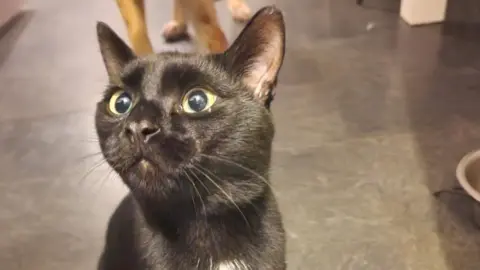
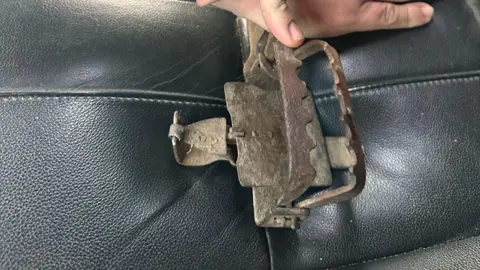
A cat owner said it was “sickening” to find her missing cat return home with an illegal metal trap on his leg.
Three-year-old Loki from Kelvedon, Essex, went missing on 28 March and returned home on Tuesday with the rusted gin trap on his front right leg.
A vet had to amputate his leg and give him strong antibiotics to prevent infection spreading from his wound.
Owner Gemma Hodge said she had received messages from three other cat owners whose pets had been caught by the traps.
“It’s sickening, to be honest. I can’t stop thinking about what he must have been through to get home with that on his leg,” Mrs Hodge said.
“The fact that someone’s put that down knowing it’s going to cause distress and pain to someone or something is just vile.
“That could have easily been a child.”
ADVERTISEMENT
The traps, which have spring-operated jaws with teeth that snap shut, have been illegal in the UK since 1958.
Staff at Spring Lodge Vets in Witham told Mrs Hodge that Loki may have had the trap on his leg for the full five days he was missing.
Loki managed to jump a 6ft-high (183cm) fence at the back of the family’s garden while the trap was on his leg, Mrs Hodge said.
“That gobsmacked me the most.”
Her 10-year-old daughter had not been sleeping when her “best friend” Loki was missing and was “so excited” he had been found.
“She’s been getting everything ready for him – his milk and his treats. She just wants him home,” Mrs Hodge said.
An RSPCA spokesperson said it had seen domestic animals fall victim to the illegal traps “many times” and said they were “totally indiscriminate in nature”.
“Gin traps are cruel and anyone setting one faces prosecution,” they added.

