LDWF Agents Cite Subject for Hunting Violations in Plaquemines Parish
Reply

Pennsylvania Outdoors Columnist
Jan. 21, 2026, 3:17 p.m. ET
The Pennsylvania Game Commission is looking at easing some of the restrictions for deer hunters in areas where Chronic Wasting Disease (CWD) has been found and there will also be improvements for those applying for an elk license.
The commission is meeting Jan. 23-24 for its quarterly meeting in Harrisburg for a variety of topics, including deer and elk regulations.
The board may reduce some of the regulations on those who hunt in areas where deer have been found to have CWD.
The neurological disease is fatal to deer and can be transmitted to other deer through liquids, such as saliva and feces.More: Rifle deer hunting season may start week earlier in Pa. this yearNeed a news break? Check out the all new PLAY hub with puzzles, games and more!

Jan. 24 meeting preview: Game Commission considers 13 properties for hunters across Pennsylvania
The meeting agenda proposes to eliminate the restriction on interstate and intrastate movement of high-risk parts like the brain, spine and spleen.
The agenda also looks at removing the requirements for deer processors and taxidermists, and eliminates the prohibition on cervid (deer) urine-based attractants for hunting.
There is a proposal to expand the prohibition against the disposal of high-risk parts of deer on the landscape.
If the changes are approved, a hunter in a Disease Management Area will be able to take their deer to be processed at the processor of their choice or butcher it themselves, but they need to properly dispose of the high-risk parts.
As of Jan. 21, the agency’s online CWD Surveillance Map revealed 86 of 6,792 deer tested for CWD were positive for the 2025-26 license year. Those detections were mostly in southcentral Pennsylvania, and all were found within existing DMA boundaries. Testing of deer, including those found along the highways, will continue through the license year.
In the 2024-25 license year, the commission had 530 positive CWD detections from 13,526 deer.

More: Of 140 elk hunters in Pennsylvania, 108 get elk this fall and winter
For elk, the agency is looking at offering an early October firearms season segment.
In previous years, the rifle season was only the first week of November. There have also been archery and late rifle seasons.
Get the Go Outdoors PA newsletter in your inbox.
Join Brian Whipkey in new adventures every Thursday.
Delivery: THURSYour Email
This year, elk seasons are proposed to include Sept. 12-27 for archery, Oct. 3-11 for the first regular (firearms), Oct. 31 to Nov. 8 for the second regular season, and Jan. 9-17 for the late season.
The agency reports the early October firearms season segment is proposed to limit crowding and maintain hunter satisfaction under current and potential future increased license allocations. The late firearms elk season is proposed to be moved later in January to avoid conflicts with major holidays. This year, it was held Dec. 27-Jan. 3.
The commission is looking at a new process for applying for an elk licenses that will benefit those who live in the commonwealth.
Among the changes being implemented to the program is a new requirement for hunters across the nation to have a general Pennsylvania hunting license before applying for the elk license lottery.
In past years, a hunting license wasn’t required to purchase a $11.97 chance for an elk license. The winners of the license lottery are then required to purchase their hunting license and elk permit. General hunting licenses cost $20.97 for residents of Pennsylvania and $101.97 for nonresidents.
The agency is also limiting each year’s allocation of elk licenses to a maximum of 10% going to nonresidents of Pennsylvania.
Rifle deer hunting season may start week earlier in Pa. this yearIf you want to start living the van life, here’s what to considerOf 140 elk hunters in Pennsylvania, 108 get elk this fall and winterFinal pheasant releases happening now, but there may be a bonus onePennsylvania flintlock hunter gets massive buck while still-huntingOutdoor shows slated soon in Harrisburg, Clearfield, Pittsburgh, EriePennsylvania archer with bad luck borrows flintlock to get heavy buck5 hunters shot, including 2 fatalities, during Pennsylvania deer seasonPennsylvania hunters get at least 200 more black bears than last yearLook at some of 2025’s big bucks, bears, elk and fish in Pennsylvania
The Game Commission’s two-day public meeting begins at 1 p.m. Jan. 23 and will include staff presentations on a range of wildlife management topics, including elk and turkey management, as well as other key agency initiatives. No public comment will be accepted Friday.
The meeting resumes at 8:30 a.m. Jan. 24. Public comment, limited to five minutes per speaker, will be accepted on a first-to-register, first-to-speak basis.
Game Commission meetings are held at the agency’s headquarters, 2001 Elmerton Ave., Harrisburg, just off the Progress Avenue exit 69 of Interstate 81. Those unable to attend may watch them live on the Game Commission’s YouTube channel.
16 hours, 47 minutes ago by Special to The Commercial
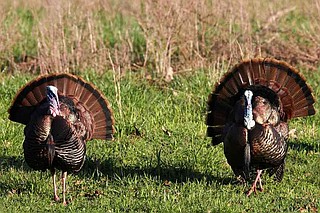 Two mature gobblers enter a field in northeastern Arkansas to compete for hens. (Special to The Commercial/Mike Wintroath/Arkansas Game and Fish Commission)
Interested in getting The Pine Bluff Commercial’s Newsletter delivered to your inbox every morning?Sign Up
Hunters have until 11:59 p.m. Feb. 15 to apply for a chance at one of the Arkansas Game and Fish Commission’s managed permit-only turkey hunts on select wildlife management areas (WMAs) throughout the state this spring.
Visit the AGFC website and click the “Get a License” link in the top right corner of the page to get started. WMA hunt applications are listed under the Special Hunt Permits Section of the licensing system, according to an AGFC news release.
Turkey hunting is open on many Arkansas WMAs to anyone during the season, but a handful of locations are managed through randomly drawn permits to increase hunt quality. Some draws are designed to reduce pressure on birds in popular hunting areas, while others are used in smaller areas where hunters may get too close to each other to have enjoyable hunts, according to the release.
WMA Turkey Hunt Permits will be drawn Feb. 17, and successful applicants will be notified by Feb. 18. Any leftover permits will be made available through the AGFC licensing site beginning at 8 a.m. Feb. 23. Hunters who successfully draw a permit for a special WMA turkey hunt will also need to claim their free permit upon notification of their draw status.
In addition to WMA Turkey Hunting Permits, all turkey hunters must carry a valid Arkansas hunting license that allows the harvest of big game as well as a Nonresident Turkey Permit ($100), Resident Turkey Tag (free), Nonresident Youth Turkey Tag (free), or a Resident Youth Turkey Tag (free).
Each permit holder is allowed to bring one hunting mentor who did not draw a permit on their hunt. Hunting mentors must have a valid hunting license, and they are not eligible to harvest a bird or hunt any other in-season game animals, but they can call for the permitted hunter and help them learn the ropes.
Applications require a $5 nonrefundable processing fee. Winning applicants are not required to pay any additional fees beyond the purchase of their hunting license.
Visit the AGFC website to view a list of available permits and odds of drawing each hunt based on last year’s permit applications.
The Missouri Department of Conservation (MDC) reminds hunters they can now use artificial light and other methods for an extended period during the coyote hunting season. Regulation changes were approved by the Conservation Commission in fall 2025, allowing the use of artificial light, night vision, and thermal imagery equipment from Jan. 1 through Sept. 30, excluding the prescribed spring turkey hunting season. The changes took effect Jan. 1, 2026.
During this extended period, coyotes may not be chased, pursued, or taken during the daylight hours from April 1 through the day prior to the beginning of the spring turkey hunting season. Coyotes, except as otherwise provided in the Wildlife Code of Missouri, may be taken by hunting, and pelts and carcasses may be possessed, transported, and sold in any numbers throughout the year.

Special method restrictions apply during spring turkey season, elk season and deer season. See Allowed & Prohibited methods at http://short.mdc.mo.gov/o3H. Any questions about conservation area regulations and the Wildlife Code can be directed to local MDC staff. Find local MDC staff by county at http://short.mdc.mo.gov/4ok.
Find a complete list of Missouri’s hunting seasons at http://short.mdc.mo.gov/o3j.

According to Mike Koshmrl of WyoFile, wolf hunters in 2024 spent an average of 450 days in the field per animal for each wolf they killed. Apparently these guys have some slow snow machines, eh? Sorry, bad joke, but you get the gist of it, no?
Point of fact: Montana and Idaho, the only other states in the lower 48 that legalized wolf hunting, have adopted by legalizing, methods like trapping, snaring, and thermal-imagery-assisted night hunting over baits . All of which are a big no-no in Wyoming’s wolf trophy game areas, for no other reason except that those methods work. In our state’s declared predator zone, which is most of the state, virtually anything goes including using motorized vehicles to run the critters to ground. After all, contrary to the popular belief out there among the “Friends of the Furries,” this predator control is not a big party thing. Unlike the popular press would have most of our more naive citizens to believe.
Don’t believe me? Spend a season or two tending calving heifers on a range with wolves present and see if your attitude doesn’t change significantly or go on a calf count in the nurse pasture and count the half-eaten and the totally missing calf carcasses, not to mention the damaged mother cows minus their calves. Any attitude of sunshine and butterflies will soon disappear as you personally validate the carnage. But that’s just about what is as opposed to what’s touted as being so by the Disneyfiles. Butterflies land on Bambi’s nose too.

Regardless, during that same hunting period, 2024, my sources indicate the average Wyoming deer hunter spent 12 days out in the boonies hunting for the deer of their choice. Back when wife Sandi and I were hunting critters for groceries, I think we may have averaged, not counting travel time or prep time, about three hours per deer. Unless we were looking for antlers, in which case it could have varied from hours to days and even weeks, depending on the quality and size of those sought-after antlers. Mostly, unless we were hunting buck-only tags, we didn’t get concerned about antlers. And, although we collected some super bucks over the years, we never entered any of them in any of the local “Big Bucks” contests. Seems to run counter to the reasons we hunted.
The difference in our successes with big bucks lies in being able to know where to find those bucks. And, of course, always the eternal variable, the weather. What really leveled the field was having a knowledge born from being constantly immersed in the affairs of the bush people on a year-round basis. Knowing where the big boys are at various times during the season is a whale of a lot better than wondering where. As far as that goes, in that regard it doesn’t matter if you’re talking about hunting critters, furred or feathered, or fishing for your dinner – actual, factual knowledge of your quarry makes life a lot more pleasant and rewarding.
Unlike deer hunters during that same time period mentioned above, elk hunters had it a bit leaner. According to Koshmrl, statewide, these nimrods drove, hiked and hunted for an average of 19 days per each elk. At that, only 53% punched tags that year. Listening to the scuttlebutt at the local pubs and coffee shops, that figure sounds about right. This probably includes those dudes who hired guides and hunted what amounts to virtual game farms in select locations who racked up a 100% kill ratio. But then again, including stats from actual hunters tends to drop that percentage down simply because there are some nimrods who spent an entire season, all 30 or 45 days or more, chasing elk through the wild high country and never punched their tags.
So some ranch styles of “buckboard hunting” shouldn’t count. Semi-domesticated ranch elk are fairly easy to hunt, or so I’m told. And an unfair inclusion into the regular hunting stats I might add if so and yes, apparently there are some pay-to-play ranches even here in Wyoming where the elk are so used to seeing people that you can dang near pet them.
Or so I’ve heard. While semi-tame elk still taste as good as wild elk and the mounts still look impressive hanging on the wall, that ain’t hunting to my mind. But the environmentally ignorant, the lazy and, unfortunately, the disabled appreciate the simplicity of the hunt. Like with Boone & Crockett records, only fair chase should count in those harvest stats, and fair chase, like pornography, can be fairly hard to define.
Then there are the bison hunts, which are basically hunts in name only. The hard part is finding a bison rancher whom you can afford. Or, drawing a tag to hunt a free-ranging buff usually on state or federal lands. In the old days, the hardest part of the hunt was finding the herd. And that didn’t matter whether you were a native Amerindian or a northern European import. Once located, the proper critter was selected and assassinated. No other word for it because it’s only an excercise in marksmanship. I’ve done it and so have several of my friends.
They’ll tell you that the purpose is to secure meat the old-fashioned way, by killing it ourselves, and perhaps because ranch hunting is usually the only way one can legally hunt bison. Even with the proper authorities involved and the lucky hunter drawing a state tag, it still requires a working officer of some type to take you back to the bison, point out the proper critter and then validate your state-issued tag after consummation. Arduous in some cases, yes, but still not the epitome of a grand hunt. And yes, I’d do it again.
As far as hunting our state’s larger carnivores, excluding mountain lions (for which I have no data available), the challenge seems to be magnified in proportion to the perceived status of the species. For example, Wyoming black bear hunters spent, in 2023, the last year of my data, 66 days in the field per each bruin rugged out. Success rates hovered around 14%. Bears, even when hunted over a legal bait site, are no dummies and are totally capable of turning the tables on overly arrogant hunters.
We’re referring to black bears here, not those hoary old he-bears called grizzlies. If you want to hunt them, the brown bears and the grizzlies, you need to either go to Alaska or Canada and engage a for-certain wilderness guide, not some unemployed cowboy picked up at a local bar.
Just saying.
 Exposing the Big Game