Propositions with three numbers (e.g., Proposition 127, Proposition 128, etc.) are measures amending state statutes.
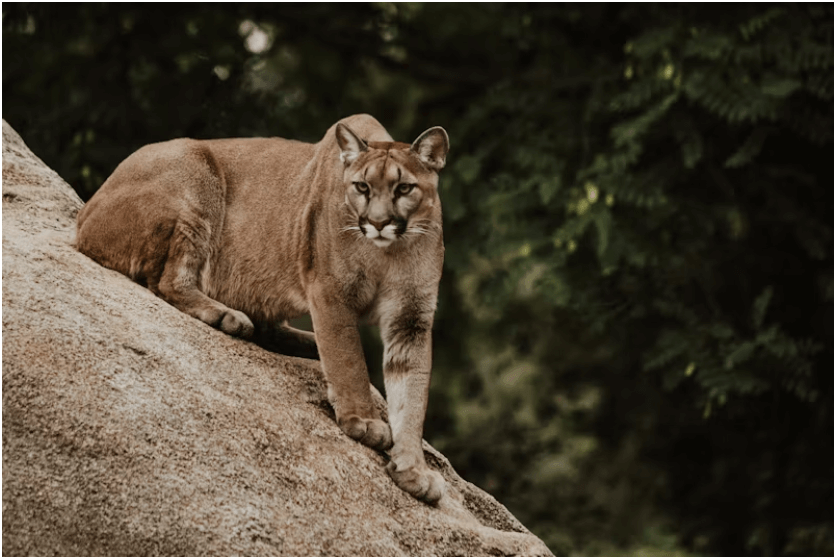
Proposition 127 is a grassroots citizens initiative that would make it illegal to hunt, shoot at, or trap bobcats, lynx, and mountain lions in Colorado. The only exceptions are for the protection of human life, property and livestock. Violation would be a Class 1 misdemeanor punishable by a fine and limiting of the violator’s wildlife hunting privileges.
The measure is supported by Cats Aren’t Trophies, and is endorsed by animal welfare societies, wildlife sanctuaries and rescues, Audubon Societies, Wild Earth Guardians and the Sierra Club, among others.
Maliyah Mounce’s first buck during Wisconsin’s youth deer hunt season (Photo: Lukas Mounce)
1
BROWN COUNTY (WLUK) — This weekend marked the youth deer hunt season across Wisconsin, bringing families out together in the wilderness.
While the 2024 deer hunting season will be out in full force later this year, early October presents a great opportunity for hunters like Ty Rabas and his 10-year-old son, Mack.
“It brings me a lot of joy and excitement to pass on what my dad showed me to him and my other little guy and the other one behind him,” said Ty Rabas.
The father and son duo were trekking on public land in Brown County on Sunday during the youth deer hunt, hoping to find the perfect buck.
Mack already harvested a buck last month in Michigan.
“At the end of the day it’s like, it feels like you’re not gonna get anything but then like they come in like right before the sun sets,” said Mack Rabas.
Wisconsin’s youth deer hunt offers hunters 15 years and younger the chance to learn the techniques of hunting.
Lukas Mounce’s 7-year-old daughter, Maliyah, harvested this eight point buck on Saturday in the Fox Valley, her first in her young hunting career.
“I’m really proud that I got that buck, and my little brother, he really really wants to go hunting with me,” said Maliyah Mounce.
For Lukas, he’d describe that moment with his daughter as special.
“Her eyes said it all when she found it. I mean, she just whipped around and her eyes were as big as pie plates and, I mean, that was the most exciting part for me,” said Lukas Mounce.
JOIN THE CONVERSATION (1)
Whether you come home with a trophy buck or empty-handed, hunting is all about the memories you make along the way.
UPDATE: The Berkeley County Sheriff’s Office tells News 2 they are investigating this case. Anyone with information can call 843-723-3800.
—
SUMMERVILLE, S.C. (WCBD) – An investigation is underway in Summerville after more than a dozen animals were found dead on a recently sold property along Drop Off Drive.
Biden administration focuses on ‘climate resilience’ after Helene
close
volume_off
-00:00
sd
closed_captions
fullscreen
Pet Helpers said 12 cats and three possums, part of a monitored cat colony, were discovered scattered throughout the wooded area where they lived.
Lowcountry TNR and Feral Cat Network have been monitoring and caring for the animals. According to Pet Helpers, the groups are “committed to trap-neuter-return efforts” for feral cats in the community.
Stephanie Fauvelle, president and co-founder of the Charleston Animal Legislative Action League, said in an email to News 2 that the cats were found poisoned on the recently sold property. She said the previous owner agreed to sell the land with the “explicit condition that the colony of cats […] would be cared for.” She added that the previous owner was devastated upon learning about the deaths.
According to Pet Helpers, police are actively investigating the incident. The animal shelter is now offering a $5,000 reward for information that leads to an arrest and conviction of those responsible.
Members of the TNR group are monitoring the area to collect any surviving animals to protect them from further harm. So far, seven additional felines have been found and trapped.
Melissa Susko, executive director of Pet Helpers, called the incident a “heartbreaking and horrifying situation.”
“The cruelty inflicted on these innocent animals is beyond comprehension,” said Susko. “These cats were being cared for, loved, and looked after by volunteers who had committed their time to helping them. We are committed to seeking justice for these animals and will do everything in our power to ensure those responsible are held accountable. Our thoughts are with the caregivers of this colony, and we hope no more animals are harmed. We urge anyone with information to come forward to ensure that those responsible are held accountable.”
Anyone with information is asked to contact the Berkeley County Sheriff’s Office at 843-723-3800.
Three men were arrested in the Dhekelia area on Monday morning after a Sovereign Base Area Police anti-bird trapping raid discovered them in an orchard using active mist nets.
During the raid, between the villages of Ormidhia and Xylophagou, the dedicated Bird Trapping Action Team working alongside the Committee Against Bird Slaughter, released 69 live Ambelopoulia (Black Caps) which had been snared in three mist nets.
The police have also confirmed that a bird imitating device used to attract migrating Ambelopoulia was seized, along with three loudspeakers, 100 metres of electric cabling, one car battery and a vehicle used by the men.
All three are from the Xylophagou area and police are now in the process of tracing the owner of the orchard used for the crime.
Sergeant Yiannis Louca, who ran the operation, said the men are now all facing prosecution for their crimes.
He explained: “Firstly, this is a really good result and sends out a very strong message that despite our success in heavily reducing this crime over the years, we remain committed.
“We are still investigating this crime but the men will face prosecution in the SBA Court as we operate a zero-tolerance policy on bird trapping.”
Inspector Fanos Christodoulou, who oversees the team, warned trappers his officers were now better resourced and more prepared than ever before.
He said: “We have assembled a team of 10, full of experience with officers that are keen to make a difference in tackling this crime.
“We will have the capacity to call on up to 10 members of the military to assist us in our operations when working on military land and on top of that, we will once again work very closely with Bird Life Cyprus and CABS to combat bird trapping.
“As always, we will continue to develop our technology, with drones, hidden cameras and any other modern means of detection.”
Natural Resources Commission member Patrick Early (left), department Director Dan Bortner and commission Chair Bryan Poynter at a commission meeting on Tuesday, Sept. 17, 2024. (Leslie Bonilla Muñiz/Indiana Capital Chronicle)
Indiana’s Natural Resources Commission on Tuesday approved preliminary rules for a new, lawmaker-mandated bobcat trapping season, and finalized statewide river otter trapping regulations.
Commission leader Bryan Poynter called the bobcat work a “heavy lift,” speaking from the ballroom at the Fort Harrison State Park Inn in Marion County.
The Department of Natural Resource’s proposed changes would include establishing a bobcat trapping season in 40 southern Indiana counties, with a bag limit of one bobcat per trapper and a season quota of 250 bobcats. It would run November to January.
Public comments can be submitted here by clicking on “Comment on this rule.”
Biologist Geriann Albers said the department based the limits on a data model created in collaboration with Purdue University.
Department of Natural Resources Biologist Geriann Albers speaks at a commission meeting on Tuesday, Sept. 17, 2024. (Leslie Bonilla Muñiz/Indiana Capital Chronicle)
The model’s assumptions were “very conservative,” she said.
“We’re very confident that that number is sustainable and is not going to negatively impact our bobcat population,” Albers told the commission.
The season is limited to “established” populations in the south, for example, because bobcat populations further north are still considered “emerging.”
The department also recommended other amendments: letting legally acquired bobcats and parts to be sold, letting bobcats found dead to be kept for personal use with a permit, and more.
Traps would be limited to cage, foothold and cable device traps.
“We know those three types have been tested on bobcats, and they’re humane, efficient and selective for bobcats,” Albers said.
She told the Capital Chronicle that the department’s efforts related to bobcat trapping go back at least four years. Rulemaking for a brand-new season is complex, she said, because it involves plenty of data and other moving parts.
In 2019, the department weighed a bobcat season but dropped the idea after public backlash. Lawmakers stepped in earlier this year to require a season.
The department’s Fish and Wildlife Division aimed for balance.
“People like to participate in hunting and trapping, but we also want to strike that balance of (bobcats) still being available for people to view or photograph and things like that,” Albers said. “So we’re trying to maximize the outdoor activity that’s available, but in a sustainable way.”
Fort Benjamin Harrison State Park’s inn on Tuesday, Sept. 17, 2024. (Leslie Bonilla Muñiz/Indiana Capital Chronicle)
The commission approved preliminary adoption of the amendments by voice vote. Public comment comes before a final vote.
Animal rights activists decried the move.
Samantha Chapman, Indiana state director for the U.S. Humane Society, said the group was “deeply disappointed” in the initial approval.
“While the Commission was given no choice on proposing such an unpopular season, we urge them to recognize Hoosier’s overwhelming opposition to this inhumane and scientifically unjustifiable treatment of Indiana’s only remaining native wildcat, whose population is still recovering,” Chapman said in a Wednesday statement.
She pushed the commission to set a quota of zero bobcats, noting it has the discretion to do so.
Swimming out of extinction
Commission members separately O.K.’d final rules for an expanded river otter trapping season, a development that Poynter dubbed “one of the biggest success stories that we’ve had in Indiana in a long time.”
Hoosier river otters were few and far between by the 1900s, and were even classified as extinct in Indiana in 1942, according to Purdue University.
The department began a reintroduction program in 1995, releasing 303 river otters into the state before the new millennium, according to its website. Most came from Louisiana, per Albers.
By 2005, the population had recovered so much that river otters were removed from the state-endangered list. The department opened its first limited season for the creatures in 2015.
Now, the department estimates there are upwards of 8,000 river otters in Indiana.
“As … otters have kept expanding, we’ve upped that quota once, and we started adding more and more counties, and we were kind of at a tipping point where most of the state was already open and there was only some counties that weren’t,” Albers said.
And, Hoosiers having “otter issues” can take them during the season instead of having to get other permits. River otters commonly get into small ponds stocked with fish, she said.
“Otters see those kind of as buffets,” she remarked.
The changes establish a statewide trapping quota of 750 river otters with an individual bag limit of two. The season extends from mid-November to mid-March.
Note: This article has been updated with comments from Indiana’s chapter of the Humane Society.
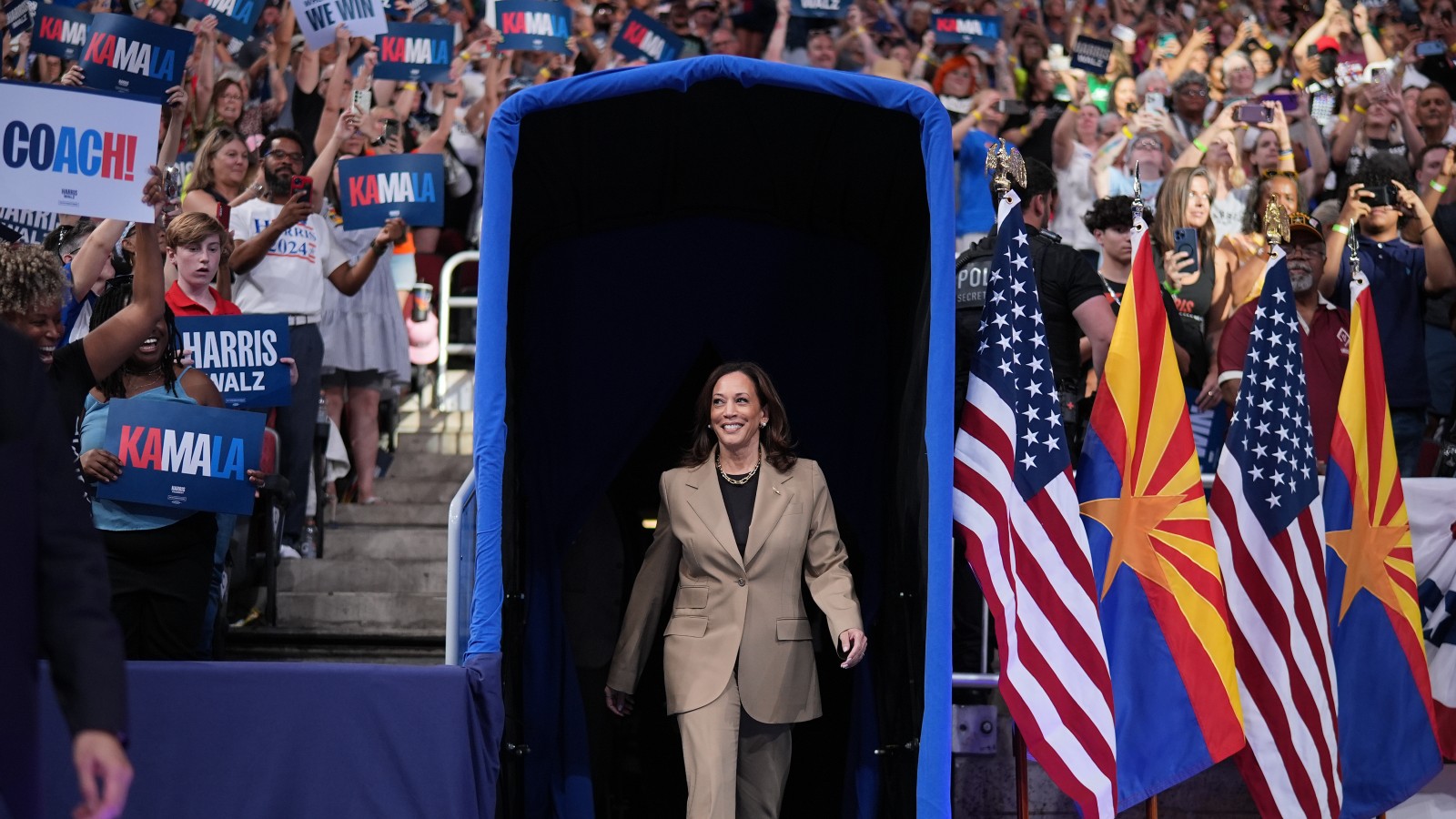
At an August rally in Glendale, Arizona, the rowdiness of the crowd suggested a rockstar was about to take the stage. Instead, a booming voice welcomed the spectators with a full-throated endorsement of Democratic presidential candidate Kamala Harris: “She is the right person at the right time to be our country’s 47th president!” The voice belonged to Governor of the Gila River Indian Community Stephen Roe Lewis, a tribal leader who helped resolve long overdue water rights in the state for the tribe last year. “Skoden!”
Later on, after a warm-up speech from running mate Tim Walz, Vice President Harris took the stage, saying she would “always honor tribal sovereignty and respect tribal self-determination,” (The 22 federally recognized tribes in Arizona make an Indigenous voting block that proved essential to President Joe Biden’s win in the swing state in 2020.) On her campaign website, she maintains that she will work to secure America’s industrial future by investing in clean energy — but clean-energy development often negatively impacts sites on federal lands that are sacred to Indigenous peoples.
Grist Weekly| The best of Grist’s essential climate reporting, delivered straight to your inbox every Saturday.Sign up now
The Biden-Harris administration has been one of the most supportive of Native peoples, investing millions of dollars of federal funding for climate resilience and green energy initiatives. Still, the Indigenous vote for Harris in 2024 is far from assured. While the U.S. has big goals on its path to a clean-energy future, those plans have to compete against the preservation of tribal lands — an issue Harris has stumbled over in her political career, dating back to her time as California’s attorney general.
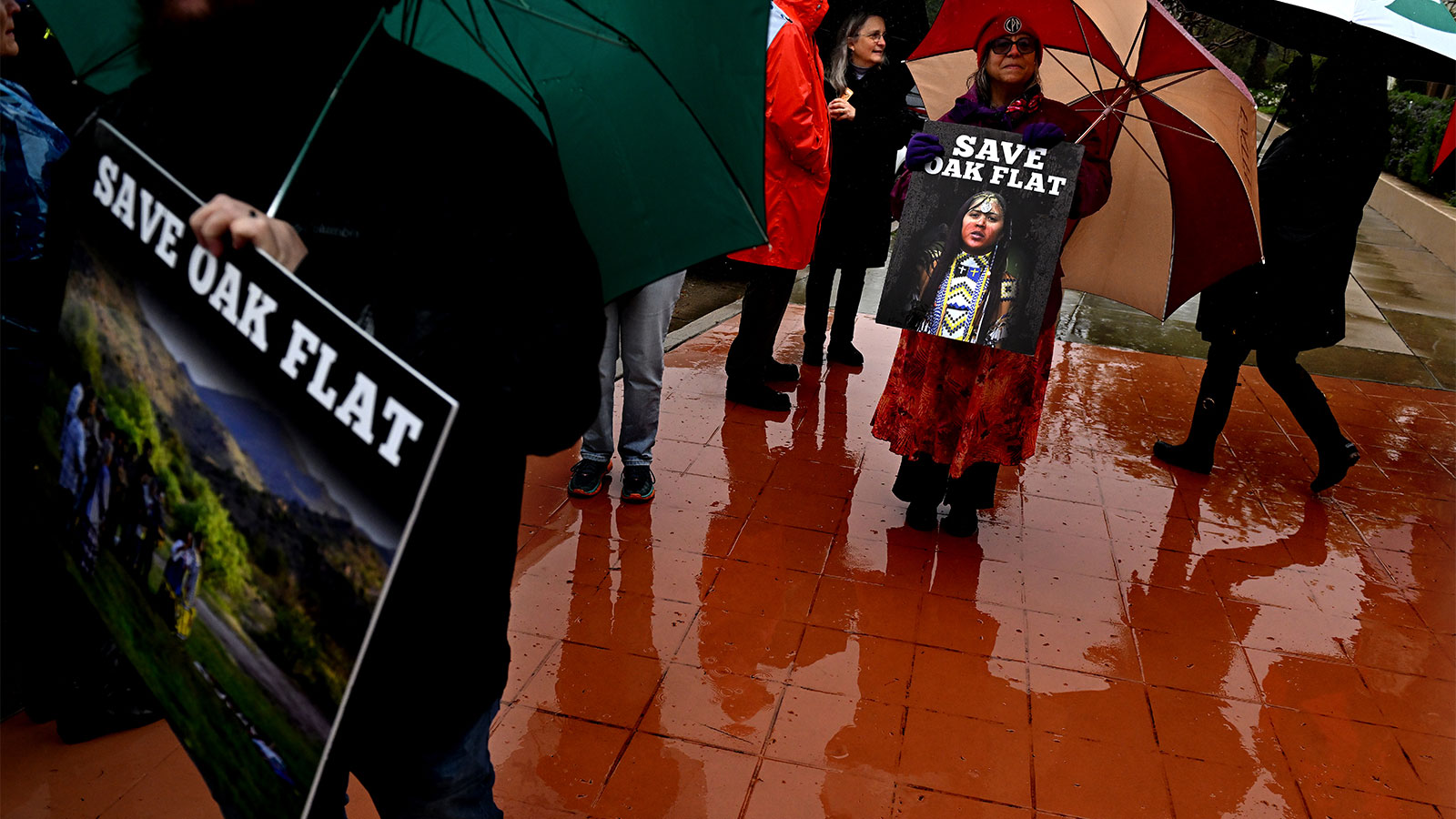
Almost 80 miles east of the Arizona rally, a sacred site is in danger. Oak Flat, a swath of national forest land in the high desert, has been an important spiritual site for tribes like the San Carlos Apache for centuries, and is used for ceremonies and gathering medicines like sage, bear root, and greasewood. Yet the area is under threat — Rio Tinto, an international mining company, has been fighting to put a copper mine there for more than a decade. Oak Flat is home to one of the planet’s largest undeveloped copper reserves, and the metal is critical to making the electric batteries necessary for the shift to cleaner energy sources.
Oak Flat and other sacred sites have not been given enough federal protections, activists say, despite intense advocacy from the tribal nations affected. Much of the U.S. has already been built and powered at the expense of tribal lands and peoples. To reach its goal of 80 percent renewable energy generation by 2030, and carbon-free electricity five years after that, the U.S. needs big investments and robust policy support. While Harris says she is the candidate in the best position to achieve those goals, there is a concern among Indigenous communities that doing so will continue to exploit tribal homelands — most of the minerals needed for the energy transition are located within 35 miles of away from tribal communities, on lands originally stolen from them. Read Next
“They definitely are hard to do at the same time. That’s the conflict,” said Dov Kroff-Korn, an attorney at Lakota People’s Law and Sacred Defense Fund, of the balance between extracting the minerals critical to the energy transition and protecting tribal lands where many such minerals are located. He mentioned that Harris has few environmental policies of her own to critique, and that, policy-wise, the broader Biden-Harris administration has been a mixed bag. “There’s been a lot of positive signs that should be recognized and applauded. But it’s also been a continuation of a lot of the same old extractive policies that have powered America for pretty much its entire history.”
In a bid to protect some places from industry, President Biden flexed his ability to make national monuments out of sacred sites, such as the Ancestral Footprints of the Grand Canyon National Monument — or Baaj Nwaavjo I’tah Kukveni — as well as to fully restore the boundaries of the Bears Ears monument in Utah from a Trump-era rollback. Biden also appointed the first-ever Native American to his Cabinet — Deb Haaland, Pueblo of Laguna — as the head of the Department of Interior. In her role, Haaland has instructed federal agencies to incorporate traditional knowledge in order to better protect Indigenous sacred sites on public land.
During her tenure as vice president, Harris has been party to the administration’s push to produce more oil and gas than ever, despite promises to halve greenhouse gas emissions by 2030. Last year, the Biden administration also gave the green light to the Willow project, an $8 billion dollar drilling operation on Alaska’s North Slope that some, but not all, tribes were against. Throughout her presidential campaign, and in a reversal of her previous stance, Harris has showed support for fracking, a controversial drilling method that extracts oil and natural gas from deep within the ground.
Crystal Cavalier-Keck, a member of the Occoneechee Band of the Saponi Nation in South Carolina, is the co-founder of 7 Directions of Service, an Indigenous-led environmental justice organization. She’s concerned that the Mountain Valley Pipeline, currently a 303-mile system that runs through West Virginia and Virginia, will permanently damage the sacred Haw River where she has many memories with her family. Over the years, the beleaguered river has been polluted by chemicals and is now threatened by the pipeline, which began operations in June.
In 2020, Cavalier-Keck campaigned for Biden in South Carolina but didn’t see movement on the environmental protections she wanted after he got elected. She said she will still vote for Harris in November but feels like her concerns are not being talked about. “There’s not much at all on her environmental policies,” she said. “They’re saying the right buzzwords, like ‘clean, renewable, forward.’ But where’s the meat of it?” Read Next
She lives about a two-hour drive from where Hurricane Helene has claimed more than 100 lives in North Carolina, and she worries that the next big climate disaster will reach her community. Cavalier-Keck said that her tribe has had issues accessing the roughly $120 million in federal funding to help tribes build climate resilience.
During Harris’ time as attorney general of California, she argued against tribes putting land into trust, a process that can protect land as well as allow economic development like casinos where gambling might be banned, claiming the situation only applies if a tribe was “under federal jurisdiction” when the Indian Reorganization Act was passed in the 1930s. The Ninth Circuit Court of Appeals ruled against Harris and the state, but had she won the case, about 100 tribes in California would not have been allowed to benefit from trust lands.
Still, Lael Echo Hawk, who is Pawnee and an expert in tribal law, says Harris’ decisions as attorney general aren’t reflective of what she might be capable of as president. She pointed out that as attorney general, Harris helped pass a red flag law in California to take away firearms from people deemed dangerous. Plus, she called on the U.S. Congress to reauthorize the Violence Against Women Act — an issue important in Native communities, where women go missing and are the survivors of violence at a rate higher than the national average. Echo Hawk also knows of tribes concerned with border issues and immigration that are endorsing Harris. “These are important issues that I think better demonstrate her commitment to advancing and protecting tribal sovereignty,” Echo Hawk said.
But for Nick Estes, a member of the Lower Brule Sioux Tribe and a professor at the University of Minnesota, Harris might just be a continuation of the Biden administration, which he maintains has taken advantage of tribal lands. As it stands today, 1.6 million surface and subsurface acres of land within 83 reservations have non-Natives benefiting from oil, gas, and mining operations, among other extractive industries.
“You can’t just have a vibes-based environmental policy. It actually needs to be concrete,” said Estes. “What we’ve seen is just service to industry at the expense of Native lands and livelihoods.”