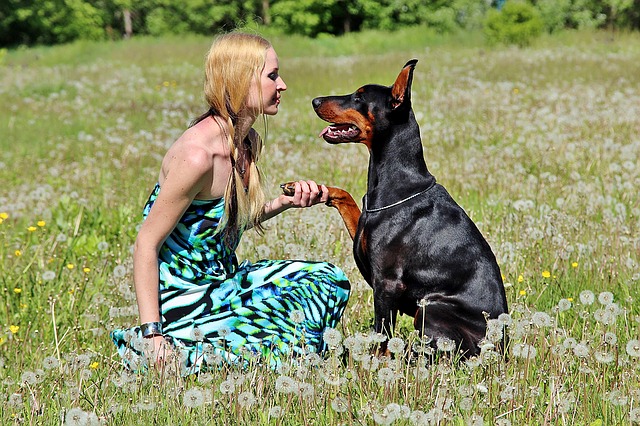
Dog owners know their pups love them deeply, even if they express it differently than humans. Recent research, however, left many dog lovers saddened when it revealed that most dogs don’t like being hugged. This doesn’t mean our furry friends dislike affection; they thrive on our love and approval! Instead of giving them hugs, which can make them uncomfortable, try showing your devotion in ways they truly understand—belly rubs, treats, or playtime. These gestures strengthen your bond and express love in a language they fully appreciate.
Gaze Deeply Into Their Eyes
Shutterstock
Dr Brian Hare, Professor of Cognitive Neuroscience at Duke University, topped the NY Times bestseller list with his book, The Genius of Dogs. In an interview with Anderson Cooper this past Spring, he told the dog-loving newsman that when your dog stares at you, he is “hugging you with his eyes.”
This doesn’t mean you should stare deeply into the eyes of the dog that guards your local junkyard! Direct eye contact is still considered a challenge or threat in many situations. But with your trusted pet, try gazing into his eyes when you are calmly relaxing.
Speak softly, stroke him gently, and maintain eye contact. According to Hare, these quiet moments stimulate the release of Oxytocin in the canine brain – the same hormone that bonds mother and child.
Raise Your Eyebrows
Shutterstock
A Japanese study published in the September 2013 volume of Behavioral Processes found that dogs raise their eyebrows – especially the left one – when greeted by their owners. Using a high-speed camera, they scrutinized the dogs’ facial movements when seeing their owners vs. strangers.
When the strangers came along to greet them, the test dogs displayed far less facial activity, most of which was right-sided. The significance is that the right brain controls the left side of the face and is tied to emotion, while the left brain controls the right side of the face and is tied to analytical behaviors.
The more facial activity you display when greeting your dog, the more they know they are loved. If you can raise one eyebrow (sadly, I cannot), then make it to the left one. Your pup will really feel special!
Lean On Them
Shutterstock
Not just figuratively, but press your weight against your dog physically. Not to the point where he feels cornered (or crushed!), but just a little to show you trust him. Our pups do this to display their affection for us, which is often overlooked.
Have you ever had your pooch press up against the backs of your legs while you’re busy in the kitchen? That’s a type of dog hug! Try giving him one right back.
Let Them Sleep With You
Shutterstock
Emory University neuroscientist Gregory Berns is the author of How Dogs Love Us, and he has spent decades studying the canine brain using MRI. According to his research, sleeping with a human is the ultimate display of love and trust our dogs can give because that is when they are most vulnerable.
It also shows that they consider us a member of their pack. If you have a No Dogs in Bed policy, try snuggling up on the sofa or floor for a few minutes daily to show affection.
Rub Their Ears
Shutterstock
A pat on the head might feel natural to show praise, but rubbing your dog’s ears may express more love. When you rub your dog’s ears, their bodies produce endorphins. Endorphins are hormones that cause pleasure for your pup. A gentle ear massage in a circular motion is enough for your dog to know how you feel.
Spend Quality Time Together
Shutterstock
Engaging in fun activities with your dog is a great way to help your bond grow. Going for walks, playing fetch, or working on training are all ways to show your dog you care. These activities bring you and your dog closer together.
When your dog sees you having fun, they’ll feel happy too. In addition to feeling loved, your dog will get the exercise and mental stimulation they need.
Keep Using the “Baby Voice”
Shutterstock
We all do it! As dog parents, it’s hard to resist having conversations in a high-pitched voice with our dogs. It might be embarrassing to admit, but dogs enjoy it. They respond well to the exaggerated emotions in your voice, and it helps them know you’re addressing them.
So, there’s no need to feel crazy if you talk to your dog. Odds are, their love for you grows even stronger when you do. Reading to dogs is another special way to bond with them.
Give Them a Loving Touch
Shutterstock
Not every act of love has to be grand. You can show your dog you love them just by petting them. Touching a dog releases oxytocin, a hormone that makes you feel good. So, if your dog enjoys it, there’s no reason to hold back on the pets and belly rubs.
Adding an extra touch to your dog’s routine, such as a massage, grooming session, or extended petting time, might make your dog feel more loved. Most dogs will happily welcome the extra attention.
Just Be Yourself
Shutterstock
Throughout his extensive research Dr. Berns has found that although it’s sometimes hard for us to tell what our dogs are thinking, they definitely do not have the same problem reading our emotions! If your love is true for your pups, they know it by reading your voice, body language, and actions. So just keep doing what you’re doing, and your dogs will reward you by showing affection in their own special ways.
Shutterstock
Dog owners know their pups love them deeply, even if they express it differently than humans. Recent research, however, left many dog lovers saddened when it revealed that most dogs don’t like being hugged. This doesn’t mean our furry friends dislike affection; they thrive on our love and approval! Instead of giving them hugs, which can make them uncomfortable, try showing your devotion in ways they truly understand—belly rubs, treats, or playtime. These gestures strengthen your bond and express love in a language they fully appreciate.
Gaze Deeply Into Their Eyes
Shutterstock
Dr Brian Hare, Professor of Cognitive Neuroscience at Duke University, topped the NY Times bestseller list with his book, The Genius of Dogs. In an interview with Anderson Cooper this past Spring, he told the dog-loving newsman that when your dog stares at you, he is “hugging you with his eyes.”
This doesn’t mean you should stare deeply into the eyes of the dog that guards your local junkyard! Direct eye contact is still considered a challenge or threat in many situations. But with your trusted pet, try gazing into his eyes when you are calmly relaxing.
Speak softly, stroke him gently, and maintain eye contact. According to Hare, these quiet moments stimulate the release of Oxytocin in the canine brain – the same hormone that bonds mother and child.
Raise Your Eyebrows
Shutterstock
A Japanese study published in the September 2013 volume of Behavioral Processes found that dogs raise their eyebrows – especially the left one – when greeted by their owners. Using a high-speed camera, they scrutinized the dogs’ facial movements when seeing their owners vs. strangers.
When the strangers came along to greet them, the test dogs displayed far less facial activity, most of which was right-sided. The significance is that the right brain controls the left side of the face and is tied to emotion, while the left brain controls the right side of the face and is tied to analytical behaviors.
The more facial activity you display when greeting your dog, the more they know they are loved. If you can raise one eyebrow (sadly, I cannot), then make it to the left one. Your pup will really feel special!
A Barred Owl from the Whispering Willow Wild Care facility of Schenectady, N.Y. (AP Photo/Hans Pennink)
The Barred Owl is considered “invasive” in the Pacific Northwest and it’s pushing the Northern Spotted Owl to extinction. The U.S. Fish and Wildlife Service has a plan — kill nearly half a million Barred Owls over the next 30 years.
Guests
Tom Wheeler, executive director of the Environmental Protection Information Center [EPIC]
Jay Odenbaugh, professor of humanities, professor of philosophy at Lewis & Clark College.
Also Featured
Kessina Lee, Oregon State supervisor for the U.S. Fish and Wildlife Service.
Mark Higley, wildlife biologist at Hoopa Valley Tribal Reservation.
Transcript
Part I
(NORTHERN SPOTTED OWL CALL)
WBUR is a nonprofit news organization. Our coverage relies on your financial support. If you value articles like the one you’re reading right now, give today.
MEGHNA CHAKRABARTI: This is the call of the Northern Spotted Owl.
And this is the call of the Barred Owl.
(BARRED OWL CALL)
CHAKRABARTI: The two species are close relatives. The medium sized, dark brown, Northern Spotted Owl being smaller than its more aggressive and territorial cousin the Barred Owl. But the most critical difference between the two is that in the forests of the Pacific Northwest, the Spotted Owl is considered a native species. The Barred Owl, an invasive from the Eastern U.S.
The Spotted Owl is also a listed threatened species. And the successful spread of, and competition from, the Barred Owl is one of the factors pushing the Spotted Owl closer to extinction.
Now, the two raptors are at the center of a controversial federal plan that raises questions about the entire philosophy behind traditional models of conservation and the goals of the Endangered Species Act.
Advertisement
Put simply: How many hundreds of thousands of one species can be justifiably killed to preserve another? And what, exactly is it, that we’re trying to save?
This is On Point. I’m Meghna Chakrabarti.
To understand the importance of the current debate over Spotted Owl conservation and forest management, we have to go back about fifty years, before the invasive Barred Owl was firmly established in the forests of the Northwest.
Back then, the Spotted Owl was at the center of another years-long battle. One that went on for so long and created so much upheaval in the Northwest, it came to be known as the Timber Wars.
(CHAINSAW CUTTING OLD GROWTH / TREE HITS GROUND)
The old growth forests of the Pacific Northwest are some of the most complex ecosystems in the world. Conifer trees two centuries old and two hundred feet tall create an intricate canopy that protects a dense understory below. The forests have a storybook aura to them, with pristine waterways and mist draped mountainsides. They were also a critically important natural resource, and therefore the economic heart of logging communities across the Northwest.
But a century of logging meant that the old growth forests were rapidly disappearing. Environmentalists made it their mission to save them.
In the 1980s and early 90s, as environmental lawyers sought court injunctions to stop timber sales on federal lands, protestors blockaded logging roads, chained themselves to trees, held hunger strikes, and camped up in the canopy of stands slated for cutting.
(PROTESTOR MONTAGE)
CHAKRABARTI: The Northern Spotted Owl lives in those old growth forests. And as billions of board-feet of timber were felled, the owl’s numbers plummeted too. That spurred the push to use the Endangered Species Act to protect the Spotted Owl. In June 1990, the federal government made its decision.
ARCHIVAL RADIO NEWS: Good Friday morning, it’s 8:30 in sweet home … as a threatened species this morning.
CHAKRABARTI: Logging communities who’d worked the forests for generations felt they were fighting for their lives. Automation in the timber industry had already cost thousands of jobs. Now, they feared that the federal mandate to protect the Spotted owl would wipe out their entire way of life.
LOGGERS: Why should the owl be protected 100% and a way of life not … thre are thousands more than that.
CHAKRABARTI: Between 1989 and 1995, logging on federal land fell by 90%.
I grew up in Oregon. When I was in middle and high school, it felt like we heard about another sawmill closing almost every month.
There were t-shirts and bumper stickers with “Save a Logger Eat an Owl” and “I like my spotted owl fried” sold in places like Sweet Home and Mill City.
And then, in 1994, the Clinton Administration established the Northwest Forest Plan. It protected 10 million acres of federal land, preserving old growth forests, encouraging younger trees, and creating buffer zones in order to protect endangered species, including the Northern Spotted Owl.
Did it work?
We’re now three decades on. The Spotted Owl is still a dangerously threatened species. In fact, in the past twenty years, the number of spotted owls has declined by as much as 80 percent.
And part of the reason for that dire decline – pressure from the Barred Owl, an East Coast native, but invasive in the Northwest.
Doug Heiken is with the conservation group Oregon Wild. He described the problem to Portland TV station KGW.
DOUG HEIKEN: You have these territorial species … you need to make your house bigger.
CHAKRABARTI: But making the owl’s house bigger is a project of decades, if not centuries. They are old growth forests after all. Instead, the US Fish and Wildlife Service opted for a different strategy.
Last month, the agency announced its Barred Owl management plan. It calls for the culling of almost half a million Barred Owls in the next thirty years, in order to reduce pressure on the Spotted Owls.
If we don’t do this, we are facing the extinction of the spotted owl, and I think folks really understand that the science is very clear, that if we don’t manage barred owls, we are facing the likely extinction of northern spotted owls, and no one wants that.
CHAKRABARTI: Kessina Lee is the Oregon State supervisor for the U.S. Fish and Wildlife Service. Her office leads the Barred Owl Management Strategy.
KESSINA LEE: What the strategy does not propose to do is to eliminate barred owls in the Western United States. That’s not a goal that we think is attainable. This is really about strategically managing barred owls in some places to create a kind of refugia that is for spotted owls to reoccupy and reproduce and grow those areas. Create a core and then try to grow that core understanding that we’re always going to have barred owls in the West. And we’re really talking about managing barred owls in less than half of the range of the northern spotted owl.
CHAKRABARTI: And though the cull may be controversial, Lee says U.S. Fish and Wildlife is legally required to do all it can to protect threatened species like the spotted owl.
LEE: The Fish and Wildlife Service, at its sort of most basic, we have a responsibility to do all we can to prevent the extinction of federally listed species.
In this case, the Northern Spotted Owl and to support its recovery. And as I said, the science tells us that if barred owls are left unmanaged, we’re facing the likely extinction of the Northern Spotted Owl. We’re asked sometimes if this is about choosing one owl species over another, and I want to be very clear that it’s not. It’s choosing to have both species on the landscape as opposed to just one, because if we don’t act now, we will only have barred owls on the landscape.
And if we act, we can save spotted owls for future generations in the Pacific Northwest as well as barred owls on the landscape.
CHAKRABARTI: Finally, Lee says the brutal truth is that time is running out for the spotted owl.
LEE: The science is telling us we’ve got a two-pronged approach, if we’re going to prevent the extinction of the spotted owl, it’s habitat management, which right now the biggest threat is catastrophic wildfire in terms of the habitat side.
And the threat of invasive barred owls, and we have time to act with regard to barred owl, but that window is closing. If we don’t act, that’s a decision to let the spotted owl go. And we simply have an obligation to do everything we can to prevent that.
CHAKRABARTI: We went over the history of the Timber Wars, because the truth is, the Spotted Owl has been on the brink of extinction twice, and both times because of human impacts on the land. In this sense, the Barred Owl is a victim of human management, too, because its spread West was facilitated by manmade changes to the Great Plains and the Northern Boreal forests that go back more than a century.
So with the Spotted Owl, we have a species pushed to the brink, saved from oblivion by drastic action, only to be pushed to the brink again, requiring a cycle of more drastic action that necessitates decisions such as culling a half million other animals? How long can this go on? Is there a better model for conservation – one that does not rely on the Endangered Species Act, which is now 51 years old?
Part II
CHAKRABARTI: I’m joined today by Tom Wheeler. He’s executive director of the Environmental Protection Information Center, or EPIC, and he’s in Eureka, California.
Tom, welcome to On Point.
TOM WHEELER: Thank you for having me. Jay Odenbaugh is also with us today. He’s a professor of philosophy at Lewis and Clark College in Portland, Oregon, and he recently co-authored a New York Times opinion piece that was headlined, A dystopian effort is underway in the Pacific Northwest to pick ecological winners and losers.
Professor Odenbaugh, welcome to you.
JAY ODENBAUGH: Thanks for having me.
CHAKRABARTI: Tom, I’d love to start with you because I think we need a further explanation about why Fish and Wildlife has come to this conclusion that this mass culling over several decades of barred owls is an effective way to extend the protection to the spotted owl.
Can you talk us through that a little bit?
WHEELER: Absolutely. So this is something that the U.S. Fish and Wildlife Service and researchers across the Pacific Northwest have studied for many decades now. The first paper considering the potential impact of barred owls on spotted owls was in the 1970s when barred owl invasion was really recent.
We have engaged in removal studies across the Pacific Northwest. Those removal studies have shown that when barred owls are removed from spotted owl habitat, the rate of decline significantly reduces. It basically flatlines. And so if we were to extend this across the range of the Northern Spotted Owl and really try to target high quality habitat for the Northern Spotted Owl, it seems that we have a chance to hold on to our precious Northern Spotted Owls.
CHAKRABARTI: What is it about the Barred Owl that’s putting so much pressure on the Spotted Owl?
WHEELER: The Barred Owl is slightly bigger than the Northern Spotted Owl. It’s more aggressive. It’s also a generalist both in habitat and diet. It eats a wider variety of life than the Northern Spotted Owl. And when Barred Owls and Spotted Owls overlap, the Barred Owls force them off of their territory, force Northern spotted owls out of their nesting and roosting habitat.
And Northern spotted owls no longer will reproduce. So it causes the Northern spotted owl population to drop very significantly, very quickly.
CHAKRABARTI: And Fish and Wildlife has said that other options were considered, right? Removing barred owls or seizing eggs in order to reduce reproduction rate of barred owls. But none of those seemed to provide the same impact in terms of protection of the spotted owls, or they were extremely expensive, is that correct?
WHEELER: That’s correct. We have to figure out what’s feasible in trying to protect the northern spotted owl.
And killing barred owls is frankly the most feasible option here.
CHAKRABARTI: Jay Odenbaugh, I’m going to come to you in just a second here, but Tom Wheeler, let’s get down to the bottom line here. And again, I keep thinking back to the upheaval that was caused from Northern California all the way to Washington State during those timber wars.
People did lose their jobs, but other folks were arrested. President Bill Clinton even came to Oregon to moderate essentially a conversation, to try to find a solution to this problem. So it seems like there’s a lot emotionally, morally, and politically on the line when it comes to the preservation of the spotted owl.
So what is at stake here?
WHEELER: There’s a lot at stake here. Not only is it species extinction, it’s also protection of larger Pacific Northwest mature and old growth forests. So I don’t want to treat the spotted owl as a tool, but it is often a tool for the protection of these forests. We environmental activists, I’m an environmental attorney myself.
We have utilized the listing of the Northern Spotted Owl to protect all of the myriad of life that also requires these mature and old growth forests. So when we lose the protections for the northern spotted owl, when they become extinct or when they are no longer present on the landscape, we also lose a critical tool for protecting these forests.
CHAKRABARTI: Well, Professor Odenbaugh, so you and your co-authors wrote this extensive opinion piece in the New York Times that challenges some of the ways we even see what the barred owl is. I kept using the word invasive, right? It’s native to the Eastern United States over what, a century and a half or so, it’s moved westward, considered invasive in the Pacific Northwest, but you challenged even just that approach to seeing what a species is in a landscape.
ODENBAUGH: Yes, my co-authors Avram Hiller and Yasha Rohwer, we worried about whether or not it’s best to think of the barred owl as an invasive, in part because of a study that came out recently. The study basically said that the eastern and western barred owl are so genetically different, but those differences would appear, have to appear over, say, 7,000 years of separation rather than the century.
As Tom knows, and I know too, this paper has some limitations. I think the bulk of evidence suggests that it’s invasive, our worries concern some other issues as well.
CHAKRABARTI: Such as?
ODENBAUGH: So the worries were basically twofold. So one thing that Tom mentioned is that there were experiments, removal experiments that happened in the Pacific Northwest and Washington, Oregon, and California.
And it’s true that removing barred owls did slow the decline of the Northern spotted owl. But on average, there was still a decline occurring. So they weren’t exactly stabilized, and they certainly didn’t increase. So one worry is that this very well may not work. And so you’re killing an enormous number of barred owls for something that really isn’t a guarantee.
So that’s the sort of first, where the second worry is that killing half a million barred owls over the next 30 years. The way the management plan set up is that this would happen over 30 years, but there’s no reason to think that we’ll stop killing barred owls then, it seems like we will have to kill them in perpetuity.
60 years, we’ll be at, say, a million barred owls killed at 90 years. … I think we have to ask is conservationists, do we want to be committed to endlessly killing barred owls?
CHAKRABARTI: This is how you put it in the Times piece, you say, you and your co-authors say, constant killing to keep ecosystems from changing in an already volatile world is a dystopian rearguard conservation strategy.
To me, that drives at the central question here, which is, what exactly are we trying to save? Yes, the spotted owl as a species, right? Extinction is bad whenever it happens. But it seems like it’s more than that. What’s being, trying to save here is an image of what the old growth forests of the Pacific Northwest should look like, should be like.
Who should be living there? But is that image or that ideal somewhat limited? Because it’s our ideal as human beings and it’s informed especially by human habitation. Let’s say colonial and westward expansion habitation that only dates back to the mid nineteenth century or so.
ODENBAUGH: That’s right.
I think this is sometimes called the baseline problem. If you want to restore an ecosystem, say, to some prior state, the question is what sort of, what prior state? And in this instance, we’re trying to hold the line, keeping the northern spotted owl around. I’m a big fan of the northern spotted owl and I would hope that we can save it.
But the thought here is that it’s trying to create a kind of stasis in these old growth forests, which unfortunately, face climate change, wildfire, and that’s all against the history of fire suppression. These forests are dynamic and they’re increasingly so because of what humans have done and are doing.
And so one worry is that we’re trying to hold the line, to use the metaphor, we were putting our fingers in a dam that’s leaking. And the question is, how many fingers do we have?
CHAKRABARTI: So Tom Wheeler, I’d love to hear your response to this. Because I think this is a perpetual challenge when it comes to what exactly are we trying to conserve?
Is trying to keep those old growth forests as close as we can, even as they are changing, to what they were like before mass logging began in the middle of the 19th century. Is that a worthy goal for conservation?
WHEELER: I don’t think that’s what we conservationists are attempting to do.
I know that our western forests are going to change because of climate change because the force is outside of our control. I think here with the barred owl, the impact of the barred owl is not just to the northern spotted owl, but the whole Western Forest ecosystem, because the barred owl is not a stand in for the Northern spotted owl.
It eats more varied prey than the Northern spotted owl. This prey is both common and rare. So we are seeing new pressure is being applied to prey species in the Pacific Northwest. Basically, anything small enough to fit into the talons of a barred owl is at risk of being eaten by a barred owl. This could massively disrupt West Coast ecosystems.
Advertisement
I understand the point of wanting to allow forests to evolve and to change, because that’s inevitable. That’s nature. But I think that there is a very significant cost to doing nothing here.
CHAKRABARTI: But when you say massive disruption to the forest though, are you talking about ecosystem collapse in the old growth forest?
Certainly, the forest ecosystem as a whole is more robust than that.
WHEELER: So the barred owl eats a wide variety of life from things like newts and salamanders and crayfish to small birds, as well as rodents. The northern spot owl basically just eats rodents. So if we start to eliminate this other life from the forest.
If the Northern spotted owl is gone and replaced by the barred owl, we could see not maybe ecosystem collapse, but very significant ecosystem change. Because we’re going to have new and different pressures on some of these lower trophic life animals that really influence how forests operate.
So if we’re removing the newts and salamanders, we’re going to have an impact to the understory of our forest, to the duff layer of our forest. It could have a really destabilizing effect on West Coast Forest ecosystems.
CHAKRABARTI: Jay Odenbaugh, do you want to respond to that? Because I think what Tom is pointing to here is that while the law, i.e. the Endangered Species Act, may focus on one species, let’s say, in an ecosystem, by virtue of protecting that, the entirety of the ecosystem receives that protection, not just the species. So it’s not just trying to keep the old growth forest frozen in aspic. It’s actually effective, perhaps the most effectively legal way we have to protect the forest itself, even as it changes.
ODENBAUGH: That’s a really important point. I think Tom mentioned this earlier. The Endangered Species Act basically works by, you find, say, a threatened or endangered species, or in this case, subspecies, and you protect its habitat as a way of conserving it. And our best tool that we have for protecting old growth is through the Northern Spotted Owl.
One of the things that came up in our piece was advocating for, in addition to the ESA, the Endangered Species Act, is having legislation, you can think of it as Endangered Ecosystem Act, if you like. President Joe Biden recently issued an executive order for inventorying and also managing mature and old growth forest as another tool. And so I think it’s a really important tool in our toolkit. But one worry here is if we can’t save the northern spotted owl, and I have worries that even this barred owl management strategy will, once the northern spotted owl is gone, then that tool no longer works.
That is, we can’t protect the old growth, absent the northern spotted owl under the ESA. I think we need some extra tools to in our toolkit.
CHAKRABARTI: Okay. I want to come back to that a little bit later in the show, because we’re always seeking new ideas here on how to handle really complex challenges. But, and Tom, I want to hear your thoughts on that again, a bit later.
But again, I think a lot of people may have been stuck, or their minds are really still hooked into, in a sense, the moral cost of choosing to have to cull half a million other animals who are just doing what animals do. They move as environments become either more or less habitable to them.
And now human beings are saying, we are going to choose the future of the spotted owl over the lives of the half a million barred owls. That is a morally complex and challenging situation. How do you see that?
ODENBAUGH: I think the, sort of the really, the thing that makes this morally complicated is that we have our hands on a lot of different parts of these forests and we’ve affected them.
And because we have altered them, we now have moral responsibilities towards them. For example, we removed a tremendous amount of habitat of the northern spotted owl, basically beginning its decline. We also, given the best science, have pushed the barred owl west. And in that sense, we’re culpable for facilitating its invasion out here in the Pacific Northwest as well.
In both ways, we have to use a kind of ugly metaphor, blood on our hands, right? Every time that we intervene in these systems, we’re adding more and more responsibility for taking care of it. And I think that sort of implicates us in importantly complicated ways. One thing I want to mention about the previous point we were talking about, the trophic cascades and the effects of the barred owl on old growth.
I think the best science we have at the moment suggests that there could be things like trophic cascades or ecosystem collapse, but I think the data at this particular moment just doesn’t show that you can’t go from the fact that these forests will change, to necessarily they’re going to collapse.
And so I think we just need more studies to see what the effects will be right.
CHAKRABARTI: Especially because the word collapse is extreme, right? The trees, the protected trees will still be there. The waterways will still be there. Other species will still be there. I think I’m personally feeling challenged to what to envision what collapse might look like in the old growth forest.
And that keeps making me come back to this question about the long-term dynamism of these ecosystems, that even before human beings were ever even on the North American continent in any way, shape or form, perhaps the ecosystem of the old growth forest at that time was just unrecognizable in comparison to what we believe is a more familiar model for it now.
ODENBAUGH: One thing that I think is remarkable, if you look at pictures of, say the Cascade Mountains here in the Pacific Northwest, say before wildfire suppression, the forest looks very different. They look much more patchy, et cetera. When you look at these for us now, they’re incredibly dense.
You might even say weedy, right? Because fire has not been allowed to move through them. And we look at these forests and think they’re absolutely beautiful and they are, but the human sort of imprint on these landscapes is there. In every way, shape, and form, the human imprint is there.
Part III
CHAKRABARTI: Today we’re talking about the new U.S. Fish and Wildlife Plan that calls for the lethal removal or the culling of half a million barred owls in order to save the northern spotted owl from extinction in the Pacific Northwest.
The U.S. Fish and Wildlife Service’s decision to authorize the mass culling came only after a decade of detailed research on the impacts of Barred Owl removal. Mark Higley is the wildlife biologist at Northern California’s Hoopa Valley Reservation – the largest tribal reservation in California.
MARK HIGLEY: I think barred owls are a magnificent species. I really like barred owls and I would like to travel to a place where I don’t necessarily need to shoot them. Um, it would be great.
CHAKRABARTI: His first year working for the reservation, in 1991, straight out of grad school, Higley counted 27 pairs of Northern Spotted Owls – and just one pair of Barred Owls.
HIGLEY: That pair of barred owls was fairly unique in Humboldt County at that time, and a lot of people, uh, local bird watchers would come up to Hoopa and drive up Big Hill Road and listen for barred owls to get Barred Owl on their, uh, Humboldt County species list. Barred owls at that point were kind of a novelty. I do remember some people saying, um, basically we should shoot them now. And I kind of wish that that would have been the approach back then given how many more Barred owls we’re going to have to shoot in order to protect spotted owls now that Barred owls have saturated the landscape.
CHAKRABARTI: Hoopa Valley Reservation is 12 by 12 miles, approximately 90,000 acres and during the early 2000s as the population of Barred Owls was exploding in Washington, Oregon, and into California, the Hoopa Valley Reservation became one of the first experimental Barred Owl removal experiment sites for the US Fish and Wildlife Service. In 2013, Higley began removing Barred Owls and he’s been doing it ever since.
HIGLEY: You know, I’ll go home after I work today, feed my kid, and then I’ll turn around and come back and go out for barred owls tonight. I drive out there, um, just as it’s getting dark, start to play my broadcast calls of barred owls. [BARRED OWL SOUND]
They’re vigorously defend their territories against all other barred owls and spotted owls, and so they’re relatively easy to call into shotgun range. And then once they are, you identify them as barred owls. I use binoculars, you know, a flashlight, and of course vocalizations, and look for a clean shot so that once you pull the trigger, the bird’s going to fall dead. And that’s essentially it. And sometimes they come in as a pair. I generally take the male first because they tend to be more shy than the females.
Once the female is removed, the male will often stay back and not come into range. So that’s basically the process. Locate them, call them in, shoot them.
CHAKRABARTI: Higley says on average about 73 Barred Owls a year are culled from the Hoopa Valley Reservation. Since 2013, he personally has killed 693 barred owls.
HIGLEY: Doing this work, to me, it’s a bit soul crushing at times. I was never, I never in a million years thought that I would be shooting a raptor of any kind ever. But the conservation benefit to spotted owls, I believe, is warrants actually culling barred owl populations. Otherwise, I wouldn’t be able to do it at all.
CHAKRABARTI: Higley says recently the moral cost of killing so many owls is taking its toll on him. And, at times, it also feels futile. The Barred owls always come back into the reservation from the surrounding areas where they aren’t being culled. But with the new U.S. Fish and Wildlife plan, he has renewed hope for the future.
HIGLEY: I’d like to be around to see spotted owls come back to the point where they’re fairly stable. I believe it’s possible. You know, for the last decade and a half, they’ve been, the populations have been declining rapidly. And I do believe that at least in parts of the range, there’s still enough spotted owls in the landscape that the population will rebound and fill in the spaces made available.
CHAKRABARTI: That was Mark Higley – wildlife biologist at the Hoopa Valley Reservation in Northern California.
In the late 90s, he said, at Hoopa Valley, they had 35 pairs of northern spotted owls. By 2014, they were down to 12, and as of last count, it’s 20 pairs of spotted owls. Now, Tom Wheeler and Jay Odenbaugh, as we’ve discussed, and even as we heard there in Mark Higley’s example for what’s happening in Hoopa Valley, the barred owls do come back.
I guess their superiority in competing with the spotted owls makes it easy for them to come back after they’ve been, even their numbers have been reduced. And so Tom, it makes me wonder, as Jay pointed out earlier, does that mean that we are going to be in a forever cycle of culling of barred owls in order to protect the spotted owl, for as long as another critical piece is not in place, and that is simply more habitat for these animals, Tom.
WHEELER: So there’s no amount of habitat that could exist that would allow barred owls and northern spotted owls to coexist without barred owl management. That just means the extinction of the northern spotted owl. There are ways that we can reduce the number of barred owls killed. If we begin an aggressive barred owl removal program now, then we can clear out areas of barred owls and then it’s cleanup work after that.
There might be some that return or migrate into the area, but it largely means that we will just have to kill fewer barred owls. There are also areas that do not have substantial numbers of barred owls that we can clear out and then set up bright lines and prevent the expansion of the barred owl’s range.
So this is not only for the Northern Spotted Owl, this is also for the California Spotted Owl. The barred owl is not as significantly in California spotted owl territory, yet which is largely in the Sierra mountains of California. So if we have an area where we ensure that barred owls do not cross, that’s going to be a very significant benefit for a cousin of the Northern spotted owl.
The California spotted owl.
CHAKRABARTI: So Tom, but if conservation requires an endless amount of killing of another species, is it conservation at all? At what point in time are we as humans basically fighting the inevitable? And it’s inevitable because of all the ecological changes that we as a species have caused that have brought us to this moment with the spotted and the barred owl.
WHEELER: We are also buying time through doing barred owl removal. In 2024, it appears that removing barred owls via shotgun is the necessary way to preserve the Northern spotted owl. It’s possible that in 2050 we might have developed, some new barred owl birth control or some sort of other creative method of managing this problem in a less dramatic way.
But if we don’t remove barred Owls today, the Northern Spot Owl will likely be extinct in the wild by 2050.
CHAKRABARTI: So buying time critical there. And I do definitely acknowledge that other perhaps forms of management or conservation can emerge in that time. But Jay Odenbaugh, you and your colleagues write in this New York Times opinion piece that restoring or preserving those historical baselines for old growth forests is only going to get more difficult, and in some cases, it will be impossible, and this might be one of them.
And you say that current policy offers us a choice between a forest out of time, engineered to look more like the forests of old, but only by a hail of bullets or nothing at all. So what’s the alternative then?
When you mentioned, maybe we need something like an endangered Ecosystems Act. What did you mean?
What would that look like?
ODENBAUGH: So the sort of the idea here would be to continue with the Endangered Species Act. So we wouldn’t want challenge it. It’s an incredibly powerful and important piece of legislation. Rather, we would want to add something to it. So part of what makes these old growth forests so crucial is that they sequester or store enormous amounts of carbon.
If all of the old growth forests on the planet disappeared in a day we would blow our carbon budget. In other words, it would make our fight against climate change that much harder. So what we would like to see is legislation and policy targets ecosystem functioning, right? Things like carbon sequestration as a target of conservation.
So not just the individual species or subspecies in the system, but the system as a whole. And old growth is remarkable for its biodiversity, but also its role in storing carbon.
CHAKRABARTI: Do we already have tools like that, like the creation of national monuments, things like that? So what we have on the books now is the Endangered Species Act.
This is why the Northern Spotted Owl is so important as a subspecies. I should say there are three subspecies in the species of Spotted Owl. There’s the California Spotted Owl, there’s the Northern Spotted Owl and the Mexican Spotted Owl. The sort of Barred Owl Management Plan had a variety of possible proposals or alternatives that were being considered.
And even if we lost the northern spotted owl, the spotted owl species will not yet be extinct. It would be a bad thing to lose the northern spot. Obviously. But so we don’t have currently existing legislation. As I said earlier, President Biden issued an executive order, which is targeting the protection of mature and old growth forest.
And we think that’s a really wonderful tool. The problem is executive orders can come and go depending on the president who’s been elected. And so it’s a more fragile tool.
CHAKRABARTI: Tom Wheeler though, even if say we did have ideally some sort of Endangered ecosystems act as Jay has been describing, it seems that with the spotted and barred owl situation, to put it bluntly, would we still find ourselves in the position of having to choose as human beings, winners and losers because of, as you’re saying, the threat to the spotted owl from the barred owl?
WHEELER: So first, I just want to point out something that is the political reality, which is an Endangered Species Act would not be able to pass this Congress today. So it is from 1973. So the idea of protecting endangered habitats is one that I share and would love to see that pass. I don’t think that it’s a political reality, so I don’t want to pin too many hopes on some sort of future legislation that I don’t believe is possible.
And also, I do think that even in this sort of future, if we are talking about preserving endangered habitats, we’re probably also talking about removing barred owls because barred owls are impacting ecosystems, not just Northern spotted owls.
CHAKRABARTI: So there’s something that you told our producer Hilary McQuilkin before the show, Tom, that I wanted to follow up on because I think it’s really important to understand.
You told her that there’s a question of moral consistency here, right? Because we, meaning human beings and the way we were managing old growth forests and logging them and then having to suddenly put the brakes on that, caused all those mills or it was one of the causes of all those mills shuddering in the Northwest in the 90s.
So that means that we have to be able to be willing to do other hard things to protect the spotted owl, because the cost has already been so great. And then you said that you reject the idea that we have to let nature be nature, because we have that moral obligation to protect the spotted owl. But, how can we stop nature from being nature?
WHEELER: I think that this idea that we are disconnected from nature is a false premise. We are part of nature. Even in our discussion earlier in this show about Euro Canadian management of the Great Plains that resulted in the range expansion of the Barred Owl, the Great Plains were maintained in part because of native burning.
WHEELER: So our Western forests have also had human intervention in them prior to Euro American colonization. I think that here when we just have a tally sheet of pros and cons, to me the pros of barred owl removal frankly just outweigh the cons of it.
CHAKRABARTI: And ultimately, can you just take a second and then I want to give Jay Odenbaugh the last question here.
As I said earlier, I grew up in Oregon and love those forests for everything that they provide the people and obviously the environment of the Pacific Northwest. When you walk through this forest, Tom, how do you feel?
WHEELER: One of the things about the Northern Spotted Owl is that it gives me greater joy when I’m in the forest.
The knowledge that the Northern Spotted Owl could exist, could be watching me. It’s not an overreaction to say that my first time seeing a northern spot owl was a life changing experience. It is such a fascinating, unique creature. I’ve dedicated my life to protecting the Ecosystems in protecting wildlife.
I went to law school to do this sort of work. I never would have anticipated I would be advocating for the killing of wildlife. But here I am. I think that my enjoyment to the forest themselves, will be slightly dimmer. If we don’t do something about barred owls. Jay Odenbaugh, I apologize because we’ve just run out of time to give you a last thought here, but I appreciate so much you bringing to the table really the long term sort of moral tensions that we have in terms of our current system of managing ecosystems.
This program aired on September 5, 2024.
Thank you for choosing journalism from WBUR and On Point. I’m here to ask if you would make another choice.
Journalism is experiencing a profound disruption. Digital technologies and platforms are upending how we fund our work. No one is immune to this disruption. Not non-profit journalism. Not WBUR.
Please consider donating to WBUR. Your contribution isn’t simply funding WBUR today; it’s an investment in the future of informed citizenship.
It is taking a stand for unbiased truth, and against disinformation. You’ll become an essential part of the solution we all need to protect and preserve American democracy through the free exchange of ideas, analysis and voices that would otherwise go unheard.
That’s why I believe your choice to support WBUR isn’t just admirable; it’s transformative.
Will you make that choice?
I am grateful for your consideration. Thank you for trusting WBUR.
Shooting guns and hunting, he said, were frequent pastimes for father and son. When Colt Gray killed a deer months earlier, his father swelled with pride. He showed the investigator a photo on his cellphone, saying: “You see him with blood on his cheeks from shooting his first deer.”
Mother of Georgia shooting suspect called school to warn of emergency, aunt says
September 8, 20246:09 AM ET
By
The Associated Press
A memorial is seen at Apalachee High School after the Wednesday school shooting, Saturday, Sept. 7, 2024, in Winder, Ga.
Mike Stewart/AP
The mother of the 14-year-old who has been charged with murder over the fatal shooting of four people at his Georgia high school called the school before the killings, warning staff of an “extreme emergency” involving her son, a relative said.
Annie Brown told the Washington Post that her sister, Colt Gray’s mother, texted her saying she spoke with a school counselor and urged them to “immediately” find her son to check on him.
Brown provided screen shots of the text exchange to the newspaper, which also reported that a call log from the family’s shared phone plan showed a call was made to the school about 30 minutes before gunfire is believed to have erupted.
Brown confirmed the reporting to The Associated Press on Saturday in text messages but declined to provide further comment.
Colt Gray, 14, has been charged with murder over the killing of two students and two teachers at Apalachee High School in Barrow County, outside Atlanta, on Wednesday. His father, Colin Gray, is accused of second-degree murder for providing his son with a semiautomatic AR 15-style rifle.
Their attorneys declined to immediately seek bail during their first court appearance on Friday.
Investigators previously interviewed the suspects
The Georgia teenager had struggled with his parents’ separation and taunting by classmates, his father told a sheriff’s investigator last year when asked whether his son posted an online threat.
“I don’t know anything about him saying (expletive) like that,” Gray told Jackson County sheriff’s investigator Daniel Miller, according to a transcript of their interview obtained by the AP. “I’m going to be mad as hell if he did, and then all the guns will go away.”
Sponsor Message
Jackson County authorities ended their inquiry into Colt Gray a year ago, concluding that there wasn’t clear evidence to link him to a threat posted on Discord, a social media site popular with video gamers. The records from that investigation provide at least a narrow glimpse into a boy who struggled with his parents’ breakup and at the middle school he attended at the time, where his father said others frequently taunted him.
Father says his son was bullied at school
“He gets flustered and under pressure. He doesn’t really think straight,” Colin Gray told the investigator on May 21, 2023, recalling a discussion he’d had with the boy’s principal.
Middle school had also been rough for Colt Gray. He had just finished the seventh grade when Miller interviewed the father and son. Colin Gray said the boy had just a few friends and frequently got picked on. Some students “just ridiculed him day after day after day.”
“I don’t want him to fight anybody, but they just keep like pinching him and touching him,” Gray said. “Words are one thing, but you start touching him and that’s a whole different deal. And it’s just escalated to the point where like his finals were last week and that was the last thing on his mind.”
Shooting guns and hunting, he said, were frequent pastimes for father and son. Gray said he was encouraging the boy to be more active outdoors and spend less time playing video games on his Xbox. When Colt Gray killed a deer months earlier, his father swelled with pride. He showed the investigator a photo on his cellphone, saying: “You see him with blood on his cheeks from shooting his first deer.”
“It was just the greatest day ever,” Colin Gray said.
There’s no mention in the investigator’s report and interview transcript of either Gray owning an assault-style rifle. Asked if his son had access to firearms, the father said yes. But he said the guns weren’t kept loaded and insisted he had emphasized safety when teaching the boy to shoot.
“He knows the seriousness of weapons and what they can do,” Gray said, “and how to use them and not use them.”
Sponsor Message
Family evicted in 2022
An eviction upended the Grays’ family in summer 2022. On July 25 of that year, a sheriff’s deputy was dispatched to the rental home on a suburban cul-de-sac where Colin Gray, his wife, Colt and the boy’s two younger siblings lived. A moving crew was piling their belongings in the yard.
The Jackson County deputy said in a report that the movers found guns and hunting bows in a closet in the master bedroom. They turned the weapons and ammunition over to the deputy for safekeeping, rather than leave them outside with the family’s other possessions outside.
The deputy wrote that he left copies of receipt forms for the weapons on the front door so that Gray could pick them up later at the sheriff’s office. The reason for eviction is not mentioned in the report. Colin Gray told the investigator in 2023 that he had paid his rent.
It was following the eviction, he said, that his wife left him, taking the two younger siblings with her. Colt Gray “struggled at first with the separation and all,” said the father, who worked a construction job.
“I’m the sole provider, doing high rises downtown,” he told the investigator. Two days later, there was a follow-up interview with Colin Gray while he was at work. He said by phone: “I’m hanging off the top of a building. … I’ve got a big crane lift going, so it’s kind of noisy up here.”
Boy described as quiet
The investigator also interviewed the boy, then 13, who was described in a report as quiet, calm and reserved.
He denied making any threats and said that months earlier he’d stopped using the Discord platform, where the school threat was posted. He later told his father his account had been hacked.
“The only thing I have is TikTok, but I just go on there and watch videos,” the teen said.
A year before they would both end up charged in the high school shooting, Colin Gray insisted to the sheriff’s investigator that his son wasn’t the type to threaten violence.
“He’s not a loner, Officer Miller. Don’t get that,” the father said, adding: “He just wants to go to school, do his own thing and he doesn’t want any trouble.”
Killing beautiful animals for fur was, since dawn of Homo sapiens, a matter of animal sacrifice for human warmth. Fur-wearing, you could say, was coldly utilitarian.
Over the last few centuries, the fur industry procured its commodity by killing free-roaming wild animals with deadly and indiscriminate body-gripping traps. Within the last century, it added to its supply chain by keeping wild animals as captives and then killing them.
To be sure, throughout the long arc of the Anthropocene, fur always came at the complete expense of the animal, even if there was great practical value in wearing fur. For all of time, there’s no way to get the fur without hurting and killing the animal.
In more contemporary times, furriers traded on the beauty and elegance of the fur while also touting that practical value.
But fur lost its special usefulness within the last century. Human innovation brought us other fabrics to keep us warm, and human creativity allowed designers to weave coats, gloves, and hats that could also please the eye.
Stripped of the key rationale for their enterprise, the furriers, trappers, and fur farmers were reduced to peddling a product for ostentatious display. And when hurting animals isn’t leavened by some noble purpose – such as self-defense, sustenance, or protection from biting wind – it simply becomes cruelty. A dictionary definition of cruelty is “callous indifference to or pleasure in causing pain and suffering.”
A ready alternative ratchets up the quotient of moral responsibility for the end user.
But now, there’s more to the matter of fur farming than cruelty and moral choice. The farming of mink – the primary species used in fur production – is now a biohazard. To put it in stark terms, mink farming, with its proven ability to incubate and spread deadly viruses, threatens human survival.
New Report Underscores Pandemic Threat from Fur Farms
A new report underlines the well-known zoonotic disease risks from farms not only raising mink but also several other animals killed on these production facilities. It underscores that, purely as a matter of self interest, it is time to shut down the mink farms, in every part of the world.
A September 4 paper in the prestigious journal Nature found 125 different viruses in the tissues of 461 fur-farmed mink, raccoon dogs, muskrats, and guinea pigs that were found dead on fur farms in China. This included 36 never-before-seen viruses and 39 viruses at high risk of zoonotic spillover to people or infection cross-over to our domestic animals.
There are an estimated 11,000 fur farms across Europe, North America, and China. At least 15 species, totaling 85 to 100 million animals per year, are farmed for their pelts across at least 19 countries. However, the North American mink [Neogale vison], East Asian raccoon dog [Nyctereutes procyonoides], and foxes [Vulpes vulpe & Alopex lagopus]), all carnivores, are the most commonly fur-farmed species.
Three-quarters of emerging infectious diseases among humans are zoonotic, with viruses that originate in wild mammals of particular concern (e.g., HIV, Ebola, and SARS). Fur farming of mink, foxes, raccoon dogs, and muskrats essentially places these wild animals under high stress, crowded, and low-welfare and low-sanitation conditions. Workers must then be in close contact with these animals, conducting feeding and other animal husbandry duties. That human-animal intersection is a prescription for zoonotic disease transmission.
The Nature report had these dangerous revelations:
Three influenza viruses in guinea pig, mink, and muskrat lungs
A bat coronavirus in mink lungs related to the Middle East Respiratory Syndrome (MERS) coronavirus
Six additional coronaviruses including an emergent canine coronavirus in a raccoon dog
Known human zoonotic hepatitis E and (often fatal) Japanese encephalitis viruses in guinea pigs
As the authors stated, “These data also reveal potential virus transmission between farmed animals and wild animals, and from humans to farmed animals, indicating that fur farming represents an important transmission hub for viral zoonoses.”
While we don’t know all the details of the scale of China’s fur farm production, we have a general picture of the operations in the United States.
The most recently produced USDA annual review of mink production, released in July, shows that we are taking this risk in the United States for a negligible amount of human commerce. At the U.S. mink industry’s peak in 1966 when America dominated the global market, 6,000 U.S. mink farmers produced 6.2 million pelts worth about $120 million ($19.35 per pelt average) for American and foreign consumers. In inflation-adjusted dollars, a 1966 U.S. mink pelt was worth $183 and the U.S. mink industry annually generated $1.13 billion in commerce.
The average price per pelt for the 2023 crop year was $34, up from $27.20 in 2022 and the farm-gate value of all U.S. pelts was just $33.1 million – a 10 percent drop from the prior year ($36.6 million) and 83 percent drop in the value of this U.S. enterprise since 2013. Last year was the first year since that mink production dipped below one million animals.
The collapse of supply and demand for mink was accelerated by the massive worldwide SARS-CoV-2 epidemic in farmed mink that paralleled the human COVID-19 pandemic starting in 2020, with outbreaks on at least 450 mink farms in 13 countries in Europe, Canada, and the United States. Only humans and mink contract the virus in large numbers and can spill it back to other species — with more than 21 million captive mink (including culling) and more than 7 million people perishing directly as a result of the pandemic.
But as the SARS-CoV-2 pandemic receded, we recognized within the last year an even more ominous threat than COVID-19 mutations. Among the viruses mink can contract and spill over to other species is a deadly form of bird flu. An H5N1 mink mutant strain killed more than 200,000 farmed mink on six farms in Spain and Finland in 2022-23. This bird flu strain has killed 458 of 873 of the people it’s infected — a case fatality rate of 53%, much higher than any known influenza virus, including the infamous 1918 Spanish Flu that killed 50 million people. In short, if it mutates at a mink farm in the U.S. and becomes more transmissible, this new H5N1 strain would become a public health catastrophe of nightmarish proportions.
With the release this month of the Nature study, focused on China’s fur farms, we can now see that mink farms are hosts for a much larger assortment of emerging viruses. The nation that launched the SARS-CoV-2 crisis may be poised to deliver yet one more pandemic. But to be fair, the virus could also easily be launched from a fur farm in Wisconsin or Utah – the two states with the majority of U.S. production.
With their low output of commerce and high output of viral loads, it’s long past due that we take action.
With our active support, Congresswomen Rosa DeLauro, D-Conn., and Nancy Mace, R-S.C., urged the nation to ban mink farms first in 2021 and they quickly built strong support for their legislation. Thanks to them, the House of Representatives passed their amendment in 2022 to ban mink farming.
Unfortunately that effort stalled in the U.S. Senate. But with the findings of the Nature study as a reminder, it’s no time to relent in the political efforts to address the cruelty, negligible commerce, and viral threats built into the marrow of this industry. In this 118th Congress, Mace and DeLauro have renewed their efforts. Their bill, the MINKS Are Superspreaders Act, would end mink farming in the United States.
We know that mink are the only non-human animals who are bilateral transmitters of COVID-19. We also know they are now infected by H5N1 and could spill that far more deadly virus into the human population. And now we know about a variety of other emerging viral threats on mink farms. Yet we continue to house them on factory farms to generate a luxury product that few people want or need.
Wayne Pacelle is president of Animal Wellness Action and the Center for a Humane Economy. Jim Keen, DVM, PhD, is director of veterinary sciences for AWA and CHE. Dr. Keen is a former infectious disease researcher with USDA.