Officials seek tips after 4 elk illegally shot dead in Redwood National Park

By Emily Mae Czachor

July 31, 2024 / 10:17 AM EDT / CBS News

Officials are investigating a poaching incident in Redwood National Park that killed four elk and poses an ongoing deadly threat to condors in the region. Rangers and California Fish and Wildlife wardens are asking the public for help as they continue to search for the suspected hunters responsible.

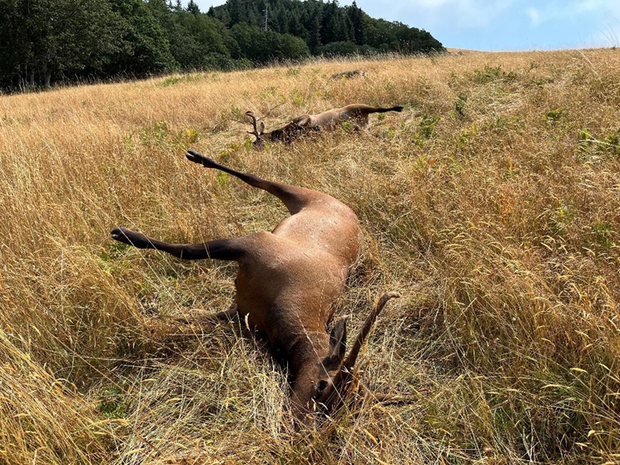
The elk were found dead earlier this month near Williams Ridge along Bald Hills Road, which is inland of the dense coastal forests that Redwood National Park is known for, park officials said in a news release Tuesday. It’s still on protected land within the park, where hunting is prohibited under both federal and state law. Officials learned that the four animals had been shot on July 21. No meat was taken, and an image published by the park service showed two of the deceased animals lying not far from each other in a patch of tall grass.
elk-redwoods.png
Officials are searching for suspects in a poaching incident that left four elk dead in California’s Redwood National Park, where hunting of any kind is illegal.National Park Service

Redwood National and State Parks includes 133,000 acres of federal and state land in Northern California, where seven herds of elk have made their habitats. The herds include Roosevelt elk, a subspecies brought back from the brink of extinction thanks to careful conservation initiatives, the Pacific Forest Trust writes, calling the current population “a conservation success story” in the Pacific Northwest. In California, Roosevelt elk are only found in areas in and immediately around the Redwoods park. Most elk seen in Redwood National Park are Roosevelt elk.

“Tourists from all over the world and Californians alike enjoy the opportunity to see Roosevelt elk within their historical home range at Redwood National and State Parks,” the National Park Service said in a statement. “Park rangers are committed to protecting these amazing animals and urge the public to help them in this effort.”

Investigators also determined that the poachers who shot those elk used lead ammunition, further endangering a condor population that was recently reintroduced to the Redwoods. The National Park Service notes on its website that using lead-core rifle bullets in any setting means putting the health and safety of animals and humans at risk, because most pellets break into tiny fragments when they strike an animal and completely removing the fragments after the fact is hard to do. Scavengers, like condors, who go on to consume meat from that animal could be ingesting lead-tainted food as a result, which is toxic. 

symbol

00:00

00:00

Read More

Lead poisoning is the biggest threat to California condors, the park service says, citing various scientific studies. The endangered vulture is the largest land bird in North America and places in the West have taken steps in recent decades to revive the species. Working with Redwood National and State Parks and several other agencies including the U.S. Fish and Wildlife Service, the Yurok Tribe, whose reservation is close to the Redwoods, reintroduced California condors to the region just two years ago, according to the park service. Poaching and illegal hunting directly undermine their efforts, officials said.

See the mother bear and her cubs that survived Jasper National Park’s largest wildfire in 100 years by hiding

By Li Cohen

Updated on: July 29, 2024 / 9:24 AM PDT / CBS News

Jasper National Park in Alberta, Canada, is facing the largest wildfire it has seen in a century. But as crews continue to race to control the flames, park officials say that there has been a glimmer of hope – a mother bear and her two cubs somehow managed to survive by hiding in place. 

“In the face of flames, the extraordinary instincts of wildlife, like bears and elk, guide them to safety,” Jasper National Park wrote on Facebook.

The park said that Grizzly Bear 222, who is often found around the park’s lodge and is fitted with a GPS collar, found a way to save herself and her offspring “in the moments leading up to the most extreme wildfire activity” that unfolded on July 24. As of Sunday night, officials said the fire tearing through Jasper and Jasper National Park had burned an estimated 79,000 acres, about 123 square miles.

But how did the bears survive? 

“[They] tucked themselves into a wet spot by the Athabasca River,” the park said, adding that the mother bear continues to look “very healthy” and has been eating berries and clover. 

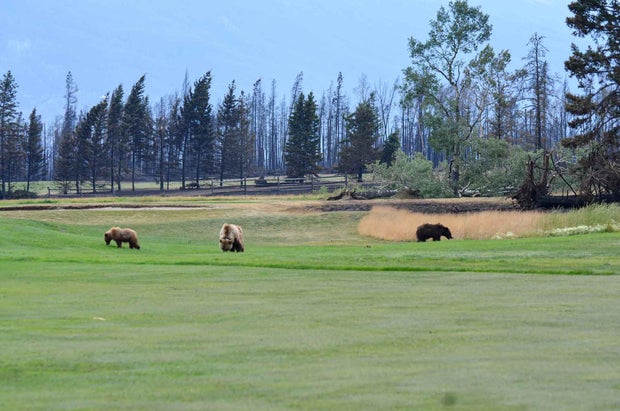
Grizzly sow 222 walks with her two cubs on the grounds of the Fairmont Jasper Park Lodge Golf Course after a wildfire
Grizzly sow 222 walks with her two cubs on the grounds of the Fairmont Jasper Park Lodge Golf Course after a wildfire sweeping through Alberta’s mountainous Jasper National Park left charred forests near the town of Jasper, Alberta, Canada July 26, 2024.Parks Canada/Handout via REUTERS

James McCormick, a human-wildlife coexistence specialist at Parks Canada, said that despite the toll of this particular blaze, “fire is a natural process” that wild animals know how to deal with. 

00:38

02:00

See More

https://imasdk.googleapis.com/js/core/bridge3.655.0_en.html#goog_157119127

https://imasdk.googleapis.com/js/core/bridge3.655.0_en.html#goog_157119128

https://imasdk.googleapis.com/js/core/bridge3.655.0_en.html#goog_157119129

“We expect animals to find new places to live,” McCormick said. 

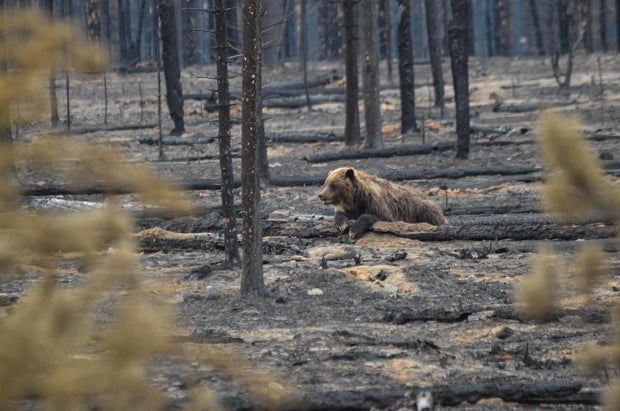
Photos released of the bears show one of them on July 26 – the day of their great hiding escape. That photo, which many commentators described as “heartbreaking,” shows the grizzly laying over the charred remains of a tree as the forest behind is covered in black ash. 

453381218-882701257235221-1998524557078757225-n.jpg
A grizzly bear guards a carcass after a wildfire sweeping through Alberta’s mountainous Jasper National Park left charred forests, near the town of Jasper, Alberta, Canada July 26, 2024.Parks Canada/H.Fengler/Handout via REUTERS

“You can see the bear’s emotions of sadness, grief just like how we humans feel about what’s happening there right now,” one person commented on the photo. 

While these bears are so far unscathed, conservationists told the Canadian Broadcasting Corporation that some species, like caribou, may face a higher toll. Tara Russell, the program director for the northern Alberta chapter of the Canadian Parks and Wildlife Society, told the CBC that of the two caribou herds that remain in Jasper National Park “don’t really” have another place to go. 

https://8f9603c7d142db3b1743258f474ded83.safeframe.googlesyndication.com/safeframe/1-0-40/html/container.html

“There’s really so little left of their habitat to maintain that resiliency to the occasional fire,” she told CBC. 

Deforestation and mining have reduced the species’ available habitat outside of the park, she said, and could set back the park’s breeding program for the species by “a number of years.” 

The park says on its website that “Mountain caribou depend on vast and undisturbed habitats.”

“Over the last fifty years, mountain caribou herds in Alberta and British Columbia have gotten smaller in number and some herds have disappeared. Protected areas like national parks are key for their survival.” 

Regardless though, the park is not giving up hope on recovery.

“Amidst the ashes, life finds a way,” Jasper National Park wrote on Facebook. “Just like the community of Jasper, Jasper National Park’s wildlife will rebound from this crisis.”