ST. PAUL, Minn. (FOX 9) – Farmers bringing dairy cattle to the Minnesota State Fair will have to take extra precautionary steps ahead of time before officials allow them into the Great Minnesota Get-Together.
Minnesota State Fair officials announced that an outbreak of H5N1, the same virus that causes avian influenza in poultry, also known as bird flu, is leading to new protocols for lactating dairy cattle.
Lactating dairy cows that are participating in dairy shows are now required to have a negative test for H5N1 within seven days before arriving, as well as a Certificate of Veterinary Inspection (CVI) that lists the Minnesota State Fair as a destination. Any lactating cows that will not return home within 10 days after testing must get another test at the fairgrounds.
All other livestock and horse shows are expected to proceed as normal.
The State Fair announced that there would be no pregnant cows at the Miracle of Birth Center and no live dairy calf births would take place. However, calves and other cows will be on display.
Fairgoers will still be able to witness the births of sheep, pigs and poultry at the Miracle of Birth Center.
Minnesota State Fair officials say the exhibit is making biosecurity a top priority and will follow strict protocols, including hand-washing and keeping food and drink away from animals. A licensed Minnesota State Fair veterinarian will be on-site 24 hours a day, which is standard practice.
No changes are planned yet for the poultry exhibit, but fairgoers and exhibitors are asked to stay informed on any possible developments.
The recent news hit me like a heat wave: Climate experts have no doubt that we are on our way to overshooting the 1.5°C increase in global heating the UN leaders agreed on in the Paris Agreement of 2015 by at least 1°C before the end of this century. This would have devastating consequences for the Earth and everybody who lives on it.
Guardian reporters reached out to the most knowledgeable people on the planet, all senior authors of climate reports for the Intergovernmental Planet on Climate Change, and the responses were shocking: Almost 80 percent of the respondents expect global temperature to rise at least 2.5°C above pre-industrial levels by 2100, and almost half predict at least 3°C, a catastrophic level of heating. Just 6 percent think we can still limit global heating to a 1.5°C increase.
I was worried when I read their predictions but even more worried by the lack of public response to them. Are we so used to horrifying climate predictions that we simply ignore them?
Drought has dried up Barcelona’s Sau Reservoir. Credit: Alberto Gonzalez / Shutterstock
A global increase of 3°C means deadly heat waves, massive wildfires, the disappearance of the Amazon rainforest, the death of the last coral reefs and the drowning of large populated areas, including Charleston, all of Rhode Island and the Space Center in Houston. It’s impossible to distance ourselves from this. It will affect us, no matter where we live.
Some of my friends and colleagues are motivated by the bad news to intensify their climate-friendly actions, while I’ve heard from others, “It’s too late now anyways,” or, “What difference does it make if I recycle my trash or drive a diesel?”
I don’t intend to shame anybody, but I do hope we can agree we need to take this issue seriously and do more to reduce emissions. If anything, the survey results are an urgent call to action.
Luckily, the same experts also tell us what we can do to have the most significant impact on climate change.
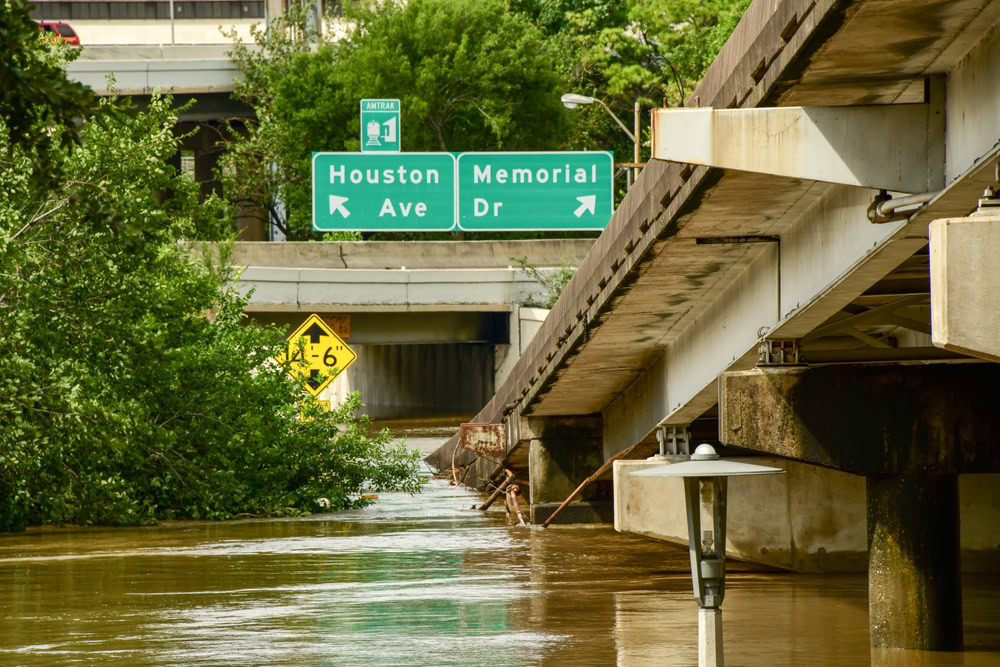
Flooding in Houston following Hurricane Beryl. Credit: Mathew Risley / Shutterstock
“I am convinced that we have all the solutions needed for a 1.5°C path and that we will implement them in the coming 20 years,” said Henry Neufeldt, the Head of Impact Assessment and Adaptation at the UN’s Copenhagen Climate Centre. “But I fear that our actions might come too late and we cross one or several tipping points.”
The position we’re in could hardly be clearer: We do have solutions, but we need to implement them. Now.
“Every 10th of a degree matters a lot,” one scientist said to The Guardian, which means: Everything we do matters.
EVERY action matters. EVERY flight, EVERY steak I eat, EVERY unnecessary mile I drive matters. Here are some of the biggest things we can do to help:
Vote
The scientists have identified prime actors who are responsible for failing to tackle the climate crisis: “A lack of political will was cited by almost three-quarters of the respondents, while 60 percent also blamed vested corporate interests, such as the fossil fuel industry.”
This means that we can and need to use our vote to make ourselves heard. Just look at Brazil: Under Jair Bolsonaro’s presidency, the deforestation of the rainforest reached a 15-year high. In the first six months after Luiz Inácio Lula da Silva took over as president in 2023, deforestation dropped by 33.6 percent.
Crushed by negative news?
Sign up for the Reasons to be Cheerful newsletter.
I’m a single-issue voter. If a politician doesn’t care about climate change, I won’t vote for him or her. We are almost 10 years past the Paris Agreement and still, many leaders of the world are climate deniers. We can still fix this, but we don’t have time to waste on political expediency, profit margins and apathy. It doesn’t matter if they fight for all the other issues I care about, because if our communities become too hot to live in, if our oceans and planet become uninhabitable, then the other issues will no longer seem as important.
So, let’s use our power at the ballot box and at the gas pump. This recommendation is particularly powerful this year when half the world votes, including in the US, the UK, India, Mexico and South Africa. Politicians need to know that we care and that we demand action.
Take the bicycle, bus or train whenever possible
The second most powerful action we can take is to reduce flying and fossil-fuel powered transport.
I’m sure you’ve heard this before, but a scientific review study on climate change mitigation in Nature Climate Change analyzed thousands of pages of research to calculate the effects of our individual actions. You can look up exactly how much CO2 you save with each bicycle or train ride.
My yoga teacher lectures convincingly about love and compassion for all, including the planet, but flies to Bali every year with 50 of his students for a yoga retreat. Sure, Bali is beautiful, but he lives in coastal California and most of his students are local, so couldn’t he find a gorgeous location closer to home? Or at least not at the other end of the planet?
The Schuylkill River Trail in Philadelphia. Credit: East Coast Greenway Alliance
Each 36-hour-round trip is responsible for 6.7 tons of CO2 emissions, more than the average person produces in an entire year. Multiply that by 51, and you would generate the same emissions by driving 855,000 miles or 35 times around the entire globe with an average gas-powered vehicle.
“Flying is the largest single activity you can omit for the planet,” Will Stedden told me when I interviewed him and his wife Claire about their initiative to inspire “regenerative travel” — travel that gives back to the planet and communities. Have you taken the Flight Free Pledge, vowing to “fly less and save more”? Take the Jump is another website that details dozens of actions everybody can take to lessen their carbon footprint, with reducing consumption, changing our diets and flying less as the top three.
“Where does the bigger change come from?” Claire Stedden asks. “People have to start demanding, or corporations won’t change. If everybody decides to fly less, eventually you’ll find fewer planes in the air. We have to start living the change for that to happen.”
Eat less meat
The production of meat leads to significantly more carbon emissions than vegetarian and vegan goods. “In the context of food, the highest carbon savings come from dietary changes, particularly the adoption of a vegan diet,” researchers found.
I pivoted to a plant-based diet last year and happily experiment with homemade chickpea falafel and spinach smoothies, much to the joy and health of my family.
Eating less meat is one thing individuals can do to reduce greenhouse gas emissions. Credit: Stacy Spensley / Flickr
And beyond
Other ways individuals can have a measurable impact include participating in climate protests, opting for more sustainable construction (including investing in heat pumps) and commuting less (remote working). The Solutions Project recently detailed the measurable effect grassroots climate groups — especially those led by women and people of color — have on securing climate policy wins and pushing for clean energy projects to reduce emissions.
A recent poll in Germany, where I’m from, showed that 20 percent of youths between ages six and 19 didn’t know anything about climate change; even among the 18- and 19-year olds, one in six had either never heard of climate change or didn’t know what it meant.
We often assume that everybody is aware of climate change by now, but this is clearly not the reality. We need to learn to talk about this pressing issue in a way that people around us can relate to.
Experts have also weighed in on the best ways to inform and motivate more people, including through rebates and climate information in eateries. German universities, for instance in Munich and Dresden, are now publishing climate info alongside each dish in their cafeterias. The results show that providing an information nudge reduces the likelihood of choosing meat by 12 percentage points. Somewhat surprisingly, peer pressure didn’t work nearly as well.
Become a sustaining member today!
Join the Reasons to be Cheerful community by supporting our nonprofit publication and giving what you can.Join
A marine biologist I follow and author of the forthcoming book What If We Get It Right?, Ayana Elizabeth Johnson, talks about the power of reframing climate-friendly action. “People don’t like sacrifice. People don’t like bans. But I think there’s a way to frame that as: This is an opportunity to live a different and better life,” she recently told the New York Times. “Often we think about the changes that are needed, and we don’t look at both sides of the coin. We think about, This is going to be expensive, or, This is going to be inconvenient, without thinking about, Do you know how inconvenient and expensive climate change is? It is so much worse.”
Maybe most importantly, there is a “positive and robust” link between pro-environmental action and subjective wellbeing. I’m not saying this to make you feel good but that, too, has been scientifically proven in the above-mentioned review: “Individuals who engage in pro-environmental behaviors tend to experience higher levels of subjective wellbeing.”
In other words, among all its other benefits, caring for the environment will make you happier. The more we care for our planet, the greater our wellbeing. And that of the earth.
It was a familiar refrain in a different setting Friday. 20 members and supporters of the group “Save the Deer” set up across from a fundraiser at Fellows Riverside Gardens, looking to get the attention of wealthy donors. Two years into their protests of deer culling to control population throughout Mill Creek Park, they’re not giving up ahead of the next hunt the park board scheduled for October.
“Back at their last meeting, they released their plan for how many more deer they want to kill this year, and just like last year, we don’t believe it’s right, we don’t believe the numbers, we don’t believe deer should be killed in our metro parks and we do believe that there’s a significant safety aspect that they’re just ignoring,” said rally organizer Chris Flak.
The group argues that by continuing these hunts without looking at any other options, the park board is not serving the best interests of the citizens, the wildlife or the environment. In may – we told you about lots of complaints that the save the deer group filed against the park board – even calling for some members to be removed. The board responded by denying all the group’s claims, including that they failed their duties by refusing accountability to taxpayers.
Nonetheless, the group is pushing forward with efforts to have the park board and director Aaron Young removed.
“We do have our appeals process on now, that’s in Youngstown (municipal) court, and we also have a complaint that’s being heard by probate court,” said Flak.
Which means only time will tell whether this group’s two year rally cry will be heard.
When you purchase through links on our site, we may earn an affiliate commission. Here’s how it works.
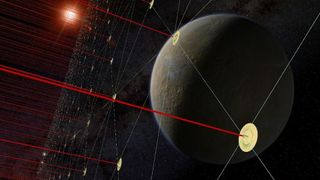
Lasers could be used to propel tiny spacecraft toward Alpha Centauri, scientists suggest. (Image credit: Artist’s impression by Michel Lamontagne, courtesy of Space Initiatives Inc.)
Our space-exploration ambitions have boldly taken humans to the moon, rovers to Mars and spacecraft to the outer reaches of the solar system. But could humans or spacecraft ever reach Alpha Centauri, the closest star system to our planet?
Alpha Centauri is about 4.4 light-years (roughly 25 trillion miles, or 40 trillion kilometers) from Earth and is home to three separate stars. The closest star, Proxima Centauri, also hosts an exoplanet that scientists believe could have the conditions necessary for life.
But reaching this star system would be no small feat. NASA estimates that, using a space shuttle like NASA’s now-retired 122-foot-long (38 meters) Discovery, it would take close to 150,000 years to reach Alpha Centauri.
If humans could travel at the speed of light, we could reach Alpha Centauri in four years flat. However, the laws of physics dictate that only massless light particles called photons can reach this cosmic speed limit. So, while humans will probably never reach Alpha Centauri, it’s possible that spacecraft designed to go a much smaller fraction of the speed of light could reach these stars in a human lifetime. To even hope of getting a spacecraft up to top speed, scientists will need something much smaller than Discovery.
Marshall Eubanks, CEO of the startup Space Initiatives Inc and a fellow at NASA Innovative Advanced Concepts, is researching remote methods for visiting Proxima Centauri using swarms of picometer-sized spacecraft. (A picometer is one-trillionth of a meter.)
It’s possible that tiny spacecraft could reach Alpha Centauri within a human lifetime. (Image credit: Courtesy of Space Initiatives Inc.)
“We are in the midst of a real revolution in space flight and space exploration, with extremely small systems,” Eubanks told Live Science in an email. “While an individual small spacecraft will not be as capable as a larger spacecraft, such as the Voyagers, their development times are much shorter; they are relatively inexpensive.”
Sign up for the Live Science daily newsletter now
Get the world’s most fascinating discoveries delivered straight to your inbox.Contact me with news and offers from other Future brandsReceive email from us on behalf of our trusted partners or sponsorsBy submitting your information you agree to the Terms & Conditions and Privacy Policy and are aged 16 or over.
Tiny spacecraft also require less power to propel them, which could be a key advantage in increasing their speed.
Eubanks isn’t the only one pursuing this kind of research. Breakthrough Initiatives started its Starshot project in 2016 to combine nanometer-sized spacecraft with light sails, and in 2017, NASA began funding its own project targeted at launching a mission to Alpha Centauri by 2069, 100 years after Apollo 11.
While small spacecraft are easier to accelerate than larger probes, traditional fuel sources alone are not powerful or plentiful enough to push these craft to near light speed. Instead, Philip Lubin, a professor of physics at the University of California, Santa Barbara whose ideas for interstellar travel inspired the Starshot team, told Live Science that these craft will likely rely on light instead.
Spacecraft flying by the Alpha Centauri star system could see whether the planet circling Proxima Centauri has signs of extraterrestrial life. (Image credit: Courtesy of Space Initiatives Inc.)
Solar energy
To go fast in space, it helps to be small and have low mass. One major benefit of light-powered propulsion is that it’s mass-less, Lubin said. Traditional rocket fuel, in contrast, creates propulsion by transforming heavy fuel into energy by burning it. Using either a solar sail, which is propelled by the sun’s light, or a photonic sail, which is propelled by laser light, gives you all of the power without any of the weight.
Lubin said you can think of it like throwing a ball at a piece of paper. When a ball strikes the paper, it will apply a force, causing the paper to recoil or be pushed away. Similarly, the momentum carried by light is transferred to the spacecraft, which causes it to recoil and accelerate.
“The system is basically a gigantic flashlight — it’s a giant laser array [on Earth],” Lubin said. If the spacecraft are sailboats, then the laser light is the wind in their sails.
Technology to create and test these craft, such as communications equipment small enough to fit on them, is still being developed. But there’s no physical reason to believe that such a spacecraft couldn’t conduct a flyby mission of Alpha Centauri, Lubin said.
This mission could behave much like the Voyager 1 and 2 probes and transmit high-resolution images of the star system back to Earth, some of which might contain our first look at Proxima Centauri’s potentially habitable planet.
While Lubin stressed that a journey to Alpha Centauri would be a long-term endeavor, Eubanks said he’s confident that big advances could come this century.
“I think that we will reach the Alpha Centauri system, with small probes launching in the decade of the 2040s, and thus arriving in the 2060s,” Eubanks said. “Significantly larger probes should be possible by the end of the century, but without unexpected breakthroughs in propulsion physics, I think that crewed missions will be a task for the next century.”