Trial date for Kent man charged with a hare coursing offence at Lutton Marsh
Reply

✓
By
Breaking News & General Assignment
PublishedJuly 27, 20263 min read

Australia is tracking seven new suspected cases of H5 bird flu found in wild seabirds along the coast of South Australia, officials announced Monday, as the country’s outbreak of the strain continues to spread through migratory and native bird populations.
All seven suspected cases were detected in greater crested terns on the Limestone Coast in the state’s South East, SA Minister for Primary Industries Clare Scriven said. Five were found at Southend, near Beachport, with one at Port MacDonnell and one at Cape Jaffa. Of the five birds found at Southend, four were sick and one was deceased.
If confirmed, the cases would bring South Australia’s total to 14. Nationally, Australia has recorded 20 confirmed H5 bird flu cases across South Australia, Western Australia, New South Wales and Queensland. All have been detected in migratory and seabirds.
Federal Agriculture Minister Julie Collins said the birds have been sent to the CSIRO laboratory in Geelong for sequencing to determine whether local transmission has occurred.
“We will provide an update as soon as I get those CSIRO lab tests back, they may take some time for the sequencing to be done,” Ms Collins said. “At this time there are no mass mortalities, there is no evidence of any H5 bird flu in our poultry or agricultural systems and the risk to human health remains low.”
SA chief veterinary officer Skye Fruean said results were expected within one or two days. She said it was too early to say whether local transmission had occurred.
“The overseas experience has shown that we do expect it to spread, we don’t know how quickly and where,” Ms Fruean said. “We don’t know what this is going to mean for Australia but we are preparing for the worst.”
On Sunday, the CSIRO confirmed two native birds found dead on separate SA beaches tested positive for the H5 strain. One greater crested tern was found near Robe. The second was found near the Semaphore Surf Life Saving Club, marking the first time a case has been detected on a metropolitan beach in the state.
Scriven said a community forum on bird flu would be held Monday night at Glenelg to answer questions from locals and provide public health and safety advice.
All seven suspected cases were reported by members of the public through the Emergency Animal Disease Hotline, Fruean said. Authorities are now increasing both aerial surveillance and foot patrols in areas where high-risk seabird species, including crested terns, are expected to gather.
Collins said states and territories have been conducting extensive triaging and testing across the country, with detections so far running along the coast.
For Northeast Philadelphia readers watching the global spread of bird flu, the Australian outbreak remains confined to wild birds. No cases have been found in poultry or agricultural systems, and officials say the risk to human health remains low. Lab results on the latest suspected cases are expected within days.

Valid Indiana address required to sign
Bobcats were nearly erased from Indiana’s landscape before receiving state protection decades ago. Now, Indiana officials have approved a reckless expansion of bobcat killing that could drive them toward disappearance once again.
An interim rule raises the number of bobcats who can be killed from 250 to 400 and allows trophy hunters to shoot them with firearms, bows, and crossbows. The state is now seeking to make these dangerous changes permanent. Tell Gov. Mike Braun to reverse course, stop the expanded killing, and protect Indiana’s bobcats!
Last year, the state allowed people to trap more than 250 bobcats, marking the first time a trapping season was allowed since they were protected as endangered in 1969 after being decimated by hunting, trapping, and habitat loss.
The quota was reached in just a month, leaving bobcats to suffer in traps for up to 24 hours before anyone came back to kill them. Now the DNR is increasing the quota to 400 and allowing more killing methods, including firearms, bows, and crossbows, even though there has been no solid population survey. The agency’s own population model shows that killing 400 bobcats annually would cause steep population declines and, under one modeled survival scenario, could completely eliminate them from Indiana within a decade.
This is appalling and out of line with what state residents want.

Tell Gov. Mike Braun to reverse the expanded bobcat killing rule and prevent these dangerous changes from becoming permanent by making a call, sending a message on social media, and sending our letter.
1. Make a Call. Call the governor’s office at 317-232-4567 to urge Gov. Braun to reverse the expanded bobcat killing rule and prevent it from becoming permanent.
You can say:
As a constituent concerned about bobcats, I’m calling to urge Gov. Braun to reverse the interim rule that raises the bobcat killing quota to 400 and allows firearms, bows and crossbows, and to prevent these changes from becoming permanent. The DNR’s own population model shows that killing 400 bobcats annually would cause steep population declines and, under one modeled survival scenario, could completely eliminate them from Indiana within a decade. Please protect Indiana’s bobcats and stop this expanded killing.
2. Send a Message on Social Media. Send a message to the governor on X and Facebook.
You can say:
Gov. Braun, reverse Indiana’s expanded bobcat killing rule! The DNR’s own model shows that killing 400 bobcats annually could cause devastating population declines. Protect #bobcats & stop these changes from becoming permanent.
Valid Indiana address required to sign
Sign to immediately deliver your comments to:
Witnessing cruelty is heartbreaking — but you don’t have to carry it alone. In Defense of Animals is the only nonprofit that offers free, confidential support just for animal advocates. Call our helpline or connect online now: idausa.org/activistsupport
In Defense of Animals fully expects and strongly urges all people involved in this campaign to act responsibly and lawfully and to respect the personal interests and privacy rights and concerns of any individuals who may be affected by, or become the subject of, your protests or related efforts. **The information you supply will be shared with the decision-maker per our privacy policy **
 ?Take future action with a single click.
Log in or Sign up for FastActionContact InformationPrefix*First Name*Last Name*Street Address*Postal Code*State*- State -ALAKAZARCACOCTDEDCFLGAHIIDILINIAKSKYLAMEMDMAMIMNMSMOMTNENVNHNJNMNYNCNDOHOKORPARISCSDTNTXUTVTVAWAWVWIWYASGUMPPRVIFMMHPWAAAEAPEmail*Mobile Phone (Optional)
By submitting your cell phone number you are agreeing to receive periodic text messages from this organization. Message and data rates may apply. Text HELP for more information. Text STOP to stop receiving messages. Terms of Use | Privacy Policy
Reverse Indiana’s expanded bobcat killing rule
Dear [decisionmaker],Personalize your message
Sincerely, [Your information here]
Indiana Residents: Stop Expanded Bobcat Trapping & Trophy Hunting
Massachusetts Residents: Stop Expanded Hunting in the MassReady Act
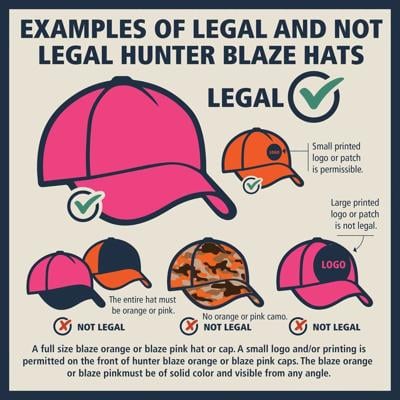
Alabama hunters looking to expand their in-the-woods fashion choices will have another legal option besides traditional blaze orange this hunting season.
The Alabama Department of Conservation and Natural Resources’ Wildlife and Freshwater Fisheries Division announced that fluorescent pink, often called “hunter pink,” is now an approved alternative to hunter orange in situations where high-visibility clothing is required. The agency recently shared examples of legal and illegal hats and vests to help hunters prepare before heading into the field this fall.
During gun deer season, including youth deer season and special muzzleloader and air rifle deer seasons, hunters on private and leased lands, as well as public lands that are not designated Wildlife Management Areas (WMAs), must wear either:
The department said hunter orange or fluorescent pink must be a solid color and visible from every angle.
A representative from the Wildlife and Freshwater Fisheries Division said orange and pink were selected because they are less likely to blend into the natural surroundings than other bright colors, such as yellow.
“Orange and pink are two colors that you don’t often see naturally in the woods,” the representative said. “That bright of an orange or pink color won’t be seen naturally in any season. Yellow can sometimes blend in with certain leaves or bright plants and can easily be mistaken.”
What is legal? According to the Wildlife and Freshwater Fisheries Division:
What is NOT legal? Hunters should avoid wearing:
The department emphasized that only solid hunter orange or fluorescent pink materials, commonly called blaze orange or ten-mile cloth, meet Alabama’s legal requirements.
According to the Alabama Department of Conservation and Natural Resources, the visibility requirement does not apply in certain situations, including:
Hunters and trappers on Alabama Wildlife Management Areas must also wear a minimum of 144 square inches of hunter orange or fluorescent pink, or a full-size hunter orange or fluorescent pink hat.
The WMA exceptions are similar, including turkey hunting, migratory bird hunting, nighttime hunting for certain species, hunting from elevated or enclosed stands and traveling inside an enclosed vehicle.
The new fluorescent pink option gives hunters another highly visible choice while maintaining the safety standards required under Alabama’s Game and Fish regulations. Hunters are encouraged to verify that their clothing meets the state’s visibility requirements before the season begins.

