Emergency declared in Colorado after bird flu outbreak at egg facility
Reply

ELEANOR HIGGS
Digital Content Creator
EditedbyKaty Evans

DOWNLOAD PDF VERSION
 9Comments
 600Shares

Parents in the animal kingdom often have their work cut out for them, from octopus moms who can’t eat while looking after their eggs, to those animals going it solo. What is unusual is large mammals having multiple offspring, but that is exactly what’s happened in Yellowstone National Park as a grizzly bear female was spotted with an extremely rare five cubs.
Advertisement
Grizzly bears (Ursus arctos horribilis) are one of two species that live within Yellowstone, the other being the black bear (Ursus americanus). Bear cubs are usually born in January or February and typically in pairs though some litters can be up to four. This makes this litter of five even more unusual. In fact, it seems this is the first time a litter that large has ever been reported in the park.
Andrea Baratte, a tour guide at Yellowstone who managed to film the cubs, told Cowboy State Daily he’d never heard of a litter of five before. “I’m so glad that I got to document it, otherwise nobody would have believed it,” he said.
Nature photographer Stan Mills also filmed the cubs. “These grizzlies were walking toward the right when I came over a little mound and spotted them,” Mills wrote in a caption in the video below (the bears can be seen at 2:23). “The mother spotted me while I was getting my camera out.”
There is the question of whether the cubs all belong to the one bear mother or some have been adopted from another litter. In 2011, mother and daughter adult bears each gave birth to two and three cubs, respectively. The third cub originally belonging to the daughter was later adopted by the older bear. In 2016, a Katmai brown bear adopted a yearling cub in addition to her own 9-month-old after its mother died. Grizzly bear mothers have been known to abandon their cubs, possibly due to fear of humans or human contact.
“If this was truly a litter of five, it would be the first one recorded in the history of the Greater Yellowstone Ecosystem, for sure,” said Frank van Manen, who leads the Interagency Grizzly Bear Study Team, in a statement in WyoFile.
Without genetic testing, we won’t know if the current Yellowstone supermom is biologically related to each of her offspring.
“Five cubs in a litter are the most we have ever observed in the park, at least from 1959 to present — the period of the park’s history we have good records for,” National Park Service spokeswoman Linda Veress told Cowboy State Daily.
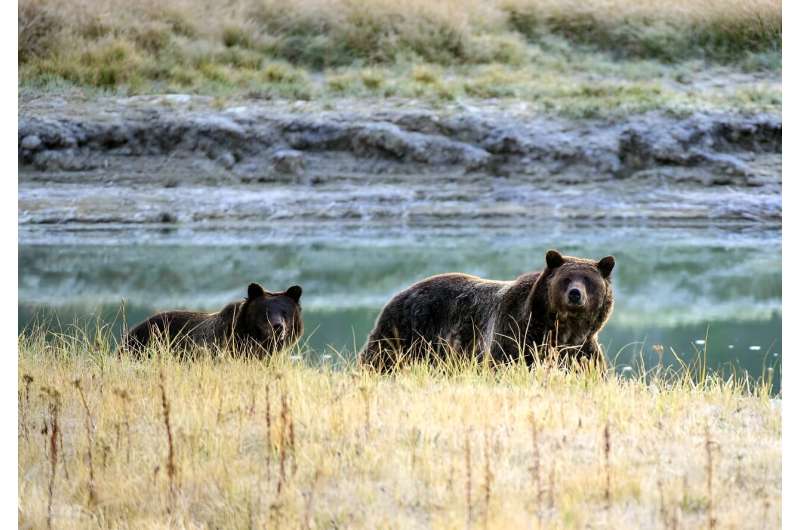
A decision to partially reverse a nearly two-decade ban on hunting grizzly bears in Canada’s Alberta has angered environmentalists, with a group saying Wednesday they feared its impact on the species.
Hunting of the mammals, listed as threatened in 2010 by the western Alberta province, had been prohibited for 18 years—leading to growth in the population of grizzlies.
But there has also been conflict between bears and humans, Alberta authorities say.
The number of grizzlies has increased from 800 to more than 1,150 today, provincial authorities say, and that has caused them to move to more populated rural areas.
“Hunting is not an acceptable management approach for a threatened species,” said Devon Earl of the Alberta Wilderness Association.
“Grizzly bears have a very slow reproductive rate, and trophy hunting could undo all the recovery of the last decade,” she added.
The province’s government last month quietly moved to allow the hunting of individual bears deemed a “problem.”
Authorities say 104 attacks by black or grizzly bears were recorded from 2000 to 2021.
However, Earl said that other “science-based approaches” can help reduce wildlife conflict.
She cited an example in southern Alberta which worked by “securing attractants on agricultural lands and putting in electric fences… to prevent bears from being attracted to coming onto people’s property in the first place.”
© 2024 AFP
https://phys.org/news/2024-07-canada-conservationists-grizzly.html#google_vignette
Explore further
Montana advances grizzly bear plans that could allow hunting

