APRIL 25, 2024
After spending years working and living in Africa, I have learned you cannot take anything for granted. Even though foreign navies and coast guards exist on paper, that does not mean they have boats that float and work. Even if they do have boats that float and work, that does not mean they have fuel or spare parts. Even if the boats are able to regularly operate, that does not mean they put a dent in maritime crime because maritime law enforcement is only one component of a government effectively policing its waters.
In December 2022, U.S. Coast Guard Cmdr. Aaron Delano-Johnson and U.S. Navy Cmdr. Chris Bernotavicius published an article in War on the Rocks where they argued that the U.S. government should more aggressively confront Chinese illegal, unreported, and unregulated fishing practices across the globe. Unlike current U.S. strategies, the authors consider these practices a “coercive tool of Chinese statecraft” and frame them as a component of strategic competition. Delano-Johnson and Bernotavicius propose that the U.S. Coast Guard, due to the service’s unique capabilities and relationships, lead efforts against Chinese fishers by helping partner governments to develop more effective maritime enforcement capabilities that ideally become self-sufficient.
This proposal, however, takes the functioning of other state institutions for granted and fails to address the larger problems that facilitate harmful Chinese fishing practices.
Illegal, unreported, and unregulated fishing in general and Chinese fishing practices in particular do pose significant threats to international and U.S. national security. Meaningfully addressing these threats, however, would require a more robust response than what Delano-Johnson and Bernotavicius propose. A more effective U.S. approach should more directly confront the system of factors that prevent a foreign government from effectively policing its waters. In addition to maritime enforcement, two other significant factors include corruption and economic coercion. All these factors significantly impact many U.S. partner governments’ ability to police their waters, and focusing on maritime enforcement while failing to address corruption and coercion would likely result in a failure to effectively push back against harmful fishing practices even if the U.S. Coast Guard is able to train a perfect foreign counterpart.
A Significant National Security Threat
Illegal, unreported, and unregulated fishing practices, particularly as practiced by the Chinese fishing fleet, pose multiple threats to international and U.S. national security. These practices often lead to overfishing, which depletes local fishing stocks and makes it difficult for the poorest in costal countries to afford the fish they rely on as their primary source of protein. Overfishing depresses local fishing industries, eliminating the livelihoods of many of the same people. These practices also challenge global norms and infringe upon the sovereignty of any country in which they occur.
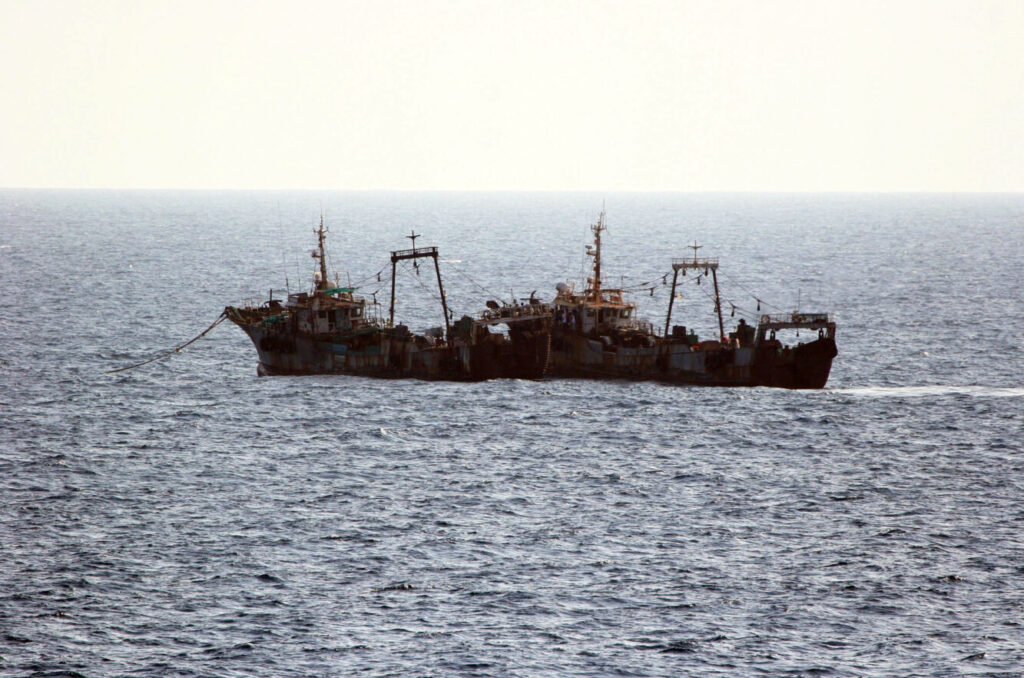
The Chinese government heavily subsidizes the Chinese distant-water fishing fleet, which is the largest in the world and often engages in illegal, unreported, and unregulated fishing. The Chinese government further aids this fleet by coercing foreign governments to minimize enforcement against Chinese vessels, and it uses many of the same fishing vessels as part of its maritime militia, which operates in waters closer to home.
The 2022 U.S. National Security Strategy mentions the necessity for U.S. support to allies and partners that “stand on the frontlines of the [People’s Republic of China] coercion and are rightly determined to seek to ensure their own autonomy, security, and prosperity.” Governments that suffer from illegal Chinese fishing practices are on the frontlines of daily Chinese government coercion and threats to autonomy, security, and prosperity.
Challenges to Enforcement
There are many challenges that enable illegal, unreported, and unregulated fishing practices beyond poor maritime enforcement. Two main challenges include corruption and susceptibility to economic coercion, and both of these permeate through many of the countries the U.S. government wants to help combat such practices.
A government’s ability to police its exclusive economic zone, 200 nautical miles from its coastline, neither starts nor stops on the water. Before maritime enforcement takes place, governments pass laws, participate in international agreements, and issue permits to regulate how fishing should be conducted. Should a navy or coast guard apprehend illegal fishers, a government’s criminal justice system levies punishments to disincentivize further violations.
Corruption is pervasive throughout the global fishing industry and undermines regulation through bribes to politicians who oversee the process, officials who issue fishing permits, law enforcement personnel, investigators, prosecutors, and judges, among others. Fighting corruption presents a significant challenge to a majority of the partners the U.S. government wants to engage with to combat illegal, unreported, and unregulated fishing. The October 2022 U.S. Interagency Working Group on Illegal, Unreported, and Unregulated Fishing’s National 5-Year Strategy for Combatting Illegal, Unreported, and Unregulated Fishing lists 57 priority countries in Latin America, Africa, Asia, and the Pacific Ocean where U.S. government assistance is most needed. The World Bank assessed 50 of these 57 priority countries in 2021. Thirty of them scored in the bottom 50th percentile for control of corruption, and 17 of those scored in the bottom 25th percentile.
As an example, Ghana is one of the U.S. government’s strongest partners in West Africa, one of the strategy’s priority countries, and scored just above the 50th percentile for control of corruption, making it an above-average country. The Environmental Justice Foundation, a British non-governmental organization, found in an October 2022 study about the Chinese-owned fishing fleet in Ghana that a “culture of corruption” exists throughout the official Ghanaian fishing management system. The majority of the Ghanian fishing sector personnel who the foundation interviewed had witnessed corruption from port authorities, members of the navy, and official government fishing observers.
Furthermore, according to a January 2023 BBC story, most of the Ghanian government fishing observers take bribes due to “fear, corruption, and neglect.” The neglect the article is referring to is that the government is paying these observers meager salaries infrequently, if at all, driving them to seek alternate sources of income to make a living and support their families. In my experience, this form of neglect among government workers is common throughout much of Africa and often leads to corruption out of economic necessity. Ghana’s relatively high scores in controlling corruption make it likely that corruption would pose an even greater challenge when trying to confront illegal, unreported, and unregulated fishing in a majority of the working group’s priority countries.
The Chinese government adds to these difficulties, making its support to illegal, unreported, and unregulated fishing particularly acute. With the second-largest economy in the world, the Chinese government uses its significant power and influence to coerce governments into minimizing enforcement against Chinese fishing vessels. As Delano-Johnson and Bernotavicius point out, one way the Chinese government does this is by forcing governments to choose between prosecuting Chinese fishing vessels or accepting Chinese aid. “It’s hard to say no to China when they are building your roads,” as one former head of Senegal’s Oceanic Research Institute puts it. Senegal is one of five “flag states” that the working group’s strategy designates as a focus of U.S. government-to-government engagement to counter illegal, unreported, and unregulated fishing.
Many of the strategy’s priority countries are also underdeveloped, making them vulnerable to coercion with foreign aid. The United Nations assessed 49 of the strategy’s 57 priority countries in 2021. Twenty-one of them, including Ghana, are in the medium human development category. Eight, including Senegal, are in the low human development category. These are the two lowest human development categories of four.

Challenges to Self-Sufficiency
Pervasive corruption and susceptibility to economic coercion would make it extremely difficult for Delano-Johnson and Bernotavicius’ solution to become self-sufficient. They propose that the U.S. Coast Guard’s maritime security cooperation efforts be modeled after the Department of State’s Global Peace Operations Initiative, but this initiative is also unlikely lead to lead self-sufficiency. Its primary goal is to help partner militaries develop forces that contribute to U.N. peacekeeping operations, and the authors provide examples of notable successes. The successes, however, rely on the United Nations to pay governments directly for their troop contributions.
For maritime enforcement capabilities to reach true self-sufficiency, countries need a reliable internal source of income. Some portion of this income could come from governments issuing fishing licenses and imposing fines on guilty illegal, unreported, and unregulated fishers. The governments, however, must be capable of effectively doing both to collect enough revenue to pay for the operations. Corruption and economic coercion undermine these processes.
An ineffective system to effectively punish illegal, unreported, and unregulated fishers could also create motivation and morale problems within a maritime force, no matter how well-trained, further hindering its performance. To paraphrase what a senior African counterpart once told me, “Why should military members risk their lives on the high seas to catch illegal fishers if they know the fishers will just be let free when they are pulled into port?” In other words, if the navy or coast guard knows nothing will happen to any illegal fishers they catch, then why should they bother patrolling their country’s waters?
Finally, government leaders must want to maintain a capability before the capability can become self-sufficient. One adage of security cooperation is “you can’t want it more than they do.” For any maritime security cooperation to bear long-term dividends and produce capable maritime forces after U.S. trainers leave, host-nation government and military leaders must want to maintain the forces. If government leaders are gaining financially through corruption or politically through economic aid, then they may have little to no motivation to start enforcing fishing regulations and see their income and political support disappear.
A More Holistic Solution
The U.S. Coast Guard is the right organization to lead security cooperation efforts against Chinese illegal, unreported, and unregulated fishing practices. Focusing on security cooperation without addressing the other issues that prevent partner governments from effectively policing their waters may result in short-term success but would likely result in long-term failure. Instead, other agencies, like the Department of State or U.S. Agency for International Development, should lead a more holistic approach to challenge Chinese fishing practices at sea as well as challenge corruption within the fishing industry and propose viable alternatives to Chinese economic coercion.
A more effective U.S. approach would seek to change the incentives for enough partner government officials to want to effectively police a country’s waters and maintain a maritime enforcement capability after U.S. trainers leave. Many of these officials would likely not be in the military, like fishing observers and judges.
The Department of State and U.S. Agency for International Development specialize in conducting holistic approaches to security issues due to their unique capabilities and relationships. They work with foreign governments to decrease corruption and improve criminal justice systems. The U.S. Agency for International Development’s specialty is economic development, which would likely be necessary to provide viable alternatives to Chinese economic coercion. The Biden administration’s “Memorandum on Combatting Illegal, Unreported, and Unregulated Fishing and Associated Labor Abuses,” released four months prior to the working group’s strategy, calls on the U.S. Agency for International Development Administrator to lead anti-corruption and judicial reform efforts as well. The Department of State works regularly with and funds U.S. Coast Guard and military security cooperation efforts, like the Global Peace Operations Initiative, and it has a bureau that specializes in training police and strengthening criminal justice institutions. The Department of State also recently opened the Office of China Coordination to manage U.S. competition with China.
Conclusion
The Chinese government uses subsidies and coercion to enable the Chinese distant-water fishing fleet to conduct illegal, unreported, and unregulated fishing across the globe. These activities represent a direct threat to the rules-based international system, and they occur daily in multiple countries that have a minimal capacity to push back and have structural governance issues that disincentivize them from doing so. These illegal fishing activities also represent a daily threat to the lives and livelihoods of the poorest citizens within these countries.
For the U.S. government to more effectively push back against harmful Chinese fishing practices and help create indigenous, self-sustaining maritime enforcement capabilities, it should not focus its efforts primarily on maritime security cooperation led by the U.S. Coast Guard. Instead, the U.S. government should address the system of factors that enable illegal Chinese fishing practices, including government corruption and Chinese economic coercion as well as maritime enforcement. A more holistic approach would likely have to be led by a more holistic agency that already addresses similar issues, such as the Department of State or U.S. Agency for International Development.
More aggressively pushing back against Chinese illegal fishing practices is an opportunity for the U.S. government to highlight its global leadership in a way that directly defends the rules-based international order, challenges its most capable global competitor, helps rehabilitate the maritime environment, and increases the food security and economic opportunity for some of the world’s poorest and most helpless people. But Chinese fishers are not the only ones that engage in illegal, unreported, and unregulated fishing, and the U.S. government should not take its own institutions and those of its partners and allies for granted. The U.S. government should also ensure it is effectively pushing back against the lesser but not insignificant numbers of American, allied, and partner fishers who conduct the same activities. To truly defend the rules-based order against all violators, the U.S. government should ensure U.S. fishers follow the rules, and it should be willing to defend the rules from its best friends and most fierce competitors alike.
Michael E. Clark is an active-duty U.S. Marine lieutenant colonel, F/A-18 weapons systems officer, and Africa foreign area officer.
The views expressed are those of the author and do not reflect the official position of the Department of Defense, Department of the Navy, or U.S. Marine Corps.