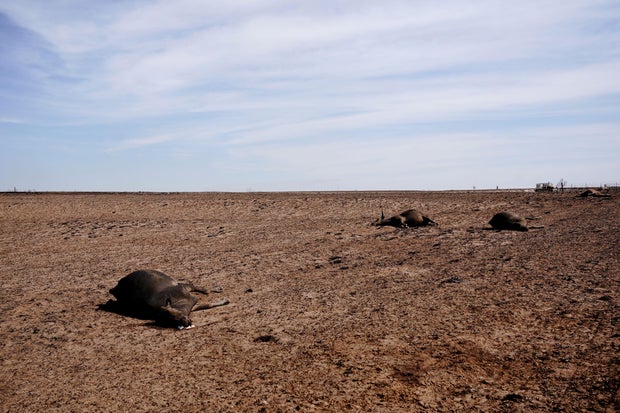
We Have a Date for Mass Extinction of Mammals
New Spanish law strengthens animal rights but exempts bullfights
Federal government seeking public input on reintroducing grizzly bears to the North Cascades
The move is to increase the endangered population in the Washington ecosystem, but not everyone is on board.
00:2330:12
- https://www.king5.com/article/tech/science/environment/national-park-services-grizzly-bears-north-cascades/281-3ae887f5-38fc-4c41-8324-eac62c70194e
Author: Hong Ta
Published: 3:29 PM PDT September 28, 2023
Updated: 5:53 PM PDT September 29, 2023
SEDRO-WOOLLEY, Wash. — The federal government is seeking public opinion on whether grizzly bears should be restored to the North Cascades ecosystem.
“We are looking for the public’s help in selecting the best path forward as we evaluate grizzly bear recovery on these federal lands,” Don Striker, superintendent of North Cascades National Park, said in a statement.
The public input is being collected by the National Park Service and the U.S. Fish & Wildlife Service. The input is for a draft Environmental Impact Statement that evaluates the options available for the restoration of grizzly bears.
The U.S. Fish & Wildlife Service is also separately inviting public comment on designating grizzlies in the area as an experimental population under section 10(j) of the Endangered Species Act. This would allow communities and land managers flexibility in managing the bears. This would include the relocation, removal, or deterrence of animals involved in conflict.
“If this part of our natural heritage is restored, it should be done in a way that ensures communities, property, and the animals can all coexist peacefully. A 10(j) experimental designation could provide the tools to do that,” said Hugh Morrison, U.S. Fish & Wildlife Service regional director in a statement.
Grizzly bears have existed in the North Cascades Ecosystem for thousands of years, according to the NPS. However, in the 1800s, they were hunted and most of the population was killed by 1860. This, coupled with habitat loss, led to the now state-designated endangered listing of the grizzly bear. From around 2005 to 2015, only two grizzly bears were identified in the North Cascades ecosystem in British Columbia. The last time a grizzly bear was confirmed in U.S. territory of the North Cascades ecosystem was in 1996.
Jason Ransom, the Wildlife Program Lead at the North Cascades National Park Service Complex, said there are three options in the draft EIS. He said one option would result in no action being taken. The two other options would result in 25 grizzly bears being relocated over ten years to the North Cascades. The difference between the two options where grizzlies would be restored to the area is how the bears are allowed to be managed. Ransom said their preference is the option that allows for more flexibility.
“So, that might include, you know, getting bears and moving them back, if they stray outside of where we want them to be,” said Ransom.
He said the bears would come from other areas where there are large grizzly bear populations.
“The North Continental divide ecosystem near Glacier National Park is a very strong candidate,” said Ransom. “Interior British Columbia in the northern part where there is actually still a good, viable population, and possibly even Yellowstone. And the reason is, those bears come from a very similar food economy, so a plant-based diet.”
Ransom added that they want to bring in young bears who are actively trying to go out and establish a home range and learn where they want to live. He also said they would bring in bears that have no history of conflict with people.
There are people both supporting and opposing this plan.
Joe Scott with the group Conservation Northwest has been advocating for grizzly bear restoration in the North Cascades for decades. He said this is one of few habitats in the United States that are sustainable for grizzly bears and that the bears are meant to be there. He said humans are the reason they are no longer in the North Cascades.
“There’s a 100-year history of grizzly bear persecution, overhunting, trapping,” said Scott. “The fur trade had a lot to do with the demise and decline of bears here.”
Other people, like Scott Schuyler, with the Upper Skagit Indian Tribe, said not only are the bears important to the ecosystem in the North Cascades, but restoring grizzlies, also means restoring culture and history. He hopes bears will be restored to the area and that humans and grizzlies can coexist once again.
“We are people of the landscape,” said Schuyler. “In our history, a part of our values includes protecting and preserving the ecosystem in the most natural state that we possibly can.”
However, there is opposition to the introduction of grizzly bears.
In a statement, Rep. Dan Newhouse (R-Washington) voiced his dissent to the plan and called for the process to be ended immediately, “time and again, our communities have spoken to express staunch opposition to the introduction of these apex predators, which would be detrimental to our families, wildlife, and livestock alike. The introduction of grizzlies has also been deemed illegal by the Washington state legislature since 1995”.
His opposition began in March 2017, when he wrote to then North Cascades National Park Service Superintendent Karen Taylor-Goodrich. He cited an insufficient amount of community input and advocated for states and local authorities to manage the grizzly bear population instead.
Although there is a statute in Washington banning the state from reintroducing grizzly bears, that law does not apply to federal agencies.
There will be a 45-day public comment period with virtual and in-person meetings held by the federal agencies. More information about the draft Environmental Impact Statement to introduce grizzly bears can be found at the National Park Service’s website.
The National Park Service tells KING 5 there will be a final draft released in early spring and a decision will be made by late spring.
To avert climate catastrophe, the US needs to do more than Meatless Mondays
BY BEN WILLIAMSON, OPINION CONTRIBUTOR – 09/29/23 11:30 AM ET

The streets of New York City were a hive of activity last week, with global leaders ending a summer of record-breaking heat, floods and wildfires with a trip to New York for Climate Week and the United Nations General Assembly. But as many important discussions as there were about energy and fossil fuels, one topic needed to be higher on the agenda: the devastating impact of intensive animal agriculture on our planet.
It is increasingly evident that high levels of meat consumption are associated with a rapidly deteriorating climate. Livestock farming accounts for around 20 percent of all human-caused greenhouse gas emissions — that’s more than the exhaust emissions from the world’s cars, trucks, planes and ships combined. Large swaths of rainforest are being cut down to create cow pastures or soybean fields for feed. The U.N.’s Food and Agriculture Organization (FAO) estimates that around 80 percent of deforested areas in the Amazon are now used for cattle grazing, reducing the ability of the planet’s lungs to absorb carbon dioxide and release oxygen.
The problem is only worsening because of expected changes in population and income levels, which drive the food system’s environmental effects to levels far beyond a safe operating space for humanity. Research suggests that even if the world stopped using fossil fuels today, our current food system makes keeping global warming below 1.5 degrees Celsius impossible.
Industry-led tweaks will not be enough. Mitigation techniques (such as improved manure management) and productivity improvements can reduce emissions, but supply-side measures will be insufficient on their own to achieve an adequate reduction.
This is why the organization I lead, Compassion in World Farming, is calling for a dramatic reduction in U.S. meat consumption. America is the world’s leading consumer of meat. We eat about 233.3g per person per day, according to the FAO. That’s more than any other country and the equivalent of two burger patties or four sausages daily.
ADVERTISING
But heavy meat consumption is driving us toward extinction. Not only is it responsible in large part for extreme weather events, it is also a significant contributor to water scarcity and biodiversity loss. Reducing meat consumption would not only help to alleviate these burdens but also allow us to redirect precious resources toward more sustainable agricultural practices and forest preservation.
Several years ago, 37 scientists from 16 countries working in various fields, from human health and agriculture to political science and environmental sustainability, formed the EAT-Lancet Commission. Along with other suggested measures, such as halving food loss and waste and improving food production practices, the commission developed global scientific targets for healthy diets, or what became known as the “Planetary Health Diet.”
This diet recommends a range of 0-86 grams of meat consumption per person per day to achieve the Sustainable Development Goals and objectives of the Paris Climate Agreement — the international climate change treaty adopted in 2015. That’s a long way from the 233.3 grams of meat currently consumed daily by the average American.
In fact, our new research lays out the stakes in the bluntest terms yet: If the United States is to meet our climate goals, we need to reduce meat consumption not a little, but a lot: by 82 percent. It may seem impossible, but it’s not.
For us to significantly reduce meat consumption, obviously individual diet change is one way to get there. Goodness knows we need it; scientific studies have repeatedly linked high meat intake to a host of personal health issues, including heart disease, obesity, diabetes and certain types of cancer. But governments and institutions have their roles to play, too.
Governments can play an active role, from new regulatory approaches, such as meat taxes; subsidies for plant-based innovation; and ensuring a competitive landscape for meat alternatives, such as by collaborating with industry through marketing strategies and mobilizing the international finance and trade communities, where so much of the support for harmful industrial agricultural practices stems comes from.
We can also stop the massive subsidies going to industrial agriculture and meat production, including in the upcoming farm bill, to be voted on by year’s end.
Institutions and municipalities can use their purchasing power, as cities like New York City have done, to transform what foods are sourced and served at scale.
And all parties — from our families at home shopping for food to international institutions like the U.N. — can acknowledge the urgency of transforming how and what we eat as a climate solution.
National governments and other policy-setting institutions ignore the overwhelming evidence that meat consumption is a primary driver of the climate crisis and significantly impacts our ability to limit the planet’s warming to sustainable levels. Without a dramatic reduction in U.S. meat consumption, we will be unable to avert a climate catastrophe.
Ben Williamson is the United States director of Compassion in World Farming.
Biden admin moves to unleash apex predator near rural community
Deer hunting to begin in 2 Pittsburgh parks
South Dakota road hunting laws the most lax in the Great Plains
White House confirms Biden will sign bipartisan bill reversing his own admin’s crackdown on hunting
Dad and 16-Year-Old Daughter Were Struck by Lightning While Hunting. She Died Days Later
Baylee Holbrook and her dad were hunting on Tuesday when “lightning struck a tree, hitting them,” according to police
By
https://people.com/dad-daughter-struck-by-lightning-while-hunting-she-died-days-later-7976249
Brian Brant is an Associate Editor, Human Interest, at PEOPLE. His work has previously appeared 1010 WINS/WCBS 880 and NewsBreak.
Published on September 28, 2023 05:12PM EDT
Trending Videos
https://imasdk.googleapis.com/js/core/bridge3.593.1_en.html#goog_408478133
0 seconds of 1 minute, 0Volume 0%
This ad will end in 21
:max_bytes(150000):strip_icc():focal(716x274:718x276):format(webp)/Baylee-Holbrook-lightening-092823-tout-1dd53ca170494645a79e8d1566f42736.jpg)
A 16-year-old girl has died after she was struck by lightning while on a hunting trip with her dad in Florida on Tuesday, authorities said.
Baylee Holbrook died on Thursday morning, two days after a lightning bolt struck a tree and hit her and her dad, the Putnam County Sheriff’s Office said.
They said her father, Matthew Holbrook, “lost consciousness” and awoke to find Baylee “not breathing.”
“The father called 911 and began CPR as rescue personnel rushed to the scene,” authorities continued. “Deputies arrived first and took over life saving measures until rescue arrived and could transport the teen.”
The 16-year-old was taken to HCA Florida Putnam Hospital, where she was stabilized and moved to a trauma center.
Baylee had been in critical condition Wednesday, the sheriff’s office said.
Dramatic Footage Captures Man Walking in Rain with Umbrella and Nearly Getting Struck by Lightning
Never miss a story — sign up for PEOPLE’s free daily newsletter to stay up-to-date on the best of what PEOPLE has to offer, from celebrity news to compelling human interest stories.
Before Baylee’s death, the Putnam County School District said in a Facebook post on Wednesday that students joined to pray for her on “See You at the Pole” day, an annual national event recognized as a time for student-led prayer.
“We stand with our community in support of Baylee,” the school district added.
Georgia Teen Dies a Week After He Was Struck by Lightning While on Family Vacation in Florida
Students at Palatka Jr-Sr High School were asked to wear green on Thursday “to show our continued support for her and her family,” according to a Facebook post by the school.
On Wednesday night, hundreds gathered at the high school gymnasium for a vigil to pray for Baylee, according to First Coast News.
“It’s a very rare occurrence, it truly is, it’s not something you see and hear a lot about,” family friend Willie McKinnon told the outlet. “You see car wrecks, you see all these other things, but this is a rare one.”
Fla. Woman Says She ‘Died’ After Being Struck by Lightning While Walking Dog: ‘A Lot to Process’
The Trinity Baptist Church has announced that all athletic events have been canceled for Thursday night, adding, “We are in prayer for the Holbrook family and reflecting as well as sharing.”
The lightning attack came amid days of an increase in lightning strikes in the area, the sheriff’s office said Wednesday.
“We want to remind our community that the forecast is predicted several more days of increased rain, thunder and lightning,” the department said. “Storms can come quickly and lightning can strike up to 10 miles away from any rainfall.”